Si votre chauffe-eau cesse de produire de l'eau chaude, vous êtes souvent confronté à un problème simple lié à l'élément chauffant. Vous pouvez rapidement rétablir le confort en vérifiant d'abord ce composant. De nombreux propriétaires choisissent de remplacer un élément chauffant eux-mêmes, économisant ainsi du temps et de l'argent.
- Réparer un élément chauffant de chauffe-eau coûts entre $200 et $300.
- L'élément chauffant lui-même coûte environ 20 €.
- La main-d'œuvre et les matériaux provenant de fabricants d'éléments chauffants ou de prestataires de services peuvent faire grimper les coûts jusqu'à 300 €.
Chauffage électrique Jinzhong fournit des éléments chauffants pour appareils ménagers, fiables, rendant les réparations DIY accessibles.
Pourquoi l'élément chauffant du chauffe-eau est souvent le problème
Lorsque votre chauffe-eau cesse de fonctionner, vous constatez souvent que élément de chauffe-eau est en cause. Vous comptez sur les éléments chauffants pour chauffer l'eau dans votre réservoir. Si ces composants tombent en panne, votre chauffe-eau électrique ne peut pas fournir d'eau chaude. Les experts en réparation d'appareils électroménagers rapportent que les éléments chauffants subissent des pannes plus fréquentes que les autres électriques.
du chauffe-eau.
Causes courantes de défaillance de l'élément chauffant du chauffe-eau
Accumulation de minéraux sur les éléments chauffants.
L'accumulation de minéraux représente un défi majeur pour les éléments chauffants. L'eau dure contient des minéraux qui se déposent à l'intérieur du réservoir de votre chauffe-eau. Avec le temps, ces minéraux forment une couche de sédiments autour de l'élément. Ces sédiments isolent l'élément chauffant, provoquant une surchauffe et finalement un grillage. Vous pouvez entendre des bruits de claquement ou de crépitement provenant du réservoir lorsque les sédiments s'accumulent.
Conseil : Purger régulièrement votre réservoir de chauffe-eau aide à réduire l'accumulation de minéraux et prolonge la durée de vie de votre élément chauffant.
Les éléments chauffants ne durent pas éternellement. L'usure due aux cycles de chauffe constants affaiblit l'élément. La plupart à l'aide de multimètres, de mégohmmètres et de caméras thermiques. Ce guide couvre 7 tests critiques, l'interprétation des résultats et les modes de défaillance courants. durent entre six et dix ans. À mesure que l'élément vieillit, il perd en efficacité et peut ne plus chauffer l'eau correctement. Le tartre ou la corrosion accélèrent également l'usure, en particulier sur les appareils plus anciens.
Les éléments chauffants ne durent pas éternellement. L'usure due aux cycles de chauffage constants affaiblit l'élément. La plupart des éléments chauffants de chauffe-eau durent entre six et dix ans. En vieillissant, l'élément perd en efficacité et peut ne plus chauffer l'eau correctement. Le tartre ou la corrosion accélèrent également l'usure, en particulier sur les unités plus anciennes.
Problèmes électriques et surtensions.
Les problèmes électriques endommagent souvent les éléments chauffants. Les surtensions, le câblage défectueux ou les connexions desserrées peuvent provoquer un court-circuit de l'élément. Si votre disjoncteur se déclenche à plusieurs reprises, vous pourriez avoir un problème électrique affectant l'élément chauffant du chauffe-eau. Les dommages mécaniques dus à une installation ou un entretien inapproprié peuvent également entraîner une défaillance.
Absence totale d'eau chaude
Signes que votre élément chauffant de chauffe-eau nécessite une attention.
L'eau ne devient pas assez chaude
Vous remarquez de l'eau froide sortant de vos robinets. Cela signifie généralement que l'élément chauffant du chauffe-eau est complètement défaillant. Si les deux éléments chauffants cessent de fonctionner, votre chauffe-eau ne peut pas produire d'eau chaude. Température de l’eau irrégulière Vous pouvez rencontrer.
Disjoncteur déclenché ou fusible grillé
ou seulement de l'eau tiède. Un élément chauffant défaillant ne peut pas atteindre la température réglée. Un volume d'eau chaude réduit ou un temps de chauffage plus long indique également un élément en difficulté.
Un disjoncteur déclenché ou un fusible grillé signale un problème électrique avec votre chauffe-eau. Un déclenchement répété indique souvent un élément détérioré ou un câblage défectueux. Vous devez inspecter l'élément chauffant du chauffe-eau si vous remarquez ce problème.
Remarque : Les chauffe-eau plus récents peuvent afficher des codes d'erreur lorsque l'élément fonctionne mal. Consultez toujours le manuel de votre appareil pour des conseils de dépannage.
Étapes de sécurité avant de tester les éléments chauffants.
Couper l'alimentation du chauffe-eau
Localisation et basculement du disjoncteur
Avant de commencer tout travail sur votre chauffe-eau, vous devez prendre la sécurité au sérieux. Les chauffe-eau fonctionnent avec une haute tension et de l'eau chaude, ce qui peut présenter des risques importants si vous ne suivez pas les procédures appropriées. Vous pouvez éviter les accidents en suivant ces étapes de sécurité essentielles.
Vous devez toujours mettre votre chauffe-eau hors tension avant d'ouvrir des panneaux ou de toucher des composants électriques. Localisez le tableau électrique de votre maison et trouvez le disjoncteur étiqueté pour votre chauffe-eau. Basculez l'interrupteur en position "arrêt". Cette étape prévient les chocs électriques et vous protège des blessures.
Double vérification de la sécurité électrique.
⚠️ Alerte de sécurité : Tester ou remplacer à l'aide de multimètres, de mégohmmètres et de caméras thermiques. Ce guide couvre 7 tests critiques, l'interprétation des résultats et les modes de défaillance courants. sans précautions appropriées peut entraîner des risques graves, notamment :
- Tester ou remplacer les éléments chauffants du chauffe-eau sans précautions appropriées peut entraîner des risques graves, notamment :
- Intoxication au monoxyde de carbone
- Explosions (rares mais possibles)
- Fuites de gaz
Brûlures par ébouillantement, Ces dangers soulignent l'importance d'une installation correcte.
, d'un entretien régulier et d'un respect strict des consignes de sécurité. Prenez toujours le temps de mettre votre chauffe-eau hors tension et de vérifier la sécurité électrique.
Rassemblement des outils pour tester les éléments chauffants
Vous avez besoin des bons outils pour tester l'élément de votre chauffe-eau de manière sûre et précise. Rassemblez les éléments suivants avant de commencer :
- Vous avez besoin des bons outils pour tester votre élément chauffant de chauffe-eau en toute sécurité et avec précision. Rassemblez les articles suivants avant de commencer :
- Multimètre (pour mesurer la résistance électrique et la tension)
- Tournevis plat et cruciforme (pour retirer les panneaux d'accès)
- Testeur de tension sans contact (pour confirmer que l'alimentation est coupée)
- Ruban isolant (pour sécuriser les fils si nécessaire)
Lampe torche ou lampe de poche (pour une meilleure visibilité).
Ces outils vous aident à effectuer le travail efficacement et à réduire le risque d'erreurs.
Équipement de sécurité pour travailler sur le chauffe-eau.
Conseil : Les équipements de protection individuelle vous maintiennent en sécurité pendant le processus. Portez des gants isolés pour protéger vos mains des chocs électriques. Utilisez une protection oculaire pour protéger vos yeux des débris ou des éclaboussures accidentelles. Un bon éclairage vous permet de voir tous les composants clairement et d'éviter les incidents. Lisez et comprenez toujours les instructions du fabricant.
et les avertissements de sécurité avant de commencer. N'essayez jamais de réparations si votre chauffe-eau semble endommagé ou fuit. Faites appel à un professionnel agréé pour l'installation ou les réparations majeures, et planifiez des inspections régulières pour maintenir votre système en sécurité.
Accéder à l'élément du chauffe-eau

En suivant ces étapes et en utilisant les bons outils, vous créez un environnement sûr pour tester et remplacer votre élément chauffant de chauffe-eau. N'oubliez pas de mettre votre chauffe-eau hors tension chaque fois que vous travaillez dessus.
Lorsque vous devez accéder aux éléments à l'intérieur de votre chauffe-eau, vous devez suivre une approche systématique. Ce processus vous aide à éviter les dommages et garantit votre sécurité. Vous commencerez par retirer le panneau d'accès, puis localiserez les éléments chauffants à l'intérieur du réservoir.
Retrait du panneau d'accès sur le chauffe-eau
Trouver le bon panneau.
Vous trouverez le panneau d'accès sur le côté de votre chauffe-eau électrique. La plupart des unités ont deux panneaux—un pour l'élément chauffant supérieur et un pour l'inférieur. Cherchez des panneaux fixés avec des vis. Utilisez un tournevis pour retirer ces vis. Placez-les dans un endroit sûr pour ne pas les perdre. Une fois les vis retirées, soulevez délicatement le panneau loin du réservoir. Cette étape vous permet d'accéder aux éléments pour inspection ou test.
Manipulation sécurisée de l'isolation et des couvercles
- Après avoir retiré le panneau, vous verrez une isolation recouvrant l'élément chauffant. Vous devez manipuler cette isolation avec soin. Suivez ces bonnes pratiques pour garantir la sécurité : Assurez-vous que tous les couvercles restent bien fixés pour.
- réduire le risque d'incendie et de choc électrique.
- Remettez le protecteur en plastique après avoir terminé votre travail.
- Réinstallez le couvercle de l'élément chauffant supérieur avant de rétablir le courant.
Conseil : Portez des gants lors de la manipulation de l'isolant pour protéger votre peau des irritations. Maintenez toujours l'espace de travail propre pour éviter de perdre de petites pièces.
Localisation des éléments chauffants à l'intérieur du chauffe-eau
Identification des éléments chauffants supérieur et inférieur
À l'intérieur du réservoir, vous trouverez deux éléments chauffants. L' élément chauffant supérieur chauffe d'abord l'eau dans la partie supérieure du réservoir. Replacez l'isolation en place une fois votre inspection terminée. élément inférieur. Une fois que le haut atteint la température souhaitée, le thermostat supérieur commute l'alimentation vers.
Vous pouvez identifier les éléments en suivant cette séquence :
- L'élément chauffant supérieur s'active en premier lorsque de l'eau chaude est nécessaire.
- Après que la partie supérieure atteint la température réglée, le thermostat active l'élément chauffant inférieur.
- L'élément chauffant inférieur maintient l'eau du réservoir chaude.
Ce processus garantit que votre chauffe-eau fournit de l'eau chaude efficacement.
Reconnaissance de l'élément de chauffe-eau
Vous reconnaîtrez l'élément de chauffe-eau par sa bride métallique et ses bornes électriques. L'élément est situé à l'intérieur du réservoir, avec des fils connectés à ses bornes. Vous pourriez observer des dépôts minéraux ou une décoloration si l'élément est défectueux. Utilisez une lampe torche pour inspecter la zone de près. Assurez-vous d'accéder aux éléments uniquement après avoir confirmé que le courant est coupé.
Remarque : Si vous ne pouvez pas accéder facilement aux éléments, consultez le manuel de votre chauffe-eau pour obtenir des instructions. Certains modèles ont des conceptions de panneaux ou des types d'isolant uniques.
En suivant ces étapes, vous pouvez accéder aux éléments en toute sécurité et vous préparer pour les tests ou le remplacement. Une manipulation prudente des panneaux et de l'isolant protège à la fois vous et votre chauffe-eau.
Test des éléments chauffants avec un multimètre
Lorsque votre chauffe-eau cesse de produire de l'eau chaude, vous devez vérifier les éléments chauffants. Tester les éléments chauffants avec un multimètre vous permet d'identifier rapidement et en toute sécurité un élément défectueux. Ce processus garantit que vous ne remplacez pas des pièces inutilement et contribue à rétablir efficacement votre eau chaude.
Configuration du multimètre pour les tests
Sélection du réglage de résistance correct
Vous devez régler votre multimètre sur le réglage de résistance le plus bas, généralement indiqué par Ω (ohms). Ce réglage vous permet de mesurer avec précision la résistance électrique de l'élément chauffant. La plupart des multimètres numériques ont un cadran ou un bouton pour cet ajustement. Vérifiez toujours le réglage avant de commencer les tests.
Préparation de l'élément de chauffe-eau pour le test
Avant de commencer le processus de test, suivez ces étapes pour garantir la sécurité et la précision :
- Coupez le disjoncteur de votre chauffe-eau au tableau électrique principal.
- Attendez que l'eau dans le réservoir refroidisse. Vous pouvez faire couler de l'eau chaude d'un robinet jusqu'à ce qu'elle soit tiède.
- Retirez le panneau d'accès métallique sur le côté du chauffe-eau à l'aide d'un tournevis.
- Enfilez des gants en caoutchouc et des lunettes de sécurité. Retirez l'isolant à l'intérieur du panneau pour exposer l'élément chauffant.
- Identifiez l'élément chauffant. Il ressemble à un objet rond ou hexagonal avec une plaque en plastique, maintenu en place par des vis.
- Desserrez une vis sur l'élément chauffant et débranchez le fil attaché. Cette étape isole l'élément pour un test précis.
⚡ Conseil : Confirmez toujours que le courant est coupé avec un détecteur de tension sans contact avant de toucher tout fil.
Comment tester l'élément de chauffe-eau
Mesure de la résistance des éléments chauffants
Pour tester les éléments, suivez cette procédure :
- Placez une sonde du multimètre sur la vis desserrée de l'élément chauffant.
- Placez l'autre sonde sur la vis restante du même élément.
- Observez la lecture sur l'écran du multimètre.
Répétez ce processus pour les éléments chauffants supérieur et inférieur. Tester les deux garantit de ne pas manquer un élément grillé.
Signification des lectures de résistance
Un élément chauffant fonctionnel affiche généralement une lecture de résistance entre 10 et 30 ohms. Si votre multimètre affiche une valeur très faible, zéro ou l'infini, vous avez probablement un élément défectueux. La résistance exacte dépend de la puissance et de la tension de votre chauffe-eau. Utilisez le tableau suivant pour comparer vos lectures :
| Puissance de l'élément | Plage de résistance (Ohms) |
|---|---|
| 1500 watts, 240V | 33 à 43 |
| 2000 watts, 240V | 24 à 32 |
| 3500 watts, 240V | 13 à 19 |
| 4500 watts, 240V | 11 à 15 |
| 5500 watts, 240V | 9 à 12 |
| 750 watts, 120V | 16 à 22 |
| 1000 watts, 120V | 11,5 à 16,5 |
| 1500 watts, 120V | 8 à 12 |
| 2000 watts, 120V | 6 à 8 |
| 2500 watts, 120V | 5 à 7 |
| 3000 watts, 120V | 4 à 6 |
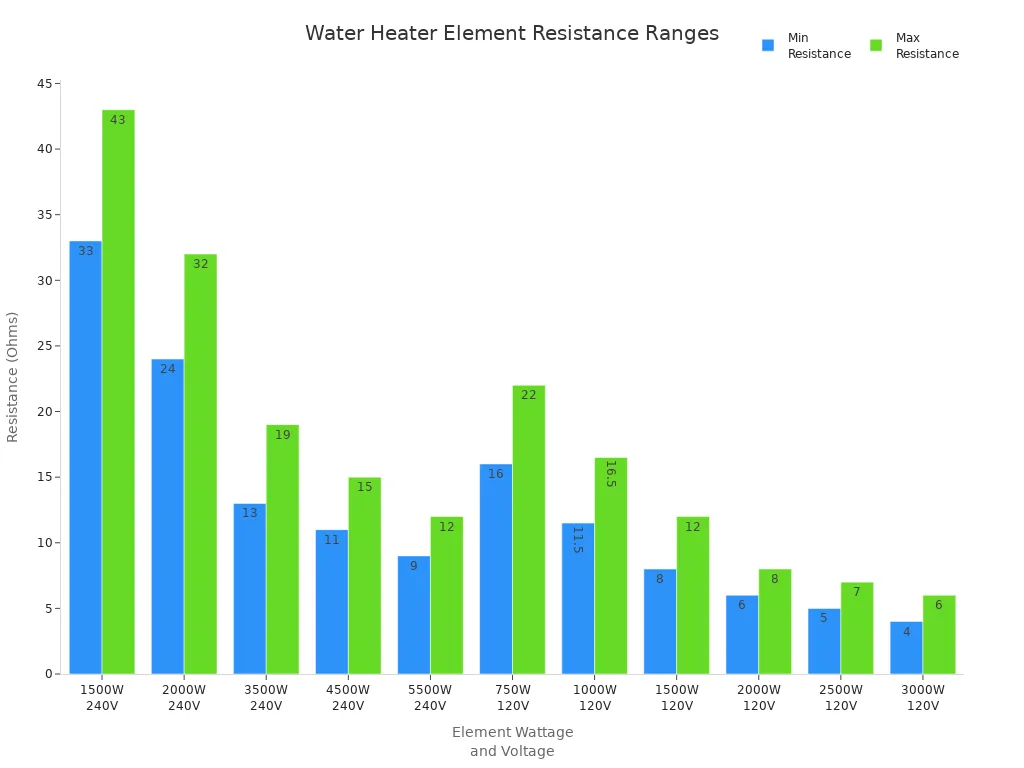
Remarque : Si votre lecture se situe en dehors de la plage attendue, vous avez identifié un élément défectueux.
Interprétation des résultats du test des éléments chauffants
Lectures d'un élément de chauffe-eau bon ou défectueux
Vous pouvez interpréter vos résultats de test à l'aide de ces directives :
- Un élément chauffant en bon état affichera une résistance comprise entre 10 et 30 ohms, ou dans la plage indiquée pour votre puissance et tension spécifiques.
- Un élément défectueux affichera une lecture de zéro, d'infini ou une valeur bien en dehors de la plage normale.
- Si votre multimètre ne bouge pas ou n'affiche aucune lecture, l'élément est défectueux.
🛠️ Alerte: Si vous constatez un court-circuit (le buzzer de test sonne ou le voyant de test s'allume lorsque vous connectez une sonde au support de l'élément), n'essayez pas de remplacer l'élément vous-même. Contactez un professionnel pour des réparations supplémentaires.
Que faire si l'élément est défectueux
Si votre test confirme un élément défectueux, vous devez le remplacer. Rebranchez les fils que vous avez débranchés, remettez l'isolant en place et fixez les panneaux de protection métalliques avant de rétablir l'alimentation. Ne remettez pas le chauffe-eau en marche avant d'avoir effectué toutes les réparations et de vous être assuré que tout est sécurisé.
Tester les éléments chauffants avec un multimètre vous donne une réponse claire sur l'état de l'élément de votre chauffe-eau. Cette approche étape par étape vous aide à éviter les remplacements inutiles et maintient votre chauffe-eau en fonctionnement efficace.
Remplacement d'un élément de chauffe-eau défectueux
Lorsque vous découvrez un élément de chauffe-eau défectueux, vous devez suivre un processus précis pour garantir un remplacement sûr et réussi. Cette section vous guide à travers le retrait de l'ancien élément chauffant, l'installation du nouveau et le redémarrage de votre chauffe-eau.
Retrait de l'ancien élément du chauffe-eau
Vidange du réservoir du chauffe-eau
Avant de commencer, vous devez vidanger le réservoir du chauffe-eau. Cette étape empêche l'eau de se déverser lorsque vous retirez l'élément chauffant. Vous devez toujours laisser l'eau refroidir avant de vidanger le réservoir. Cette précaution réduit le risque de brûlure. Utilisez un voltmètre ou un testeur de circuit pour confirmer que l'alimentation est coupée, ce qui vous protège des chocs électriques.
- Attendez que l'eau à l'intérieur du réservoir soit froide.
- Confirmez que l'alimentation est coupée en vérifiant les fils avec un testeur de circuit.
- Fixez un tuyau à la vanne de vidange au bas du réservoir.
- Dirigez le tuyau vers une zone de drainage sécurisée.
- Ouvrez le robinet de vidange et laissez le réservoir se vider complètement.
Conseil : Ouvrez un robinet d'eau chaude dans votre maison pour aider le réservoir à se vidanger plus rapidement et libérer toute pression de vide.
Dévissage et retrait de l'élément
Une fois le réservoir vide, vous pouvez retirer l'élément chauffant. Vous devez éviter d'endommager le réservoir au cours de ce processus. Utilisez les méthodes suivantes pour de meilleurs résultats :
- Appliquez de l'huile pénétrante à la base de l'élément et laissez agir toute la nuit si l'élément semble coincé.
- Utilisez une clé à élément chauffant appropriée pour éviter de dénuder les filetages.
- Tapotez doucement autour de la base de l'élément avec un maillet en caoutchouc pour briser les joints de corrosion.
- Si l'élément reste coincé, chauffez légèrement le métal environnant avec un pistolet thermique ou un chalumeau pour le dilater.
- Utilisez une douille de haute qualité et une barre de démultiplication longue pour un levier supplémentaire.
Un retrait minutieux garantit que vous n'endommagez pas le réservoir ou les composants environnants.
Installation du nouvel élément du chauffe-eau
Choisir le bon élément de remplacement
La sélection d'un remplacement compatible est essentielle pour les performances de votre chauffe-eau. Vous devez faire correspondre les spécifications de votre appareil. Utilisez le tableau ci-dessous pour guider votre sélection:
| Critères | Description |
|---|---|
| Type de bride de l'élément | Déterminez le type de bride (à visser, plate, universelle, à tête ronde) pour garantir la compatibilité. |
| Tension/Puissance | Faites correspondre la tension (120 V ou 240 V) et la puissance (1000 à 6000 watts) aux spécifications du chauffe-eau. |
| Densité de puissance | Tenez compte de la densité de puissance pour garantir un chauffage efficace et une compatibilité avec le modèle de chauffe-eau. |
Consultez le manuel de votre chauffe-eau ou l'étiquette sur le réservoir pour ces détails avant d'acheter un nouvel élément chauffant.
Fixation et étanchéité du nouvel élément
Une étanchéité correcte empêche les fuites et garantit une fiabilité à long terme. Suivez ces étapes pour fixer le nouvel élément chauffant :
- Placez un nouveau joint ou joint torique sur la base de l'élément chauffant. Ne réutilisez jamais l'ancien joint.
- Si votre modèle utilise des raccords filetés, enveloppez les filetages de ruban Téflon.
- Insérez l'élément chauffant dans le réservoir et serrez-le dans le sens horaire avec une clé à élément chauffant. Ne serrez pas excessivement.
- Rebranchez les fils aux bornes dans leurs positions d'origine. Serrez les connexions avec un tournevis.
- Inspectez toutes les connexions et les joints avant de remplir à nouveau le réservoir.
- Nettoyez l'ouverture du réservoir avec un chiffon ou une brosse avant d'installer le nouvel élément chauffant.
Remarque : Envelopper les raccords filetés de ruban Téflon aide à prévenir les fuites. Vérifiez toujours l'absence de saleté ou de débris avant l'installation.
Remplissage et redémarrage du chauffe-eau
Remplissage du réservoir avec de l'eau
Après avoir installé le nouvel élément chauffant, vous devez remplir à nouveau le réservoir. Suivez ces étapes :
- Assurez-vous que la vanne de vidange est bien fermée.
- Rétablissez l'alimentation en eau froide pour remplir le réservoir.
- Ouvrez un robinet d'eau chaude pour éliminer l'air emprisonné du système.
Attendez que l'eau coule régulièrement du robinet avant de continuer.
Rétablissement de l’alimentation du chauffe-eau
Une fois le réservoir plein et tout l'air purgé, vous pouvez rétablir l'alimentation du chauffe-eau. Allumez le disjoncteur ou ajustez le thermostat si nécessaire. Surveillez l'appareil pour détecter les fuites et confirmez que l'eau chauffe correctement.
⚡ Rappel de sécurité : Ne rétablissez jamais l'alimentation du chauffe-eau avant que le réservoir ne soit plein. Faire fonctionner l'élément chauffant à sec peut causer des dommages immédiats.
En suivant ces étapes, vous pouvez remplacer l'élément en toute sécurité et efficacement. Vous protégez votre chauffe-eau et garantissez une eau chaude fiable pour votre maison.
Et si l'élément du chauffe-eau n'est pas le problème ?
Parfois, le remplacement de l'élément du chauffe-eau ne rétablit pas l'eau chaude. Dans ces cas, vous devez étendre votre processus de dépannage à d'autres composants. Le thermostat cause souvent des problèmes de chauffage lorsque l'élément fonctionne correctement. Vous devez également envisager des problèmes avec le alimentation électrique, câblage ou d'autres pièces internes.
Vérification du Thermostat du Chauffe-Eau
Comment tester le thermostat
Vous pouvez tester le thermostat à l'aide d'outils de diagnostic standard. Commencez par couper l'alimentation au niveau du disjoncteur. Retirez les plaques de protection métalliques pour exposer les thermostats et les éléments. Utilisez un testeur de tension sans contact pour confirmer qu'aucun électricité ne circule vers l'appareil. Cette étape vous protège.
Ensuite, utilisez un testeur de continuité pour vérifier le thermostat. Débranchez les fils des bornes du thermostat. Placez les sondes du testeur sur les vis des bornes. Si le testeur n'affiche pas de continuité, le thermostat est défaillant. Vous devez également vérifier les courts-circuits en testant les vis par rapport au support de montage.
Outils nécessaires pour cette tâche :
- Tournevis 4 en 1
- Pince à bec effilé
- Testeur de tension sans contact
- Testeur de continuité
Réglage ou remplacement du thermostat
Si vous constatez que le thermostat est mal réglé, vous pouvez le réinitialiser. Utilisez un tournevis plat pour ajuster le réglage de la température. La plupart des chauffe-eau fonctionnent mieux à 120 °F. Si le thermostat ne répond pas ou n'affiche aucune continuité, remplacez-le par un nouveau qui correspond à votre modèle. Rebranchez toujours les fils solidement et remettez les plaques de protection en place avant de rétablir l'alimentation.
Quand appeler un professionnel pour la réparation d'un chauffe-eau
Signes indiquant que vous avez besoin de l'aide d'un expert
Certains problèmes nécessitent l'intervention d'un professionnel. Vous devez contacter un technicien agréé si vous remarquez l'un des éléments suivants :
- Réparations fréquentes
- L'augmentation des factures d'énergie
- Odeurs désagréables provenant du chauffe-eau
- Faible pression d'eau
- Fuites persistantes autour du réservoir
- Bruits étranges pendant le fonctionnement
- Eau rouillée ou décolorée
- Alimentation en eau chaude irrégulière
- Le chauffe-eau est proche ou a dépassé sa durée de vie prévue
⚠️ Conseil : Si vous rencontrez des problèmes électriques, tels qu’une absence de tension au niveau du réservoir ou des connexions de câblage défectueuses, n’essayez pas de effectuer les réparations vous-même. Ces situations présentent des risques de sécurité graves.
Prévenir les futurs problèmes de chauffe-eau
Vous pouvez réduire le besoin de réparations en suivant un calendrier d’entretien régulier. Vidangez le réservoir pour éliminer les sédiments. Inspectez les éléments chauffants et le thermostat chaque année. Traitez les problèmes mineurs rapidement pour éviter des pannes coûteuses. Si vous remarquez des symptômes inhabituels, agissez vite pour éviter d’autres dommages.
Un processus de dépannage approfondi vous aide à identifier la cause réelle des problèmes du chauffe-eau. En cas de doute, faites appel à une expertise professionnelle pour maintenir la sécurité et l’efficacité de votre système.
Prévenir les futurs problèmes d’élément de chauffe-eau
Entretien régulier des éléments chauffants
Rinçage du réservoir du chauffe-eau
Vous pouvez prolonger la durée de vie de vos éléments chauffants en vidangeant régulièrement le réservoir. Les sédiments et les dépôts minéraux s’accumulent au fond du réservoir avec le temps. Ces dépôts isolent l’élément chauffant, ce qui le fait surchauffer et tomber en panne prématurément. Vidanger le réservoir tous les 6 à 12 mois élimine cette accumulation et maintient l’efficacité de votre système. Dans les zones d’eau dure, vous devrez peut-être vidanger le réservoir plus souvent. Ouvrez la vanne de vidange, fixez un tuyau et laissez l’eau couler jusqu’à ce qu’elle soit claire. Cette tâche simple aide à prévenir des réparations coûteuses.
Conseil : Planifiez une vidange complète du réservoir tous les 12 mois pour maintenir des performances optimales.
Inspecter les éléments chauffants chaque année
Inspections annuelles vous aider à détecter les problèmes avant qu'ils n'entraînent des défaillances imprévues. Vous devriez vérifier les éléments chauffants, le thermostat et la tige anodique chaque année. Si votre chauffe-eau est ancien ou si vous vivez dans une région avec une eau dure, inspectez l'appareil tous les six mois. Recherchez des signes de rouille, de corrosion ou de fuites. Écoutez les bruits anormaux et surveillez une éventuelle irrégularité de l'alimentation en eau chaude. Si vous remarquez l'un de ces problèmes, traitez-les immédiatement pour éviter d'autres dommages.
Calendrier d’inspection recommandé :
- Inspectez chaque année si la qualité de votre eau est bonne.
- Inspectez tous les six à neuf mois dans les zones d’eau dure.
- Inspectez tous les six mois pour les appareils plus anciens.
- Inspectez immédiatement si vous voyez des fuites, de la rouille ou entendez des bruits inhabituels.
Remarque : Un entretien régulier, y compris les inspections et les vidanges, peut aider votre chauffe-eau électrique à réservoir à durer jusqu’à 15 ans.
Réduction de l’accumulation de minéraux dans votre chauffe-eau
Utilisation d’un adoucisseur d’eau
L’eau dure provoque une accumulation de minéraux à l’intérieur de votre réservoir et sur les éléments chauffants. L’installation d’un adoucisseur d’eau empêche la formation de tartre et élimine l’accumulation de sédiments. Cet appareil élimine le calcium et le magnésium de votre alimentation en eau, ce qui aide à maintenir l’efficacité du chauffage et prolonge la durée de vie de votre chauffe-eau. Vous remarquerez moins de réparations et une eau chaude plus constante lorsque vous utilisez un adoucisseur d’eau.
Nettoyage du réservoir du chauffe-eau
Le nettoyage du réservoir va au-delà de la vidange. Vous devez également vérifier la tige anodique et la remplacer si nécessaire. La tige anodique attire les minéraux corrosifs, protégeant le réservoir et les éléments de la rouille. Réglez votre thermostat à 120 degrés Fahrenheit pour réduire la précipitation des minéraux. Isolez votre réservoir et vos tuyaux pour minimiser les pertes de chaleur et améliorer l’efficacité. Planifiez un entretien annuel avec un professionnel de la plomberie pour un nettoyage et une inspection approfondis.
🛠️ Astuce Pro : Combinez la vidange, l’adoucissement de l’eau et les inspections annuelles pour une meilleure protection contre l’accumulation de minéraux et la défaillance prématurée des éléments.
Vérifier l’élément du chauffe-eau en premier résout souvent la plupart des problèmes de chauffage rapidement. Vous pouvez tester et remplacer l’élément avec des outils de base et des mesures de sécurité. De nombreux propriétaires commettent des erreurs en sautant l’entretien régulier ou en diagnostiquant mal l’élément. Un entretien régulier maintient l’efficacité de l’élément et prolonge sa durée de vie.
- Un entretien régulier garantit des performances optimales et des économies d’énergie.
- L’inspection de l’élément et de la tige anodique prévient la corrosion et les réparations coûteuses.
- La détection précoce des problèmes d’élément conduit à une eau chaude constante et à des factures plus basses.
FAQ
À quelle fréquence devez-vous vérifier l'élément de votre chauffe-eau ?
Vous devez inspecter l’élément chauffant au moins une fois par an. Si vous vivez dans une zone d’eau dure, augmentez la fréquence à tous les six mois pour prévenir l’accumulation de minéraux et garantir des performances fiables.
De quels outils avez-vous besoin pour tester un élément de chauffe-eau ?
Vous avez besoin d’un multimètre, d’un testeur de tension sans contact, de tournevis plats et cruciformes, de gants isolés et de lunettes de sécurité. Ces outils vous aident à tester et à remplacer l’élément en toute sécurité.
Peut-on remplacer un élément de chauffe-eau sans vider le réservoir ?
Vous devez vidanger le réservoir avant de retirer l’élément chauffant. Cette étape empêche les fuites d’eau et réduit le risque de brûlures ou de choc électrique.
Quelle lecture de résistance indique un élément de chauffe-eau défectueux ?
Une lecture de zéro, d’infini ou d’une valeur en dehors de la plage attendue signale un élément défectueux. Référez-vous aux spécifications de votre chauffe-eau pour la plage de résistance correcte.
Pourquoi l'élément de votre chauffe-eau ne cesse-t-il de tomber en panne ?
L’accumulation de minéraux, les problèmes électriques et l’âge provoquent des défaillances répétées. Un entretien régulier, y compris la vidange du réservoir et l’utilisation d’un adoucisseur d’eau, aide à prévenir ces problèmes.
Est-il sécuritaire de tester soi-même un élément de chauffe-eau ?
Vous pouvez tester l’élément en toute sécurité si vous coupez l’alimentation, utilisez les bons outils et portez un équipement de protection. Si vous n’êtes pas sûr, contactez un technicien agréé.
Que devez-vous faire si le remplacement de l'élément ne résout pas le problème ?
Vérifiez le thermostat et le câblage pour détecter les défauts. Si vous ne pouvez pas identifier le problème, appelez un professionnel pour un diagnostic et une réparation supplémentaires.
Astuce : Consultez toujours le manuel de votre chauffe-eau avant d’entreprendre des réparations. Cette étape garantit que vous suivez les directives du fabricant et maintenez la sécurité.