UN élément chauffant moulé sous pression doit être spécifié dans le cadre d'un ensemble thermique complet : le chauffage électrique, la pièce coulée, la charge chauffée, les interfaces mécaniques, le capteur de température et les dispositifs de protection doivent fonctionner ensemble. La correspondance de l'encombrement et de la puissance nominale n'est que le point de départ.
Pour une demande d'un fabricant d'équipements d'origine (OEM), définir d'abord la tâche de chauffage. Confirmer ensuite la tension d'alimentation, la puissance, les interfaces, la mesure de température et le plan de validation. Ce guide explique cette séquence pour des projets d'appareils tels que les équipements à café, le chauffage de l'eau et la production de vapeur. Les exemples numériques sont des calculs d'ingénierie transparents, et non des résultats d'essais ou des spécifications d'un produit Jinzhong.
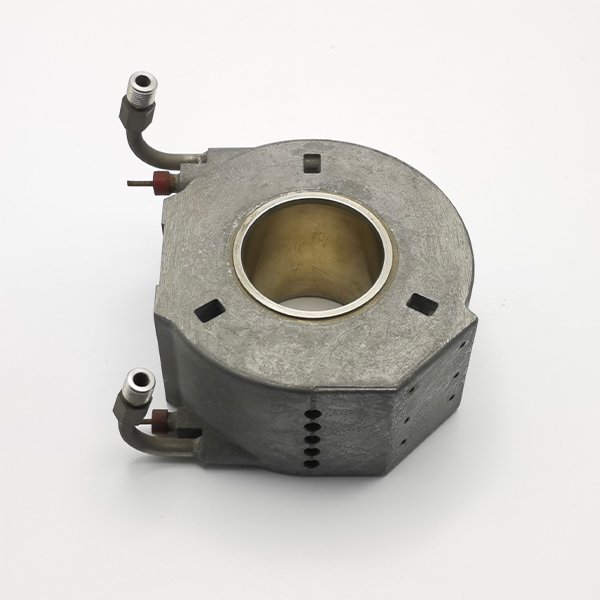
Source : dossier d'images fourni par Jinzhong, 4001/1.jpg. Il s'agit d'un exemple de géométrie ; les calculs ci-dessous ne décrivent pas l'unité photographiée.
1. Définir ce qui est chauffé avant de choisir la pièce coulée
L'expression chauffage en fonte coulée sous pression peut désigner un ensemble de chauffage utilisant un corps en métal coulé. Elle ne précise pas, à elle seule, la construction interne du chauffage, le matériau en contact avec l'eau ni la présence d'un passage de fluide dans la pièce. Ces détails figurent sur le plan et la nomenclature.
Elle se distingue également d'un chauffage utilisé sur une machine de production par coulée sous pression. Le procédé de fabrication et l'application finale de chauffage sont deux questions distinctes. Une pièce répertoriée parmi les composants coulés sous pression ne doit pas être automatiquement considérée comme adaptée à un service en métal en fusion.
La gamme de composants de chauffage coulés sous pression de Jinzhong constitue un point de départ pour discuter de la géométrie de l'ensemble. Avant de sélectionner un modèle, identifier si le service prévu consiste à chauffer un récipient, à chauffer de l'eau en écoulement, à produire de la vapeur ou à maintenir une température de surface.
| Tâche de chauffage | Informations nécessaires au fournisseur | Ce que la puissance nominale ne détermine pas |
|---|---|---|
| Chauffer un lot d'eau | Masse d'eau, température d'entrée, température cible et temps autorisé | Temps de montée en température réel sans la masse thermique et les pertes de l'ensemble |
| Chauffer de l'eau en écoulement | Débit, températures d'entrée/sortie et configuration hydraulique | Température de sortie pour chaque condition de débit |
| Produire de la vapeur | Conditions d'alimentation, débit de vapeur requis et pression de service | Capacité de vapeur issue d'un calcul de chauffage de liquide seul |
| Chauffer un récipient ou une surface | Géométrie de contact, charge, température cible et cycle de service | Uniformité de surface ou écart de température entre le capteur et la charge |
Tableau 1. Un cadre de demande d'ingénierie, et non un tableau de caractéristiques de produits Jinzhong.
2. Vérifier la conception électrique aux conditions d'alimentation réelles
La tension et la résistance déterminent la puissance résistive instantanée
Pour un élément résistif, P = V²/R. Pour une charge résistive en courant alternatif, utiliser la tension efficace (RMS). La relation est décrite dans la référence sur la puissance électrique d'OpenStax.
L'implication pratique est simple : modifier la tension modifie la puissance, même lorsque la pièce coulée est identique. Indiquer les conditions d'alimentation prévues et convenir du point où la résistance spécifiée est mesurée. La résistance à froid, la résistance en fonctionnement à chaud et la puissance moyenne d'un régulateur ne sont pas des grandeurs interchangeables.
Exemple de calcul : une résistance hypothétique de 230 V, 1 500 W
En utilisant les valeurs nominales sélectionnées, R = 230² / 1 500 = 35,27 Ω, arrondi. En maintenant cette résistance constante, on obtient la comparaison suivante.
| Tension efficace appliquée | Puissance calculée | Par rapport à l'exemple à 230 V |
|---|---|---|
| 207 V | 1 215 W | 81% |
| 230 V | 1 500 W | 100% |
| 253 V | 1 815 W | 121% |
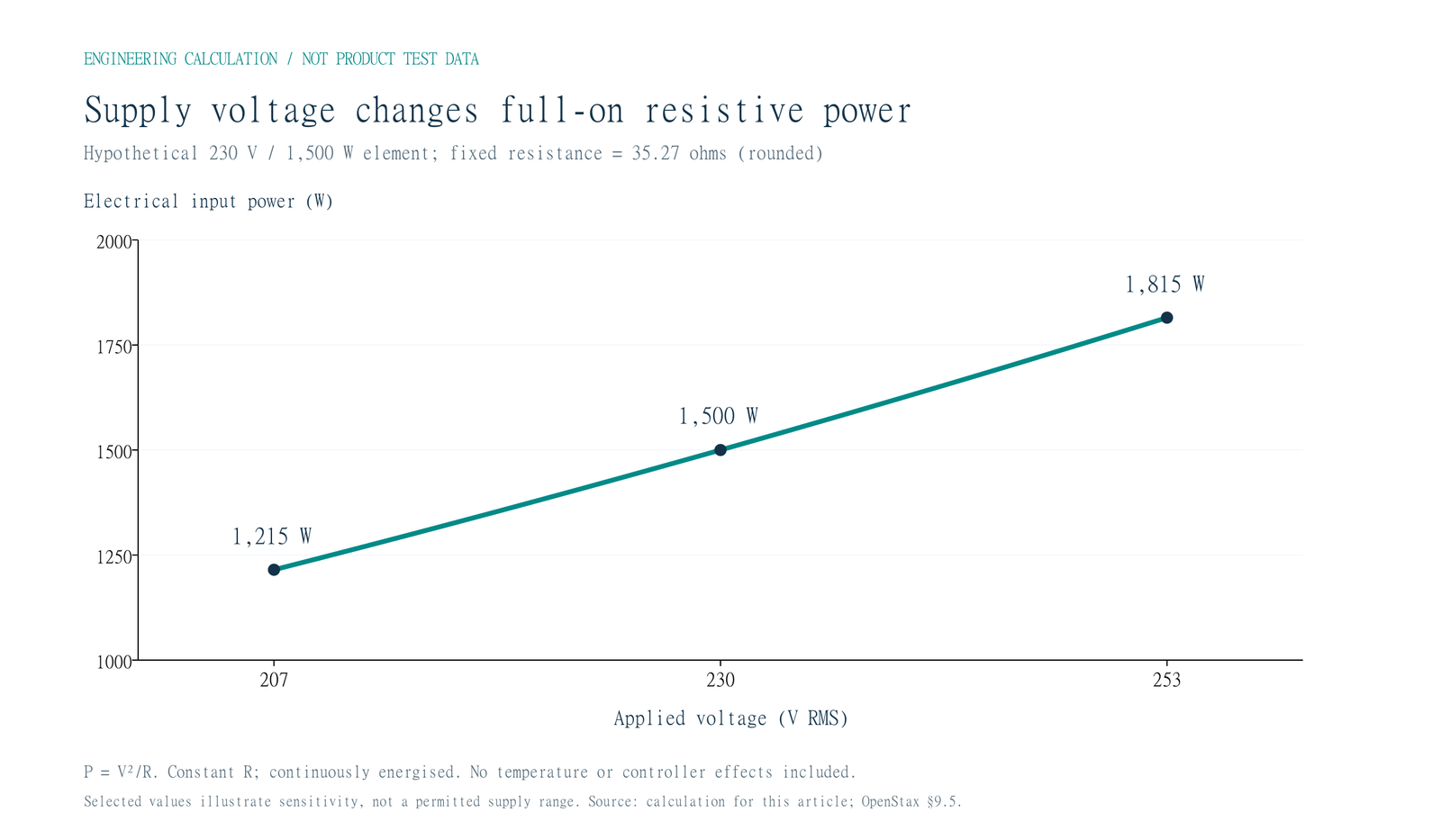
Figure 1. Exemple calculé à résistance fixe utilisant R = 230²/1 500 Ω avant arrondi. Les tensions sélectionnées illustrent la sensibilité ; elles ne constituent pas une déclaration de plage d'alimentation autorisée ni une caractéristique de produit.
Portée de ce calcul
La résistance est maintenue constante et le chauffage est alimenté en continu. L'exemple exclut la résistance dépendant de la température et la modulation par régulateur. Il ne prédit pas la température réelle de la pièce coulée, la chaleur délivrée, la durée de vie ni la sécurité. Pour un ensemble régulé, distinguer la puissance à pleine charge de la puissance moyenne sur le cycle de régulation.
3. Use an energy budget to question warm-up claims
Specify the load and the start condition
“Fast heating” is incomplete without a defined load and start state. A warm assembly reheating a small water quantity is a different test from a cold assembly heating a full vessel.
For a liquid-water example with no phase change, use Q = mcΔT et t = Q/P. OpenStax’s specific-heat reference gives the heat relationship and a reference specific heat for water; here it is rounded to 4,180 J/(kg·K) for a simple planning calculation.
Assume water starts at 20°C and reaches 90°C, giving ΔT = 70 K. With 1,500 W transferred continuously and entirely to the water, the calculated results are:
| Water mass | Energy for a 70 K rise | Ideal water-only heating time |
|---|---|---|
| 0.10 kg | 29.26 kJ | 19.5 s |
| 0.25 kg | 73.15 kJ | 48.8 s |
| 0.50 kg | 146.30 kJ | 97.5 s |
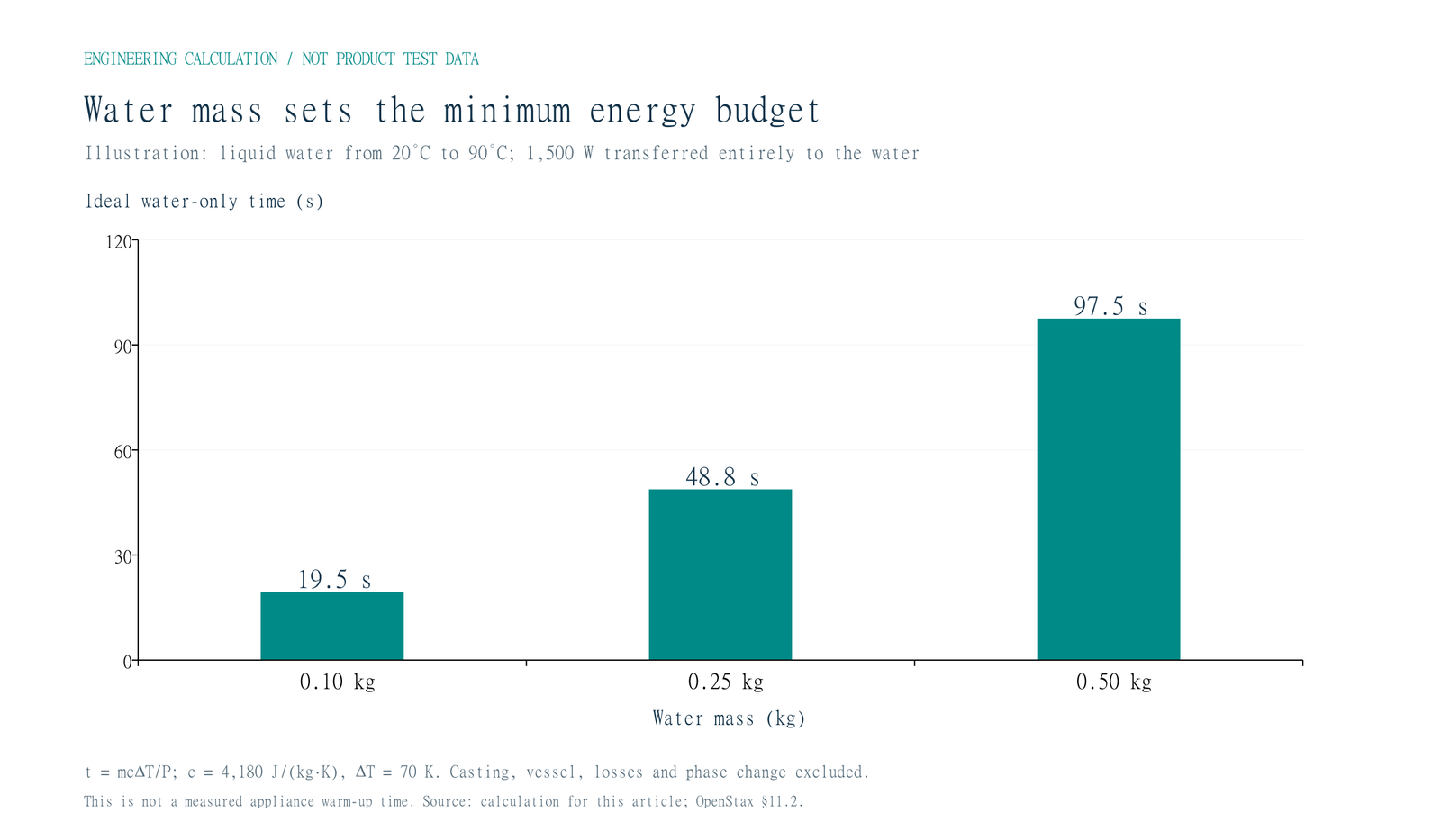
Figure 2. A simplified energy calculation, not measured heater performance. Inputs: c = 4,180 J/(kg·K), ΔT = 70 K and P = 1,500 W. The casting, vessel, heat losses and any phase change are excluded.
Pour un cold-start assembly, additional energy is needed to heat the casting and associated hardware, while losses reduce the heat reaching the water. A prototype test should therefore record both the inlet/load conditions and the assembly’s initial temperature. Do not present the water-only calculation as a guaranteed appliance warm-up time.
Keep hot-water and steam duties separate
Heating liquid water and generating steam require different energy accounting. The calculation above stops at 90°C and includes no vaporisation energy. A steam specification also needs the feed-water condition, pressure, required steam delivery and a defined test method. A hot-water result cannot establish steam output.
4. Specify the interfaces that decide whether the heater will work
Mechanical fit and the heat-transfer path
A replacement that fits the bolt pattern can still have a different heat-transfer path. Confirm the drawing datums, mating surfaces, flatness requirements, fasteners and assembly conditions. If the casting heats a separate vessel, describe that interface explicitly instead of assuming that external dimensions define thermal contact.
Likewise, water-contact material must be confirmed for the actual wetted surfaces, not inferred from the visible casting colour. Where fluid passages exist, request the passage arrangement, connections, sealing details, cleaning requirements and the intended operating conditions. Any food-contact or material declaration must apply to the actual supplied construction.
Temperature sensing and independent protection
Identify the control sensor, its location and the temperature that it is intended to represent. A sensor mounted on the casting measures a different location from the liquid outlet or the appliance’s working surface. Ask how that difference will be checked during prototype testing.
Treat normal temperature regulation and over-temperature protection as separate design functions. The operating duty, dry-run scenario, interruption of flow and sensor fault conditions should be reviewed for the complete appliance. A statement that a heater “supports a thermostat” does not establish the performance of the finished control and protection system.
5. Agree a validation plan before approving production
Prototype approval is more useful when the acceptance conditions are written before testing. Avoid accepting a single temperature reading as evidence of the entire heating system’s performance.
| Validation item | Conditions to define | Evidence to request |
|---|---|---|
| Electrical input | Supply, initial state and control mode | Voltage, current, resistance basis and measured input power |
| Warm-up and regulation | Load, initial temperatures, sensor positions and timing endpoint | Time/temperature records with the test setup identified |
| Hydraulic integrity, where applicable | Fluid, operating conditions and assembly method | Agreed leak/pressure test method and results |
| Protection behaviour | Defined abnormal conditions and reset behaviour | Documented response of the complete appliance protection system |
| Repeatability | Agreed cycle profile and inspection points | Recorded drift, leakage, mechanical changes and failures |
Table 2. Suggested topics for an OEM validation plan. It specifies no universal pass limit, endurance rating or certification.
For repeat testing, keep the same definition of “ready.” A casting sensor reaching a setpoint, water reaching an outlet temperature and stable delivery over a duty cycle are three different endpoints. Write down which one matters to the application.
6. What to send Jinzhong for a useful OEM review
Jinzhong’s company materials identify die-cast heaters and accessories among its product groups and describe manufacturing processes including die casting, stamping and CNC machining. The Jinzhong company profile provides additional company context; the supplied product presentation also includes a die-cast coffee-machine heater. These references support an application discussion; they do not certify a particular assembly’s performance.
For an initial conversation, review the coffee-machine heating body listing and the broader coffee-machine heating application page. Use them to identify the type of component you need, then confirm the exact drawing, materials, interfaces and validation requirements. Do not infer drop-in compatibility from an application label.
| Enquiry field | What to provide |
|---|---|
| Application | Appliance type, heated medium and whether the duty is batch, flow, steam or surface heating |
| Electrical requirement | Supply voltage, desired nominal power, control method and connection arrangement |
| Thermal requirement | Inlet/start temperature, target condition, load or flow, warm-up requirement and duty cycle |
| Mechanical requirement | Drawing or sample, envelope, datums, mounting, ports and mating parts |
| Control and protection | Sensor arrangement, control endpoint and protection requirements for the appliance |
| Commercial and compliance scope | Target market, required documentation, prototype quantity and intended production volume |
Table 3. A practical RFQ checklist. Fields should be completed for the project rather than copied from another model.
To start a review, send Jinzhong your heater drawing and operating requirements. A defined load and test endpoint give the engineering discussion a firmer basis than a request for “the same shape, but faster.”
Frequently asked engineering questions
Can two die-cast heaters with the same wattage be interchanged?
Not on wattage alone. Check voltage, resistance basis, terminals, mounting, mating surfaces, fluid path where applicable, sensor position and protective devices. Interchangeability requires confirmation against the actual assembly and appliance requirements.
Does a larger power rating guarantee faster usable heat?
It increases electrical input under the specified conditions, but usable heating performance also depends on the load, thermal path, initial state and control behaviour. Define the required endpoint and validate the prototype rather than using wattage as a complete performance specification.
Can a published warm-up time be used as an acceptance criterion?
Only when its test conditions and endpoint match the project, and the supplier agrees to that criterion. Ask for the initial assembly temperature, heated mass or flow, supply conditions and measurement locations. A headline time without that information is not a reproducible test specification.
What should be confirmed before a quotation becomes a production specification?
The drawing revision, electrical configuration, material declarations, sealing and mounting details, control interfaces, validation requirements and required documentation. A quotation identifies an offer; the agreed technical documents define the assembly to be supplied.
References and calculation basis
Company context was checked against Jinzhong Company Profile.pdf, pages 4, 15 and 19, the supplied application workbook, and the linked Jinzhong pages. The PDF and workbook are supplied company materials; they are not independent test reports. The product photograph is from the supplied image folder.
The two figures were calculated specifically for this guide using the stated inputs. General equations are supported by the linked OpenStax references. No efficiency, endurance, certification, brand-compatibility or measured warm-up claim is made for a Jinzhong model.