A elemento de aquecimento de fundição injetada deve ser especificado como parte de um conjunto térmico completo: o aquecedor elétrico, o fundido, a carga aquecida, as interfaces mecânicas, o sensor de temperatura e os dispositivos de proteção devem funcionar em conjunto. Corresponder ao contorno e à potência nominal é apenas o ponto de partida.
Para uma consulta de OEM, defina primeiro a tarefa de aquecimento. Em seguida, confirme a tensão de alimentação, a potência, as interfaces, a medição de temperatura e o plano de validação. Este guia explica essa sequência para projetos de eletrodomésticos, como equipamentos de café, aquecimento de água e geração de vapor. Os exemplos numéricos são cálculos de engenharia transparentes, não resultados de testes ou especificações de um produto Jinzhong.
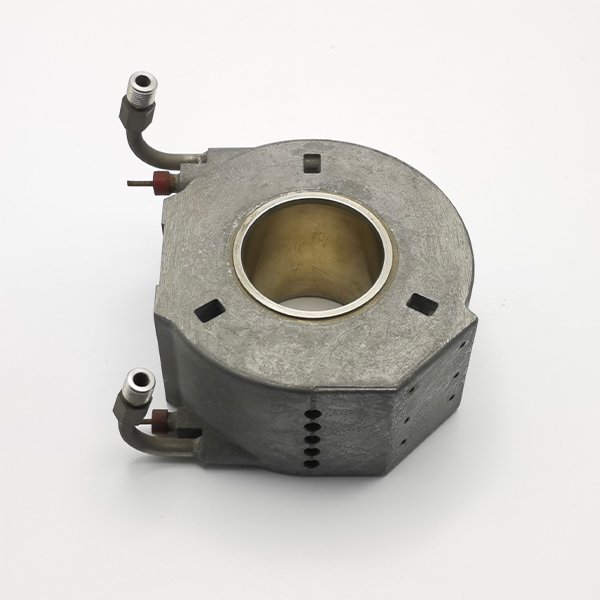
Fonte: pasta de imagens fornecida pela Jinzhong, 4001/1.jpg. Esta é uma geometria de exemplo; os cálculos abaixo não descrevem a unidade fotografada.
1. Defina o que está sendo aquecido antes de escolher o fundido
A expressão aquecedor fundido sob pressão pode descrever um conjunto de aquecimento que utiliza um corpo de metal fundido. Por si só, não informa a construção interna do aquecedor, o material em contato com a água ou se a peça contém uma passagem de fluido. Esses detalhes pertencem ao desenho e à lista de materiais.
Também é diferente de um aquecedor usado em uma máquina de produção de fundição sob pressão. O processo de fabricação e a aplicação final de aquecimento são questões separadas. Uma peça listada como componente fundido sob pressão não deve ser automaticamente considerada adequada para serviço com metal fundido.
A linha da Jinzhong de componentes de aquecimento fundidos sob pressão fornece um ponto de partida para discutir a geometria do conjunto. Antes de selecionar um modelo, identifique se a função pretendida é aquecer um recipiente, aquecer água em fluxo, produzir vapor ou manter uma temperatura superficial.
| Tarefa de aquecimento | Informações necessárias ao fornecedor | O que a potência nominal não estabelece |
|---|---|---|
| Aquecer um lote de água | Massa de água, temperatura de entrada, temperatura alvo e tempo permitido | Tempo real de aquecimento sem a massa térmica e as perdas do conjunto |
| Aquecer água em fluxo | Vazão, temperaturas de entrada/saída e arranjo hidráulico | Temperatura de saída em cada condição de vazão |
| Gerar vapor | Condições de alimentação, produção de vapor necessária e pressão de operação | Capacidade de vapor a partir de um cálculo apenas de aquecimento de líquido |
| Aquecer um recipiente ou superfície | Geometria de contato, carga, temperatura alvo e ciclo de trabalho | Uniformidade superficial ou diferença de temperatura entre sensor e carga |
Tabela 1. Uma estrutura de consulta de engenharia, não uma tabela de classificação de produtos Jinzhong.
2. Verifique o projeto elétrico nas condições reais de alimentação
Tensão e resistência determinam a potência resistiva instantânea
Para um elemento resistivo, P = V²/R. Para uma carga resistiva CA, use a tensão RMS. A relação é descrita na referência de potência elétrica da OpenStax.
A implicação prática é simples: alterar a tensão altera a potência, mesmo quando o fundido é idêntico. Declare as condições de alimentação pretendidas e acorde onde a resistência especificada é medida. Resistência a frio, resistência operacional a quente e a potência média de um controlador não são grandezas intercambiáveis.
Exemplo prático: uma resistência hipotética de 230 V, 1.500 W
Usando os valores nominais selecionados, R = 230² / 1.500 = 35,27 Ω, arredondado. Mantendo essa resistência constante, obtém-se a seguinte comparação.
| Tensão RMS aplicada | Potência calculada | Relativo ao exemplo de 230 V |
|---|---|---|
| 207 V | 1.215 W | 81% |
| 230 V | 1.500 W | 100% |
| 253 V | 1.815 W | 121% |
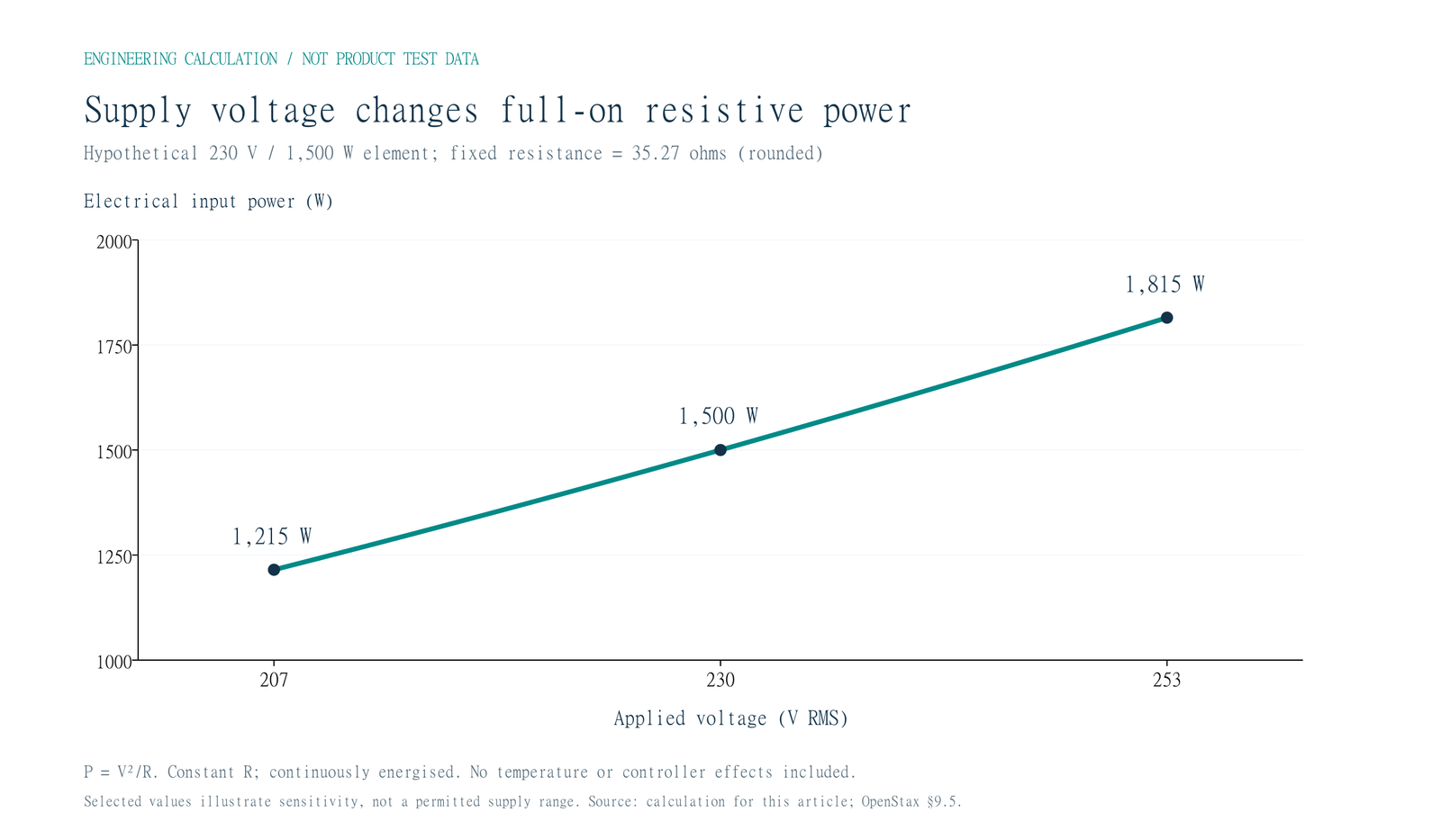
Figura 1. Exemplo calculado de resistência fixa usando R = 230²/1.500 Ω antes do arredondamento. As tensões selecionadas ilustram a sensibilidade; não são uma declaração de faixa de alimentação permitida ou de classificação de produto.
Escopo deste cálculo
A resistência é mantida constante e o aquecedor é energizado continuamente. O exemplo exclui resistência dependente da temperatura e modulação do controlador. Não prevê a temperatura real do fundido, o calor entregue, a vida útil ou a segurança. Para um conjunto controlado, distinga a potência em plena carga da potência média ao longo do ciclo de controle.
3. Use an energy budget to question warm-up claims
Specify the load and the start condition
“Fast heating” is incomplete without a defined load and start state. A warm assembly reheating a small water quantity is a different test from a cold assembly heating a full vessel.
For a liquid-water example with no phase change, use Q = mcΔT e t = Q/P. OpenStax’s specific-heat reference gives the heat relationship and a reference specific heat for water; here it is rounded to 4,180 J/(kg·K) for a simple planning calculation.
Assume water starts at 20°C and reaches 90°C, giving ΔT = 70 K. With 1,500 W transferred continuously and entirely to the water, the calculated results are:
| Water mass | Energy for a 70 K rise | Ideal water-only heating time |
|---|---|---|
| 0.10 kg | 29.26 kJ | 19.5 s |
| 0.25 kg | 73.15 kJ | 48.8 s |
| 0.50 kg | 146.30 kJ | 97.5 s |
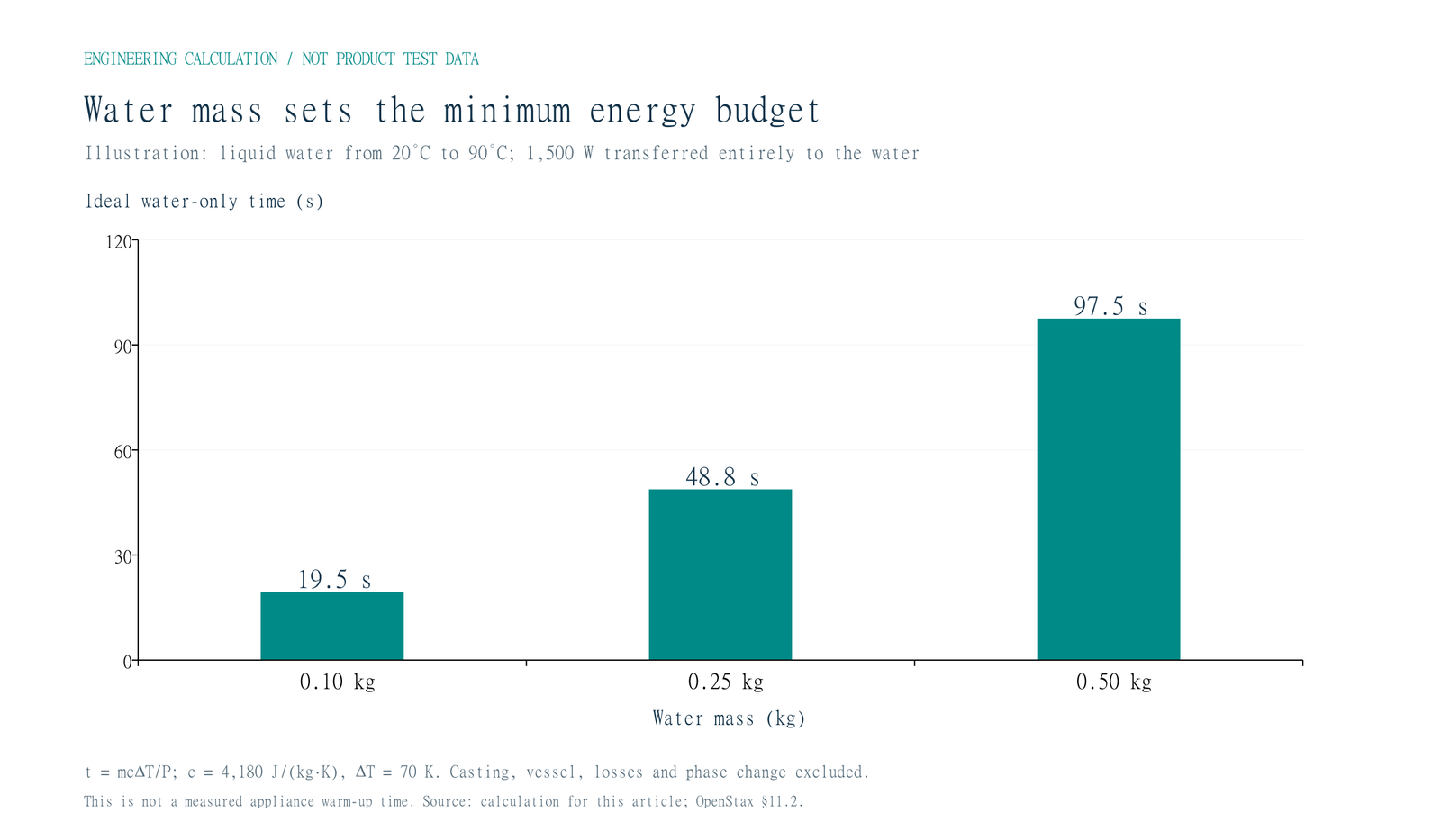
Figure 2. A simplified energy calculation, not measured heater performance. Inputs: c = 4,180 J/(kg·K), ΔT = 70 K and P = 1,500 W. The casting, vessel, heat losses and any phase change are excluded.
Para uma cold-start assembly, additional energy is needed to heat the casting and associated hardware, while losses reduce the heat reaching the water. A prototype test should therefore record both the inlet/load conditions and the assembly’s initial temperature. Do not present the water-only calculation as a guaranteed appliance warm-up time.
Keep hot-water and steam duties separate
Heating liquid water and generating steam require different energy accounting. The calculation above stops at 90°C and includes no vaporisation energy. A steam specification also needs the feed-water condition, pressure, required steam delivery and a defined test method. A hot-water result cannot establish steam output.
4. Specify the interfaces that decide whether the heater will work
Mechanical fit and the heat-transfer path
A replacement that fits the bolt pattern can still have a different heat-transfer path. Confirm the drawing datums, mating surfaces, flatness requirements, fasteners and assembly conditions. If the casting heats a separate vessel, describe that interface explicitly instead of assuming that external dimensions define thermal contact.
Likewise, water-contact material must be confirmed for the actual wetted surfaces, not inferred from the visible casting colour. Where fluid passages exist, request the passage arrangement, connections, sealing details, cleaning requirements and the intended operating conditions. Any food-contact or material declaration must apply to the actual supplied construction.
Temperature sensing and independent protection
Identify the control sensor, its location and the temperature that it is intended to represent. A sensor mounted on the casting measures a different location from the liquid outlet or the appliance’s working surface. Ask how that difference will be checked during prototype testing.
Treat normal temperature regulation and over-temperature protection as separate design functions. The operating duty, dry-run scenario, interruption of flow and sensor fault conditions should be reviewed for the complete appliance. A statement that a heater “supports a thermostat” does not establish the performance of the finished control and protection system.
5. Agree a validation plan before approving production
Prototype approval is more useful when the acceptance conditions are written before testing. Avoid accepting a single temperature reading as evidence of the entire heating system’s performance.
| Validation item | Conditions to define | Evidence to request |
|---|---|---|
| Electrical input | Supply, initial state and control mode | Voltage, current, resistance basis and measured input power |
| Warm-up and regulation | Load, initial temperatures, sensor positions and timing endpoint | Time/temperature records with the test setup identified |
| Hydraulic integrity, where applicable | Fluid, operating conditions and assembly method | Agreed leak/pressure test method and results |
| Protection behaviour | Defined abnormal conditions and reset behaviour | Documented response of the complete appliance protection system |
| Repeatability | Agreed cycle profile and inspection points | Recorded drift, leakage, mechanical changes and failures |
Table 2. Suggested topics for an OEM validation plan. It specifies no universal pass limit, endurance rating or certification.
For repeat testing, keep the same definition of “ready.” A casting sensor reaching a setpoint, water reaching an outlet temperature and stable delivery over a duty cycle are three different endpoints. Write down which one matters to the application.
6. What to send Jinzhong for a useful OEM review
Jinzhong’s company materials identify die-cast heaters and accessories among its product groups and describe manufacturing processes including die casting, stamping and CNC machining. The Jinzhong company profile provides additional company context; the supplied product presentation also includes a die-cast coffee-machine heater. These references support an application discussion; they do not certify a particular assembly’s performance.
For an initial conversation, review the coffee-machine heating body listing and the broader coffee-machine heating application page. Use them to identify the type of component you need, then confirm the exact drawing, materials, interfaces and validation requirements. Do not infer drop-in compatibility from an application label.
| Enquiry field | What to provide |
|---|---|
| Aplicação | Appliance type, heated medium and whether the duty is batch, flow, steam or surface heating |
| Electrical requirement | Supply voltage, desired nominal power, control method and connection arrangement |
| Thermal requirement | Inlet/start temperature, target condition, load or flow, warm-up requirement and duty cycle |
| Mechanical requirement | Drawing or sample, envelope, datums, mounting, ports and mating parts |
| Control and protection | Sensor arrangement, control endpoint and protection requirements for the appliance |
| Commercial and compliance scope | Target market, required documentation, prototype quantity and intended production volume |
Table 3. A practical RFQ checklist. Fields should be completed for the project rather than copied from another model.
To start a review, send Jinzhong your heater drawing and operating requirements. A defined load and test endpoint give the engineering discussion a firmer basis than a request for “the same shape, but faster.”
Frequently asked engineering questions
Can two die-cast heaters with the same wattage be interchanged?
Not on wattage alone. Check voltage, resistance basis, terminals, mounting, mating surfaces, fluid path where applicable, sensor position and protective devices. Interchangeability requires confirmation against the actual assembly and appliance requirements.
Does a larger power rating guarantee faster usable heat?
It increases electrical input under the specified conditions, but usable heating performance also depends on the load, thermal path, initial state and control behaviour. Define the required endpoint and validate the prototype rather than using wattage as a complete performance specification.
Can a published warm-up time be used as an acceptance criterion?
Only when its test conditions and endpoint match the project, and the supplier agrees to that criterion. Ask for the initial assembly temperature, heated mass or flow, supply conditions and measurement locations. A headline time without that information is not a reproducible test specification.
What should be confirmed before a quotation becomes a production specification?
The drawing revision, electrical configuration, material declarations, sealing and mounting details, control interfaces, validation requirements and required documentation. A quotation identifies an offer; the agreed technical documents define the assembly to be supplied.
References and calculation basis
Company context was checked against Jinzhong Company Profile.pdf, pages 4, 15 and 19, the supplied application workbook, and the linked Jinzhong pages. The PDF and workbook are supplied company materials; they are not independent test reports. The product photograph is from the supplied image folder.
The two figures were calculated specifically for this guide using the stated inputs. General equations are supported by the linked OpenStax references. No efficiency, endurance, certification, brand-compatibility or measured warm-up claim is made for a Jinzhong model.