A elemento calefactor fundido a presión debe especificarse como parte de un conjunto térmico completo: el calentador eléctrico, la fundición, la carga calentada, las interfaces mecánicas, el sensor de temperatura y los dispositivos de protección deben funcionar juntos. Igualar el contorno y la potencia nominal es solo el punto de partida.
Para una consulta de OEM, defina primero la tarea de calentamiento. Luego confirme la tensión de alimentación, la potencia, las interfaces, la medición de temperatura y el plan de validación. Esta guía explica esa secuencia para proyectos de electrodomésticos como equipos de café, calentamiento de agua y generación de vapor. Los ejemplos numéricos son cálculos de ingeniería transparentes, no resultados de pruebas ni especificaciones de un producto Jinzhong.
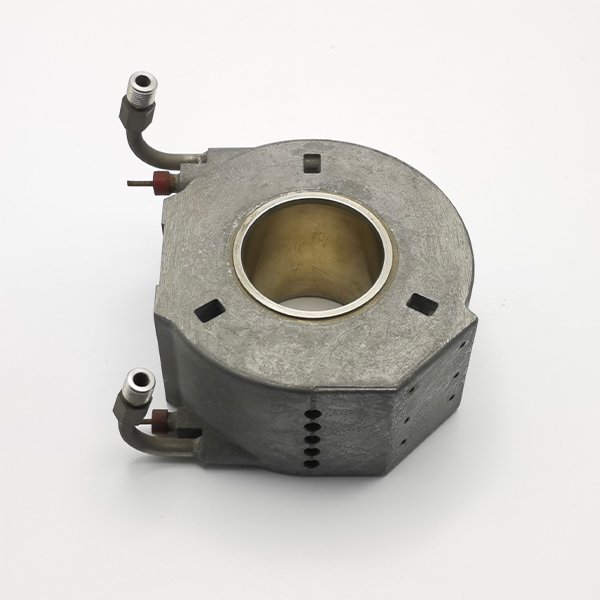
Fuente: carpeta de imágenes suministrada por Jinzhong, 4001/1.jpg. Esta es una geometría de ejemplo; los cálculos a continuación no describen la unidad fotografiada.
1. Defina qué se está calentando antes de elegir la fundición
La frase calentador de fundición inyectada puede describir un conjunto calentador que utiliza un cuerpo de metal fundido. Por sí sola, no indica la construcción interna del calentador, el material en contacto con el agua ni si la pieza contiene un paso de fluido. Esos detalles pertenecen al plano y a la lista de materiales.
También es diferente de un calentador utilizado en una máquina de producción de fundición inyectada. El proceso de fabricación y la aplicación final de calentamiento son cuestiones separadas. Una pieza listada bajo componentes de fundición inyectada no debe tratarse automáticamente como apta para servicio con metal fundido.
La gama de componentes de calentamiento de fundición inyectada de Jinzhong proporciona un punto de partida para discutir la geometría del conjunto. Antes de seleccionar un modelo, identifique si el servicio previsto es calentar un recipiente, calentar agua en circulación, producir vapor o mantener una temperatura superficial.
| Tarea de calentamiento | Información que necesita el proveedor | Lo que la potencia nominal no establece |
|---|---|---|
| Calentar un lote de agua | Masa de agua, temperatura de entrada, temperatura objetivo y tiempo permitido | Tiempo real de calentamiento sin la masa térmica y las pérdidas del conjunto |
| Calentar agua en circulación | Caudal, temperaturas de entrada/salida y disposición hidráulica | Temperatura de salida en cada condición de caudal |
| Generar vapor | Condiciones de alimentación, producción de vapor requerida y presión de operación | Capacidad de vapor a partir de un cálculo de calentamiento de líquido únicamente |
| Calentar un recipiente o superficie | Geometría de contacto, carga, temperatura objetivo y ciclo de trabajo | Uniformidad superficial o diferencia de temperatura entre sensor y carga |
Tabla 1. Un marco de consulta de ingeniería, no una tabla de clasificación de productos Jinzhong.
2. Verifique el diseño eléctrico en las condiciones reales de alimentación
La tensión y la resistencia determinan la potencia resistiva instantánea
Para un elemento resistivo, P = V²/R. Para una carga resistiva de CA, utilice la tensión RMS. La relación se describe en la referencia de potencia eléctrica de OpenStax.
La implicación práctica es simple: cambiar la tensión cambia la potencia, incluso cuando la fundición es idéntica. Indique las condiciones de alimentación previstas y acuerde dónde se mide la resistencia especificada. La resistencia en frío, la resistencia en operación en caliente y la potencia promedio de un controlador no son cantidades intercambiables.
Ejemplo resuelto: una resistencia hipotética de 230 V, 1.500 W
Usando los valores nominales seleccionados, R = 230² / 1.500 = 35,27 Ω, redondeado. Manteniendo esa resistencia constante se obtiene la siguiente comparación.
| Tensión RMS aplicada | Potencia calculada | Relativo al ejemplo de 230 V |
|---|---|---|
| 207 V | 1.215 W | 81% |
| 230 V | 1.500 W | 100% |
| 253 V | 1.815 W | 121% |
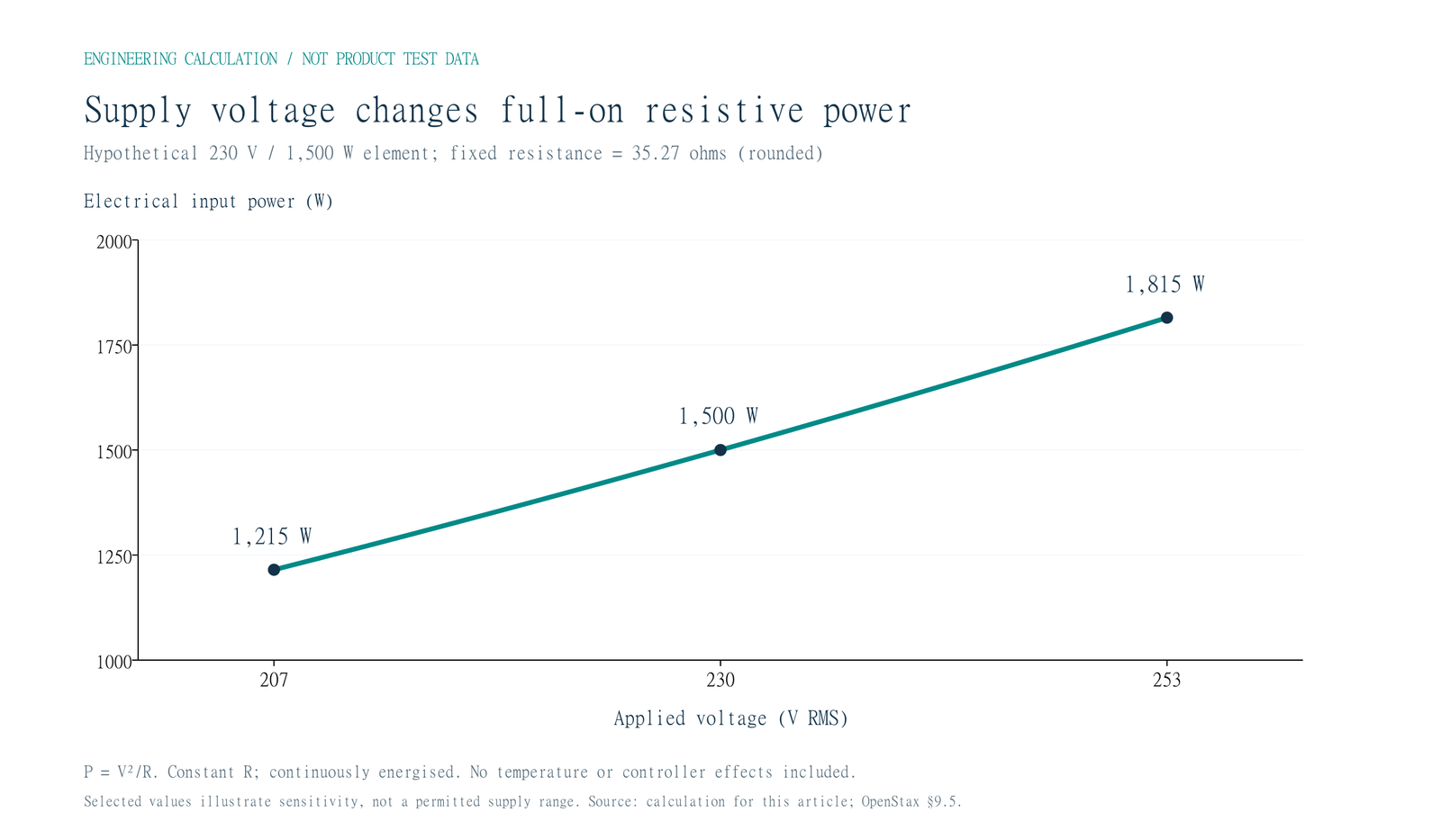
Figura 1. Ejemplo calculado de resistencia fija usando R = 230²/1.500 Ω antes del redondeo. Las tensiones seleccionadas ilustran la sensibilidad; no son una declaración de un rango de alimentación permitido ni una clasificación de producto.
Alcance de este cálculo
La resistencia se mantiene constante y el calentador está energizado continuamente. El ejemplo excluye la resistencia dependiente de la temperatura y la modulación del controlador. No predice la temperatura real de la fundición, el calor entregado, la vida útil ni la seguridad. Para un conjunto controlado, distinga la potencia a plena carga de la potencia promedio durante el ciclo de control.
3. Use an energy budget to question warm-up claims
Specify the load and the start condition
“Fast heating” is incomplete without a defined load and start state. A warm assembly reheating a small water quantity is a different test from a cold assembly heating a full vessel.
For a liquid-water example with no phase change, use Q = mcΔT y t = Q/P. OpenStax’s specific-heat reference gives the heat relationship and a reference specific heat for water; here it is rounded to 4,180 J/(kg·K) for a simple planning calculation.
Assume water starts at 20°C and reaches 90°C, giving ΔT = 70 K. With 1,500 W transferred continuously and entirely to the water, the calculated results are:
| Water mass | Energy for a 70 K rise | Ideal water-only heating time |
|---|---|---|
| 0.10 kg | 29.26 kJ | 19.5 s |
| 0.25 kg | 73.15 kJ | 48.8 s |
| 0.50 kg | 146.30 kJ | 97.5 s |
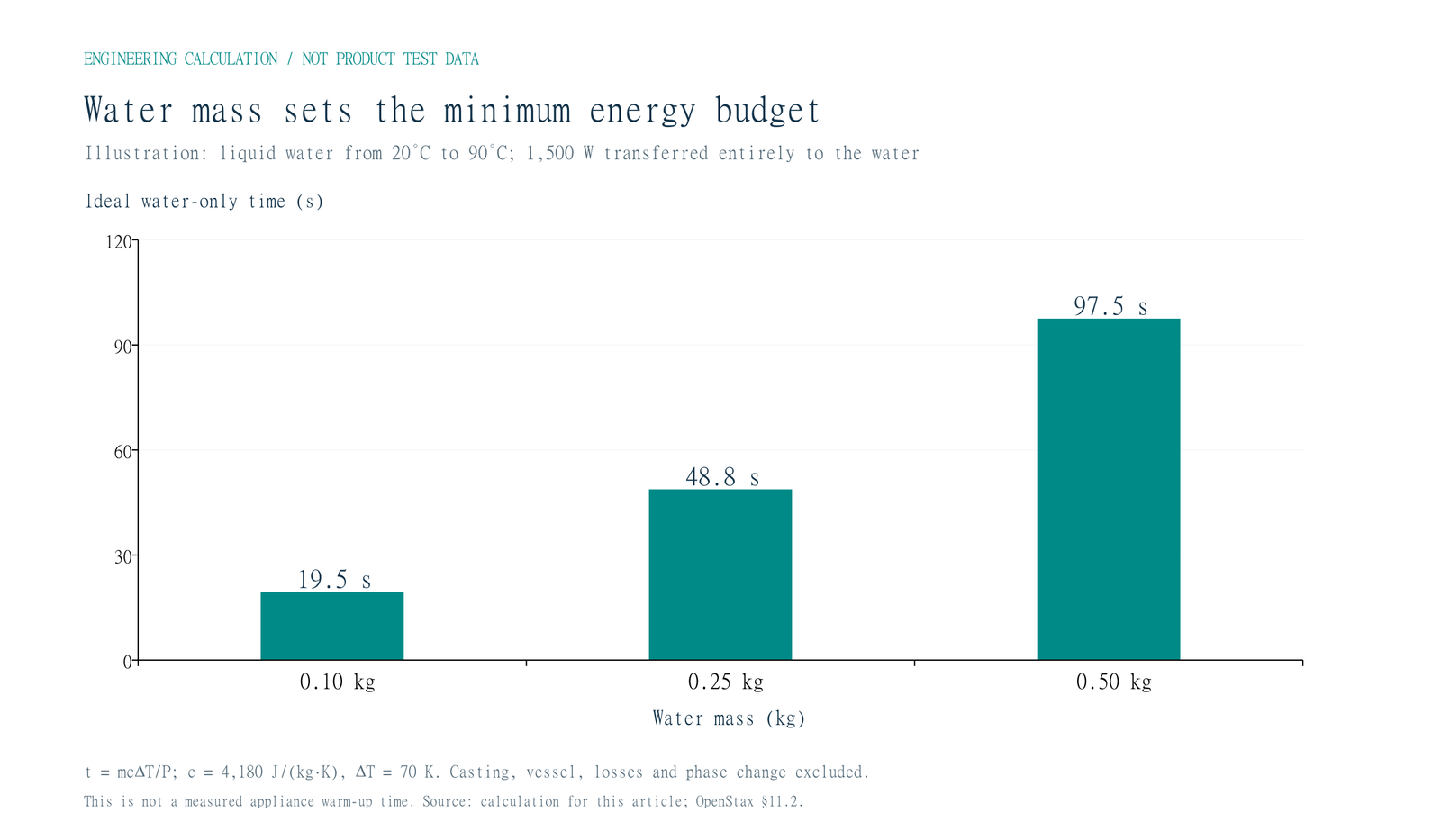
Figure 2. A simplified energy calculation, not measured heater performance. Inputs: c = 4,180 J/(kg·K), ΔT = 70 K and P = 1,500 W. The casting, vessel, heat losses and any phase change are excluded.
Para una cold-start assembly, additional energy is needed to heat the casting and associated hardware, while losses reduce the heat reaching the water. A prototype test should therefore record both the inlet/load conditions and the assembly’s initial temperature. Do not present the water-only calculation as a guaranteed appliance warm-up time.
Keep hot-water and steam duties separate
Heating liquid water and generating steam require different energy accounting. The calculation above stops at 90°C and includes no vaporisation energy. A steam specification also needs the feed-water condition, pressure, required steam delivery and a defined test method. A hot-water result cannot establish steam output.
4. Specify the interfaces that decide whether the heater will work
Mechanical fit and the heat-transfer path
A replacement that fits the bolt pattern can still have a different heat-transfer path. Confirm the drawing datums, mating surfaces, flatness requirements, fasteners and assembly conditions. If the casting heats a separate vessel, describe that interface explicitly instead of assuming that external dimensions define thermal contact.
Likewise, water-contact material must be confirmed for the actual wetted surfaces, not inferred from the visible casting colour. Where fluid passages exist, request the passage arrangement, connections, sealing details, cleaning requirements and the intended operating conditions. Any food-contact or material declaration must apply to the actual supplied construction.
Temperature sensing and independent protection
Identify the control sensor, its location and the temperature that it is intended to represent. A sensor mounted on the casting measures a different location from the liquid outlet or the appliance’s working surface. Ask how that difference will be checked during prototype testing.
Treat normal temperature regulation and over-temperature protection as separate design functions. The operating duty, dry-run scenario, interruption of flow and sensor fault conditions should be reviewed for the complete appliance. A statement that a heater “supports a thermostat” does not establish the performance of the finished control and protection system.
5. Agree a validation plan before approving production
Prototype approval is more useful when the acceptance conditions are written before testing. Avoid accepting a single temperature reading as evidence of the entire heating system’s performance.
| Validation item | Conditions to define | Evidence to request |
|---|---|---|
| Electrical input | Supply, initial state and control mode | Voltage, current, resistance basis and measured input power |
| Warm-up and regulation | Load, initial temperatures, sensor positions and timing endpoint | Time/temperature records with the test setup identified |
| Hydraulic integrity, where applicable | Fluid, operating conditions and assembly method | Agreed leak/pressure test method and results |
| Protection behaviour | Defined abnormal conditions and reset behaviour | Documented response of the complete appliance protection system |
| Repeatability | Agreed cycle profile and inspection points | Recorded drift, leakage, mechanical changes and failures |
Table 2. Suggested topics for an OEM validation plan. It specifies no universal pass limit, endurance rating or certification.
For repeat testing, keep the same definition of “ready.” A casting sensor reaching a setpoint, water reaching an outlet temperature and stable delivery over a duty cycle are three different endpoints. Write down which one matters to the application.
6. What to send Jinzhong for a useful OEM review
Jinzhong’s company materials identify die-cast heaters and accessories among its product groups and describe manufacturing processes including die casting, stamping and CNC machining. The Jinzhong company profile provides additional company context; the supplied product presentation also includes a die-cast coffee-machine heater. These references support an application discussion; they do not certify a particular assembly’s performance.
For an initial conversation, review the coffee-machine heating body listing and the broader coffee-machine heating application page. Use them to identify the type of component you need, then confirm the exact drawing, materials, interfaces and validation requirements. Do not infer drop-in compatibility from an application label.
| Enquiry field | What to provide |
|---|---|
| Solicitud | Appliance type, heated medium and whether the duty is batch, flow, steam or surface heating |
| Electrical requirement | Supply voltage, desired nominal power, control method and connection arrangement |
| Thermal requirement | Inlet/start temperature, target condition, load or flow, warm-up requirement and duty cycle |
| Mechanical requirement | Drawing or sample, envelope, datums, mounting, ports and mating parts |
| Control and protection | Sensor arrangement, control endpoint and protection requirements for the appliance |
| Commercial and compliance scope | Target market, required documentation, prototype quantity and intended production volume |
Table 3. A practical RFQ checklist. Fields should be completed for the project rather than copied from another model.
To start a review, send Jinzhong your heater drawing and operating requirements. A defined load and test endpoint give the engineering discussion a firmer basis than a request for “the same shape, but faster.”
Frequently asked engineering questions
Can two die-cast heaters with the same wattage be interchanged?
Not on wattage alone. Check voltage, resistance basis, terminals, mounting, mating surfaces, fluid path where applicable, sensor position and protective devices. Interchangeability requires confirmation against the actual assembly and appliance requirements.
Does a larger power rating guarantee faster usable heat?
It increases electrical input under the specified conditions, but usable heating performance also depends on the load, thermal path, initial state and control behaviour. Define the required endpoint and validate the prototype rather than using wattage as a complete performance specification.
Can a published warm-up time be used as an acceptance criterion?
Only when its test conditions and endpoint match the project, and the supplier agrees to that criterion. Ask for the initial assembly temperature, heated mass or flow, supply conditions and measurement locations. A headline time without that information is not a reproducible test specification.
What should be confirmed before a quotation becomes a production specification?
The drawing revision, electrical configuration, material declarations, sealing and mounting details, control interfaces, validation requirements and required documentation. A quotation identifies an offer; the agreed technical documents define the assembly to be supplied.
References and calculation basis
Company context was checked against Jinzhong Company Profile.pdf, pages 4, 15 and 19, the supplied application workbook, and the linked Jinzhong pages. The PDF and workbook are supplied company materials; they are not independent test reports. The product photograph is from the supplied image folder.
The two figures were calculated specifically for this guide using the stated inputs. General equations are supported by the linked OpenStax references. No efficiency, endurance, certification, brand-compatibility or measured warm-up claim is made for a Jinzhong model.