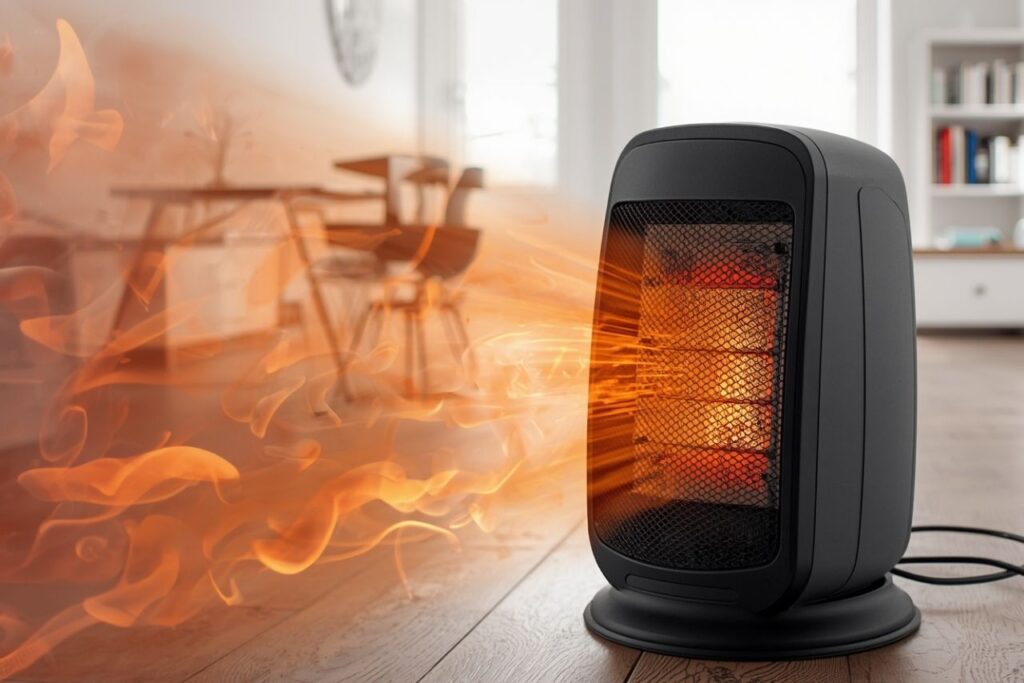
Ceramic heating elements show up in many “ceramic space heaters,” but the word ceramic can mean different things: sometimes it’s a ceramic insulator supporting a resistance wire, sometimes it’s a ceramic substrate carrying a printed heating film, and sometimes it’s a ceramic-based PTC (self-regulating) element inside a compact heater module. This guide explains what ceramic heating elements are, how space heaters actually move heat, and how to pick a safer, more suitable heater for your room.
- What is a heating element (and why “ceramic” is only part of the story)
- How space heaters heat a room: convection, radiation, and airflow
- Common ceramic element types used in space heaters
- Conductive alloy + insulating framework: the real “element”
- Wattage and sizing: what matters more than the marketing
- Controls & safety: thermostats, overheat protection, and why integration matters
- Environment & heater life: dust, humidity, contaminants, and cycling
- Related heating element formats (tubes, plates, films, die-cast modules)
- FAQ
What is a heating element (and why “ceramic” is only part of the story)
At its core, an electric heater converts electrical energy into heat via resistive (Joule) heating. But a “heating element” is not just a piece of metal that gets hot. It’s an assembly: a conductive part where the electrical load occurs, plus the insulating structure, terminals/leads, and mechanical support that make it safe and usable.
That’s why ceramic matters: ceramics are commonly used as high-temperature electrical insulators and structural supports—exactly the kind of framework a heating element needs.
How space heaters heat a room: convection, radiation, and airflow
Regardless of element type, space heaters typically warm a room through a mix of:
- Convection: heating air that then circulates (naturally or via a fan).
- Radiation: emitting heat you feel directly (more noticeable when close to the heater).
- Conduction: mainly inside the heater (heat moving through internal parts), not the primary room-heating mode.
Two heaters with the same wattage can feel different based on airflow design, element temperature, and how much heat is delivered to air vs. to a hot surface. “Ceramic” often changes how the heater is packaged and controlled—not the fundamental physics.
Common ceramic element types used in space heaters
1) Ceramic-supported resistance wire (open coil / supported / suspended)
One common approach is a resistance wire alloy (often NiCr or FeCrAl class alloys in many applications) arranged as a coil and held by ceramic or mica insulators. When the wire is exposed to airflow, the heater can deliver heat efficiently to moving air.
In heater engineering terms, wire elements are often described by how they contact their insulating framework: suspended, supported, or embedded. Suspended elements primarily transfer heat by convection and radiation (not conduction).
2) Embedded/sheathed constructions (ceramic insulation inside a metal sheath)
Another family is the “embedded” style: the resistive coil is encased in an insulating material (often magnesium oxide in many cartridge/tubular styles), and the heat transfers by conduction through the insulation to an outer sheath.
This is a common pattern across many heater types (cartridge heaters, tubular heaters), even when the end-product isn’t a space heater.
3) PTC ceramic elements (self-limiting behavior)
Some space heaters use PTC-style elements where resistance increases as temperature increases, helping cap the element temperature. In practice, that can simplify control and improve safety margins—though the heater still needs proper airflow and protection design.
4) Printed thick-film / thin-film heaters on ceramic substrates
Ceramic can also mean a ceramic substrate carrying a deposited/printed resistive pattern (thick film or thin film). This enables compact designs and potentially uniform heat distribution across a plate or defined geometry.
Conductive alloy + insulating framework: the real “element”
If you remember only one definition, use this: a heating element is a component made of electrically conductive material plus electrically insulating material, designed to serve a heating purpose. The alloy selection, dimensions, and the insulating framework are engineered together to balance: efficiency, reliability, performance, cost, and safety.
- It can provide electrical insulation at elevated temperatures.
- It can add mechanical stability to coils or printed elements.
- It can help shape airflow paths and element placement, improving consistent heating.
Wattage and sizing: what matters more than the marketing
Space heaters are usually compared by wattage, but wattage is only the “input.” What you care about is the delivered heat in your room and how controllable it is. From an engineering perspective, choosing wattage is tied to requirements: what you’re heating (air), starting vs. target temperature, airflow/room circulation, and time-to-warm.
Watt density (why some heaters run “hotter” than others)
Watt density is a way to compare how intensely a heater is loading its heat-generating surface area. Higher watt density can mean higher element temperature, which can impact longevity and safety if not designed and controlled properly.
If a compact heater is trying to deliver high wattage through a very small element area, it may need excellent airflow and fast control to avoid overshoot or hot spots. A “ceramic” label doesn’t guarantee low element temperature—design details do.
A concrete example of wattage in a different context (plug-in element)
Wattage alone doesn’t define the application. For example, a 1000W plug-in electric heating element sold for radiators/towel warmers is designed to connect to the bottom of a radiator or towel warmer and operate even without central heating. That product lists a 35.4" cable (with plug), ABS plastic & stainless steel construction, IP67 ingress protection rating, UL approval, chrome finish, and a 2-year warranty. It also ships free to the contiguous U.S. with a stated 1–5 business day delivery window after dispatch and a 30-day return policy. This is not a space heater, but it illustrates how “1000W” can be packaged very differently depending on where the heat must go.
Controls & safety: thermostats, overheat protection, and why integration matters
For space heaters, “ceramic element” is only one part of a safer system. The overall heater should manage:
- Temperature control (thermostat logic, sensor placement, response speed)
- Overheat protection (hardware cutoff / thermal fuse behavior)
- Airflow dependency (especially for exposed or high watt density designs)
- Electrical insulation & secure connections (terminals, lead wires, strain relief)
In industrial and appliance heating components, you’ll often see references to compatibility with control systems (e.g., PID/PLC) and to built-in protective functions. Those ideas matter in space heaters too: stable control and layered safety features reduce risk during continuous operation and cycling.
Environment & heater life: dust, humidity, contaminants, and cycling
Heating elements don’t fail only because they “get old.” Their operating environment matters: humidity, dust, and airborne contaminants can change how the element oxidizes or how insulation performs over time.
Contaminants and material match
Different gases and contaminants can shorten heater life if the alloy is poorly matched to the environment. Examples called out in heater engineering discussions include ammonia, sulfur, zinc, chlorine, and boron—each can be harmful depending on alloy choice and conditions.
Thermal cycling and oxide layers
Resistance alloys often form oxide layers at elevated temperatures. Whether that oxide layer stays adhered during repeated heat-up/cool-down cycles is linked to longevity. Designs that reduce unnecessary peak element temperature (for instance, by adjusting watt density or increasing effective surface area) can extend service life.
Keep intake/exhaust paths clear, prevent dust buildup, and avoid operating a heater in environments it wasn’t designed for (e.g., high aerosol sprays). Many “mystery smells” and early failures start with restricted airflow and contamination.
Related heating element formats (tubes, plates, films, die-cast modules)
If you zoom out beyond space heaters, you’ll find that electric heating is delivered through several common element formats—each optimized for a different heat transfer problem:
Heating tubes (sheathed, insulated)
Heating tubes are designed for efficient heat conduction and are often described with stainless steel/copper/special alloy sheaths, magnesium oxide powder insulation, and resistance wire. They can be customized in diameter, shape, and wattage, and are used in appliances like kettles, ovens, and water heaters where durability and insulation are crucial.
Heating plates (stable, uniform surface heat)
Heating plates emphasize stable, uniform surface heating and are commonly used in rice cookers, electric irons, coffee makers, and thermostatic equipment. Manufacturing approaches mentioned for heating plates include die-casting and welding processes to improve adhesion and reduce heat loss, along with mechanical strength to resist deformation over long-term high temperatures.
Heating films (thin, flexible, low-voltage operation)
Heating films are positioned as ultra-thin, lightweight solutions that conform to curved surfaces or tight spaces and deliver rapid, uniform heating. Example application areas include smart toilet seats, medical devices, car rearview mirror defrosting, and precision instrument insulation, with emphasis on safe operation at low voltages.
Die-cast integrated heating modules
Die-cast heating approaches combine heating elements with metal die-casting (such as aluminum and copper alloys) to create integrated thermal modules. This is presented as a way to improve heat transfer efficiency and provide mechanical strength and durability (including anti-corrosion characteristics), with offerings spanning highly customized parts and standard parts for replacement.
When a product label says “ceramic heater,” it may be describing the insulator framework, the substrate technology, or the self-limiting element type. Understanding the broader ecosystem (tubes, plates, films, integrated modules) helps you ask better questions about safety, controls, and longevity.
FAQ
Are ceramic space heaters “more efficient” than other electric heaters?
At the wall outlet, electric resistance heating is fundamentally converting electrical energy into heat. Differences people feel are typically about heat distribution (fan vs. radiant), control behavior, and comfort—not a magical efficiency boost from the word “ceramic.”
Is a ceramic heater safer?
Ceramic components can improve insulation and structural stability, and PTC-style behavior can help limit temperature. But safety ultimately comes from system design: protections, airflow management, secure wiring, and appropriate use conditions.
What should I check before buying a ceramic space heater?
- Does it have clear overheat protection and stable temperature control?
- Is the airflow path easy to keep clean (dust management)?
- Is the heater designed for your environment (humidity, contaminants, continuous operation)?
- Is the wattage appropriate for your comfort goal and expected run time?
If you want, tell me your room size, insulation quality, and whether you prefer “direct warmth” (radiant feel) or faster room air circulation (fan convection), and I can map those preferences to the ceramic element styles above—without relying on marketing terms.