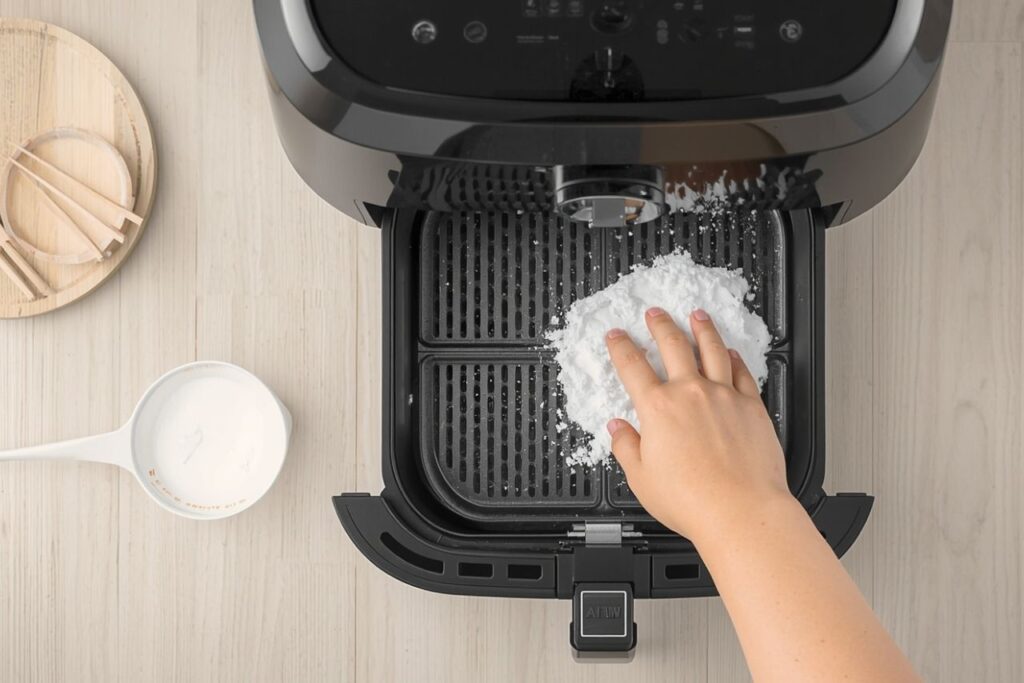
Baking soda is one of the simplest “natural” cleaners for an air fryer, but it works best when you treat the heating area like what it is: a precision heating element assembly, not a frying pan. The safest approach is gentle lifting (softening + wiping), not aggressive scrubbing.
Why baking soda helps (and when it doesn’t)
Baking soda works in two ways:
- Mild abrasion: it can help lift greasy film and light carbon from hard surfaces.
- Soil “release”: as a paste, it can soften and loosen baked-on residue so you can wipe instead of scrape.
Baking soda is still an abrasive. On delicate coatings, printed surfaces, exposed heater coils, or insulating supports, abrasion can do more harm than good. If your air fryer’s element is an exposed coil supported by insulators, treat it like a fragile electrical component—use minimal moisture and almost no scrubbing.
Heater design basics explain the caution: a heating element is a component composed of both electrically conductive and insulating material. Some elements are suspended (often on mica/ceramic supports), some are embedded (for example, sheathed elements with insulation inside), and each construction changes what “safe cleaning” looks like.
Safety checklist before cleaning
- Unplug the air fryer (don’t rely on the power button).
- Let it cool completely.
- Remove the basket/tray and wash those separately.
- Use a work light so you can see residue without scraping blindly.
3 natural baking-soda methods (gentle → stronger)
Method 1: Baking soda “dust + wipe” (lowest risk)
Best for: light grease haze and mild odor.
- Dry-wipe loose crumbs with a microfiber cloth.
- Lightly sprinkle baking soda onto a damp cloth (wring it out well).
- Wipe the greasy surfaces near the heater area gently (avoid pushing residue into vents/crevices).
- Wipe again with a clean damp cloth to remove powder.
- Dry thoroughly.
Method 2: Baking soda paste spot treatment (best balance)
Best for: sticky varnish-like grease spots on metal shields/reflectors.
- Make a paste:
2 parts baking soda : 1 part water(thick, not runny). - Apply paste to a cloth or soft sponge (not directly dripping onto the heater).
- Dab onto the spot and let sit 10–15 minutes.
- Wipe gently with a soft toothbrush or cloth. Reapply if needed—avoid heavy pressure.
- Rinse-wipe with clean water on a cloth until no powder remains.
- Dry completely before powering on.
Method 3: Baking soda + a drop of dishwashing liquid (for heavy grease)
Best for: heavier grease that keeps coming back (common in frequent air-frying).
- Make the paste above, then add one small drop of hand dishwashing liquid.
- Use only on wipeable metal surfaces (avoid labels, wiring, insulation pads).
- Let it dwell, then wipe. Follow with a thorough rinse-wipe to remove soap film.
Grease behaves differently depending on heat and airflow. In air-heated appliances, residues can repeatedly re-bake and smoke. A paste that softens residue reduces the temptation to scrape—important because heating elements can include insulating frameworks and coatings that are easy to damage.
Rinse + dry correctly (prevent smoke later)
Many “it still smokes after cleaning” complaints come from leftover cleaner residue, not leftover grease. Baking soda powder and soap film can burn and smell when reheated.
- Rinse-wipe: wipe with a cloth dampened with clean water until no chalky residue remains.
- Dry: wipe dry and air-dry with the drawer/basket open before plugging in.
What to avoid (most common damage mistakes)
| Avoid | What can go wrong |
|---|---|
| Scrubbing an exposed coil with baking soda | Abrasive wear, deformation, or damage to insulating supports/contacts. |
| Pouring water or paste into the top cavity | Liquid intrusion into electrical areas; residue wicking into seams. |
| Metal scrapers / steel wool | Scratches coatings and can create new “burn points” for grease to stick and smoke. |
| Powering on while damp | Steam + residue = odor/smoke; moisture near electrical parts is unsafe. |
If you see sparks/arcing, melting plastic smell, damaged wiring, or repeated heavy smoke even after careful cleaning and drying, stop using the appliance and seek service. Some issues aren’t “dirt”—they’re electrical or insulation faults.
For readers who work with heater components beyond consumer cleaning: different product families (tubular heating tubes, plates, films, and integrated modules) exist because materials, insulation, and heat transfer requirements vary across applications. Cleaning compatibility always follows construction.