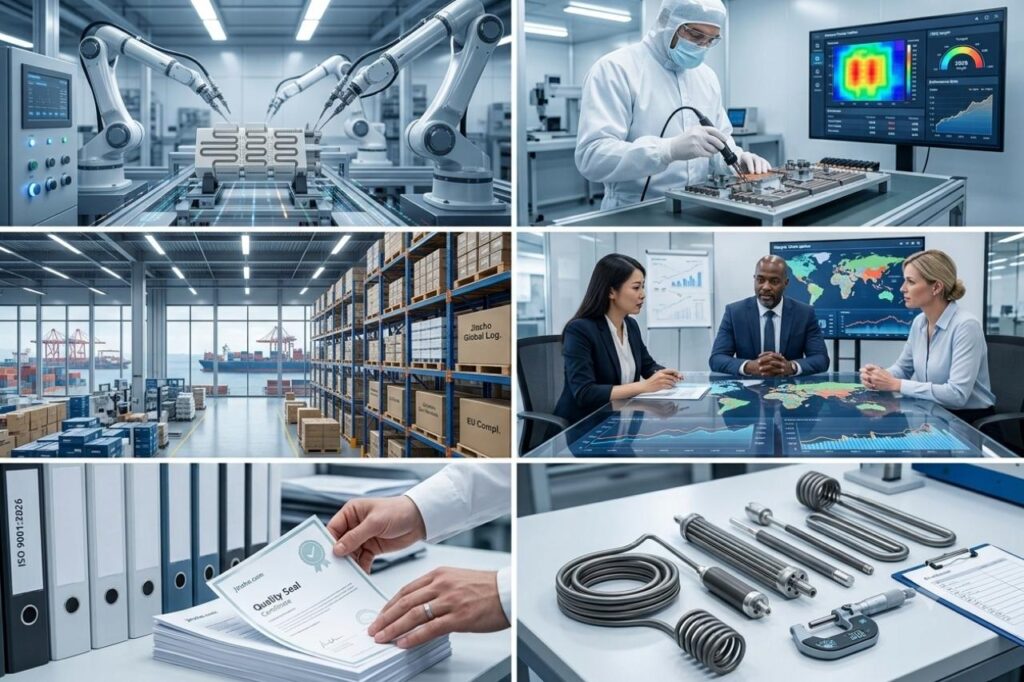
Meta title: Electric Heating Element Market Trends 2026 | OEM Buyer Guide
Meta description: Learn 2026 electric heating element market trends, product types, OEM selection parameters, testing checks, and Jinzho heating element applications.
Author: Tim daihui
Technical review: Jinzho Engineering / QC Team, recommended before publishing
Last updated: July 24, 2026
Opening Summary
An electric heating element is a component that converts electrical energy into controlled heat.
This article discusses electric heating element market trends in 2026. It focuses on tubular heaters, heating plates, heating films, immersion heaters, cartridge heaters, and related electric heater parts. The target readers are OEM buyers, appliance manufacturers, commercial equipment brands, and industrial heating equipment engineers.
Market data should be read as a range. Public reports use different product scopes, base years, and forecast periods. Some reports include household appliances and commercial heating equipment. Other reports only count industrial electrical heating elements.
1. What Is an Electric Heating Element?
An electric heating element is a resistive component that generates heat when electrical current passes through it.
The main product forms include tubular heaters, heating plates, heating films, immersion heaters, cartridge heaters, strip heaters, band heaters, and die-cast heating parts. These products are used in water heaters, ovens, coffee machines, dishwashers, cooking appliances, industrial tanks, packaging equipment, and process heating systems.
This article does not cover complete HVAC systems or finished consumer appliances. It only discusses the heating element when the element is the core heat-generating component.
Jinzho’s public product categories include heating tubes, heating plates, heating films, die-casting heating solutions, electric heater parts, and related heating element products. This matches the product scope used in this article. (jinzho.com)
2. 2026 Market Scope and Data Boundaries
The electric heating element market does not have one fixed public number.
Different market reports define the category differently. A broad report may include electric heater parts for appliances, commercial equipment, and industrial systems. A narrow report may only include industrial electrical heating elements.
For this reason, OEM buyers should compare three items before using market data. They should check the product definition, the base year, and the forecast period.
Public market pages show this difference clearly:
| Market scope | Example public estimate | How to read it |
|---|---|---|
| Broad electric heating elements | About USD 12.0 billion in 2026, projected to about USD 17.0 billion by 2033, CAGR 5.09% | Broad component-level scope (marketresearch.com) |
| Electric heating elements market | USD 8.5 billion in 2024, projected to USD 15.2 billion by 2034, CAGR 6.1% | Broad market scope and longer forecast period (emergenresearch.com) |
| Electric heating elements / electric heater market | USD 6.5 billion in 2024, projected to USD 11.3 billion by 2032, CAGR 7.2% | Different product definition and forecast window (verifiedmarketresearch.com) |
| Industrial electrical heating element market | USD 3.86 billion in 2025, projected to USD 6.66 billion by 2035, CAGR 5.7% | Industrial-only scope (omrglobal.com) |
| Industrial electric heating element market | USD 342.0 million in 2024, projected to USD 552.1 million by 2032, CAGR 6.17% | Narrower market definition or methodology (congruencemarketinsights.com) |
The useful conclusion is not one exact number. The useful conclusion is that public estimates generally show positive growth. Most cited CAGR figures are in the mid-single-digit range.
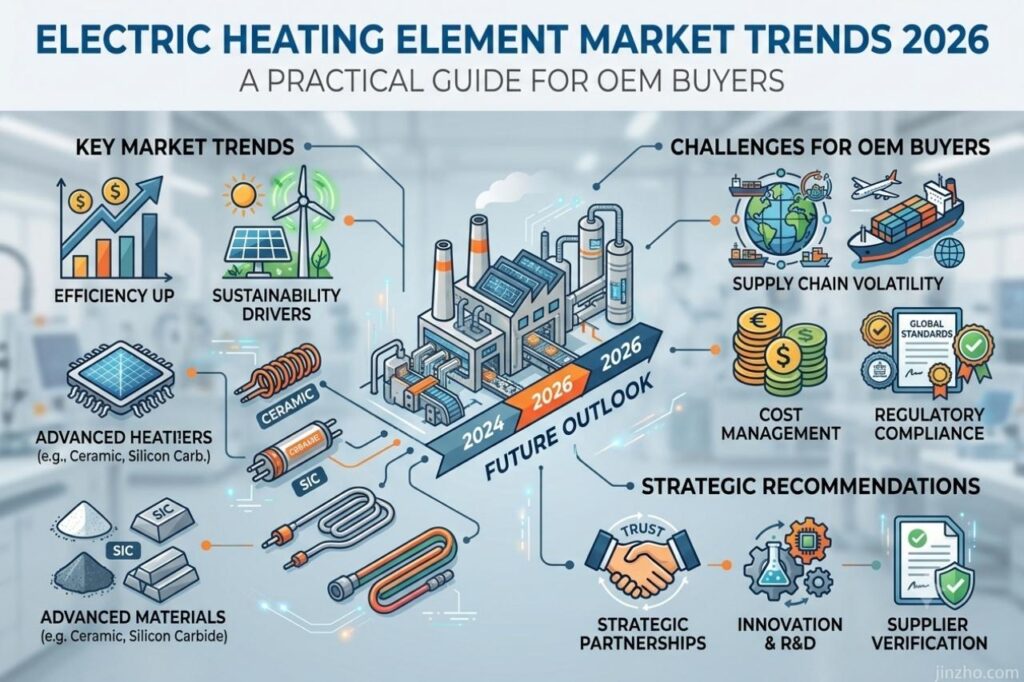
3. Main Demand Drivers in 2026
3.1 Industrial Electrification
Industrial electrification means using electric technologies to replace or reduce combustion-based heating in selected processes.
This trend is relevant to electric heating elements used in tanks, dryers, ovens, sealing machines, food equipment, and industrial process heating systems. Electric heating can support cleaner operation, precise temperature control, and easier integration with sensors and controllers.
The International Energy Agency says commercially available electric technologies, including resistance heaters, can meet much of the heat demand in less energy-intensive industrial sectors such as food and beverages, textiles, chemicals, paper, and other manufacturing activities. The same source also notes that electrification depends on the process, temperature level, and industrial energy system. (iea.org)
The limit is important. Electric heating is not suitable for every process. Electricity cost, grid capacity, peak load, and required temperature still affect adoption.
3.2 Energy Efficiency
Energy efficiency in heating elements is not only about rated wattage.
A heating element with the correct wattage can still waste energy if heat transfer is poor. Heat transfer depends on surface contact, material, insulation, airflow, liquid flow, mounting structure, and temperature control.
For OEM buyers, the full heating system matters more than the element alone. A lower-wattage heater can perform better if it transfers heat more effectively to the target object.
The U.S. Department of Energy supports research and deployment work related to industrial process heat and electrification. Its programs focus on reducing energy use and improving process heating efficiency. (energy.gov)
3.3 Precision Temperature Control
Precision temperature control means keeping the target temperature stable during repeated operation.
This requirement is important for coffee machines, ovens, laboratory equipment, food equipment, packaging equipment, and selected medical or commercial devices. The heating element must work with sensors, thermostats, controllers, and proper mechanical mounting.
The element alone cannot guarantee temperature stability. Poor sensor placement can cause overheating. Weak surface contact can create cold zones. Incorrect watt density can shorten service life.
For OEM buyers, temperature control should be designed at the system level. The heating element, sensor, controller, insulation, and installation structure should be tested together.
4. Product Categories with Strong OEM Relevance
4.1 Tubular Heaters
A tubular heater is a metal-sheathed electric heating element used for liquid, air, and surface heating.
It is one of the most common heating element types for water heaters, ovens, dishwashers, fryers, boilers, and industrial tanks. The key parameters include sheath material, tube diameter, voltage, wattage, watt density, bending radius, terminal structure, and sealing method.
A tubular heater is not selected by wattage alone. The material must match the heated medium. The watt density must match the heat transfer condition. The sealing structure must match moisture, steam, or liquid exposure.
Jinzho’s website lists heating tubes as a major product category and describes use cases such as electric kettles, ovens, water heaters, commercial ovens, medical equipment, industrial ovens, and liquid heating equipment. (jinzho.com)
4.2 Heating Plates
A heating plate is a flat heating component that transfers heat through a contact surface.
It is used in coffee machines, cooking appliances, laboratory equipment, packaging equipment, steam irons, and controlled surface heating systems. The key attributes include plate material, surface flatness, heat distribution, mounting method, sensor position, power density, and surface temperature.
A heating plate works best when the heated object has stable contact with the plate surface. Poor contact can create uneven heating. Uneven heating can reduce product performance or damage nearby parts.
Jinzho’s product pages include heating plates and die-cast heating plate solutions for appliance and equipment applications. (jinzho.com)
4.3 Heating Films
A heating film is a thin electric heating component used where a lightweight structure or fast thermal response is required.
It is relevant to compact appliances, surface warming systems, smart devices, humidifiers, and thin-profile heating applications. The key attributes include film material, resistance pattern, voltage, surface temperature, adhesive layer, flexibility, insulation layer, and moisture protection.
A heating film is not suitable for every high-load heating application. Mechanical pressure, moisture, bending stress, and operating temperature can limit service life.
Jinzho’s public product category includes heating films as part of its heating element product line. (jinzho.com)
4.4 Immersion Heaters
An immersion heater is an electric heating element designed to heat liquid directly.
It is used in water heaters, boilers, tanks, chemical containers, cleaning systems, and selected industrial fluid heating applications. The key parameters include sheath material, flange or thread type, watt density, immersion length, terminal protection, and liquid compatibility.
The main risk is surface overheating. This can happen when the liquid level is too low, the liquid is stagnant, or scale builds up on the sheath. For this reason, immersion heaters often require level control, dry-burn protection, and regular maintenance.
4.5 Cartridge Heaters
A cartridge heater is a cylindrical heating element inserted into a drilled hole or metal block.
It is used in molds, packaging machines, sealing equipment, plastic processing machinery, and compact industrial heating systems. The key parameters include diameter tolerance, length, wattage, lead wire type, sheath material, and fit clearance.
The installation fit is critical. Loose contact can reduce heat transfer. Tight installation can make removal difficult. OEM buyers should confirm hole tolerance and operating temperature before mass production.
5. Application Scenarios and Design Priorities
Each application creates a different design priority.
A water heater does not have the same risk profile as a coffee machine. A dishwasher does not have the same material requirement as a dry oven. An industrial tank does not have the same heat transfer condition as a surface heating plate.
| Application | Common problem | Design priority |
|---|---|---|
| Water heater | Long-term water contact | Corrosion resistance, sealing, leakage protection |
| Oven | High air temperature | Oxidation resistance, surface temperature control |
| Dishwasher | Moisture and detergent exposure | Stainless steel material, insulation resistance, terminal sealing |
| Coffee machine | Compact space and fast heating | Small size, stable wattage, food-contact suitability |
| Industrial tank | Liquid corrosion, scaling, or low flow | Sheath material, watt density, installation method |
| Packaging machine | Repeated heating cycles | Fit tolerance, response speed, thermal stability |
| Laboratory equipment | Stable temperature requirement | Uniform heat distribution, sensor position, controller matching |
A dishwasher heating element operates in a wet and chemically active environment. The main risks are corrosion, leakage current, insulation resistance drop, and terminal sealing failure. For this application, OEM buyers should evaluate sheath material, sealing structure, grounding design, and dielectric strength.
A coffee machine heating plate has a different priority. It needs compact size, fast heat-up, stable heat transfer, and reliable temperature control. The heated surface, sensor location, and contact pressure can matter as much as the rated wattage.
6. How OEM Buyers Should Select Electric Heating Elements
OEM buyers should select electric heating elements by application conditions.
The first question is not “How many watts do we need?” The first question is “What object, liquid, air, or surface needs to be heated?”
After that, the buyer should define voltage, wattage, watt density, material, installation space, terminal type, control method, and safety requirements.
| Parameter | Why it matters |
|---|---|
| Voltage | Must match the equipment electrical system |
| Wattage | Determines basic heating capacity |
| Watt density | Affects surface temperature and service life |
| Sheath material | Affects corrosion resistance and temperature resistance |
| Tube diameter | Affects installation space and heat transfer |
| Plate flatness | Affects contact heating performance |
| Insulation resistance | Affects electrical safety |
| Dielectric strength | Affects safety testing and certification readiness |
| Terminal type | Affects wiring and assembly efficiency |
| Mounting method | Affects OEM production and maintenance |
| Sensor position | Affects temperature control accuracy |
| Sealing method | Affects moisture and liquid resistance |
Watt density is the heat output per unit surface area of a heating element. It affects surface temperature, heat transfer, and service life. High watt density can shorten heater life if the medium cannot remove heat quickly.
Material selection is also application-specific. Stainless steel may be suitable for many appliance and water-heating applications. Other liquids may need different sheath materials. The final choice should be based on corrosion risk, operating temperature, water quality, chemicals, and cleaning conditions.
7. Quality Testing and Reliability Checks
Quality testing verifies whether the heating element is safe and consistent.
OEM buyers should not rely only on appearance inspection. Electrical tests, dimensional checks, and application tests are needed before mass production.
Common checks include:
| Test or check | Purpose |
|---|---|
| Resistance tolerance test | Confirms electrical resistance and power consistency |
| Insulation resistance test | Checks insulation between conductor and sheath |
| Dielectric strength test | Checks ability to withstand high-voltage stress |
| Leakage current test | Evaluates electrical safety risk |
| Grounding continuity test | Confirms grounding path where required |
| Surface temperature test | Checks overheating and temperature distribution |
| Dimensional inspection | Confirms fit with OEM assembly |
| Visual inspection | Checks surface defects, terminals, and sealing |
| Moisture protection check | Reduces risk in storage and humid operation |
| Batch traceability | Supports quality control and after-sales analysis |
Insulation resistance is a key safety indicator. It measures the resistance between the live conductor and the outer sheath or grounded part. Low insulation resistance can increase leakage current risk, especially in humid or liquid-heating applications.
Dielectric strength testing is also important. It checks whether the insulation system can withstand a specified high voltage without breakdown. The test condition depends on the product type, application, voltage, and relevant standard.
UL 1030 covers sheathed heating elements rated 600 volts or less. UL 499 covers electric heating appliances and includes safety test topics such as insulation resistance, leakage current, and dielectric voltage-withstand testing. (shopulstandards.com)
For household and similar appliances, IEC 60335-1 deals with appliance safety for rated voltages up to 250 V for single-phase appliances and 480 V for other appliances. IEC 60335-2-9 covers electric portable cooking appliances such as baking, roasting, and grilling appliances. (webstore.iec.ch)
8. Common Selection Mistakes
The first mistake is selecting a heating element only by wattage.
Wattage shows power output. It does not show whether the heat can transfer safely into the medium or surface. A high-wattage heater can fail early if the watt density is too high or the heat transfer path is weak.
The second mistake is ignoring the heated medium. Water, air, oil, detergent solution, steam, and chemical liquid create different material risks. The sheath material and sealing structure should match the actual medium.
The third mistake is copying an old design without checking the new application. A heating element that works in one appliance may fail in another appliance. The reason may be different airflow, water quality, mounting pressure, sensor position, or duty cycle.
The fourth mistake is skipping real-condition sample testing. Bench tests are useful. They are not enough for every OEM project. Buyers should test samples under the real voltage, working temperature, liquid condition, mounting structure, and operating cycle.
9. Jinzho Product Relevance for OEM Buyers
Jinzho supplies electric heating element products for appliance, commercial, and selected industrial heating applications.
The main product categories include heating tubes, heating plates, heating films, die-casting heating solutions, electric heater parts, and related heating element products. Jinzho’s public website presents these categories across home appliance, commercial equipment, liquid heating, oven, coffee, boiler, and industrial heating use cases. (jinzho.com)
For OEM buyers, the main value is application matching. The heating element should match the voltage, wattage, material, shape, mounting method, sealing structure, and operating environment.
A custom heating tube may be more suitable for water or air heating. A heating plate may be more suitable for contact heating. A heating film may be more suitable for compact surface heating. A die-cast heater may be more suitable when the heating structure must fit an irregular surface or integrated module.
Jinzho should present project support through drawings, samples, test reports, and batch inspection records. This is more useful than broad marketing claims. OEM buyers usually need proof of fit, proof of safety, and proof of consistency before confirming mass production.
10. Risks and Limitations
Electric heating elements are not suitable for every heating requirement.
The final performance depends on the complete system. The system includes the heater, material, sensor, controller, insulation, mounting structure, airflow, liquid flow, and user environment.
A heating element with the correct rated power can still fail. Failure can happen if the watt density is too high, the material is unsuitable, the liquid level is too low, the terminal sealing is weak, or the sensor is placed incorrectly.
Market growth does not remove engineering risk. OEM buyers should confirm samples under real working conditions before mass production. They should also define inspection standards with the supplier before placing repeat orders.
11. FAQ
What is the most important parameter when selecting an electric heating element?
There is no single most important parameter.
Voltage, wattage, watt density, material, insulation resistance, dielectric strength, mounting method, and operating environment must be evaluated together. For liquid heating, material and watt density are especially important. For compact appliances, size, response speed, and safety protection may be more important.
Why do market reports show different electric heating element market sizes?
Market reports use different definitions.
Some reports include household appliances, commercial heating equipment, and industrial components. Other reports only count industrial electrical heating elements or specific heater types. This is why market size and CAGR should be compared by scope, base year, region, and product category.
Are tubular heaters still important in 2026?
Yes, tubular heaters remain important for many OEM heating designs.
They are widely used because they can be formed into different shapes and applied to liquid, air, and surface heating. The main selection factors are sheath material, watt density, diameter, shape, terminal design, and sealing method.
When should an OEM buyer choose a heating plate?
An OEM buyer should choose a heating plate when stable surface contact is required.
Heating plates are suitable for coffee machines, cooking equipment, laboratory devices, packaging systems, and surface heating modules. The key design points are flatness, heat distribution, mounting pressure, sensor position, and surface material.
When should an OEM buyer choose a heating film?
An OEM buyer should choose a heating film when the product needs a thin, light, or flexible heating structure.
Heating films are suitable for compact spaces and surface warming applications. They are not always suitable for high-load heating, wet environments, or applications with repeated mechanical stress. The final design should be tested under real operating conditions.
Can Jinzho customize electric heating elements for OEM equipment?
Yes, Jinzho’s public product pages show heating tubes, heating plates, heating films, die-cast heating solutions, and electric heater parts.
Customization can include voltage, wattage, shape, size, material, terminal structure, mounting method, and application-specific requirements. Final specifications should be confirmed through drawings, samples, and testing before mass production. (jinzho.com)
Conclusion
The 2026 electric heating element market should be understood through product scope and application demand.
Public reports show positive growth, but the exact market size varies by definition. The practical opportunity for OEM buyers is not only market expansion. It is better product matching.
A reliable electric heating element must match the heated object, operating environment, safety requirements, and production process. OEM buyers should compare voltage, wattage, watt density, material, insulation resistance, dielectric strength, sealing, terminal design, and mounting method.
For Jinzho, the strongest content angle is not only “market trends.” The stronger angle is “market trends plus OEM selection guidance plus engineering support.” That type of content is more useful for buyers. It is also less likely to look like generic AI SEO content.
References
This article uses public source pages for market scope, industrial electrification background, safety standard scope, and Jinzho product-category verification. Market numbers should be treated as directional estimates because report scopes and methodologies differ. (marketresearch.com)
Learn more:
- Heating Tubes | Jinzhong Electric Heating
- Global Electric Heating Elements Competitive Landscape Professional Research Report 2026
- Electric Heating Elements Market Size, Share & 2034 Growth Trends Report
- Electric Heating Elements (Electric Heater) Market Report: Size, Growth, Trends & Forecast (2025–2033)
- Industrial Electrical Heating Element Market Trends
- Industrial Electric Heating Element Market Report | Size & Forecast to 2032
- Renewables for Industry – Analysis – IEA
- Electrified Processes for Industrial Excellence | Department of Energy
- Heating Element | Jinzhong Electric Heating
- UL 1030 | UL Standards & Engagement | UL Standard
- IEC 60335-1:2020 | IEC