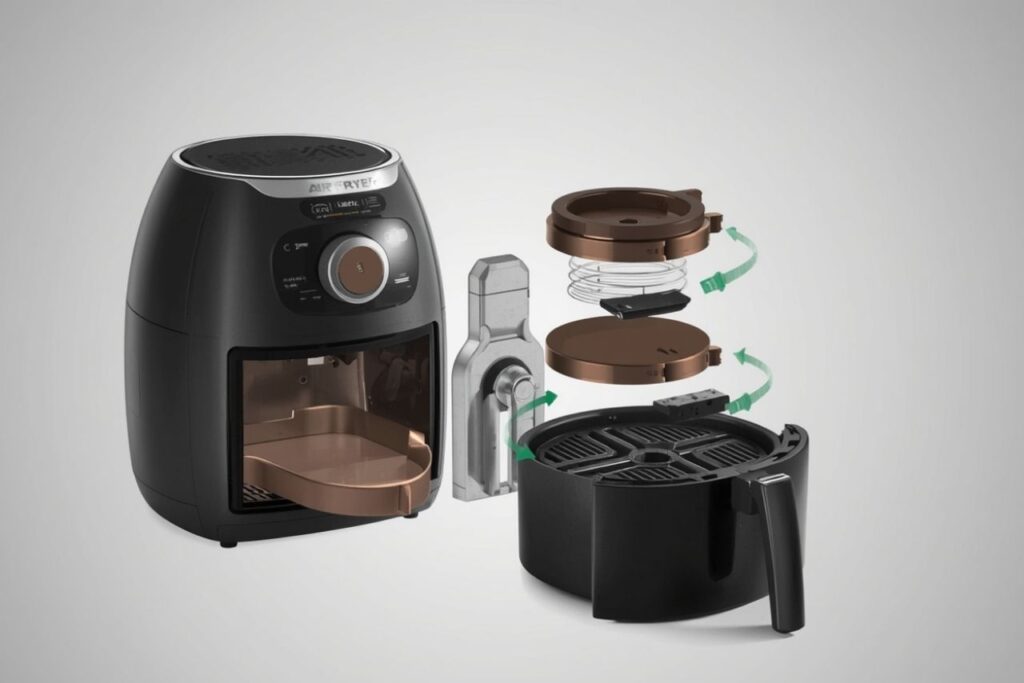
Cluster page for the broader Heating Element content hub. Topic: repair feasibility and decision-making for air fryer heating elements.
- Short answer: yes, sometimes—but it depends
- What “heating element” means inside an air fryer
- When replacement is realistic vs. when it’s not
- How to confirm the element is the problem
- Replacement paths: OEM part, compatible module, or custom
- Safety and “don’t do this” list
- Repair vs replace: a practical decision checklist
- FAQ
Can you replace an air fryer heating element? (short answer)
Yes—sometimes. An air fryer heating element can be replaceable if (1) the brand sells the part or a compatible module exists, and (2) the unit is designed to be serviced without destroying the housing, wiring, or safety insulation. If the element is integrated into a sealed heating module or the manufacturer does not supply parts, replacement can be impractical.
In other words: the question is less “Is it physically possible?” and more “Is the element a service part with safe access and an obtainable replacement?”
What “heating element” means inside an air fryer
In engineering terms, a heating element is not just “the metal that gets hot.” It’s a component that combines electrically conductive material (where the electrical load turns into heat) with insulating/support structures and terminals. That combination is why swapping an element is sometimes easy and sometimes extremely risky.
Air fryers are compact convection appliances: the element, insulation, wiring, airflow path, and temperature controls are tightly packaged. If you disturb insulation spacing, nick a lead, or reassemble incorrectly, you can create overheating, arcing, or exposed live metal.
Common heating element “formats” you might encounter
| Format | What it looks like | Replacement difficulty |
|---|---|---|
| Exposed coil / open-coil style | Coiled resistive wire supported by insulating points (often ceramic/mica-like support structures) | Moderate: possible if the unit is serviceable and coil is a replaceable part |
| Sheathed / tubular heater | Metal sheath enclosing resistive wire with insulating fill (often MgO conceptually); can be bent into shapes | Moderate to hard: feasible if a matching assembly exists and mounting is accessible |
| Integrated heater module | Element + insulation + brackets + sensor mounts + connectors (sometimes riveted or sealed) | Hard: often replaced as a whole module if parts are available |
Note: Sheathed/tubular concepts also appear across appliance heating product lines. For example, heating tubes are often described as using stainless steel/copper/special alloy sheaths with magnesium oxide powder insulation and resistance wire, with customizable shapes and wattages—features that can matter if you’re trying to match a form factor rather than repair a single broken coil.
When replacement is realistic vs. when it’s not
- The brand sells the heating element or a heater module as a spare part.
- You can access the element by removing screws (not destructive cuts).
- Connectors are plug-in terminals (spade/plug), not potted-in leads.
- The element has clear markings/specs or an identifiable part number.
- Thermal fuses/sensors and insulation can be restored exactly as designed.
- The heater is integrated into a sealed assembly and parts are unavailable.
- Access requires drilling rivets, cutting the housing, or breaking insulation barriers.
- Internal wiring is heat-damaged (brittle insulation) beyond the element itself.
- The unit has repeated overheating, burning smells, or melted plastic—indicating broader failure.
- You can’t confidently verify voltage/wattage compatibility for a replacement.
A useful comparison: plug-in “heater as a component”
Some heating products are explicitly designed for easy swap/installation as a component. For example, a plug-in 1000W heating element used for a radiator or towel warmer can be sold as a standalone part with a plug-in cable and safety ratings (e.g., ingress protection and UL approval). That kind of “replaceable by design” is not how most air fryers are built—but it illustrates what service-friendly looks like.
How to confirm the heating element is the problem (before buying parts)
Air fryers can fail to heat for reasons that are not the element: a blown thermal fuse, failed thermostat/control board, fan failure (some models won’t energize heat without airflow), or a bad connector.
Basic confirmation checks (high level)
The element has an open circuit (burned out) or a short to chassis/ground—or conversely, the element is fine and the control/safety chain is open.
- Visual inspection (unplugged): Look for a snapped coil, burned spots, broken terminal tabs, or cracked insulators.
- Connector inspection: Loose spade terminals and heat-discolored connectors can mimic a “bad element.”
- Continuity/resistance test (unplugged): If you have a multimeter and safe access, measure across the element terminals to check for continuity (open = likely failed element).
- Chassis short check (unplugged): If the element reads short to metal chassis, it’s unsafe.
Testing an air fryer while disassembled can expose you to live mains voltage and hot surfaces, and it can defeat airflow/thermal safeguards.
Replacement paths: OEM part, compatible module, or custom
Path 1: OEM heating element or heater module (preferred)
If available, OEM parts are the safest route because mounting, watt density, airflow exposure, and insulation clearances were designed and validated for that appliance.
Path 2: Compatible heater assembly (only if you can match key parameters)
Some air fryer heaters are sold as assemblies that include brackets and terminals. If you go this route, you must match:
- Electrical specs: voltage and wattage (and any staged/dual circuit behavior)
- Geometry: length/diameter/shape so it sits in the same airflow region
- Mounting: screw points, thermal isolation parts, and terminal orientation
- Sensor integration: how temperature sensors or thermal fuses mount nearby
Path 3: Custom heater design (usually for manufacturers, not DIY repair)
For product makers (not typical home repair), heater suppliers can support customization. Categories commonly used in appliances include:
- Tubular/sheath heaters (often described as sheaths + MgO insulation + resistance wire, with custom diameters/shapes/wattages)
- Heating plates for uniform surface heating in appliances
- Heating films for thin, flexible, low-voltage, tight-space heating applications
- Integrated die-cast thermal modules that combine heating elements with metal die-casting for heat transfer efficiency and mechanical strength
A custom heater might solve a design problem, but for a one-off repair it’s hard to justify the engineering, validation, and safety testing compared with buying an OEM part or replacing the appliance.
Safety and “don’t do this” list
Heating elements concentrate power into a small area (high temperature, high watt density). In a small countertop appliance, safe operation depends on the full system: insulation, airflow, controls, and wiring.
- Replace an element with “something that fits” but has unknown wattage/voltage.
- Bypass thermal fuses, thermostats, or safety interlocks “just to test.”
- Use household wire, random crimp terminals, or tape inside the hot zone.
- Move insulation pieces or reflective shields without restoring them exactly.
- Operate the air fryer with the housing open (shock + burn + fire hazard).
Repair vs replace: a practical decision checklist
Use this checklist to decide quickly—especially if the air fryer is out of warranty.
| Question | If “Yes” | If “No” |
|---|---|---|
| Can you buy the OEM heater/assembly? | Repair is more realistic. | Replacement appliance often wins. |
| Can you access the element with screws (non-destructive)? | Repair is safer and faster. | Risk and time increase sharply. |
| Is the failure clearly limited to the element (not wiring/control damage)? | Repair may be cost-effective. | Multiple parts = diminishing returns. |
| Do you have the tools/skills to reassemble safely? | Proceed carefully. | Consider professional service or replace. |
FAQ
Is an air fryer heating element the same as a water heater element?
No. A tank water heater element is typically a screw-in immersion heater designed for water and serviced with tools like an element wrench or 1 1/2" deep well socket. An air fryer element is usually an air-heating component designed around airflow and compact insulation, and it may be integrated into a heater module.
What if my air fryer runs but won’t get hot?
Don’t assume “bad element” first. The heat circuit can be interrupted by a thermal fuse, sensor, control board, or connector. Confirm the element’s continuity (unplugged, safely accessed) and inspect wiring for heat damage.
Can I upgrade to a higher-wattage element to make it heat faster?
Not safely. Higher wattage can exceed the appliance’s thermal design, wiring rating, and safety controls, increasing fire risk. Heating elements are system-designed components, not drop-in performance parts.
When should I stop and replace the whole air fryer?
If the heater part is unavailable, the unit is not serviceable without destructive disassembly, or there’s visible melting/burning beyond the element area, replacing the appliance is typically the safer option.
Disclaimer: This guide is general information. Air fryers are mains-powered appliances; improper repair can cause shock, fire, or injury. If you’re unsure about diagnostics or safe reassembly, use manufacturer service channels or replace the unit.