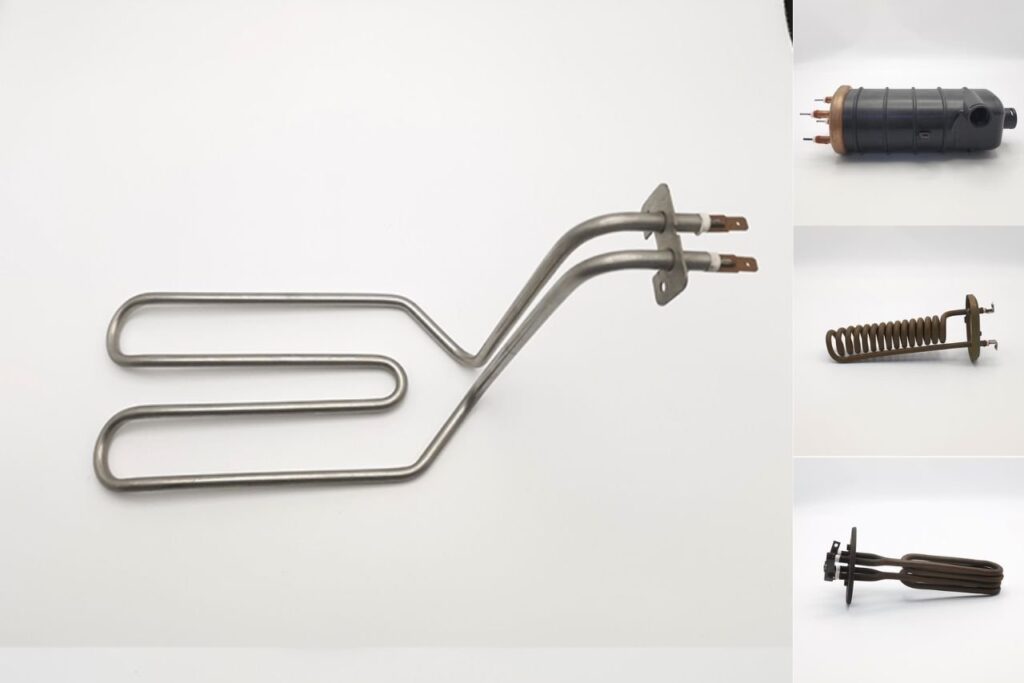
Replacing a failed dryer heater is typically a high-ROI repair because the part cost is modest relative to the price of a new dryer, and the rest of the machine (drum, motor, cabinet) often has years of life left. The decision changes when the dryer has multiple simultaneous failures, chronic overheating from **restricted airflow**, or evidence of repeated electrical damage conditions that increase the probability of a second repair and inflate total cost of ownership.
- Decision in 60 seconds (repair vs replace)
- A practical cost model (what people forget to include)
- Typical cost ranges: element repair vs new dryer
- Scenario comparisons (5 real-world profiles)
- Risk factors that turn a cheap fix into an expensive cycle
- How to make the repair stick (avoid repeat burnout)
- If you source heating components: what good specs look like
- ЧаВО (5)
- Ссылки и внешние ссылки
- The dryer otherwise runs normally (stable drum rotation, no loud bearing noise, no burning smell).
- There is a single-point failure (heater coil open) and wiring is not heat-damaged.
- Airflow can be restored (vent path clean; no crushed/overlong ducting).
- The repair cost is below the comfort threshold (many households use 25 C40% of new dryer price as a rule of thumb).
- There is visible harness damage (melted terminals) or repeated safety cutouts.
- Heat failure is paired with other major symptoms (motor issues, control faults, drum support wear).
- The dryer has chronic overheating from unresolved **vent restriction** and keeps blowing thermal protection.
- Total repair estimate approaches half the cost of replacement, especially if multiple parts are involved.
The comparison is not part price vs new dryer price. A realistic model includes:
- Запчасти (heater, thermal fuse/thermostat kit, terminals if heat-damaged)
- Труд (DIY time or technician fee)
- Risk buffer (probability of a second visit because the root cause was missed)
- Downtime cost (laundromat trips, missed work time for service windows)
- Energy penalty if airflow is poor (longer cycles increase kWh use)
Heater design references emphasize that environment and operating conditions (airflow, contaminants, watt density) impact heater life meaning the risk buffer is not theoretical. (Источник)
This prioritization reflects common service economics: a missed airflow issue can trigger repeat failures and inflate total cost.
Prices vary by country, model, and service availability. The goal is to compare categories of cost and the decision logic, not promise a universal price. Use the tables below to estimate best case and worst case for your situation.
| Cost item | Repair path (replace heater circuit parts) | Replacement path (buy new dryer) | Notes / what to watch |
|---|---|---|---|
| Core hardware | Heating element + (optional) fuse/thermostat kit | New dryer unit | Element choice must match rating/fit; thermostats often fail after overheating. |
| Труд | DIY time or technician call-out | Delivery + install + haul-away (varies) | Repairs can be cost-effective if DIY is safe/competent. |
| Hidden costs | Vent cleaning, terminal repair, repeat visit risk | Warranty registration, accessory kits, disposal fees | Repeat heater failure is commonly linked to **restricted airflow**. |
| Lead time | Depends on parts availability | Depends on stock/delivery windows | Downtime can dominate total value for large households. |
Table 1 Use this structure to build a realistic comparison for your region and model.
Many buyers decide to replace when repair cost reaches roughly 50% of the replacement cost, especially if the repair includes multiple high-risk items. The bars below show typical decision pressure as repair cost rises.
This is a budgeting heuristic, not a warranty rule. Reliability risk and household downtime may override it.
If the dryer has one clear failure (open heater) and the vent path is clean, replacing the heater is typically the best-value choice. In heater design terms, the element is operating within its intended conditions (airflow and duty cycle), so life expectancy is more predictable.
This scenario often indicates **vent restriction**. A repair must include vent remediation, not just a fuse or heater. If airflow cannot be improved due to building constraints, the risk of repeated failures rises and replacement becomes more attractive.
When connectors are overheated, cost increases because the repair becomes a harness/terminal rehabilitation, not just a part swap. Loose connections create high-resistance hot spots; addressing them is necessary for safety and reliability.
If no heat appears alongside bearing noise, drum support wear, or motor issues, the heater is unlikely to be the only expense. In these multi-fault cases, replacement often provides lower risk and predictable outcomes.
Repeat failures are a signal of unresolved root cause: airflow restriction, element misfit, coil rubbing/shorting, or supply/control issues. Heater engineering guidance notes that environment and operating conditions strongly influence heater life. A second failure should trigger a system-level evaluation before spending again. (Источник)
Poor airflow raises element temperature and can open thermal protection. It also increases cycle time and energy use. In practical terms, a $30 C$80 part can become a $200 C$400 repeat repair if venting is not addressed.
Whirlpool s water-heater element replacement steps include a clear instruction to verify the new element matches voltage and wattage on the data plate because mismatch causes premature failure. The same discipline applies when selecting dryer heater assemblies: match fit and electrical rating. (Whirlpool guidance)
- Confirm strong exhaust airflow outdoors after reassembly (not just air at the back of the dryer ).
- Replace any heat-discolored terminals; ensure tight connections (avoid high-resistance hot spots).
- Verify heater housing alignment so the coil cannot rub or short.
- Run a supervised heated cycle and confirm stable cycling behavior.
Background: heating elements are assemblies where design, materials, and environment determine life. (See: TUTCO.)
Understanding heater categories helps avoid incorrect substitutions. JINZHO s catalog shows how broad the term heating element is, spanning tubes, plates, films, and integrated die-cast heating solutions each optimized for different heat transfer modes and packaging.
- Нагревательные трубки (e.g., water heating tube, boiler heating tube, bundle rod heaters)
- Нагревательная пластина (e.g., aluminum heater plates, coffee maker heating plates)
- Нагревательная пленка (thick film / thin film heater families)
- Решения по нагреву при литье под давлением (die-cast aluminum alloy substrates + thick film resistor tech in many listings)
Company context: Jinzhong Electric Heating presents itself as a Производитель нагревательных элементов with 30+ years of experience and scaled capacity (they cite ~3 million units/month), plus multiple certifications (ISO systems, UL/VDE/RoHS listed on-site).
Product pages in other heater categories show what good documentation looks like. Hudson Reed s 1000W plug-in element lists power (1000W), material (ABS & stainless steel), IP67 ingress protection, and UL approval, plus a 2-year warranty. This is not a dryer part, but it illustrates the importance of matching **voltage/wattage**, materials, and safety approvals to the use case. (Источник)
In many cases, yes because the element is a relatively low-cost part and the repair can restore full function. The main exception is when overheating/airflow problems or multiple major component failures make repeat repairs likely.
The biggest hidden cost is a repeat visit caused by missed root cause most commonly **restricted airflow** (blocked vent, crushed ducting, lint buildup), which can trip thermal protection or shorten heater life.
If a thermal device opened due to overheating, replacing it may be necessary, but it should be paired with airflow correction. Otherwise, the new safety device may open again.
If the total repair estimate is below roughly 25 C40% of a comparable new dryer and the unit has no other major symptoms, repair is usually attractive. As costs approach 50% especially with multiple risk factors replacement often becomes the safer financial choice.
Fit alone is not enough. Heating elements are designed assemblies; electrical rating and thermal operating conditions matter. Whirlpool s own guidance in another heating-element context emphasizes verifying voltage and wattage against the unit s data plate before installation, which is a helpful discipline here as well. (Источник)
- TUTCO-Farnam heating element definition, heater types, materials, and life factors: https://tutco.com/conductive/heating-elements
- Whirlpool Water Heaters replacement workflow emphasizing correct element rating (voltage/wattage) and safe power restoration: https://www.whirlpoolwaterheaters.com/support/help/element-was-out-of-range/24
- Hudson Reed example heater spec documentation (1000W, IP67, UL, materials, warranty): https://usa.hudsonreed.com/1000-plug-in-watt-electric-heating-element-76309
- JINZHO (Jinzhong Electric Heating) product category context for heating element families and manufacturing positioning: https://jinzho.com/ и https://jinzho.com/product-category/heating-element/
Originality note: This article is an original cost-comparison framework and does not copy text from the sources. Sources are used to support definitions, safety principles, and specification examples.