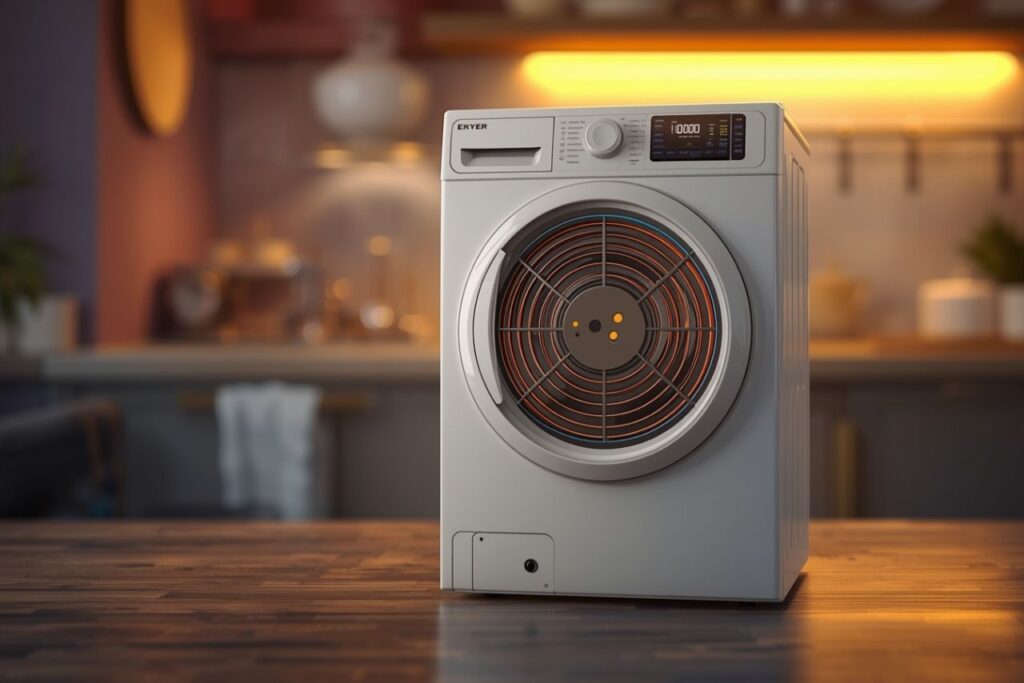
When an Amana electric dryer runs but produces little or no heat, the most reliable troubleshooting sequence is: confirm correct power supply (a dryer can tumble on 120V while the heater needs full supply), remove airflow restrictions (lint filter, vent, blower path), then electrically test the heating circuit as a system—heating element assembly, thermal fuse/thermal cutoffs, thermostats, and wiring connections. Because a heating element is an **assembly** (conductive alloy plus insulation/support framework and terminals), “no heat” is frequently caused by a failed safety device, a loose/burned connector, or overheating from poor airflow—not only a broken coil.
Helpful product context: Heating Element, Heating Element manufacturer, Heating Element Factory, Die Casting Heating Solutions.
- Fast triage: isolate airflow vs. electrical causes
- Safety rules and access basics
- Step 1 — Confirm correct power supply
- Step 2 — Fix airflow first (most common root cause)
- Step 3 — Test the heating circuit (element, fuses, thermostats, wiring)
- Step 4 — Verify replacement element specifications before installing
- Charts & tables: symptoms, causes, and test outcomes
- FAQ (6 questions)
- References and outbound links
Fast triage: isolate airflow vs. electrical causes
A structured approach prevents unnecessary part swapping. The objective is to determine whether heat is being generated but not delivered (airflow/venting problem), or whether the heater circuit is not energizing (electrical problem).
Section summary
Triage should separate “heat not produced” from “heat produced but trapped,” then proceed in the order: power → airflow → electrical tests.
Safety rules and access basics
Dryer heater circuits operate at high current. Troubleshooting requires de-energizing the appliance and preventing accidental contact with live terminals. Panels should remain installed for normal operation; test runs should be brief and controlled.
Safety essentials
- Disconnect power at the plug or the dedicated breaker before opening panels.
- Do not bypass safety devices (thermal fuse/high-limit thermostats).
- Allow the heater housing to cool before handling.
- If wiring insulation is charred or a terminal is melted, stop and repair wiring/terminals before energizing.
Section summary
Proper lockout and refusal to bypass protective devices are mandatory for safe diagnosis.
Step 1 — Confirm correct power supply
A common “no heat” scenario is partial supply: the motor/control can run while the heater cannot energize at full requirement. The correct diagnostic is to verify supply integrity at the outlet/breaker (qualified personnel may measure across supply legs as applicable).
| Check | What it confirms | If it fails |
|---|---|---|
| Dedicated breaker/fuses | Both supply paths are present | Reset/replace as appropriate; if repeated trips, investigate shorts or wiring faults |
| Outlet/cord condition | No burned prongs, loose receptacle | Repair outlet/cord; overheating connections can mimic heater failure |
| Terminal block (if accessible) | No loose lugs/heat discoloration | Tighten/repair; loose connections generate heat and voltage drop |
Section summary
Confirming full supply prevents misdiagnosing a healthy heating element as failed.
Step 2 — Fix airflow first (most common root cause)
Heating elements are sensitive to their environment. Engineering guidance emphasizes that heater life depends on conditions around the element (airflow, contaminants, and heat transfer). In a dryer, lint and vent restriction raise element temperature, forcing safety devices to open and accelerating burnout.
Airflow restoration checklist
Why airflow problems cause “no heat”
Many dryers protect against overheating by opening a thermal fuse or high-limit thermostat. A restricted vent elevates internal temperatures; the safety device trips, and the dryer then runs without heat. If the vent issue is not corrected, a replacement element or fuse may fail again.
Section summary
Airflow restrictions are both a performance issue and a reliability issue; they can directly lead to a “no heat” condition through safety cutoffs.
Step 3 — Test the heating circuit (element, fuses, thermostats, wiring)
After power and airflow are addressed, the heating circuit should be tested with a multimeter. The heater system includes the heating element, safety devices, and wiring. Industry engineering references define a heating element as more than a coil: it includes insulating framework and lead connectors, so terminals and supports must be treated as failure points.
Core components to test
| Component | Role | Typical failure signal |
|---|---|---|
| Heating element assembly | Converts electrical energy to heat (resistive/Joule heating) | Open circuit; visible break; coil sag/contact hot spots |
| Thermal fuse / thermal cutoff | One-time or resettable overtemperature protection | Open circuit; no heat even with good element |
| High-limit thermostat | Limits heater housing temperature | Stuck open (no heat) or cycling too early (weak heat) |
| Wiring and terminals | Delivers current safely to the heater | Burned spades, loose fit, arcing marks, intermittent heat |
Connection quality matters
Manufacturer-style service guidance for heating elements emphasizes tight wire connections and verifying correct replacement ratings. Even with a new element, a loose connector can create resistive heating at the terminal, leading to repeat failures or unsafe operation.
Decision logic (service-friendly sequence)
- With power OFF, inspect heater housing for broken coil, sagging, or contact marks.
- Check terminals: discoloration, looseness, melted insulation; replace damaged connectors.
- Test continuity of thermal fuse/thermal cutoff and thermostats (per model layout).
- If all safety devices are closed/continuous, test the element for continuity (open = replace).
- After repairs, restore covers and verify airflow before the first heat run.
Section summary
Electrical troubleshooting should treat the heater as a circuit: safety devices and terminals fail as often as the element itself, especially after overheating.
Step 4 — Verify replacement element specifications before installing
Correct replacement means more than “fits physically.” Service guidance for other heating appliances explicitly instructs verifying voltage and wattage from the data plate. The same discipline applies to dryers: the replacement element must match the dryer’s designed electrical load and mounting geometry.
| Spec to verify | Why it matters | What to document |
|---|---|---|
| Voltage & wattage | Defines heat output and safe electrical loading | Photo of data plate + part label/packaging |
| Terminal style | Prevents loose/forced connections that arc | Terminal width/type; wire gauge compatibility |
| Housing/interface | Ensures clearances and correct airflow path | Mount points, element orientation, insulators |
| Supply quality indicators | Reduces early failure risk | Supplier reputation; compliance claims where applicable |
Note: Retail listings for other electric heating elements commonly highlight wattage, materials, ingress protection, UL approval, and warranty. Even if those fields differ for dryer parts, the takeaway is consistent: verify critical specs and keep documentation.
Section summary
Specification discipline (rating + interface + documentation) reduces mis-installs and repeat callbacks.
Charts & tables: symptoms, causes, and test outcomes
Chart 1 (table): Symptom → highest-probability cause mapping
| Observed symptom | Highest-probability cause | First corrective action |
|---|---|---|
| Tumbles but never heats | Open thermal fuse/cutoff, open element, or power supply issue | Confirm supply; then continuity-test fuse/cutoff and element |
| Heats briefly then stops | Airflow restriction causing high-limit cycling | Clean vent path, blower area, lint housing |
| Burning smell / very hot cabinet | Lint accumulation or connector overheating | Stop use; clean; inspect terminals and heater housing |
| Repeated element failures | Chronic overheating (vent), coil contact/sag, poor connectors | Correct airflow and replace damaged terminals; ensure element is properly supported |
Chart 2 (table): Test result interpretation
| Test outcome (power OFF) | Interpretation | Next step |
|---|---|---|
| Element shows open circuit | Element failed (break/hot spot damage) | Replace element; also inspect airflow and terminals to avoid repeat failure |
| Thermal fuse/cutoff open | Overtemperature event occurred | Replace device and correct vent restriction before using |
| Terminals discolored/loose | High-resistance connection heating | Replace connectors and ensure tight fit; inspect wire condition |
| All components test good | Control/relay/timer issue or intermittent wiring fault possible | Escalate to model-specific diagnostics or qualified technician |
Chart 3 (table): Heating element design context (why it matters in dryers)
| Engineering concept | Practical meaning in a dryer | Technician takeaway |
|---|---|---|
| Heating element = assembly | Coil plus insulating/support framework and terminals | Inspect supports and terminals, not only the coil |
| Supported vs. suspended behavior | Sag/contact can create hot spots and shorts | Confirm the element sits centered and cannot touch the housing |
| Environment/contaminants | Lint acts like an insulating contaminant and can ignite/overheat surfaces | Clean lint thoroughly; correct venting before replacing parts |
| Watt density and temperature | Restricted airflow raises element temperature and shortens life | Treat airflow as the element’s “cooling system” |
Section summary
The tables above provide a repeatable diagnostic map: symptoms guide the first check, test outcomes define the repair, and engineering context explains repeat failures.
FAQ
1) Can a dryer tumble normally even if it cannot heat?
Yes. The motor/control can operate while the heater circuit is disabled by a supply issue or an open safety device. Power verification is therefore a first-step diagnostic.
2) Should the vent be cleaned before replacing heating parts?
Yes. Airflow restriction is a leading cause of overheating and repeated failures. Correcting venting first helps prevent replacing a fuse or element only to have it fail again.
3) Is it safe to bypass a thermal fuse “just to confirm the element works”?
No. Thermal protection devices exist to prevent unsafe overheating. Bypassing them can create fire risk and additional component damage.
4) Why do terminals and connectors matter so much?
A loose connector increases resistance at the contact point, producing heat at the terminal itself. This can cause arcing, melted wiring, and intermittent or total loss of heat.
5) What does “verify voltage and wattage” mean for dryer parts?
It means the replacement element must match the dryer’s designed electrical rating and interface. Service guidance in other appliances explicitly calls for checking the data plate for voltage and wattage to ensure correct replacement.
6) When should troubleshooting be escalated to a professional?
If breakers trip repeatedly, wiring is burned, test results indicate a control/relay issue, or measurement at live supply is required, a qualified technician should perform the remaining diagnostics and repairs.
Conclusion
A “no heat” complaint in an Amana electric dryer should be approached as a system problem rather than a single-part assumption. The most effective sequence is to confirm correct power supply, restore airflow by removing lint and vent restrictions, then test the entire heater circuit—heating element assembly, safety devices, and wiring/terminals. This approach aligns with engineering guidance that heating elements are assemblies operating within environmental constraints, and with service best practices that emphasize correct specifications and tight connections.
References and outbound links
Heating element engineering concepts (element as assembly; supported/suspended/embedded frameworks; alloys; environment/contaminants; watt density; lifecycle considerations):
https://tutco.com/conductive/heating-elements
“Verify replacement” and tight-connection discipline (used as general safety-method parallels for heater servicing):
https://www.whirlpoolwaterheaters.com/support/help/element-was-out-of-range/24
Product-family context for heating components (tubes/plates/films; integrated solutions):
https://jinzho.com/
https://jinzho.com/product-category/heating-element/
https://jinzho.com/product-category/heating-element/heating-tubes/
https://jinzho.com/product-category/heating-element/heating-plate/
https://jinzho.com/product-category/heating-element/heating-film/
https://jinzho.com/product-category/die-casting-heating-solutions/
https://jinzho.com/product-category/electric-heater-parts/electric-boiler-heater/
Example specification-style listing (wattage/materials/IP/UL/warranty) used to reinforce spec-check habits:
https://usa.hudsonreed.com/1000-plug-in-watt-electric-heating-element-76309
Disclosure: This content is educational and model-agnostic. Exact component locations and test points vary across Amana dryer models. Manufacturer service documentation should be used for model-specific disassembly and diagnostics.