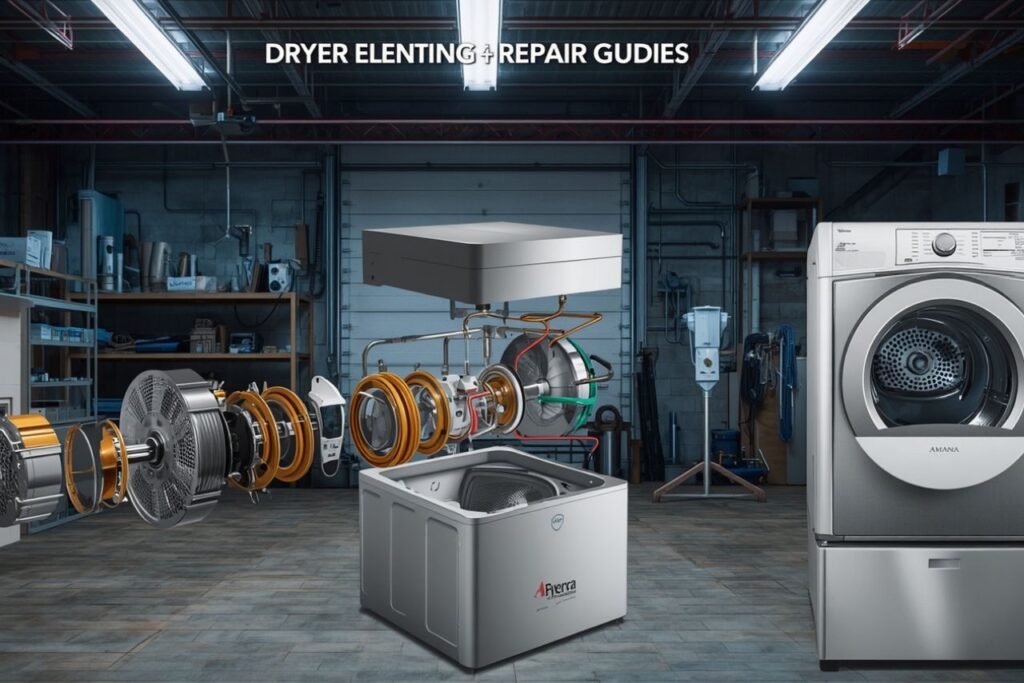
Repairing a no-heat or poor-heat Amana or Roper electric dryer typically centers on the heating element circuit as a whole: the heating element assembly, airflow path, thermal cutoffs/thermostats, and wiring terminals. A durable repair follows a disciplined sequence—verify the correct replacement part rating and fit, de-energize the unit, document wiring, remove lint restrictions that can overheat the element, replace the element assembly without deforming supports, restore all covers, then run a controlled heat test. Because a heating element is an **assembly** (conductive alloy plus insulating/support framework and terminals), connection quality and operating environment heavily affect service life.
Internal references: Heating Element, Heating Element manufacturer, Heating Element Factory, Die Casting Heating Solutions.
- Scope: what this guide covers (and what it does not)
- Fast diagnosis: symptoms, likely causes, and decision path
- Safety and preparation (non-negotiables)
- Part verification: correct rating, correct geometry, correct connectors
- Heating element replacement: step-by-step (Amana/Roper patterns)
- Related repairs that prevent repeat failures
- Charts & tables (tests, specs, airflow, costs)
- FAQ (6 questions)
- References and outbound links
Scope: what this guide covers (and what it does not)
This guide addresses electric dryers sold under Amana and Roper lines where the heating system uses a resistive heating element in a heater box/duct. It focuses on best-practice field repair: diagnosing “no heat,” replacing the heating element assembly, and preventing repeat failures caused by airflow restriction or weak terminals.
Not covered
- Gas dryer burner/igniter repairs (different system)
- Control board reprogramming or complex electrical troubleshooting beyond element circuit checks
- Model-specific disassembly drawings (service manual should be used for exact panel locations)
Section summary
The content is optimized for electric dryer heating-element repairs across common chassis patterns, while acknowledging model-by-model access differences.
Fast diagnosis: symptoms, likely causes, and decision path
In practice, “no heat” is rarely solved by swapping parts at random. A heating element’s performance depends on electrical supply, safety devices, airflow, and mechanical support. Engineering guidance emphasizes that heating elements are designed components whose material properties and environment influence reliability (including oxidation and temperature cycling).
Decision path (practical)
- Confirm dryer type: electric vs gas.
- Confirm airflow: lint screen, lint housing, vent run, outside hood.
- Inspect heater housing for lint accumulation and connector heat damage.
- If the element is open or physically broken, replace the element assembly.
- If safety devices are open, determine whether airflow/overheat caused the trip before returning to service.
Section summary
Symptom-led diagnosis reduces unnecessary parts replacement and targets the most repeatable causes: airflow restriction and degraded terminals.
Safety and preparation (non-negotiables)
Dryer heater circuits carry high current. Repair must begin with full power isolation and a controlled work area. A “safe sequencing” mindset is essential: manufacturers of other heating equipment explicitly warn against energizing elements under unsafe conditions; for dryers, the comparable hazards are exposed terminals, missing covers, or operating with blocked airflow.
Mandatory safety steps
- Unplug the dryer or switch off the dedicated breaker (do not rely on the control panel).
- Verify the heater duct is cool to the touch before handling.
- Do not bypass thermal fuses/thermostats for “testing.”
- Reinstall covers before running heat tests to reduce shock/fire risk.
Section summary
Safe repairs are sequence-driven: de-energize, cool-down, do the work, restore covers, then test.
Part verification: correct rating, correct geometry, correct connectors
Heating elements are not interchangeable purely by appearance. Engineering references describe a heating element as an assembly of conductive alloy plus insulating/support structure and terminals. Therefore, verification must cover electrical rating and mechanical fit.
What “correct” means in the field
- Electrical rating: match expected voltage/wattage range for the dryer’s heater circuit design.
- Physical geometry: the coil frame must sit centered with proper clearance so it cannot sag into the housing.
- Terminal style: spade/flag terminals must match harness connectors.
- Quality and compliance signals: reputable sourcing and clear spec sheets reduce mismatch risk.
Spec-sheet discipline (why it matters)
Product listings for heating elements in other applications commonly present fields such as wattage, materials, ingress protection, approvals, and warranty. Even when the application differs, the habit is valuable: verifying specifications reduces the chance of installing a misrated component.
Section summary
Verification is a three-part check: electrical rating, mechanical clearance/support, and correct connector interface.
Heating element replacement: step-by-step (Amana/Roper patterns)
Access varies by model (rear panel vs front/lower panel). The steps below describe a repeatable best-practice sequence that applies across common Amana/Roper electric dryer layouts.
Step 1 — Access the heater housing
- Move the dryer to provide workspace behind or in front, depending on access design.
- Remove the appropriate panel to reach the heater box/duct assembly.
- Use a vacuum/brush to remove loose lint before disturbing wiring.
Step 2 — Document and disconnect wiring
- Photograph all connections (element terminals and nearby thermostats/thermal cutoffs).
- Remove spade connectors by pulling the connector body—not the wire.
- Inspect for discoloration, looseness, or melted insulation; replace damaged terminals.
Step 3 — Remove the old element assembly
- Unfasten the heater cover/retainer.
- Withdraw the element carefully to avoid bending the support structure.
- Inspect the heater box for burn marks indicating coil-to-housing contact.
Step 4 — Install the new element (centered, supported, and clear)
Supported/suspended/embedded frameworks affect heat transfer and reliability. Dryer elements are typically supported within a housing and depend on airflow for cooling. The installation must preserve support and clearance to avoid hot spots and shorts.
- Set the element into place so the coil sits centered in the heater duct and is well supported.
- Reinstall screws without warping the frame.
- Reconnect wiring per photos; ensure tight connections.
Step 5 — Reassemble and perform a controlled heat test
- Reinstall all covers and panels (do not test with exposed terminals).
- Confirm vent hookup is not crushed and outside hood is clear.
- Run a short timed heat cycle and confirm warm exhaust with strong airflow.
Section summary
The repair succeeds when the element is installed as an intact assembly, connectors are tight, lint is removed, airflow is restored, and heat output is confirmed under controlled conditions.
Related repairs that prevent repeat failures
Repeat heating element failures are often not “bad luck.” They are commonly driven by environmental factors and operating conditions: airflow restriction and contamination (lint), poor terminals, or overheating cycles. Engineering references discuss how environment and contaminants can shorten heater life.
Airflow restoration (priority one)
- Clean lint screen and lint housing thoroughly.
- Inspect the entire vent run for kinks/crushing and lint build-up.
- Verify the outside hood flap opens freely.
Terminal and harness integrity
A loose terminal increases contact resistance, which creates localized heating at the connector. That heat can discolor terminals, deform plastic housings, and contribute to recurring no-heat complaints.
Thermal safety devices (do not ignore “why” they opened)
If a thermal cutoff or fuse is found open, it is essential to identify the overheat cause (often airflow) before returning the dryer to service.
Section summary
Preventive actions—vent cleaning, connector replacement, and overheat root-cause correction—are the difference between a one-time fix and repeat breakdowns.
Charts & tables (tests, specs, airflow, costs)
Table 1: Quick checks (field-practical)
| Check | What it detects | Why it matters |
|---|---|---|
| Airflow at exhaust | Vent restriction / lint blockage | Restricted airflow can overheat the element and trip limits |
| Visual element inspection | Broken coil, coil-to-housing contact marks | Physical damage often confirms replacement need |
| Connector condition | Overheated terminals, looseness | Poor connections can mimic element failure and cause repeat issues |
| Continuity/resistance test (power off) | Open element or open safety device | Confirms whether the heating circuit is intact |
Table 2: Post-repair symptom map
| After repair | Likely cause | Recommended next step |
|---|---|---|
| Breaker trips on heat | Short to chassis, misrouted wiring, wrong part | Stop use; inspect for pinched wires; professional evaluation |
| Heat cycles rapidly | High-limit cycling from airflow restriction | Clean vent run and outside hood; remove lint in ducting |
| Burning smell | Lint scorching, overheated connector | Stop and inspect heater box and terminals; correct airflow and replace terminals |
| Still no heat | Open safety device, wiring mismatch, supply issue | Re-check wiring photos; test cutoffs/thermostats; verify supply |
Table 3: Heating element “as an assembly” (engineering translation for repair)
| Engineering concept | What it means on a dryer repair | Failure mode if ignored |
|---|---|---|
| Element = alloy + insulating framework + terminals | Do not focus only on the coil; ensure supports and terminals are intact | Sags/shorts, hot spots at terminals, repeat failures |
| Environment/contaminants affect life | Lint and restricted airflow raise element temperature | High-limit trips, coil oxidation/overheat damage |
| Supported vs embedded heat transfer | Dryer elements rely heavily on convection (airflow) for cooling | Overheating when airflow is reduced |
Table 4: “Hidden costs” checklist (service perspective)
Heater engineering guidance notes that costs include more than the part itself—installation time, assembly difficulty, and field reliability drive total cost.
| Cost driver | Typical trigger | How to reduce it |
|---|---|---|
| Repeat service calls | Vent restriction not corrected | Clean vent path and lint housing during the first repair |
| Connector rework | Reusing overheated spade terminals | Replace heat-damaged terminals proactively |
| Downtime and customer dissatisfaction | Under-diagnosis (element replaced but cutoff still open) | Verify circuit continuity and safety devices before reassembly |
Section summary
Tables translate engineering principles—assembly design, environment, watt density/temperature sensitivity—into field checks that reduce repeat failures.
FAQ (6 questions)
1) Are Amana and Roper dryer heating elements the same?
They can be similar across shared chassis families, but they should not be assumed interchangeable. Correct replacement requires model-based verification of fit and electrical rating.
2) Why does a dryer heating element burn out repeatedly?
The most common causes are restricted airflow (lint/vent issues) and poor electrical connections at terminals. Both conditions raise operating temperature and accelerate failure mechanisms.
3) Should a thermal fuse be bypassed to “see if it heats”?
No. Thermal protection is a safety system. Bypassing can create fire risk and can mask the underlying problem, typically airflow restriction.
4) What should be checked before ordering a replacement element?
Model/serial identification, element geometry and terminal style, and the expected electrical rating. Using spec-sheet discipline (wattage/materials/approvals when available) reduces mismatch risk.
5) Does vent cleaning really affect the heating element?
Yes. Dryer elements rely on convection and airflow to carry heat away. Restricted airflow elevates element temperature and can trigger high-limit cycling or failure.
6) How long should it take to verify a successful repair?
A controlled heat test can confirm warm exhaust and strong airflow within minutes. However, stable performance over a full cycle depends on vent integrity and proper reassembly.
Conclusion
A reliable Amana or Roper electric dryer heating repair is a system-level service: replace the heating element assembly correctly, restore and verify airflow, ensure terminals are tight and undamaged, and confirm safety devices are intact and not being forced into operation. Treating the element as an engineered assembly—plus treating the vent path as the heater’s cooling system—reduces repeat failures, prevents nuisance high-limit cycling, and improves overall drying performance.
References and outbound links
Heating element engineering concepts (element as assembly, alloys, supported/suspended/embedded frameworks, environment/contaminants, watt density, hidden costs):
https://tutco.com/conductive/heating-elements
Safety sequencing and “verify correct replacement” principle (used as a safety-method parallel):
https://www.whirlpoolwaterheaters.com/support/help/element-was-out-of-range/24
Product-family context (heating tubes/plates/films; heating element portfolio and manufacturing framing):
https://jinzho.com/
https://jinzho.com/product-category/heating-element/
https://jinzho.com/product-category/heating-element/heating-tubes/
https://jinzho.com/product-category/heating-element/heating-plate/
https://jinzho.com/product-category/heating-element/heating-film/
https://jinzho.com/product-category/electric-heater-parts/electric-boiler-heater/
https://jinzho.com/product-category/die-casting-heating-solutions/
Example spec-style element listing (wattage, materials, ingress protection, approvals, warranty) used to reinforce specification verification habits:
https://usa.hudsonreed.com/1000-plug-in-watt-electric-heating-element-76309
Disclosure: This pillar guide is educational and not a substitute for the model-specific service manual. Panel access, fastener locations, and component layouts vary by Amana and Roper dryer models.