Sauna Heizelement Die Technologie im Jahr 2025 verändert das Saunaerlebnis durch fortschrittliche intelligente Steuerungen, umweltfreundliche Materialien und Energieeffizienz. Unternehmen wie Jinzhong Elektroheizung führen den Weg als Hersteller von Heizelementen, mit Fokus auf Innovation für Heizelemente für Haushaltsgeräte. Moderne Sauna-Innovationen umfassen nun Hybrid- und intelligente Systeme, die präzise Temperaturregelung, schnelles Aufheizen und nahtlose Integration in die Smart-Home-Technologie ermöglichen. Die wachsende Nachfrage nach immersiven Wohlfühlanwendungen treibt diesen Wandel voran, wobei Hybridheizgeräte und Infrarottechnologie den Markt neu gestalten. Fortschritte bei Heizelementen bieten den Nutzern eine maßgeschneiderte Saunaumgebung und setzen neue Maßstäbe für Entspannung.
Wichtige Trends bei Sauna-Heizelementen für 2025

Die Saunaindustrie im Jahr 2025 zeigt einen raschen Wandel, angetrieben durch fortschrittliche Technologie, nachhaltige Materialauswahl und einen Fokus auf Energieeffizienz und Materialien. Diese Trends prägen das Design der nächsten Generation von Sauna-Heizelementen und bieten den Nutzern intelligentere, nachhaltigere und energieeffizientere Heizsysteme.
Fortschrittliche Materialien im Design von Sauna-Heizelementen
Graphen-Heizelemente
Keramik-Verbundtechnologie
Infrarot-Heizpaneele
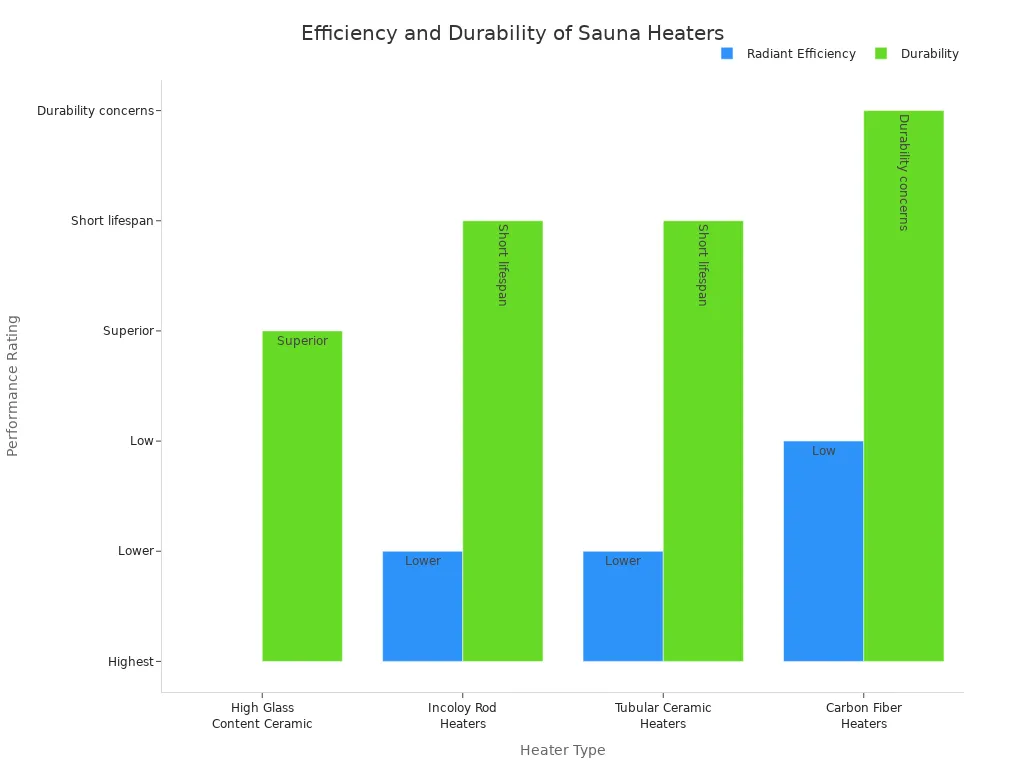
haben aufgrund ihrer Fähigkeit, bei niedrigeren Temperaturen zu arbeiten und gleichzeitig therapeutische Vorteile zu bieten, an Popularität gewonnen. Diese Paneele verwenden fortschrittliche Materialien wie Kohlefaser in Luftfahrtqualität und mikrokristallines Glas, die eine gleichmäßige Wärmeverteilung und niedrige elektromagnetische Feldemissionen (EMF) gewährleisten. Die folgende Tabelle vergleicht den Strahlungswirkungsgrad und die Haltbarkeit mehrerer Sauna-Heizelement Typen: bleibt das am häufigsten verwendete Material für Sauna-Heizelemente im Jahr 2025. Es bietet Haltbarkeit, Korrosionsbeständigkeit und einfache Wartung. Modelle wie der Harvia Cilindro Pro und der HUUM Hive nutzen Edelstahl für robuste Leistung und Langlebigkeit. Diese Eigenschaften verbessern die Wärmespeicherung und Dampfqualität und unterstützen energieeffiziente Heizsysteme.
Edelstahl Intelligente und vernetzte Innovationen bei Sauna-Heizelementen.
IoT-Integration für die Heizungssteuerung
steht an der Spitze der intelligenten Saunatechnologie. Digitale Thermostate und KI-gestützte Funktionen ermöglichen Echtzeitanpassungen von Temperatur und Luftfeuchtigkeit. Nutzer profitieren von der Fernsteuerung über mobile Apps oder intelligente Lautsprecher, was das Saunaerlebnis optimiert. IoT-fähige Systeme sammeln Echtzeitdaten, synchronisieren sich mit der Cloud und liefern Einblicke in Nutzungsgewohnheiten, was vorausschauende Wartung und Energieoptimierung unterstützt.
IoT-Integration. KI-gesteuerte Funktionen.
- personalisieren Heizpläne basierend auf physiologischen Reaktionen. Die Integration in Smart-Home-Systeme ermöglicht Sprachsteuerung und Automatisierung.
- Digitale Steuerungssysteme optimieren den Energieverbrauch durch intelligente Heizungsanpassung.
- App-basierte und Fernbedienungen.
App-basierte und Fernbedienungen sind im modernen Design von Sauna-Heizelementen zum Standard geworden. Diese Steuerungen ermöglichen es den Nutzern, Temperatur, Luftfeuchtigkeit und Sitzungsdauer von überall aus zu verwalten. Die Fernverwaltung unterstützt Firmware-Updates und Wartungswarnungen, um optimale Leistung und Energieeffizienz zu gewährleisten. Kompakte intelligente Saunadesigns, wie KI-gestützte Heimtherapiekabinen, sind auf kleine Wohnräume zugeschnitten und bieten dennoch personalisierte Therapie.
KI-gestützte Heizpläne.
KI-gestützte Heizpläne
maximieren die Wohlfühlvorteile und minimieren den Energieverbrauch. Diese Systeme passen sich den Umgebungsbedingungen und Benutzerpräferenzen an und regulieren die Heizparameter automatisch. Die Integration in häusliche Energiesysteme ermöglicht den Saunabetrieb in Zeiten reichlich vorhandener erneuerbarer Energie oder außerhalb der Spitzenzeiten, was die Energieeffizienz weiter verbessert. Fortschrittliche Gesundheitsüberwachung mit biometrischen Sensoren verfolgt Vitalfunktionen und passt die Saunaeinstellungen in Echtzeit an, was Sicherheit und Komfort erhöht. Nachhaltige und energieeffiziente Designs in der Saunabeheizung.
Solarbetriebene Sauna-Heizelemente
Solarbetriebene Sauna-Heizelemente spiegeln das Engagement der Branche für Nachhaltigkeit wider. Diese Systeme nutzen erneuerbare Energie und verringern die Abhängigkeit von traditionellen Stromquellen. Die Integration mit intelligenten Steuerungen und programmierbaren Timern ermöglicht es den Nutzern, den Energieverbrauch zu optimieren und die Betriebskosten zu senken. Die Solarkompatibilität unterstützt den breiteren Trend zu nachhaltigen und energieeffizienten Designs.
Hochleistungsdämmung und Türdichtung.
Hochleistungsdämmung und Türdichtung
spielen eine entscheidende Rolle bei der Energieeffizienz und Materialauswahl. Hochwertige Isolierung in Saunawänden, -böden und -decken speichert Wärme und senkt den Energieverbrauch. Ordnungsgemäß abgedichtete Türen und Fenster verhindern Wärmeverluste und stellen sicher, dass das Sauna-Heizelement effizient arbeitet. Lüftungssysteme mit Wärmerückgewinnung erfassen thermische Energie aus der Abluft, erwärmen die Zuluft vor und verbessern so die Effizienz weiter. Umweltfreundliche Fertigung und recycelte Materialien.
Umweltfreundliche Fertigung und die Verwendung von recycelten Materialien sind zentral für die nachhaltige Materialauswahl geworden. Hersteller bevorzugen Bambus, modulare Vorfertigung und recycelte Metalle, um die Umweltbelastung zu reduzieren. Diese Praktiken entsprechen dem regulatorischen Druck und der Verbrauchernachfrage nach nachhaltigen Produkten. Die folgende Tabelle vergleicht die Energieverbrauchsstatistiken moderner Sauna-Heizelemente mit traditionellen Modellen:
Heizleistung (kW)
| Saunatyp | Aufheizzeit (Minuten) | Energieverbrauch beim Aufheizen (kWh) | Energieverbrauch pro 30-minütiger Sitzung (kWh) | Jährliche Stromkosten (3x wöchentliche Nutzung) | Moderne Infrarot-Sauna-Heizelemente arbeiten mit niedrigeren Leistungsstufen und heizen schneller auf, was zu |
|---|---|---|---|---|---|
| Traditioneller elektrischer | 6-9 | 30-45 | 3-7 | 1.5-2.5 | $95-$130 |
| Infrarotsauna | 1.5-2.5 | 10-15 | 0.25-0.5 | 0.5-0.8 | $30-$45 |
etwa einem Drittel des Stromverbrauchs im Vergleich zu traditionellen Elektroheizgeräten führt. Faktoren wie Dämmqualität, Saunagröße und Nutzerverhalten beeinflussen ebenfalls den Energieverbrauch. Intelligente Saunatechnologie, einschließlich Timer und Fernbedienungen, optimiert die Energieeffizienz weiter. Regelmäßige Wartung und richtige Dimensionierung.
Tipp: des Sauna-Heizelements gewährleisten Spitzenleistung und verlängern die Lebensdauer der Geräte. Die Konvergenz fortschrittlicher Materialien, intelligenter Technologie und nachhaltiger sowie energieeffizienter Designs definiert die führenden Trends bei Sauna-Heizelementen für 2025. Diese Innovationen bieten überlegene Leistung, geringeren Energieverbrauch und ein personalisierteres Saunaerlebnis.
Hybride Wärmeerlebnisse und Wellness-Integration.
Kombination von traditioneller und Infrarot-Beheizung
Hybride Sauna-Heiztechnologie hat sich als führender Trend im Jahr 2025 etabliert. Hersteller kombinieren nun traditionelle und Infrarot-Heizelemente in einem einzigen Gerät. Dieser Ansatz ermöglicht es den Nutzern,
ihr Wärmeerlebnis anzupassen und von beiden Heizmethoden zu profitieren. Hybridsaunen arbeiten bei moderaten Temperaturen, typischerweise zwischen 120°F und 150°F. Nutzer können zwischen trockener Infrarotwärme und feuchter Dampfwärme wechseln und erhalten so eine Flexibilität, die bei Einzelsaunen nicht gegeben ist. Hybridsaunen liefern die.
- Hybrid saunas deliver the kombinierte gesundheitliche Vorteile sowohl traditioneller als auch Infrarot-Heizung.
- Sie unterstützen Muskelentspannung, verbesserte Atemwegsgesundheit, gestärkte Immunfunktion und bessere Durchblutung.
- Die Technologie ermöglicht ein schnelleres Einsetzen des Schwitzens, was die Hautgesundheit verbessern und Stress reduzieren kann.
- Hybridmodelle umfassen oft erweiterte Funktionen wie Rotlichttherapie und Chromotherapie, die das Wohlbefinden weiter steigern.
- Der Komfort, beide Heizarten in einem Gerät zu vereinen, ermöglicht ein personalisiertes Wellness-Erlebnis.
Ein Vergleich der Benutzerzufriedenheit über verschiedene Saunatypen hinweg hebt die Vielseitigkeit und den Komfort von Hybridmodellen hervor:
| Saunatyp | Intensität der Wärme | Typische Sitzungsdauer | Benutzerkomfort und Zugänglichkeit | Soziale vs. Einzelnutzung | Highlights der Benutzerzufriedenheit |
|---|---|---|---|---|---|
| Traditionell | Hoch (150–195 °F) | Kurz (15–20 Minuten) | Intensive Hitze, herausfordernd für hitzeempfindliche Benutzer | Größer, sozial, kulturell, gemeinschaftlich | Bevorzugt für authentische, intensive Hitze und soziale Bindung |
| Infrarot | Niedriger (120–140 °F) | Länger (30–45 Minuten) | Sanftere Hitze, leichteres Atmen, weniger Gesichtsbeschwerden | Kleiner, privat, geeignet für Einzelentspannung | Bevorzugt für Komfort, längere Sitzungen und Hitzeempfindlichkeit |
| Hybride | Mittel (120–150 °F) | Variabel | Kombiniert traditionelle und Infrarot-Heizung, anpassbare Hitze | Vielseitig, unterstützt sowohl soziale als auch Einzelnutzung | Geschätzt für Vielseitigkeit, erweiterte Funktionen und Komfort |
Die Hybrid-Saunatechnologie unterstützt sowohl soziale als auch Einzelnutzung und ist somit eine flexible Wahl für unterschiedliche Benutzerbedürfnisse. Die Möglichkeit, Hitze- und Luftfeuchtigkeitsniveaus anzupassen, erhöht die Gesamtzufriedenheit und entspricht aktuellen Trends im personalisierten Wellness.
Integration von Salztherapie und Aromatherapie
Aktuelle Trends in der Sauna-Heiztechnologie umfassen die Integration von Salztherapie und Aromatherapie. Die Salztherapie, auch bekannt als Halotherapie, beinhaltet das Verteilen feiner Salzpartikel in der Saunaluft. Dieser Prozess kann die Atemwegsgesundheit und das Hautwohlbefinden unterstützen. Aromatherapie-Systeme geben ätherische Öle in die erhitzte Luft ab und schaffen eine beruhigende und therapeutische Umgebung.
- Salztherapie kann helfen, die Atemwege zu befreien und Entzündungen zu reduzieren.
- Aromatherapie kann Entspannung und Stressabbau fördern.
- Viele Hybrid-Saunamodelle verfügen jetzt über eingebaute Spender für sowohl Salz als auch ätherische Öle.
Diese Wellness-Integrationen verwandeln die Saunasitzung in ein multidimensionales Erlebnis, das sowohl die körperliche als auch die geistige Gesundheit unterstützt.
Sanfter Dampf und multisensorische Funktionen
Hersteller haben auf die Verbrauchernachfrage nach Komfort reagiert, indem sie sanften Dampf und multisensorische Funktionen in moderne Sauna-Heizsysteme integriert haben. Dampfgeneratoren erzeugen eine feuchte Umgebung, die Gelenke beruhigt und Muskeln entspannt. Multisensorische Funktionen wie Chromotherapie-Beleuchtung und immersive Soundsysteme steigern die Entspannung weiter.
Hinweis: Multisensorische Saunatechnologie kann die Schlafqualität verbessern, indem sie den Körper entspannt und die Temperatur reguliert.
Hybrid-Sauna-Heizelemente bieten jetzt ein umfassendes Wellness-Erlebnis, das Hitze, Feuchtigkeit, Licht und Ton kombiniert. Diese Funktionen spiegeln die neuesten Trends in der intelligenten Wellness-Technologie wider.
Verbesserte Sicherheitsfunktionen in der Sauna-Heizelementtechnologie
Automatische Abschaltung und Überhitzungsschutz
Sicherheit bleibt eine oberste Priorität in der Sauna-Heiztechnologie. Automatische Abschalt- und Überhitzungsschutzsysteme sind im Jahr 2025 zum Standard geworden. Diese Funktionen überwachen die Temperatur und schalten das Heizelement automatisch ab, wenn es sichere Grenzwerte überschreitet. Dies reduziert das Risiko von Brandgefahren und elektrischen Störungen.
- ETL-, UL-, CSA-, CE- und TÜV-Zertifizierungen bestätigen die Einhaltung internationaler Sicherheitsstandards.
- Regelmäßige elektrische Inspektionen durch lizenzierte Fachkräfte tragen zur Aufrechterhaltung von Sicherheit und Zuverlässigkeit bei.
UL-Zertifizierung, insbesondere, zeigt an, dass elektrische Saunakomponenten strenge Sicherheitstests bestanden haben. Diese Zertifizierung reduziert das Risiko von Stromschlägen und Brandgefahren und sorgt für ein beruhigendes Gefühl bei den Benutzern.
Fortschrittliche Temperaturregelungssysteme
Moderne Sauna-Heiztechnologie verwendet fortschrittliche Temperaturregelungssysteme, um konstante und sichere Hitzewerte aufrechtzuerhalten. Der neueste UL 60335-2-53 Standard, der den älteren UL 875 ersetzt, entspricht internationalen Sicherheitsrichtlinien und verbessert die Benutzerfreundlichkeit.
| Aspekt | UL 875 (Alter Standard) | UL 60335-2-53 (2025 Standard) |
|---|---|---|
| Hochtemperaturauslösung | Niedrigerer Schwellenwert (~360 °F/182 °C), konservativ zum Schutz von Verkabelung und Komponenten | Höherer Schwellenwert, Reduzierung unnötiger Auslösungen und Verbesserung der Benutzerfreundlichkeit |
| Position des Thermostatsensors | Direkt über dem Heizgerät, 15 cm von der Decke entfernt (ungenau für Raumtemperatur) | Über dem Sitzbereich (europäischer Stil), genauere Temperaturregelung |
| Anforderungen an die Luftentlüftung | Erforderlicher Zuluftkanal hinter oder unter dem Heizgerät zur Kühlung des Sensors | Flexiblere Lüftungspositionierung, Verbesserung des Luftstroms und der Installationsmöglichkeiten |
| Temperaturmessung | Beschränkt auf Sensor über dem Heizgerät, Einschränkung natürlicher Saunatemperatur | Unterstützt Sitzbankmessungen, ermöglicht Raumtemperaturen >90 °C (~194 °F) auf natürliche Weise |
| Sicherheit & Dokumentation | Basierend auf älteren UL 875-Anforderungen | Abgestimmt auf internationale IEC 60335-Standards, aktualisierte Warnhinweise, IP-Schutzarten, Installationsrichtlinien und infrarotspezifische Sicherheitsregeln |
Diese Verbesserungen ermöglichen eine präzisere Temperaturregelung und einen sichereren Betrieb, was die neuesten Trends in der Sauna-Heiztechnologie widerspiegelt.
Innovationen für die Sicherheit von Kindern und Haustieren
Hersteller haben mehrere Innovationen eingeführt, um Kinder und Haustiere in der Saunaumgebung zu schützen. Dazu gehören kühle Oberflächen, manipulationssichere Bedienelemente und Bewegungssensoren, die unerwartetes Betreten erkennen. Intelligente Technologie kann die Steuerung verriegeln oder das Heizsystem abschalten, wenn ein Kind oder Haustier unbeaufsichtigt die Sauna betritt.
- Sicherheitsfunktionen für Kinder und Haustiere verringern das Risiko versehentlicher Verbrennungen oder Verletzungen.
- Intelligente Sensoren und app-basierte Benachrichtigungen informieren Nutzer in Echtzeit über etwaige Sicherheitsbedenken.
Diese Fortschritte zeigen das Engagement der Branche für Sicherheit und das Wohlbefinden der Nutzer und setzen neue Maßstäbe für die Sauna-Heiztechnologie im Jahr 2025.
Auswirkungen von Innovationen bei Sauna-Heizelementen auf die Entspannung
Präzisere Temperaturregelung beim Heizen
Echtzeitanpassungen und -überwachung
Moderne Sauna-Heizelemente ermöglichen durch fortschrittliche digitale Bedienfelder und intelligente Sensoren eine präzise Temperaturregelung. Elektrische Saunaheizgeräte nutzen elektrischen Widerstand, um Saunasteine zu erhitzen, sodass Benutzer genaue Temperaturen und Sitzungszeiten einstellen können. Empfindliche Elektronik, die oft außerhalb des Saunaraums untergebracht ist, verbessert Zuverlässigkeit und Langlebigkeit. Echtzeit-Überwachungsfunktionen, einschließlich KI-gestützter adaptiver Heizung und Klimatisierungssysteme, ermöglichen automatische Anpassungen basierend auf Benutzerpräferenzen und physiologischen Reaktionen. Diese Systeme optimieren den Energieverbrauch und halten stabile Saunabedingungen aufrecht, was das gesamte Saunaerlebnis verbessert.
- Digitale Temperaturanzeigen ermöglichen eine genaue Überwachung.
- WLAN-fähige Steuerungen ermöglichen Fernbedienung und -anpassungen.
- Vorhersagefunktionen für die Wartung verhindern Ausfälle, die die Wärmeverteilung stören könnten.
Gleichmäßige Wärmeverteilung in der gesamten Sauna
Eine gleichmäßige Wärmeverteilung bleibt für ein entspannendes finnisches Saunaerlebnis unerlässlich. Premium-Saunen mit fortschrittlichen Heizelementen erreichen optimale Temperaturen zwischen 130–150 °F, und hüllen die Benutzer in gleichmäßige Wärme. Kohlenstoffpaneele heizen effizienter als Keramikpaneele, reduzieren heiße Stellen und verbessern den Komfort. Strategische Platzierung der Heizgeräte, wie zusätzliche Einheiten für Waden, Seiten, Rücken und Vorderseite, sorgt für gleichmäßige Wärme. Ordnungsgemäße Belüftungssysteme, einschließlich Zu- und Abluftöffnungen in Bodennähe und an der Decke, gleichen den Luftstrom aus und verhindern Temperaturungleichgewichte.
Tipp: Blockierte oder defekte Lüftungsöffnungen können den Luftstrom und die Wärmeverteilung stören, was die Effektivität und den Komfort der Sauna verringert.
Benutzer berichten, dass fortschrittliche Sauna-Heizelemente ein komfortableres und effektiveres Entspannungserlebnis bieten als ältere Technologien. Hochwertige Geräte weisen extrem niedrige EMF-Werte auf, was zu einer sanfteren und sichereren Wärmeumgebung beiträgt.
Anpassbare Wärmeprofile und Wellnessprogramme
Benutzerdefinierte Einstellungen für personalisierte Entspannung
Anpassbare Wärmeprofile ermöglichen es Benutzern, ihre Saunagänge an individuelle Bedürfnisse anzupassen. Saunen mit programmierbaren Temperatureinstellungen und Sitzungsdauern unterstützen ein personalisiertes finnisches Saunaerlebnis. Physiologische Forschung zeigt, dass Ferninfrarot-Saunagänge die Skelettmuskeltemperatur erhöhen, was zu vorteilhaften kardiovaskulären und metabolischen Anpassungen führt. Diese Erkenntnisse unterstützen die Verwendung passiver Heizmethoden für gezielte gesundheitliche Ergebnisse.
Voreingestellte Wellness- und Therapieprogramme
Voreingestellte Wellnessprogramme optimieren die Gehirngesundheit, Entgiftung und Langlebigkeitsvorteile. Technologien wie die Sauna Guide Technology™ nutzen prädiktives Biofeedback, um Sitzungen basierend auf Wärmeakklimatisierung und Echtzeit-Körpertemperaturverfolgung zu personalisieren. Benutzer können aus einer Reihe von Therapieprogrammen wählen, die jeweils darauf ausgelegt sind, bestimmte Wellnessergebnisse zu maximieren. Dieser Ansatz geht über ein Einheitsmodell hinaus und ermöglicht es Benutzern, ihre Saunagänge für maximalen Nutzen zu verfolgen und zu optimieren.
| Programmtyp | Zielnutzen | Sitzungsdauer | Wärmeprofil |
|---|---|---|---|
| Entgiftung | Entfernung von Giftstoffen | 30 Min. | Hoch, gleichmäßig |
| Herz-Kreislauf | Herzgesundheit | 20 Min. | Mäßig, pulsierend |
| Entspannung | Stressreduktion | 40 Min. | Sanft, allmählich |
Leiserer und komfortablerer Saunaheizbetrieb
Leise Heiztechnologien und reduzierte Vibration
Fortschrittliche Heiztechnologien arbeiten leise und minimieren Vibrationen und Geräusche. Kohlenstoff- und Keramikpaneele erzeugen weniger Geräusche als ältere Modelle und tragen zu einer ruhigen Saunaumgebung bei. Leiser Betrieb ermöglicht es Benutzern, sich ungestört zu entspannen und unterstützt längere und komfortablere Sitzungen.
Verbesserte Luftqualität und Belüftung
Ordnungsgemäße Belüftungssysteme verbessern die Luftqualität, indem sie den Luftstrom ausgleichen und eine optimale Luftfeuchtigkeit aufrechterhalten. Feuchtigkeitssensoren in der Nähe der Decke liefern präzise Feuchtigkeitsmesswerte und ermöglichen automatisierte Anpassungen. Intelligente Saunasteuerungen integrieren Feuchtigkeits- und Temperaturmanagement und ermöglichen Fernanpassungen und Echtzeitüberwachung.
Verbesserter Komfort durch gleichmäßige Wärme
Premium-Saunen verfügen über bessere Isolierung und strategische Heizgeräteplatzierung, was zu einer gleichmäßigen Wärmeverteilung führt. Benutzer stellen fest, dass fortschrittliche Saunen eine tiefer eindringende Infrarotwärme bieten, die entspannender wirkt und weniger wahrscheinlich Unbehagen verursacht. Hochwertige Modelle ermöglichen längere, komfortablere Sitzungen, ohne dass man sich schwach oder überhitzt fühlt.
Hinweis: Fortschrittliche Heiztechnologien verbessern Komfort, Wärmekonstanz und Benutzerzufriedenheit während der Entspannung im Vergleich zu älteren Technologien erheblich.
Überlegungen für Benutzer bei der Auswahl von Sauna-Heizelementen im Jahr 2025
Auswahl des richtigen Saunaheizelements
Abstimmung des Heizelementtyps auf Saunagröße und Nutzung
Die Auswahl des optimalen Sauna-Heizelements hängt von mehreren Faktoren in Bezug auf Saunagröße und beabsichtigte Nutzung ab. Benutzer sollten das Saunaraumvolumen in Kubikfuß messen und die allgemeine Regel anwenden: 1 kW Heizleistung pro 45 bis 50 Kubikfuß. Größere Saunen oder solche in kälteren Klimazonen benötigen eine erhöhte Heizleistung, um Effizienz und Energieperformance aufrechtzuerhalten. Bei Außensaunen oder unisolierten Saunen gleicht eine Vergrößerung der Heizleistung um 25–30 % den Wärmeverlust aus. Infrarotsaunen benötigen aufgrund ihrer gezielten Wärmeabgabe in der Regel kleinere Heizgeräte. Auch die elektrischen Anforderungen spielen eine Rolle; Heizgeräte über 2 kW benötigen einen eigenen 240-Volt-Stromkreis.. Eine ordnungsgemäße Belüftung gewährleistet eine gleichmäßige Wärmeverteilung und unterstützt eine nachhaltige Energienutzung.
Tipp: Konsultieren Sie einen Fachmann für die korrekte Dimensionierung und sichere Installation, um Effizienz und Energieeinsparungen zu maximieren.
Bewertung persönlicher Vorlieben und Wellness-Ziele
Persönliche Wellness-Ziele und Vorlieben beeinflussen die Wahl des Sauna-Heizelements maßgeblich. Die folgende Tabelle vergleicht Merkmale basierend auf Benutzerprioritäten:
| Vorlieben / Ziele | Traditionelle Sauna | Infrarotsauna |
|---|---|---|
| Authentisches Erlebnis | Ritualdampf, hohe Hitze | K.A. |
| Dampf und Luftfeuchtigkeit | Essentiell | Nicht verfügbar |
| Intensives Schwitzen | Hohe Temperaturen | Sanfte Wärme |
| Atemwegsvorteile | Dampf priorisiert | K.A. |
| Soziales Umfeld | Größer, gemeinschaftlich | Kleiner, persönlich |
| Hitzempfindlichkeit | Kann überwältigend sein | Besser verträglich |
| Gelenkschmerzlinderung | K.A. | Infrarot-Durchdringung |
| Längere Sitzungen | Kürzer | Länger möglich |
| Platzbeschränkungen | Benötigt mehr Platz | Kompaktes Design |
| Moderne Funktionen | Weniger verbreitet | Fortschrittliche Technologie |
| Installation/Wartung | Komplexer | Einfacher, Steckdosenbetrieb |
| Energieverbrauch | Höher | Niedriger, schnellere Aufheizzeit |
Personen, die nachhaltige Energieeffizienz und moderne Funktionen suchen, bevorzugen häufig Infrarotsaunen. Wer Tradition und Dampf schätzt, wählt möglicherweise konventionelle Saunaheizelemente..
Budget, Wert und langfristige Einsparungen
Infrarot-Fernsaunas bieten niedrigere Anschaffungskosten und reduzierte Wartungsausgaben im Vergleich zu traditionellen Dampf- oder Heißsteinsaunen. Ihre Heizelemente können bis zu 50 Jahre halten, was Ersatzkosten minimiert und nachhaltige Energieeffizienz unterstützt. Infrarotmodelle verbrauchen weniger Strom pro Stunde, was zu niedrigeren Energierechnungen führt. Traditionelle Saunas erfordern häufigere Heizertausche und haben einen höheren Energieverbrauch, was die langfristigen Kosten erhöht. Tragbare und Infrarot-Nahsaunas können mit geringeren Anschaffungskosten starten, verursachen aber oft höhere Wartungskosten im Laufe der Zeit. Über ein Jahrzehnt betrachtet bieten Infrarot-Fernsaunas die kosteneffektivste Lösung unter Berücksichtigung von Installation, Wartung, Energieverbrauch und Haltbarkeit.
Wartung und Langlebigkeit moderner Sauna-Heizelemente
Reinigungs- und Pflegeanforderungen für neue Technologien
Regelmäßige Wartung gewährleistet die Langlebigkeit und Effizienz von Sauna-Heizelementen. Empfohlene Praktiken umfassen:
- Verwenden Sie nur für Elektroheizer geeignete Saunasteine und ordnen Sie sie locker für Luftzirkulation an.
- Reinigen Sie die Heizeraußenseite regelmäßig mit einem weichen Tuch und Spezialreinigern, um Korrosion zu verhindern.
- Prüfen Sie die Steine alle paar Monate auf Risse oder Abnutzung und ordnen Sie sie für gleichmäßige Erwärmung neu an.
- Saugen Sie Staub und Ablagerungen um und im Heizer ab, um Leistung und Sicherheit zu erhalten.
- Überprüfen Sie Heizelemente auf Abnutzung und tauschen Sie sie bei Bedarf aus; testen Sie Sicherheitssensoren und Verkabelung jährlich.
- Führen Sie saisonale Grundreinigung durch: Entfernen Sie Steine, waschen Sie sie, trocknen Sie gründlich, prüfen Sie auf Rost und ziehen Sie Montagehalterungen fest.
- Befolgen Sie die Herstellervorgaben und vermeiden Sie das direkte Gießen nicht zugelassener Substanzen auf Steine.
Saunaöfen mit Holzfeuerung erfordern häufige Inspektion und Reinigung des Ofenkörpers, der Brennkammer und des Schornsteins, um Rost zu verhindern und sichere Verbrennung zu gewährleisten. Dampfsaunas benötigen enthärtetes oder destilliertes Wasser und regelmäßige Reinigung des Dampferzeugers, um Mineralablagerungen zu vermeiden.
Haltbarkeit und Lebensdauer fortschrittlicher Materialien
Moderne Sauna-Heizelemente verwenden fortschrittliche Materialien wie Graphen, Keramikverbundstoffe und luftfahrtgeeignete Kohlefaser. Diese Materialien erhöhen die Haltbarkeit, unterstützen nachhaltige Energieeffizienz und verlängern die Lebensdauer. Infrarot-Fernheizelemente können bis zu 50 Jahre halten, während Keramik- und Edelstahlkomponenten robuste Leistung und Korrosionsbeständigkeit bieten. Regelmäßige Wartung verlängert die Lebensdauer dieser Technologien weiter.
Garantie, Support und Upgrade-Optionen
Garantie- und Supportoptionen variieren bei führenden Herstellern. Die folgende Tabelle fasst die Abdeckung zusammen:
| Hersteller | Garantiedauer | Arbeitsschutz | Details zum Versicherungsschutz | Ausschlüsse und Bedingungen |
|---|---|---|---|---|
| Heavenly Heat Saunas | 10 Jahre | 4 Jahre (USA & Kanada) | Material- und Verarbeitungsfehler, Kabinenintegrität | Ausgeschlossen sind unsachgemäße Installation, Umweltschäden. |
| SalusHEAT | 1 Jahr (Komponenten), 7 Jahre (Kerntechnologie), lebenslanger kostenpflichtiger Ersatz. | Nicht abgedeckt. | Heizkomponenten, erweiterter kostenpflichtiger Support. | Ausgeschlossen sind Umbauten, Katastrophen, unsachgemäße Nutzung; nur Direktkäufe. |
| Helo (Sauna360) | 5 Jahre (privat), 1 Jahr (gewerblich). | Support über Händler. | Herstellungsfehler, ordnungsgemäße Installation erforderlich. | Verwendung zugelassener Steine, autorisierte Installation erforderlich. |
Hersteller verlangen einen Kaufnachweis und eine ordnungsgemäße Installation, um die Garantiedeckung aufrechtzuerhalten. Support- und Upgrade-Optionen hängen von der Marke und Region ab. Benutzer sollten die Garantiebedingungen prüfen und für Reparaturen autorisierte Dienstleistungen in Anspruch nehmen, um eine dauerhafte Effizienz und Energieeinsparung zu gewährleisten.
Innovationen bei Saunaheizelementen im Jahr 2025 bieten intelligentere, sicherere und nachhaltigere Entspannung. Jüngste Fortschritte bieten den Nutzern mehrere wesentliche Vorteile:
- Ferninfrarot-Technologie unterstützt Entgiftung, Schmerzlinderung und Stressreduktion.
- Fortschrittliche Heizelemente gewährleisten präzise Temperaturkontrolle und tiefere Wärmedurchdringung.
- Intelligente Regelung und Wärmerückgewinnung optimieren die Energienutzung bei gleichbleibendem Komfort.
- Umweltfreundliche Designs verwenden nachwachsende Materialien und Energiesparmodi.
- Saunen dienen nun als personalisierte Wellness-Plattformen für individuelle Gesundheitsziele.
| Prioritätsaspekt | Expertenempfehlungen | Nutzerprioritäten | Markenbeispiele und Funktionen |
|---|---|---|---|
| Sicherheit | Betonung von Zertifizierungen, ungiftigen Materialien, automatischer Abschaltung. | Verbrennungen und Emissionen verhindern. | HUUM, Harvia |
| Energie-Effizienz | Hervorhebung energiesparender Designs, insbesondere Infrarot. | Langfristige Einsparungen und umweltfreundliche Optionen suchen. | HUUM |
| Personalisierung | Integration intelligenter Steuerungen und personalisierter Einstellungen. | Wunsch nach maßgeschneiderten Erlebnissen und Bequemlichkeit. | HUUM (WiFi-App), Amerec (A6 Touch-Steuerungen) |
| Wert für Geld | Vergleich von Funktionen und langfristigen Vorteilen. | Abwägung von Kosten mit Haltbarkeit und Einsparungen. | Harvia, Amerec |
Käufer sollten fortschrittliche Materialien, Hybrid- und intelligente Steuerungen, Energieeffizienz sowie integrierte Wellness-Funktionen priorisieren, um Komfort, Sicherheit und Wert zu maximieren.
FAQ
Welche Haupttypen von Saunaheizelementen sind im Jahr 2025 erhältlich?
Hersteller bieten traditionelle elektrische, Infrarot- und Hybrid-Heizelemente an. Jeder Typ bietet einzigartige Vorteile. Hybridmodelle kombinieren beide Technologien für ein anpassbares Erlebnis. Nutzer können die beste Option basierend auf ihren Wellness-Zielen und Sauna-Präferenzen auswählen.
Wie verbessern intelligente Saunaheizelemente das Nutzererlebnis?
Intelligente Saunaheizelemente nutzen digitale Steuerungen, IoT-Integration und KI-gestützte Zeitpläne. Diese Funktionen ermöglichen es Nutzern, Temperatur und Luftfeuchtigkeit fernzusteuern. Echtzeitüberwachung gewährleistet gleichmäßige Wärme und Sicherheit während jeder Sitzung.
Sind moderne Saunaheizelemente energieeffizient?
Moderne Saunaheizelemente verwenden fortschrittliche Materialien und intelligente Steuerungen, um den Energieverbrauch zu senken. Hochleistungsdämmung und programmierbare Timer verbessern die Effizienz weiter. Viele Modelle unterstützen erneuerbare Energiequellen, was Nutzern hilft, Betriebskosten zu senken und Wassernachhaltigkeit zu fördern.
Welche Sicherheitsfunktionen enthalten neue Saunaheizelemente?
Hersteller entwickeln Heizelemente mit automatischer Abschaltung, Überhitzungsschutz und fortschrittlicher Temperaturregelung. Sicherheitsinnovationen für Kinder und Haustiere, wie kühle Oberflächen und manipulationssichere Steuerungen, helfen, Unfälle zu vermeiden und einen sicheren Betrieb zu gewährleisten.
Wie beeinflusst die Saunagröße die Auswahl des Heizelements?
Die Saunagröße bestimmt die erforderliche Heizleistung. Größere Räume benötigen eine höhere Wattzahl für effektives Heizen. Die richtige Dimensionierung gewährleistet eine gleichmäßige Wärmeverteilung und optimale Leistung. Fachleute empfehlen, das Volumen der Sauna vor der Auswahl eines Heizelements zu messen.
Können Saunaheizelemente die Gemeinschaftssaunakultur unterstützen?
Viele moderne Saunen bieten Platz für Gruppen und unterstützen so die Gemeinschaftssaunakultur. Hybrid- und traditionelle Modelle verfügen oft über größere Kapazitäten und robuste Heizsysteme. Diese Designs fördern soziale Wellness-Erlebnisse und gemeinsame Entspannung.
Was sind die neuesten hydrothermalen Trends in der Saunatechnologie?
Zu den jüngsten hydrothermalen Trends gehören Hybrid-Wärmeerlebnisse, Salztherapie und Aromatherapie-Integration. Multisensorische Funktionen wie Chromotherapie-Beleuchtung und immersiver Klang verbessern die Entspannung. Diese Innovationen schaffen eine immersivere und therapeutischere Saunaumgebung.