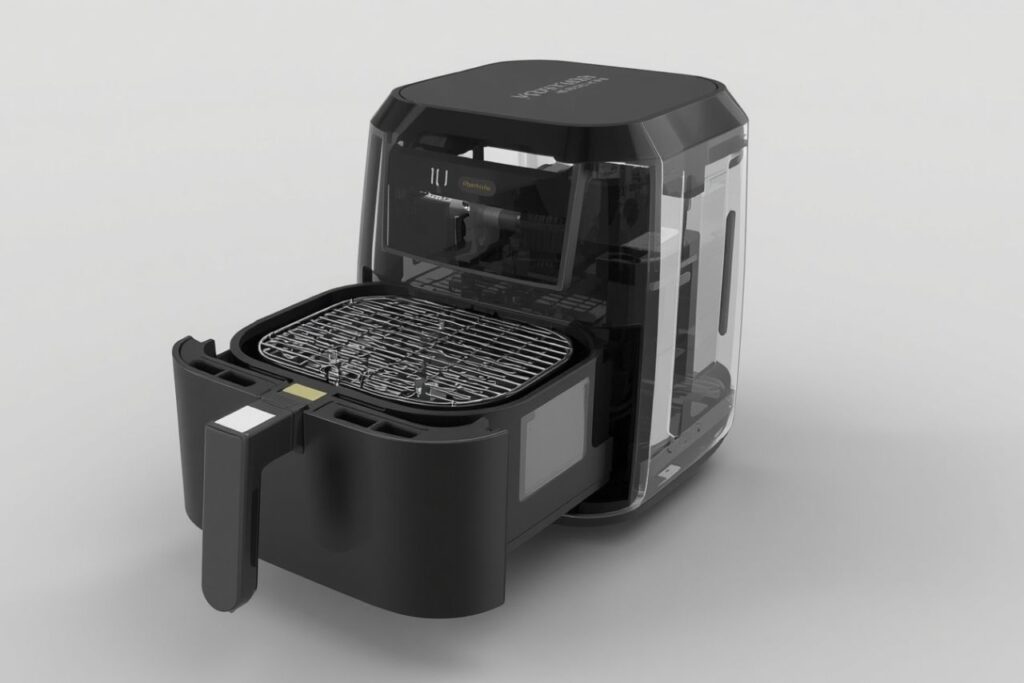
“Popular air fryer brands” don’t all share the same internal layout, so the safest way to access an air fryer’s heating element is to follow construction patterns (drawer basket vs. oven-style vs. dual-basket), then confirm with your specific model’s manual before removing panels.
1) Before you open anything: safety + reality check
Air fryers are mains-powered appliances. Accessing the heating element often exposes wiring, terminals, and insulating parts. If your only goal is removing smoke/odor, cleaning the visible heater area is usually safer than a teardown.
Heating elements are engineered assemblies: conductive alloy produces heat (resistive/Joule heating), while insulating/support components (often ceramic/mica frameworks in open designs, or insulating powders like MgO in embedded/sheath designs) keep the heater safe and positioned. Damaging supports or insulation can create overheating, leakage, or unsafe operation.
2) Where the element usually is (what you can see without teardown)
In many countertop air fryers, the heater is located at the top of the cooking cavity, positioned to heat airflow. You can often see a coil/loop shape (open coil) or a covered/heater module behind a guard. If you can see it, you can usually clean it without opening the base.
- Smoke from grease residue
- Odors from splatter on the ceiling/guard
- Crumbs and carbonized drips near the heater
3) Access patterns by air fryer style (brand-agnostic)
Instead of guessing a brand’s exact screw map, use the appliance style to predict the access route. Many “popular brands” reuse these chassis patterns across multiple models.
| Air fryer style | Where the heating element typically sits | Most common access route (if service access is required) |
|---|---|---|
| Drawer/basket air fryer (single basket) | Top of cavity, above food path | Top cover removal or rear cover removal to reach heater wiring/fasteners (varies by model) |
| Dual-basket air fryer | Top of each cavity | Separate top zones; service may require larger top housing removal |
| Oven-style air fryer (front door, racks) | Often top (and sometimes additional lower heaters) | Back panel access is common for internal wiring paths; heater may be retained from inside with guards |
| Air fryer + grill/plate hybrids | Top heater plus hot plate/grill surfaces | More internal heat shields; access can require multiple layered panels |
How to tell if the heater is “open” vs “embedded/covered”
- Open heater look: visible metal coil/loop suspended or supported by insulators/guard.
- Covered/embedded look: heater not directly visible; you see a plate, shield, or module. (In many heater technologies, the conductive part is embedded in insulating material; for example, embedded elements can use MgO insulation inside a sheath.)
Open elements are easier to inspect/clean but more sensitive to bending and contamination. Covered/embedded designs protect the conductive path, but you must avoid moisture intrusion and damage to shields/insulators.
4) Basic tools + “do not do this” list
Basic tools (typical)
- Phillips screwdriver set (and sometimes Torx/hex bits depending on model)
- Plastic spudger (to separate snap-fit covers without cracking)
- Needle-nose pliers (for connectors)
- Phone camera (before/after wire routing photos)
- Soft brush + damp cloth (for cleaning)
- Work while plugged in (even if “off”).
- Spray water or cleaner directly into the top housing.
- Scrape the element with metal tools (can deform coils or damage coatings/supports).
- Pull on wires—disconnect at the connector and document routing.
- Reassemble with missing heat shields/insulation pieces.
5) After access: inspection and safe reassembly
Once you can see the heater area clearly (either from inside the cavity or after removing a panel), focus on three checks:
- Contamination: grease/carbon on heater/guard/surrounding surfaces (common cause of smoke).
- Mechanical integrity: no sagging coil, cracked supports, loose fasteners.
- Wiring/insulation condition: no scorched connectors, brittle insulation, or melted plastic near hot zones.
Put every shield, spacer, and insulating layer back exactly as found. Heating solutions are designed as systems; missing a heat shield can change airflow/temperature distribution and lead to hotter-than-intended surfaces.
FAQs (7)
1) Can I access the heating element without opening the air fryer?
Often yes. If you can see the heater/guard from the cooking cavity, you can usually clean residue and inspect for obvious issues without removing external panels. Disassembly is more appropriate for wiring faults, repeated breaker trips, or clearly damaged parts.
2) Why do some air fryers hide the element behind a cover?
Heating elements can be open (supported/suspended) or integrated into a framework. Covers/guards reduce accidental contact and help manage airflow and heat transfer. Many heater designs combine conductive and insulating/support materials, so protecting those materials improves safety and longevity.
3) What’s the most common reason people break something during access?
Rushing cover removal and prying with metal tools. Snap-fits and thin plastic tabs crack easily, and bent heater supports can misalign airflow or create hot spots. Use a plastic spudger and take photos as you go.
4) If my air fryer smokes, does that mean I must access the element?
Not necessarily. Smoke is frequently residue burning off on hot surfaces near the heater. Start with safe cleaning of the visible heater area and surrounding ceiling/guard. If smoke persists after thorough cleaning and drying, then consider service access or professional repair.
5) Can I replace just the heating element myself?
It depends on the model and parts availability. Because the heating element is part of a designed assembly (conductive element plus insulation/supports and connectors), replacement may require correct routing, shielding, and safety checks. If you are unsure, use qualified service.
6) Do oven-style air fryers have more than one heating element?
Some heating appliances use multiple heaters to manage temperature and airflow paths. Without your specific model’s documentation, assume there may be more than one heated zone and inspect carefully (top first, then any guarded lower area) before concluding “the element is missing.”
7) How do heating technologies differ across appliances (tubes/plates/films/modules)?
Heating solutions vary by application needs: tubular heaters are common where a sheathed, insulated heating path is needed; heating plates focus on uniform surface heating; heating films prioritize ultra-thin flexibility; and integrated thermal modules (including die-cast approaches) can combine metal structures with heating functions. These differences change how access, shielding, and cleaning should be handled.
Reminder: This page provides brand-agnostic access guidance. For “popular brand” specifics, always match steps to your exact model number and service manual.