Cluster Page ? ~2007 words ? Global ? Professional/Formal ? Third person ? FAQ: 3
The best way to extend a Kenmore dryer heating element s life is to keep it from running hotter than designed. In practical terms: maintain strong vent airflow, remove lint from the heater/blower path, keep wire connections tight (no high-resistance hot spots), and use the correct replacement element when repairs are needed. These steps reduce oxidation, deformation, and premature burnout common end-of-life mechanisms for resistive heaters.
Engineering reference: TUTCO defines a heating element as a component (conductive + insulating materials + terminals) designed to serve a heating purpose, and notes that environment/operating conditions drive reliability and life. Source.
- Why dryer heating elements fail early
- A simple maintenance plan (daily/monthly/seasonal)
- Airflow and venting: the #1 longevity factor
- Lint + hot spots: how small issues become failures
- Electrical connections: preventing terminal overheating
- After a repair: rules that prevent new element burnouts
- Heater types and sourcing notes (for product teams)
- FAQ (3)
- References & outbound links
Electric dryer heaters rely on forced airflow to carry heat away. When venting is restricted, heater temperature rises, safety devices open more often, and the element s oxidation and deformation accelerate.
Lint acts as an insulator and can trap heat. It also increases fire risk. Lint buildup inside the cabinet and around the heater housing is common on older units and long vent runs.
A loose spade connector increases electrical resistance at the contact point. That localized resistance becomes localized heating, which can discolor terminals, damage insulation, and lead to repeated failures.
A heater assembly that doesn t match the dryer platform can create misalignment (coil contact with housing), improper airflow patterns, or incorrect loading. Heating elements are engineered assemblies, not generic wire.
Not a warranty dataset; this reflects common service experience and heater life principles.
| Frequency | Task | What it prevents | How to know it s working |
|---|---|---|---|
| Every load | Clean lint screen | Reduced airflow, long dry times, overheating | Air passes freely through the screen |
| Monthly | Inspect vent hose behind dryer for crush/kinks | Airflow restriction + heater overheating | Strong airflow at exterior vent |
| Seasonal | Deep-clean vent run to exterior termination | Thermal fuse trips, repeat element burnout | Exterior flap opens strongly during drying |
| After any repair | Confirm terminals tight + do a supervised heat test | Connector hot spots + repeat failures | No burning smell; stable cycling |
Table 1 A maintenance routine designed around the primary heater life drivers: airflow and connection integrity.
- Confirm strong airflow at the exterior vent while the dryer runs.
- Remove lint buildup from the lint screen housing (not just the screen).
- Replace crushed or overly long flexible ducting.
- Keep the exterior flap free-moving (no nesting, ice, or blockage).
TUTCO notes that heater design and environment influence heater life; all resistance heaters eventually burn out and factors like oxidation, deformation, and temperature cycling limit longevity. Airflow restriction pushes the element to a hotter operating point and increases cycling stress. Reference.
- Insulates and traps heat around the heater housing
- Blocks airflow (higher heater temperature)
- Increases fire risk
- Overheat a small section of coil or terminal
- Accelerate oxidation and deformation
- Cause intermittent heats then stops behavior
Once power is disconnected, inspect heater spade terminals and wire insulation. Warning signs include darkened connectors, looseness, brittle insulation, or melted plastic nearby. These indicate localized resistance heating.
- Replace loose or heat-damaged terminals rather than squeezing and reusing.
- Ensure wire connections are tight after any service.
- Route wiring away from hot surfaces and moving parts.
Whirlpool s element replacement guidance (water heater context) warns not to restore power until the tank is fully refilled and air is purged, or the element can burn out ( dry fire ). That illustrates a general heater rule: do not energize a heater before its surrounding system can safely remove heat. For dryers, the ready condition is primarily adequate airflow and fully installed covers. Source.
- All covers installed and secured.
- Vent hose connected without kinks.
- Outdoor exhaust airflow verified.
- 10 C15 minute supervised heat test (confirm stable operation, no burning smell).
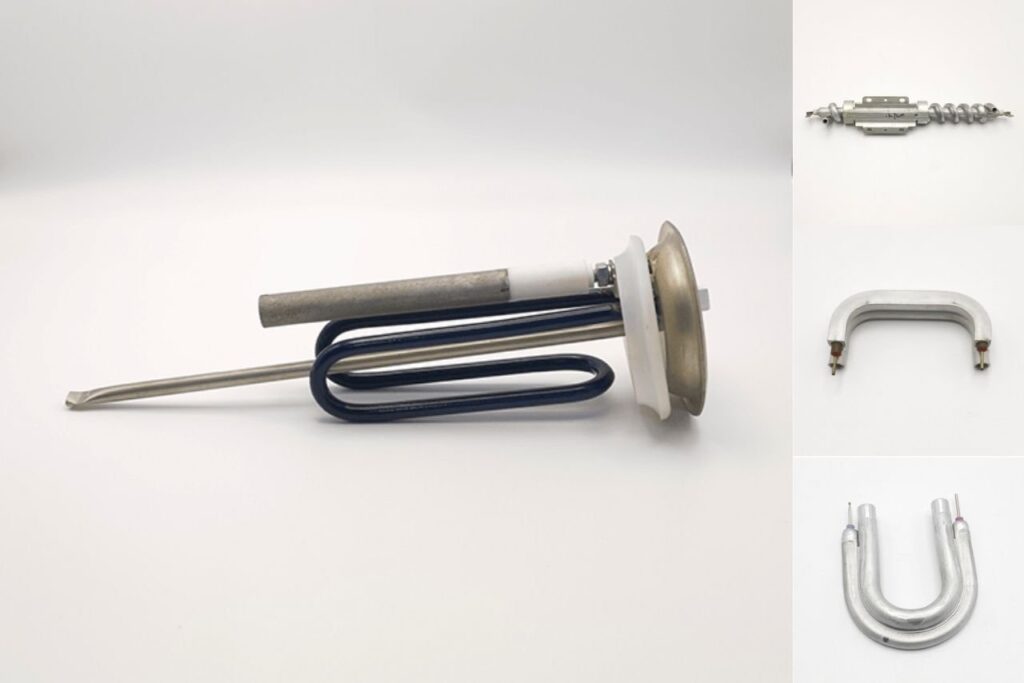
Heating element can refer to many heater families (tubes, plates, films, integrated modules). JINZHO s catalog structure illustrates this breadth via Heating Element categories and subcategories (e.g., Heating Tubes, Heating Plate, Heating Film). For integrated heater modules used in other appliances (coffee machines, irons), see Die Casting Heating Solutions and for compact boiler assemblies: Electric Boiler Heater.
Manufacturer context: Jinzhong describes itself as a Heating Element manufacturer with 30+ years experience and scaled production, with factory details linked from Heating Element Factory.
Hudson Reed s 1000W plug-in heating element (radiator/towel warmer use) lists details like 1000W, IP67, and UL Approved, plus materials (ABS & stainless) and a 2-year warranty. It s not a dryer part, but it shows what clear specs look like when evaluating heater products. Source.
Maintain vent airflow: clean the lint path and the entire exhaust run to the exterior termination. Airflow is the heater s cooling system.
Resistance heaters eventually fail due to oxidation, deformation, and changing electrical properties over many cycles. Operating hotter than intended (often from restricted airflow) accelerates these mechanisms. TUTCO reference.
Correct the root cause (airflow restriction), ensure terminals are tight and not heat-damaged, and run a supervised test cycle. Do not run heat with missing covers or poor venting.
- TUTCO heating element definition and longevity considerations: https://tutco.com/conductive/heating-elements
- Whirlpool element replacement discipline (verify voltage/wattage; safe energizing conditions; tight connections): https://www.whirlpoolwaterheaters.com/support/help/element-was-out-of-range/24
- JINZHO internal links and product families: https://jinzho.com/, Heating Element, Heating Element Factory, Die Casting Heating Solutions
- Hudson Reed heater spec disclosure example (1000W plug-in element): https://usa.hudsonreed.com/1000-plug-in-watt-electric-heating-element-76309
Originality note: This article is original maintenance guidance written for Kenmore dryer users; sources are referenced for engineering definitions and safety principles.
Disclaimer: This is educational content. Dryer designs vary by model. Follow model-specific service instructions and local electrical safety regulations.