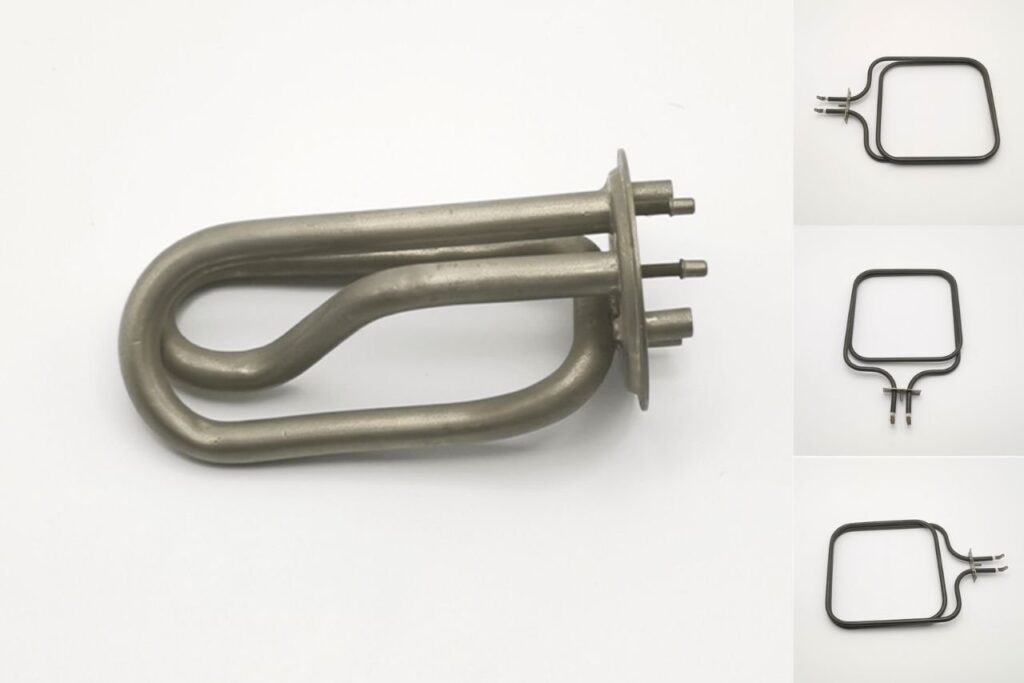
In the realm of thermal engineering, the distinction between bake and broil components is a study in thermodynamic optimization.
While both function as an 加熱エレメント through the principle of Joule heating, their roles in a modern kitchen are fundamentally different. Drawing on the 40-year manufacturing legacy of Camewould (Jin Zhong) a premier global 発熱体メーカー this technical analysis explores the material science, wattage configurations, and failure modes of these critical oven components.
Technical Guide Chapters
Thermal Fundamentals: Bake vs. Broil
Every electric oven relies on a circuit where electrical energy is converted into heat. However, the application of that heat defines the cooking method. The ベークエレメント is designed for ambient heat saturation. Located at the bottom of the cavity, often hidden beneath the floor in modern “hidden bake” models, it heats the air which then circulates through natural or forced convection. This ensures the internal temperature of the food rises uniformly.
Conversely, the Broil Element is the powerhouse of the oven. It is engineered for short-duration, high-intensity output. Positioned at the roof of the oven, it emits infrared radiation. This energy travels in waves directly to the surface of the food, causing rapid browning and searing. Because of this high-intensity requirement, broil elements often feature a higher wattage density than their bake counterparts.
Technical Comparison: Bake vs. Broil Elements
| 特徴 | Bake Element (Bottom) | Broil Element (Top) |
|---|---|---|
| 標準ワット数 | 2,000W C 3,000W | 3,000W C 4,500W |
| Primary Heat Transfer | 対流 | Radiation (Infrared) |
| Operational Cycle | Intermittent (Thermostat Controlled) | Continuous (Manual/Timed) |
| Failure Profile | Oxidation due to food spills | Thermal fatigue from high heat |
Engineering Specifications and Material Grades
A high-quality 加熱エレメント is a marvel of material science. At a specialized 発熱体工場 like Camewould, the manufacturing process begins with a precision-wound Nickel-Chromium (NiCr 80/20) coil. This coil provides the electrical resistance necessary to generate heat.
To ensure safety and longevity, the coil is centered within a metal tube often Incoloy 800 または Stainless Steel 321 and surrounded by Magnesium Oxide (MgO) powder. The MgO acts as a critical dielectric insulator, allowing heat to pass to the outer sheath while preventing the electricity from grounding out. For broil elements, which face extreme temperatures, the density of this MgO must be tightly controlled to prevent “hot spots” that can cause the element to burst or “pitting” of the sheath.
Die Casting Solutions in Modern Ovens
Traditional “exposed” heating coils are increasingly being replaced or supplemented by ダイカスト加熱ソリューション. In this configuration, the tubular element is embedded within a cast aluminum or iron plate. This design offers several advantages:
- Thermal Inertia: The metal plate retains heat longer, leading to more stable oven temperatures and reduced cycling of the electrical relay.
- Protection: The heating element is shielded from corrosive food acids and mechanical damage during cleaning.
- Uniformity: The die-cast surface acts as a heat spreader, eliminating the uneven “ring” of heat often seen with traditional bake elements.
Diagnosis: How to Identify a Failing Element
When your oven is not heating correctly, a systematic diagnostic approach is required. For the bake element, look for cold spots where the coil does not glow red during preheating. For the broil element, common failure signs include visible blisters on the sheath or a complete lack of glow when the broil setting is engaged.
Technicians use Continuity Testing with a digital multimeter to confirm failure. A healthy bake element typically shows a resistance of 15 C30 ohms, while a broil element may range from 10 C20 ohms. If the reading is infinite (O.L.), the internal NiCr coil has snapped. Replacing these components with OEM-spec parts from a certified 発熱体メーカー ensures that the appliance’s safety cut-offs and thermostats remain calibrated.
Industrial FAQ Section
Q1: Can I use the bake element for broiling if the top element is broken?
While the bake element will heat the oven, it cannot provide the direct infrared radiation required for true broiling. Attempting to “broil” with the bake element usually results in baked or steamed food rather than seared results, and may overstress the bake element if the door is left ajar (a common broiling practice).
Q2: Why does my bake element glow red but the oven doesn’t reach the set temperature?
This often indicates partial resistance failure or a faulty oven temperature sensor (RTD). The element may be drawing power but not enough to offset the heat loss of the oven cavity. It could also be a sign of a failing relay on the control board.
Q3: Are “hidden” bake elements harder to replace?
Yes. Hidden bake elements are located beneath the oven floor. Replacement typically requires removing the back panel of the stove and sometimes the side insulation. However, they are preferred in modern design as they make cleaning the oven interior significantly easier.
Q4: What certifications should I look for in a replacement element?
Always verify that the element carries UL (Underwriters Laboratories) または VDE certification. Components manufactured by Camewould are tested in CNAS-accredited laboratories to ensure they meet strict international safety standards for insulation resistance and leakage current.
Global Leadership in Heating Technology
With a production capacity of 3 million units per month and 40 years of R&D excellence, Camewould provides the heating cores for the world s most trusted appliance brands, including Philips, Midea, and DeLonghi.
References & Technical Sources:
- [1] Camewould Electrical Technology – Industrial Specifications for Tubular Heating Elements. View Technical Data
- [2] Wikipedia – The Science of Joule Heating and Resistive Materials. en.wikipedia.org
- [3] IQS Directory – Design Fundamentals of Oven Heating Components. iqsdirectory.com
- [4] Sears Home Services – Diagnostic Guide for Electric Oven Failures. searshomeservices.com