Pillar Page ? ~4000 words ? Global ? 4 FAQs ? Technical, homeowner-friendly
Most Maytag no heat problems are not solved by swapping parts at random. Les éléments chauffants are engineered assemblies: electrically conductive material produces heat, while insulating materials and terminals integrate the element into a safe, controllable system. Reliability depends on airflow (dryers), radiant/conductive heat transfer (ovens), electrical connections, and the appliance s safeties and controls.
Référence d'ingénierie : TUTCO définit un élément chauffant as a component made of both electrically conductive and insulating material, designed for heating, and discusses how environment and design choices influence heater life. https://tutco.com/conductive/heating-elements
- Heating element basics (what it is, what it isn t)
- Maytag dryers: how the heating system works
- Maytag electric ovens: bake/broil elements explained
- Why elements fail (and why replacements fail fast)
- Symptoms-to-causes: quick diagnostic map
- Replacement safety principles (avoid dry fire and other mistakes)
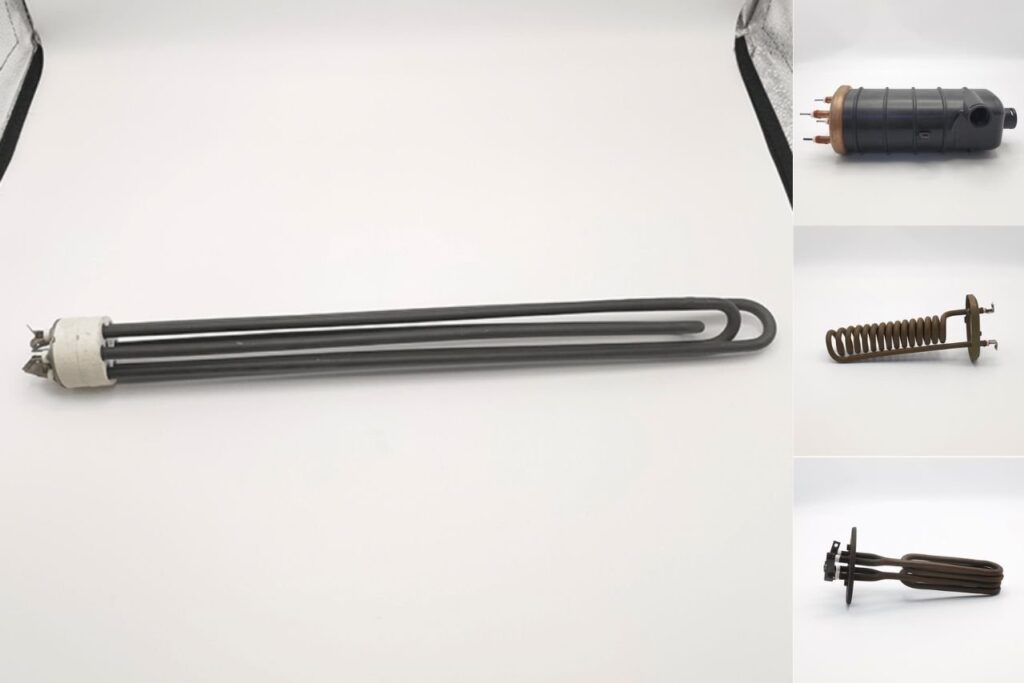
- Heating element types (tubes, plates, films, die-cast modules)
- Sourcing + spec checklist for correct replacements
- FAQ (4)
- Références et liens internes obligatoires
A resistive heater assembly where current through a resistance alloy converts electrical energy into heat (Joule heating). The element includes insulators and connectors not just the wire or metal.
- Conductive part: resistance alloy (e.g., Ni-Cr or Fe-Cr-Al family in many appliances)
- Insulating framework: ceramics, mica, MgO powder, etc., depending on design
- Terminals/leads: connect the element safely to the circuit
Not a universal commodity part. Small differences shape, wattage, mounting geometry, sheath material, and how heat is transferred can change performance and life.
If an element keeps burning out, the root cause is often airflow restriction, poor fit, incorrect rating, or terminal hot spots not bad luck.
In an electric dryer, the element heats air that the blower moves through the drum and out the vent. The element s temperature depends heavily on airflow: restrict the vent and the element runs hotter, cycles more aggressively, and fails sooner.
| Subsystem | Role | Common failure impact | Typical clue |
|---|---|---|---|
| Élément chauffant | Converts electrical power to heat | No heat or weak heat | Dries very slowly / tumbles cold |
| Airflow path (lint filter, duct, vent) | Removes heat from element and carries it to clothes | Overheating, thermal cutoff trips, repeat element burnouts | Hot cabinet, poor exterior exhaust airflow |
| Thermal safeties / thermostats | Limits temperature to prevent fire/overheat | No heat even with a good element (open safety) | Heat stops early; intermittent cycles |
| Terminals and wiring | Deliver power safely | Burnt connectors, intermittent heating, melted insulation | Discoloration at spade terminals |
Table 1 Dryer heating reliability depends on the whole system, especially airflow and safeties.
The bake element provides sustained, even heating. Failures often show as underbaking, long preheat times, or uneven temperatures.
Le broil element delivers high radiant heat. Failures show as weak browning/poor broiling even if bake still works.
TUTCO describes tubular heaters as an electric coil surrounded by insulating powder (often MgO) within a metal sheath, commonly used in electric kitchen ovens. Source
Illustrative ranking based on common service patterns and heater-life principles (oxidation, deformation, cycling) discussed by TUTCO.
TUTCO notes all resistance heating elements eventually burn out and that oxidation, changes in electrical resistance, damage, and deformation limit longevity. They also highlight how temperature cycling and material properties (like thermal expansion and oxide layer adhesion) correlate with life. Référence
| Appareil | Symptôme | Causes probables | Que vérifier en premier |
|---|---|---|---|
| Dryer | Pas de chaleur du tout | Open element; open thermal safety; wiring/terminal failure | Verify airflow + inspect safety cutoffs and terminals before replacing element again |
| Dryer | Heats then stops / intermittent heat | Restricted vent causing overtemp; cycling thermostat issues | Exterior vent airflow + vent run cleanliness |
| Four | Préchauffage lent / cuisson insuffisante | Weak/open bake element; control/sensor issues | Visual check for cracks/blisters on element; confirm bake energizes |
| Four | Broil doesn t brown | Weak/open broil element | Confirm broil element glows/energizes safely |
Table 2 Element failure symptoms often point to airflow (dryers) or specific element circuits (ovens).
Whirlpool s heating-element replacement steps for water heaters include a clear warning: do not restore electrical power until the tank is completely full and air is purged, or the element can burn out ( dry fire ). https://www.whirlpoolwaterheaters.com/support/help/element-was-out-of-range/24
Appliance translation: Dryer = do not run heat without proper airflow/vent connection and all covers installed. Four = ensure correct element seating, correct terminals, and intact insulation/guards before energizing.
- Match replacement to the appliance s voltage/wattage expectations and physical fit.
- Inspect/replace heat-damaged terminals (don t reuse loose connectors).
- Reassemble all covers/insulators; confirm no element-to-metal contact that would create hot spots.
- Do a supervised test cycle; stop if there is arcing, burning smell, or abnormal cycling.
JINZHO organizes its product line to reflect how heating element covers multiple technologies, including Tubes de chauffage, Plaque chauffante, Film chauffant. This matters because dryers/ovens typically use sheathed/tubular-style resistance heaters, while many small appliances use plates, films, or integrated modules.
The Heating Tubes category shows products like 12-380V Water Heating tube, Boiler Heating tube, bundle rod heater, and application-specific items (coffee machine/deep fryer heating elements). Category
The Heating Plate category includes items like coffee maker heating plate, Dishwasher Heater Element, Egg Boiler Heating Plate, and Customized Heating Plate. Category
The Heating Film category lists thick film heating element/system/sets, Thick Film Heater Tube, and thin film heater, plus appliance-specific parts (e.g., humidifier element, Nespresso-compatible heating elements). Category
The Die Casting Heating Solutions category lists integrated items such as 1400 Watt Boiler Heat Exchanger, Boiler Heater For Espresso Machine, and other coffee-machine heater parts built around die-cast aluminum substrates and thick-film resistor technology (as described in the product snippets). Category
For appliances that generate steam/hot water, JINZHO s Electric Boiler Heater category lists products like Coffee Boiler, electric steam boiler, and electric boiler heating element/system. https://jinzho.com/product-category/electric-heater-parts/electric-boiler-heater/
- Power and electrical: correct wattage and voltage for the appliance circuit.
- Geometry: length/shape/mounting points; ensures correct radiant pattern (oven) or correct airflow heating (dryer).
- Materials and protection: sheath/insulation suitable for temperature and environment.
- Compliance: approvals where relevant (example below).
Hudson Reed s 1000 Plug-In Watt Élément chauffant électrique lists specific attributes: 1000W, Approuvé UL, la protection contre les intrusions IP67, materials (ABS & stainless steel), and a Garantie de 2 ans, plus a 35.4" cable. While this is for radiators/towel warmers (not dryers/ovens), it demonstrates the kind of spec clarity buyers should expect. Source
They re the same principle (resistive heating) but not the same part. Dryers are airflow-heating systems; ovens are radiant/convective cooking cavities with bake/broil circuits. Shape, wattage, mounting, and temperature environment differ.
The most common driver is restricted airflow (lint buildup or long/crushed venting), which forces the element to operate hotter and cycle harder. Loose terminals can also create localized hot spots that damage the element/wiring.
Keep terminals tight and clean, avoid damaging the sheath during cleaning, and address abnormal preheat times early. If an element shows cracks, blisters, or arcing signs, it should be evaluated before it fails completely.
Energizing the heater before the system can remove heat safely. Whirlpool explicitly warns that powering a water-heater élément before the tank is full will dry fire and burn out the element. The broader lesson applies across heater systems: confirm proper environment (airflow, immersion, correct installation) before applying power. Référence
- Élément chauffant
- Fabricant d'éléments chauffants
- Usine d'éléments chauffants
- Solutions de chauffage pour la coulée sous pression
- TUTCO heating element engineering overview: https://tutco.com/conductive/heating-elements
- Whirlpool element replacement safety sequence (illustrates don t energize too early + tight connections): https://www.whirlpoolwaterheaters.com/support/help/element-was-out-of-range/24
- JINZHO site categories referenced: Tubes de chauffage, Plaque chauffante, Film chauffant, Chaudière électrique
- Hudson Reed 1000W plug-in element product page (spec disclosure example): https://usa.hudsonreed.com/1000-plug-in-watt-electric-heating-element-76309
Disclaimer: This page is informational and not model-specific service instructions. Always follow the appliance s technical sheet and local electrical safety rules.