
Sauna elemento calefactor La tecnología en 2025 transforma la experiencia de la sauna a través de controles inteligentes avanzados, materiales ecológicos y eficiencia energética. Empresas como Calefacción eléctrica Jinzhong lideran el camino como fabricantes de elementos calefactores, centrándose en la innovación para elementos calefactores de electrodomésticos. Las innovaciones modernas en saunas ahora incluyen sistemas híbridos e inteligentes que permiten un control preciso de la temperatura, calentamiento rápido e integración perfecta con la tecnología del hogar inteligente. La creciente demanda de experiencias de bienestar inmersivas impulsa este cambio, con calentadores híbridos y tecnología infrarroja reconfigurando el mercado. Los avances en elementos calefactores ofrecen a los usuarios un entorno de sauna personalizado, estableciendo nuevos estándares para la relajación.
Tendencias Clave en Elementos Calefactores de Sauna para 2025

La industria de la sauna en 2025 muestra una transformación rápida, impulsada por tecnología avanzada, selección de materiales sostenibles y un enfoque en la eficiencia energética y los materiales. Estas tendencias moldean el diseño de la próxima generación de elementos calefactores de sauna, ofreciendo a los usuarios sistemas de calefacción más inteligentes, sostenibles y eficientes energéticamente.
Materiales Avanzados en el Diseño de Elementos Calefactores de Sauna
Elementos Calefactores de Grafeno
Los elementos calefactores de grafeno representan un avance en las innovaciones modernas de sauna . Este material ofrece una conductividad térmica excepcional, permitiendo una distribución del calor rápida y uniforme. Los fabricantes utilizan grafeno por su estructura ligera y durabilidad, lo que respalda aplicaciones tanto comerciales como domésticas de sauna. La eficiencia del grafeno reduce el consumo de energía, alineándose con el impulso de la industria hacia diseños sostenibles y energéticamente eficientes.
Tecnología de Compuestos Cerámicos
La tecnología de compuestos cerámicos sigue siendo un elemento básico en el desarrollo de elementos calefactores de sauna. Los calentadores cerámicos emiten longitudes de onda infrarrojas lejanas, proporcionando calor dirigido. Sin embargo, los estudios muestran que los tubos cerámicos pueden crear puntos calientes localizados y calentamiento desigual. Su vida útil oscila entre 5,000 y 10,000 horas, pero son frágiles y menos duraderos que otros materiales avanzados. A pesar de estas limitaciones, los compuestos cerámicos ofrecen alta eficiencia radiante y contribuyen a la eficiencia energética general de la sauna.
Paneles de Calefacción Infrarroja
Los paneles de calefacción infrarroja han ganado popularidad debido a su capacidad para operar a temperaturas más bajas mientras ofrecen beneficios terapéuticos. Estos paneles utilizan materiales avanzados como fibra de carbono de grado aeronáutico y vidrio microcristalino, que proporcionan una dispersión uniforme del calor y bajas emisiones de campo electromagnético (EMF). El siguiente gráfico compara la eficiencia radiante y la durabilidad de varios tipos de elementos calefactores de sauna :
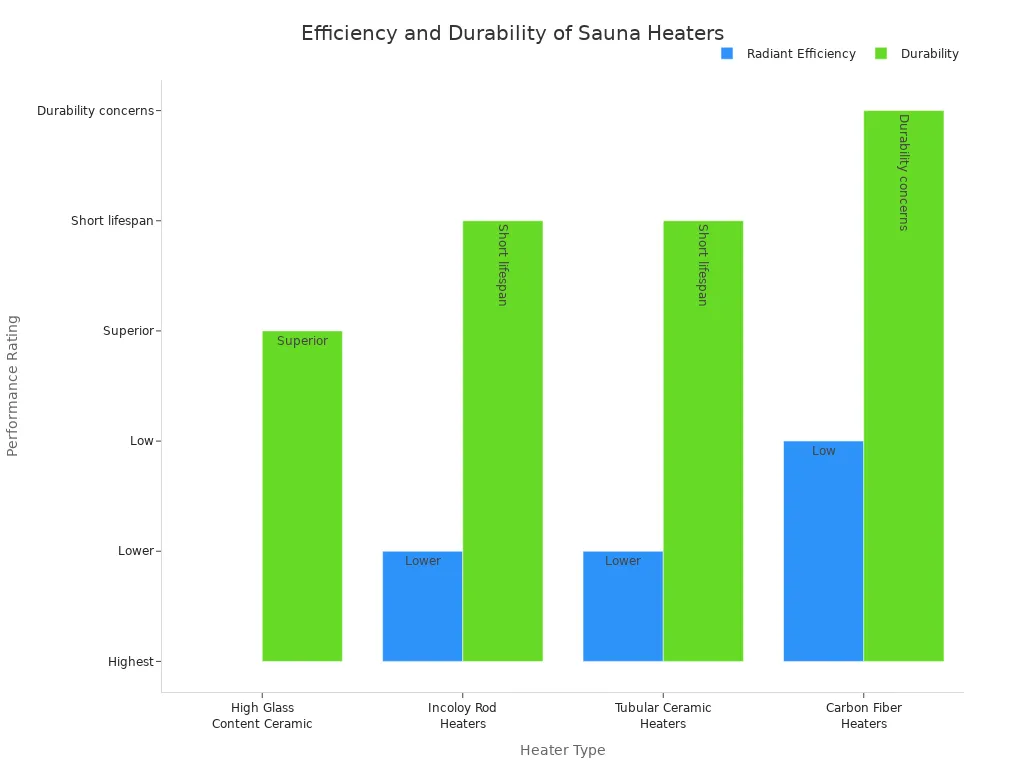
Acero inoxidable sigue siendo el material más común para los elementos calefactores de sauna en 2025. Ofrece durabilidad, resistencia a la corrosión y facilidad de mantenimiento. Modelos como el Harvia Cilindro Pro y el HUUM Hive utilizan acero inoxidable para un rendimiento robusto y longevidad. Estas características mejoran la retención de calor y la calidad del vapor, apoyando sistemas de calefacción energéticamente eficientes.
Innovaciones en Elementos Calefactores de Sauna Inteligentes y Conectados
Integración de IoT para el Control de Calefacción
integración de IoT está a la vanguardia de la tecnología de sauna inteligente. Los termostatos digitales y las funciones impulsadas por IA permiten ajustes en tiempo real de la temperatura y la humedad. Los usuarios se benefician del control remoto a través de aplicaciones móviles o altavoces inteligentes, lo que optimiza la experiencia de la sauna. Los sistemas habilitados para IoT recopilan datos en tiempo real, se sincronizan con la nube y proporcionan información sobre los hábitos de uso, apoyando el mantenimiento predictivo y la optimización energética.
- Las funciones impulsadas por IA personalizan los horarios de calefacción basándose en respuestas fisiológicas.
- La integración con sistemas de hogar inteligente permite el control por voz y la automatización.
- Los sistemas de control digital optimizan el uso de energía ajustando la calefacción de manera inteligente.
Controles Basados en Aplicaciones y Remotos
Los controles basados en aplicaciones y remotos se han convertido en estándar en el diseño moderno de elementos calefactores de sauna. Estos controles permiten a los usuarios gestionar la temperatura, la humedad y la duración de la sesión desde cualquier lugar. La gestión remota admite actualizaciones de firmware y alertas de mantenimiento, asegurando un rendimiento óptimo y eficiencia energética. Los diseños compactos de sauna inteligente, como los gabinetes de terapia doméstica impulsados por IA, se adaptan a espacios pequeños mientras ofrecen terapia personalizada.
Horarios de Calefacción Asistidos por IA
Los horarios de calefacción asistidos por IA maximizan los beneficios de bienestar y minimizan el uso de energía. Estos sistemas se adaptan a las condiciones ambientales y las preferencias del usuario, ajustando los parámetros de calefacción automáticamente. La integración con sistemas energéticos del hogar permite que la sauna funcione durante períodos de abundancia de energía renovable o fuera de las horas pico, mejorando aún más la eficiencia energética. El monitoreo avanzado de la salud con sensores biométricos rastrea los signos vitales y ajusta la configuración de la sauna en tiempo real, mejorando la seguridad y la comodidad.
Diseños Sostenibles y Eficientes Energéticamente en Calefacción de Sauna
Elementos Calefactores de Sauna Alimentados por Energía Solar
Los elementos calefactores de sauna alimentados por energía solar reflejan el compromiso de la industria con la sostenibilidad. Estos sistemas aprovechan la energía renovable, reduciendo la dependencia de fuentes de electricidad tradicionales. La integración con controles inteligentes y temporizadores programables permite a los usuarios optimizar el uso de energía y minimizar los costos de servicios públicos. La compatibilidad solar apoya la tendencia más amplia hacia diseños sostenibles y eficientes energéticamente.
Aislamiento de Alto Rendimiento y Sellado de Puertas
El aislamiento de alto rendimiento y el sellado de puertas juegan un papel crucial en la eficiencia energética y la selección de materiales. El aislamiento de calidad en paredes, pisos y techos de la sauna retiene el calor y reduce el consumo de energía. Las puertas y ventanas correctamente selladas evitan la pérdida de calor, asegurando que el elemento calefactor de la sauna funcione de manera eficiente. Los sistemas de ventilación con recuperación de calor capturan la energía térmica del aire de escape, precalentando el aire entrante y mejorando aún más la eficiencia.
Fabricación Ecológica y Materiales Reciclados
La fabricación ecológica y el uso de materiales reciclados se han vuelto centrales para la selección de materiales sostenibles. Los fabricantes priorizan el bambú, la prefabricación modular y los metales reciclados para reducir el impacto ambiental. Estas prácticas se alinean con las presiones regulatorias y la demanda de los consumidores de productos sostenibles. La siguiente tabla compara las estadísticas de consumo de energía de los elementos calefactores de sauna modernos y los modelos tradicionales:
| Tipo de Sauna | Potencia del Calentador (kW) | Tiempo de Calentamiento (minutos) | Uso de Energía Durante el Calentamiento (kWh) | Uso de Energía por Sesión de 30 min (kWh) | Costo Anual de Electricidad (uso 3 veces por semana) |
|---|---|---|---|---|---|
| Eléctrico tradicional | 6-9 | 30-45 | 3-7 | 1.5-2.5 | $95-$130 |
| Sauna Infrarroja | 1.5-2.5 | 10-15 | 0.25-0.5 | 0.5-0.8 | $30-$45 |
Los elementos calefactores de sauna infrarroja modernos operan a niveles de potencia más bajos y se calientan más rápido, resultando en aproximadamente un tercio del consumo de electricidad de los calentadores eléctricos tradicionales. Factores como la calidad del aislamiento, el tamaño de la sauna y el comportamiento del usuario también influyen en el uso de energía. La tecnología de sauna inteligente, incluidos temporizadores y controles remotos, optimiza aún más la eficiencia energética.
Consejo: El mantenimiento regular y el dimensionamiento adecuado del elemento calefactor de la sauna aseguran la máxima eficiencia y extienden la vida útil del equipo.
La convergencia de materiales avanzados, tecnología inteligente y diseños sostenibles y eficientes energéticamente define las principales tendencias en elementos calefactores de sauna para 2025. Estas innovaciones ofrecen un rendimiento superior, menor consumo de energía y una experiencia de sauna más personalizada.
Experiencias de Calor Híbrido e Integración del Bienestar
Combinando Calefacción Tradicional e Infrarroja
La tecnología de calefacción híbrida para saunas ha surgido como una tendencia líder en 2025. Los fabricantes ahora combinan elementos calefactores tradicionales e infrarrojos en una sola unidad. Este enfoque permite a los usuarios personalizar su experiencia de calor y beneficiarse de ambos métodos de calefacción. Los saunas híbridos funcionan a temperaturas moderadas, típicamente entre 120°F y 150°F. Los usuarios pueden alternar entre el calor infrarrojo seco y el vapor húmedo, obteniendo una flexibilidad que no está disponible en saunas de un solo tipo.
- Los saunas híbridos ofrecen los beneficios combinados para la salud tanto de la calefacción tradicional como de la infrarroja.
- Favorecen la relajación muscular, mejoran la salud respiratoria, potencian la función inmunológica y optimizan la circulación.
- La tecnología permite una sudoración más rápida, lo que puede mejorar la salud de la piel y reducir el estrés.
- Los modelos híbridos suelen incluir funciones avanzadas como terapia de luz roja y cromoterapia, lo que potencia aún más el bienestar.
- La conveniencia de tener ambos tipos de calefacción en una sola unidad permite una experiencia de bienestar personalizada.
Una comparación de la satisfacción del usuario entre los tipos de sauna destaca la versatilidad y comodidad de los modelos híbridos:
| Tipo de Sauna | Intensidad del Calor | Duración típica de la sesión | Comodidad y accesibilidad del usuario | Uso social frente a uso individual | Aspectos destacados de la satisfacción del usuario |
|---|---|---|---|---|---|
| Tradicional | Alta (150-195°F) | Corta (15-20 minutos) | Calor intenso, desafiante para usuarios sensibles al calor | Más grande, social, cultural, comunitario | Preferido por su calor auténtico e intenso y la vinculación social |
| Infrarrojos | Más baja (120-140°F) | Más larga (30-45 minutos) | Calor más suave, respiración más fácil, menos molestias faciales | Más pequeño, privado, adecuado para la relajación individual | Preferido por su comodidad, sesiones más largas y sensibilidad al calor |
| Híbrido | Moderada (120-150°F) | Variable | Combina calefacción tradicional e infrarroja, calor personalizable | Versátil, admite tanto uso social como individual | Valorado por su versatilidad, funciones mejoradas y comodidad |
La tecnología de sauna híbrida admite tanto el uso social como el individual, lo que la convierte en una opción flexible para diversas necesidades de los usuarios. La capacidad de ajustar los niveles de calor y humedad aumenta la satisfacción general y se alinea con las tendencias actuales en bienestar personalizado.
Integración de Terapia de Sal y Aromaterapia
Las tendencias recientes en tecnología de calefacción de saunas incluyen la integración de la terapia de sal y la aromaterapia. La terapia de sal, también conocida como haloterapia, implica la dispersión de partículas finas de sal en el aire del sauna. Este proceso puede favorecer la salud respiratoria y el bienestar de la piel. Los sistemas de aromaterapia infunden aceites esenciales en el aire caliente, creando un ambiente calmante y terapéutico.
- La terapia de sal puede ayudar a despejar las vías respiratorias y reducir la inflamación.
- La aromaterapia puede promover la relajación y el alivio del estrés.
- Muchos modelos de sauna híbrido ahora incluyen dispensadores integrados tanto para sal como para aceites esenciales.
Estas integraciones de bienestar transforman la sesión de sauna en una experiencia multidimensional, apoyando tanto la salud física como la mental.
Vapor Suave y Funciones Multisensoriales
Los fabricantes han respondido a la demanda de los consumidores por comodidad añadiendo vapor suave y funciones multisensoriales a los sistemas modernos de calefacción de saunas. Los generadores de vapor producen un ambiente húmedo que alivia las articulaciones y relaja los músculos. Las funciones multisensoriales, como la iluminación de cromoterapia y los sistemas de sonido envolvente, mejoran aún más la relajación.
Nota: La tecnología de sauna multisensorial puede mejorar la calidad del sueño al relajar el cuerpo y regular la temperatura.
Los elementos de calefacción de sauna híbridos ahora ofrecen una experiencia de bienestar integral, combinando calor, humedad, luz y sonido. Estas características reflejan las últimas tendencias en tecnología de bienestar inteligente.
Funciones de Seguridad Mejoradas en la Tecnología de Elementos de Calefacción de Saunas
Apagado Automático y Protección contra Sobrecalentamiento
La seguridad sigue siendo una prioridad máxima en la tecnología de calefacción de saunas. Los sistemas de apagado automático y protección contra sobrecalentamiento se han convertido en estándar en 2025. Estas funciones monitorean la temperatura y apagan automáticamente el elemento calefactor si supera los límites seguros. Esto reduce el riesgo de peligros de incendio y fallos eléctricos.
- Las certificaciones ETL, UL, CSA, CE y TÜV confirman el cumplimiento de las normas internacionales de seguridad.
- Las inspecciones eléctricas rutinarias realizadas por profesionales autorizados ayudan a mantener la seguridad y la fiabilidad.
Certificación UL, en particular, indica que los componentes eléctricos del sauna han superado rigurosas pruebas de seguridad. Esta certificación reduce el riesgo de descargas eléctricas y peligros de incendio, garantizando la tranquilidad de los usuarios.
Sistemas Avanzados de Regulación de Temperatura
La tecnología moderna de calefacción de saunas utiliza sistemas avanzados de regulación de temperatura para mantener niveles de calor consistentes y seguros. El último estándar UL 60335-2-53, que reemplaza al anterior UL 875, se alinea con las directrices internacionales de seguridad y mejora la usabilidad.
| Aspecto | UL 875 (Estándar Antiguo) | UL 60335-2-53 (Estándar 2025) |
|---|---|---|
| Disparo por alta temperatura | Umbral más bajo (~360°F/182°C), conservador para proteger el cableado y los componentes | Umbral más alto, reduciendo disparos innecesarios y mejorando la usabilidad |
| Ubicación del sensor del termostato | Directamente sobre el calentador, a 6″ del techo (inexacto para la temperatura ambiente) | Sobre el área de asientos (estilo europeo), control de temperatura más preciso |
| Requisitos de ventilación de aire | Se requiere una rejilla de suministro detrás o debajo del calentador para enfriar el sensor | Ubicación de ventilación más flexible, mejorando el flujo de aire y las opciones de instalación |
| Medición de temperatura | Limitada al sensor sobre el calentador, restringiendo las temperaturas naturales del sauna | Soporta mediciones en banco de prueba, permitiendo temperaturas ambiente superiores a 90 °C (~194 °F) de forma natural |
| Seguridad y documentación | Basado en requisitos anteriores de UL 875 | Alineado con las normas internacionales IEC 60335, advertencias actualizadas, clasificaciones IP, directrices de instalación y normas de seguridad específicas para infrarrojos |
Estas mejoras permiten un control de temperatura más preciso y un funcionamiento más seguro, reflejando las últimas tendencias en tecnología de calefacción para saunas.
Innovaciones en seguridad para niños y mascotas
Los fabricantes han introducido varias innovaciones para proteger a niños y mascotas en el entorno de la sauna. Estas incluyen superficies de tacto frío, controles a prueba de manipulaciones y sensores de movimiento que detectan entradas inesperadas. La tecnología inteligente puede bloquear los controles o apagar el sistema de calefacción si un niño o mascota ingresa a la sauna sin supervisión.
- Las características de seguridad para niños y mascotas reducen el riesgo de quemaduras o lesiones accidentales.
- Sensores inteligentes y alertas basadas en aplicaciones notifican a los usuarios sobre cualquier problema de seguridad en tiempo real.
Estos avances demuestran el compromiso de la industria con la seguridad y el bienestar del usuario, estableciendo nuevos estándares para la tecnología de calefacción de saunas en 2025.
Impacto de las innovaciones en elementos calefactores de sauna en la relajación
Control de temperatura más preciso en la calefacción
Ajustes y monitoreo en tiempo real
Los elementos calefactores modernos para saunas ofrecen un control preciso de la temperatura mediante paneles digitales avanzados y sensores inteligentes. Calentadores eléctricos para sauna Utilizan resistencia eléctrica para calentar las piedras de la sauna, permitiendo a los usuarios establecer temperaturas exactas y tiempos de sesión. Los componentes electrónicos sensibles, a menudo ubicados fuera de la sala de sauna, mejoran la confiabilidad y la vida útil. Las funciones de monitoreo en tiempo real, incluyendo Calefacción adaptativa impulsada por IA y sistemas de control climático, permiten ajustes automáticos basados en las preferencias del usuario y las respuestas fisiológicas. Estos sistemas optimizan el uso de energía y mantienen condiciones estables en la sauna, mejorando la experiencia general.
- Lecturas digitales de temperatura Proporcionan un monitoreo preciso.
- Los controles habilitados por Wi-Fi permiten operación y ajustes remotos.
- Las funciones de mantenimiento predictivo previenen fallos que podrían interrumpir la distribución del calor.
Distribución uniforme del calor en toda la sauna
La distribución uniforme del calor sigue siendo esencial para una experiencia relajante de sauna finlandesa. Las saunas premium con elementos calefactores avanzados alcanzan temperaturas óptimas entre 130–150 °F, envolviendo a los usuarios en un calor uniforme. Los paneles de carbono calientan de manera más eficiente que los paneles cerámicos, reduciendo los puntos calientes y mejorando la comodidad. La colocación estratégica del calentador, como unidades adicionales para pantorrillas, costados, espalda y frente, garantiza un calor uniforme. Los sistemas de ventilación adecuados, incluyendo rejillas de entrada y salida cerca del piso y el techo, equilibran el flujo de aire y previenen desequilibrios de temperatura.
Consejo: Las rejillas de ventilación bloqueadas o defectuosas pueden interrumpir el flujo de aire y la distribución del calor, reduciendo la eficacia y comodidad de la sauna.
Los usuarios reportan que los elementos calefactores avanzados para sauna proporcionan una experiencia de relajación más cómoda y efectiva que las tecnologías más antiguas. Las unidades de alta gama presentan niveles de EMF ultrabajos, contribuyendo a un entorno de calor más suave y seguro.
Perfiles de calor personalizables y programas de bienestar
Configuraciones definidas por el usuario para una relajación personalizada
Perfiles de calor personalizables permiten a los usuarios adaptar sus sesiones de sauna a sus necesidades individuales. Las saunas con configuraciones programables de temperatura y duración de sesión respaldan una experiencia personalizada de sauna finlandesa. La investigación fisiológica muestra que las sesiones de sauna de infrarrojo lejano aumentan la temperatura del músculo esquelético, lo que conduce a adaptaciones cardiovasculares y metabólicas beneficiosas. Estos hallazgos respaldan el uso de modalidades de calentamiento pasivo para resultados de salud específicos.
Programas preestablecidos de bienestar y terapia
Los programas preestablecidos de bienestar optimizan la salud cerebral, la desintoxicación y los beneficios de longevidad. Tecnologías como Sauna Guide Technology™ utilizan biorretroalimentación predictiva para personalizar las sesiones según la aclimatación al calor y el seguimiento de la temperatura corporal en tiempo real. Los usuarios pueden seleccionar entre una variedad de programas de terapia, cada uno diseñado para maximizar resultados específicos de bienestar. Este enfoque va más allá de un modelo único para todos, permitiendo a los usuarios rastrear y optimizar sus sesiones de sauna para obtener el máximo beneficio.
| Tipo de programa | Beneficio objetivo | Duración de la sesión | Perfil de calor |
|---|---|---|---|
| Desintoxicación | Eliminación de toxinas | 30 min | Alto, constante |
| Cardiovascular | Salud del corazón | 20 min | Moderado, pulsante |
| Relajación | Reducción del estrés | 40 min | Suave, gradual |
Funcionamiento de calefacción de sauna más silencioso y cómodo
Tecnologías de calefacción silenciosa y vibración reducida
Las tecnologías de calefacción avanzadas operan de manera silenciosa, minimizando la vibración y el ruido. Los paneles de carbono y cerámica producen menos sonido que los modelos más antiguos, contribuyendo a un ambiente de sauna tranquilo. El funcionamiento silencioso permite a los usuarios relajarse sin distracciones, favoreciendo sesiones más largas y cómodas.
Mejora de la calidad del aire y ventilación
Los sistemas de ventilación adecuados mejoran la calidad del aire al equilibrar el flujo de aire y mantener la humedad óptima. Sensores de humedad colocados cerca del techo proporcionan lecturas precisas de humedad, permitiendo ajustes automatizados. Los controles inteligentes de sauna integran la gestión de humedad y temperatura, permitiendo ajustes remotos y monitoreo en tiempo real.
Comodidad mejorada con calor uniforme
Las saunas premium cuentan con mejor aislamiento y colocación estratégica del calentador, resultando en una distribución uniforme del calor. Los usuarios encuentran que las saunas avanzadas proporcionan un calor infrarrojo de penetración más profunda que se siente más relajante y con menos probabilidades de causar molestias. Los modelos de alta gama permiten sesiones más largas y cómodas sin sentirse mareados o sobrecalentados.
Nota: Las tecnologías avanzadas de calefacción mejoran significativamente la comodidad, la uniformidad del calor y la satisfacción del usuario durante la relajación en comparación con las tecnologías antiguas.
Consideraciones del Usuario para la Selección del Elemento Calefactor de Sauna en 2025
Cómo Elegir el Elemento Calefactor de Sauna Adecuado
Adaptación del Tipo de Elemento Calefactor al Tamaño y Uso del Sauna
La selección del elemento calefactor de sauna óptimo depende de varios factores relacionados con el tamaño y el uso previsto del sauna. Los usuarios deben medir el volumen de la sala del sauna en pies cúbicos y aplicar la regla general: 1 kW de potencia del calentador por cada 45 a 50 pies cúbicos.. Las saunas más grandes o aquellas en climas más fríos requieren una mayor capacidad del calentador para mantener la eficiencia y el rendimiento energético. Para saunas exteriores o no aisladas, aumentar el tamaño del calentador entre un 25% y un 30% compensa la pérdida de calor. Las saunas de infrarrojos generalmente necesitan calentadores más pequeños debido a su entrega de calor dirigida. Los requisitos eléctricos también juegan un papel; los calentadores superiores a 2 kW necesitan circuitos dedicados de 240 voltios.. Una ventilación adecuada garantiza una distribución uniforme del calor y favorece un uso energético sostenible.
Consejo: Consulte a un profesional para un dimensionamiento correcto y una instalación segura que maximice la eficiencia y el ahorro de energía.
Evaluación de las Preferencias Personales y los Objetivos de Bienestar
Los objetivos y preferencias personales de bienestar influyen considerablemente en la elección del elemento calefactor de la sauna. La siguiente tabla compara características según las prioridades del usuario:
| Preferencias / Objetivos | Sauna Tradicional | Sauna Infrarroja |
|---|---|---|
| Experiencia auténtica | Ritual de vapor, calor elevado | N/A |
| Vapor y humedad | Esencial | No disponible |
| Sudoración intensa | Temperaturas altas | Calor suave |
| Beneficios respiratorios | Vapor priorizado | N/A |
| Ambiente social | Más grande, comunal | Más pequeño, personal |
| Sensibilidad al calor | Puede ser abrumador | Mejor tolerado |
| Alivio del dolor articular | N/A | Penetración infrarroja |
| Sesiones más largas | Más corto | Posible por más tiempo |
| Limitaciones de espacio | Requiere más espacio | Diseño compacto |
| Características modernas | Menos comunes | Tecnología avanzada |
| Instalación/mantenimiento | Más compleja | Más fácil, enchufable |
| Consumo energético | Más alto | Menor, calentamiento más rápido |
Las personas que buscan eficiencia energética sostenible y características modernas suelen preferir los saunas de infrarrojos. Aquellos que valoran la tradición y el vapor pueden optar por elementos calefactores de sauna convencionales..
Presupuesto, Valor y Ahorro a Largo Plazo
Las saunas de infrarrojo lejano ofrecen costos iniciales más bajos y gastos de mantenimiento reducidos en comparación con las saunas tradicionales de vapor o de rocas calientes. Sus elementos calefactores pueden durar hasta 50 años, minimizando los costos de reemplazo y favoreciendo la eficiencia energética sostenible. Los modelos de infrarrojos consumen menos electricidad por hora, lo que resulta en facturas de energía más bajas. Las saunas tradicionales requieren reemplazos del calentador más frecuentes y tienen un mayor consumo energético, lo que incrementa los costos a largo plazo. Las saunas portátiles y de infrarrojo cercano pueden tener costos iniciales más bajos, pero a menudo incurren en gastos de mantenimiento más altos con el tiempo. En una década, las saunas de infrarrojo lejano ofrecen la solución más rentable al considerar la instalación, el mantenimiento, el uso de energía y la durabilidad.
Mantenimiento y Longevidad de los Elementos Calefactores Modernos de Sauna
Requisitos de Limpieza y Cuidado para las Nuevas Tecnologías
El mantenimiento de rutina garantiza la longevidad y eficiencia de los elementos calefactores de la sauna. Las prácticas recomendadas incluyen:
- Utilizar solo rocas para sauna diseñadas para calentadores eléctricos y colocarlas de manera suelta para permitir el flujo de aire.
- Limpiar regularmente el exterior del calentador con un paño suave y limpiadores especializados para prevenir la corrosión.
- Inspeccionar las rocas cada pocos meses en busca de grietas o desgaste y redistribuirlas para un calentamiento uniforme.
- Aspirar el polvo y los residuos alrededor y dentro del calentador para mantener el rendimiento y la seguridad.
- Verificar el desgaste de los elementos calefactores y reemplazarlos si es necesario; probar anualmente los sensores de seguridad y el cableado.
- Realizar una limpieza profunda estacional retirando las rocas, lavándolas, secándolas completamente, inspeccionando si hay óxido y apretando los soportes de montaje.
- Seguir las pautas del fabricante y evitar verter sustancias no autorizadas directamente sobre las rocas.
Las estufas de leña para sauna requieren inspección y limpieza frecuentes del cuerpo de la estufa, la cámara de combustión y la chimenea para prevenir el óxido y garantizar una combustión segura. Las saunas de vapor necesitan agua ablandada o destilada y una limpieza regular del generador de vapor para evitar la acumulación de minerales.
Durabilidad y Vida Útil de los Materiales Avanzados
Los elementos calefactores modernos de sauna utilizan materiales avanzados como grafeno, composites cerámicos y fibra de carbono de grado aeronáutico. Estos materiales mejoran la durabilidad, favorecen la eficiencia energética sostenible y extienden la vida útil. Los elementos calefactores de infrarrojo lejano pueden durar hasta 50 años, mientras que los componentes de cerámica y acero inoxidable ofrecen un rendimiento robusto y resistencia a la corrosión. El mantenimiento regular aumenta aún más la vida útil de estas tecnologías.
Garantía, Soporte y Opciones de Actualización
Las opciones de garantía y soporte varían entre los principales fabricantes.. La siguiente tabla resume la cobertura:
| Fabricante | Duración de la Garantía | Cobertura de Mano de Obra | Detalles de Cobertura | Exclusiones y Condiciones |
|---|---|---|---|---|
| Saunas Heavenly Heat | 10 años | 4 años (EE. UU. y Canadá) | Defectos en materiales, mano de obra, integridad de la cabina | Excluye instalación incorrecta, daños ambientales |
| SalusHEAT | 1 año (componentes), 7 años (tecnología central), reemplazo de pago de por vida | No cubierto | Componentes del calentador, soporte extendido de pago | Excluye remodelación, desastres, mal uso; solo compras directas |
| Helo (Sauna360) | 5 años (residencial), 1 año (comercial) | Soporte a través de distribuidores | Defectos de fabricación, se requiere instalación adecuada | Uso de piedras aprobadas, se requiere instalación autorizada |
Los fabricantes requieren comprobante de compra e instalación adecuada para mantener la cobertura de la garantía. Las opciones de soporte y actualización dependen de la marca y la región. Los usuarios deben revisar los términos de la garantía y buscar servicio autorizado para reparaciones a fin de garantizar una eficiencia continua y ahorro de energía.
Las innovaciones en elementos calefactores para saunas en 2025 ofrecen una relajación más inteligente, segura y sostenible. Los avances recientes brindan a los usuarios varios beneficios clave:
- Tecnología de infrarrojo lejano favorece la desintoxicación, el alivio del dolor y la reducción del estrés.
- Los elementos calefactores avanzados garantizan un control preciso de la temperatura y una penetración del calor más profunda.
- La regulación inteligente y el reciclaje de calor optimizan el uso de energía mientras mantienen la comodidad.
- Los diseños ecológicos utilizan materiales renovables y modos de ahorro de energía.
- Los saunas ahora sirven como plataformas de bienestar personalizado para objetivos de salud individuales.
| Aspecto Prioritario | Recomendaciones de Expertos | Prioridades del Usuario | Ejemplos y Características de Marcas |
|---|---|---|---|
| Seguridad | Enfatizar certificaciones, materiales no tóxicos, apagado automático | Prevenir quemaduras y emisiones | HUUM, Harvia |
| Eficiencia energética | Destacar diseños de ahorro de energía, especialmente infrarrojos | Buscar ahorros a largo plazo y opciones ecológicas | HUUM |
| Personalización | Integrar controles inteligentes y configuraciones personalizadas | Desear experiencias a la medida y conveniencia | HUUM (aplicación WiFi), Amerec (controles táctiles A6) |
| Relación Costo-Beneficio | Comparar características y beneficios a largo plazo | Equilibrar costo con durabilidad y ahorros | Harvia, Amerec |
Los compradores deben priorizar materiales avanzados, controles híbridos e inteligentes, eficiencia energética y funciones integradas de bienestar para maximizar la comodidad, seguridad y valor.
PREGUNTAS FRECUENTES
¿Cuáles son los principales tipos de elementos calefactores para sauna disponibles en 2025?
Los fabricantes ofrecen elementos calefactores eléctricos tradicionales, de infrarrojos e híbridos. Cada tipo ofrece beneficios únicos. Los modelos híbridos combinan ambas tecnologías para una experiencia personalizable. Los usuarios pueden seleccionar la mejor opción según sus objetivos de bienestar y preferencias de sauna.
¿Cómo mejoran la experiencia del usuario los elementos calefactores para sauna inteligentes?
Los elementos calefactores para sauna inteligentes utilizan controles digitales, integración IoT y programación asistida por IA. Estas funciones permiten a los usuarios ajustar la temperatura y la humedad de forma remota. El monitoreo en tiempo real garantiza calor constante y seguridad durante cada sesión.
¿Son eficientes energéticamente los elementos calefactores para sauna modernos?
Los elementos calefactores para sauna modernos utilizan materiales avanzados y controles inteligentes para reducir el consumo de energía. El aislamiento de alto rendimiento y los temporizadores programables mejoran aún más la eficiencia. Muchos modelos admiten fuentes de energía renovables, lo que ayuda a los usuarios a reducir los costos de servicios públicos y apoyar la sostenibilidad del agua.
¿Qué características de seguridad incluyen los nuevos elementos calefactores para sauna?
Los fabricantes diseñan elementos calefactores con apagado automático, protección contra sobrecalentamiento y regulación avanzada de temperatura. Las innovaciones en seguridad para niños y mascotas, como superficies de tacto frío y controles a prueba de manipulaciones, ayudan a prevenir accidentes y garantizar un funcionamiento seguro.
¿Cómo afecta el tamaño del sauna a la selección del elemento calefactor?
El tamaño del sauna determina la potencia requerida del calentador. Los espacios más grandes necesitan mayor vataje para un calentamiento efectivo. Un dimensionamiento adecuado garantiza una distribución uniforme del calor y un rendimiento óptimo. Los profesionales recomiendan medir el volumen del sauna antes de elegir un elemento calefactor.
¿Pueden los elementos calefactores para sauna apoyar la cultura del sauna comunal?
Muchos saunas modernos pueden acomodar grupos, apoyando la cultura del sauna comunal. Los modelos híbridos y tradicionales a menudo presentan capacidades más grandes y sistemas de calefacción robustos. Estos diseños fomentan experiencias de bienestar social y relajación grupal.
¿Cuáles son las últimas tendencias hidrotérmicas en la tecnología de saunas?
Las tendencias hidrotérmicas recientes incluyen experiencias de calor híbridas, terapia de sal e integración de aromaterapia. Las características multisensoriales, como la iluminación de cromoterapia y el sonido envolvente, mejoran la relajación. Estas innovaciones crean un entorno de sauna más inmersivo y terapéutico.

