
Podría esperarse que el calentador de agua de 4500w simplemente caliente el agua más rápido, pero muchos usuarios notan una mayor eficiencia y rendimiento. Cuando elige un calentador de 4500 vatios Elemento calefactor de Calefacción eléctrica Jinzhong, accede a una tecnología en la que confían Fabricantes de elementos calefactores. El calentador adecuado puede transformar su rutina diaria, especialmente si depende de elementos calefactores de electrodomésticos para obtener agua caliente constante. Siempre verifique su sistema eléctrico antes de realizar una actualización.
Potencia y Rendimiento del Calentador de Agua de 4500w

Velocidad de Calentamiento y Sorpresas de Eficiencia
Cómo 4500 vatios cambia el tiempo de recuperación de agua caliente
Nota una diferencia significativa en el tiempo de recuperación de agua caliente cuando instala un elemento de calentador de agua de 4500w. El mayor vataje significa que el elemento entrega más energía al agua, por lo que se calienta más rápido que los modelos de menor vataje. Este principio proviene de la ciencia eléctrica básica: la resistencia del elemento permanece igual, pero el aumento de vataje incrementa la tasa de calentamiento. En pruebas del mundo real, los usuarios que cambiaron de un elemento de 3500W a uno de 4500W observaron que sus calentadores de agua se recuperaban mucho más rápido. Obtiene agua caliente más rápidamente después de un uso intensivo, lo cual es especialmente útil para hogares ocupados o durante períodos de alta demanda.
Eficiencia en comparación con elementos de calentamiento de agua de menor vataje
Podría esperarse que un calentador de mayor vataje siempre use más energía, pero la realidad es más matizada. El calentador de agua de 4500w calienta el agua en menos tiempo, por lo que pasa menos minutos consumiendo energía. Si bien la energía total utilizada (medida en kilovatios-hora) para calentar una cantidad específica de agua sigue siendo similar, el tiempo de funcionamiento más corto puede reducir las pérdidas en espera. Esto significa que puede ver una ligera mejora en la eficiencia general, especialmente si su hogar usa agua caliente con frecuencia. Se beneficia de un calentamiento más rápido sin un aumento drástico en el consumo de energía.
4500w vs Otros Vatajes de Elementos de Calentamiento de Agua
Calentador de agua de 4500w vs elementos de 3500w y 5500w
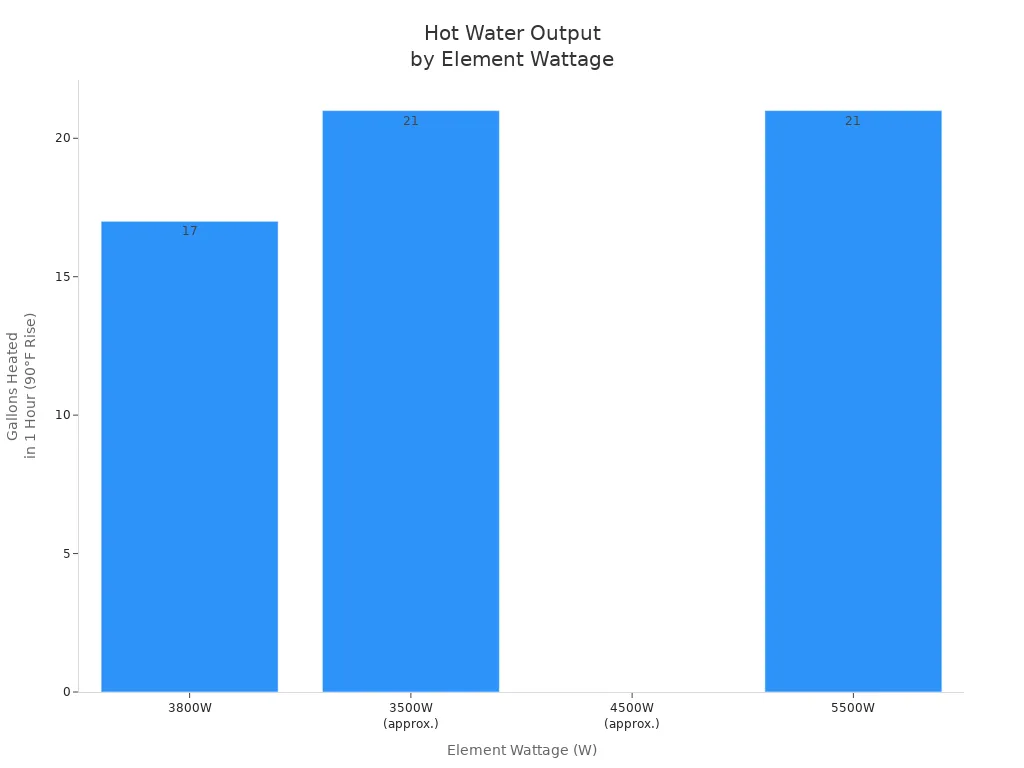
Puede comparar diferentes elementos de vataje observando cuánta agua caliente producen en una hora. La siguiente tabla resume el rendimiento de los elementos comunes elementos de calentador de agua bajo condiciones idénticas:
| Potencia (W) | Producción de Agua Caliente (Galones calentados 90°F en 1 hora) | Consumo de Corriente (Amperios) | Tamaño del Disyuntor (Amperios) | Notas de Rendimiento |
|---|---|---|---|---|
| 3500 | Entre 17 y 25 (interpolado) | N/A | N/A | Más lento que 4500W, más rápido que 3800W |
| 3800 | 17 | ~16 | 20 | Elemento de vataje base inferior |
| 4500 | Entre 17 y 25 (interpolado) | Superior a 16 | Superior a 20 | Más rápido que 3500W, más lento que 5500W |
| 5500 | 25 | ~23 | 30 | Calentamiento más rápido, mayor consumo de corriente |
Observa que el elemento del calentador de agua de 4500w se sitúa entre los modelos de 3500W y 5500W. Proporciona una producción de agua caliente más rápida que el elemento de 3500W, pero no iguala la velocidad del de 5500W. El consumo de corriente y los requisitos del disyuntor también aumentan con el vataje, por lo que debe asegurarse de que su sistema eléctrico pueda manejar la actualización.
Cuando un mayor vataje no garantiza un mejor rendimiento
Podría suponer que un mayor vataje siempre significa un mejor rendimiento, pero esto no siempre es cierto. Si el tanque de su calentador de agua es demasiado pequeño, o su cableado eléctrico no puede soportar la carga aumentada, es posible que no vea los beneficios de un elemento de 4500w. En algunos casos, el calentador puede encenderse y apagarse con más frecuencia, lo que puede reducir la eficiencia y aumentar el desgaste. Siempre debe igualar el vataje del elemento al tamaño de su tanque y capacidad eléctrica para obtener resultados óptimos.
Compatibilidad e Instalación del Calentador de Agua de 4500w

Modelos y Tamaños de Calentadores de Agua Compatibles
¿Qué tamaños de tanque funcionan mejor con elementos de calentamiento de agua de 4500w?
Necesita igualar el tamaño del tanque de su calentador de agua con el elemento adecuado para un rendimiento óptimo. Las especificaciones del fabricante muestran que los tanques de 40 galones y 50 galones funcionan mejor con un elemento de calentamiento de agua de 4500w. Por ejemplo, el tanque de 40 galones de la Serie Signature® 100 de A. O. Smith y el tanque de 50 galones Energy Saver de Lochinvar utilizan ambos elementos duales de 4500 vatios. Estos modelos operan a 240 voltios y ofrecen una fuerte producción de agua caliente para la mayoría de los hogares. El tanque de 40 galones proporciona una entrega de primera hora de 53 galones, mientras que el tanque de 50 galones entrega 62 galones en la primera hora. Puede esperar una entrega confiable de agua caliente cuando combine un elemento de 4500w con estos tamaños de tanque comunes.
Recomendaciones y limitaciones del fabricante para 4500 vatios
Siempre debe verificar las pautas del fabricante antes de instalar un nuevo elemento. Marcas importantes como A. O. Smith recomiendan y utilizan elementos de 4500 vatios en sus calentadores de agua eléctricos. Su documentación destaca los elementos de calentamiento de cobre duales de 4500 vatios como estándar para una entrega eficiente de agua caliente. El consejo de la comunidad también respalda el uso de elementos de 4500 vatios tanto en las posiciones superior como inferior en tanques compatibles. Ninguna marca importante enumera restricciones contra los elementos de 4500w, pero debe asegurar conexiones eléctricas adecuadas y seleccionar elementos de calentamiento de baja densidad de vatios para una vida útil más larga.
Consejo: Siga siempre las instrucciones de instalación del fabricante para evitar anular su garantía o causar problemas de seguridad.
Requisitos Eléctricos para Elementos de Calentador de Agua de 4500w
Necesidades de disyuntor y cableado para 4500 vatios
Debe asegurarse de que su sistema eléctrico pueda manejar de forma segura un elemento de calentamiento de agua de 4500w. El Código Eléctrico Nacional (NEC) proporciona requisitos claros para el tamaño del disyuntor y el calibre del cable. La siguiente tabla resume las especificaciones clave:
| Parámetro | Requisito |
|---|---|
| Potencia del Calentador de Agua | 4500 vatios |
| Voltaje | 240 voltios |
| Corriente Calculada | 18.75 amperios (4500W ÷ 240V) |
| Factor de Carga Continua del NEC | 125% de la corriente calculada |
| Tamaño Mínimo del Disyuntor | 30 amperios (siguiente tamaño estándar por encima de 23.44A) |
| Calibre de Cable Requerido | 10 AWG (para manejar de forma segura un disyuntor de 30 amperios) |
| Notas de Seguridad | El disyuntor y el cable deben coincidir para evitar sobrecalentamiento y riesgos de incendio |
Nunca debe usar un cable de calibre 12 para un disyuntor de 30 amperios. Use siempre cable de calibre 10 para evitar sobrecalentamiento y reducir el riesgo de incendio.
Actualizaciones potenciales para una instalación segura
Actualizar a un elemento de 4500w a menudo requiere cambios en el sistema eléctrico de su hogar. Si aumenta el tamaño del elemento, es posible que necesite actualizar el cableado o el panel eléctrico. Muchos hogares con cableado antiguo o interruptores más pequeños no pueden soportar de manera segura un elemento calentador de agua de 4500w sin modificaciones. Debe consultar a un electricista autorizado para evaluar su instalación actual. Ellos pueden determinar si su cableado, interruptor y panel cumplen con los requisitos del código para el nuevo elemento. Este paso garantiza un funcionamiento seguro y una fiabilidad a largo plazo.
Consumo de energía de 4500 vatios e información sobre costos
Uso real de energía de los elementos calentadores de agua de 4500w
Cuánta energía consume realmente un calentador de agua de 4500w
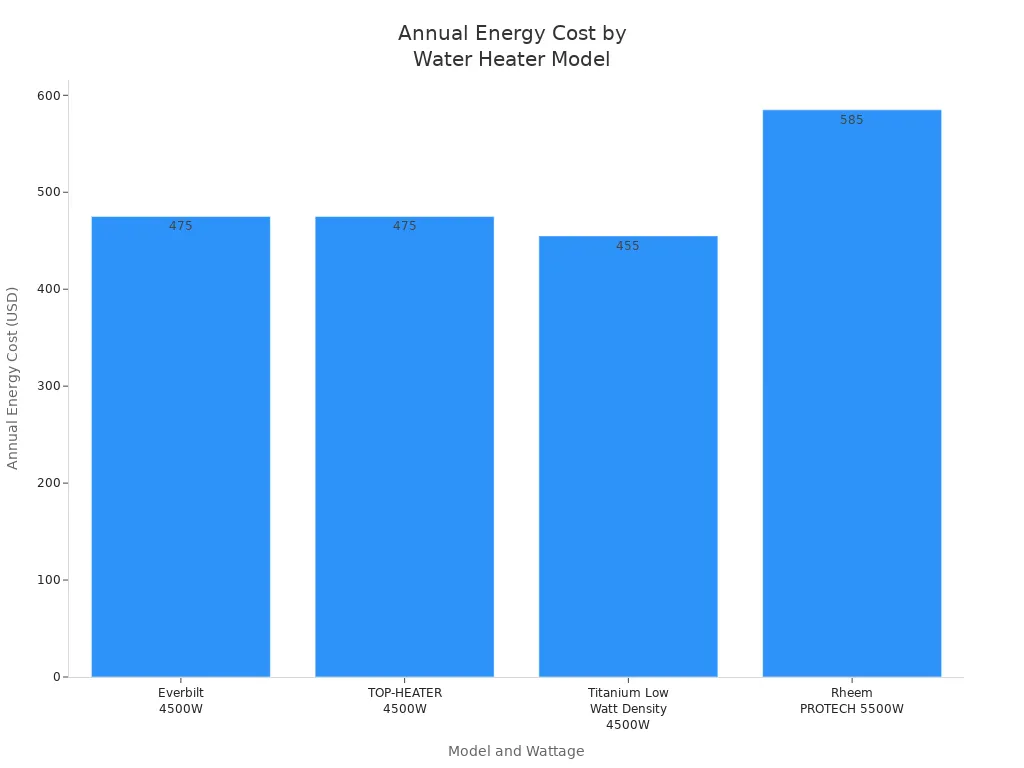
Quizás se pregunte cuánta energía consume su calentador de agua de 4500w en un año típico. Los fabricantes clasifican estos elementos para un funcionamiento continuo a 4500 vatios, pero el uso real depende de la frecuencia con la que caliente agua. La mayoría de los hogares utilizan sus calentadores de agua eléctricos durante aproximadamente tres horas al día. Si multiplica la potencia nominal por el uso diario y luego por el número de días en un año, obtiene una estimación clara. Por ejemplo, el modelo AO Smith de 4500 vatios diseñado para familias de tres a cuatro personas utiliza aproximadamente 5865 kilovatios-hora (kWh) al año. Esta cifra coincide con el costo energético anual estimado de $573, basado en un precio promedio de electricidad de $0.0977 por kWh. Puede esperar que su consumo anual se sitúe entre 5800 y 6000 kWh si utiliza una configuración similar.
Factores que afectan el consumo de energía con 4500 vatios
Varios factores influyen en el uso real de energía de su calentador de agua:
- El voltaje de suministro afecta la potencia de salida. Si su hogar suministra menos de 240 voltios, el elemento consume menos energía y calienta el agua más lentamente.
- Las tolerancias de fabricación en la resistencia pueden cambiar la potencia real hasta en un 10%.
- La frecuencia y duración del uso de agua caliente impactan directamente en el consumo total.
- La calidad del aislamiento y la temperatura ambiente afectan cuánto calor se escapa del tanque.
- Los fabricantes a veces seleccionan elementos de vataje ligeramente inferior para prolongar la vida útil de los componentes y garantizar la compatibilidad con termostatos y contactos.
Nota: El uso real de energía a menudo cae por debajo de la clasificación nominal debido a estas variables. Puede observar un consumo menor de lo esperado si su sistema opera a un voltaje reducido o si sus patrones de uso son moderados.
Consejos para ahorrar costos y mitos sobre calentadores de agua de 4500w
¿Un elemento calentador de agua de 4500w aumenta su factura?
Podría suponer que actualizar a un elemento de 4500 vatios siempre aumentará su factura de energía. En realidad, el impacto depende de cómo use el agua caliente. Si calienta el agua más rápida y eficientemente, puede reducir las pérdidas en espera y evitar que el calentador funcione por períodos prolongados. La energía total necesaria para calentar un volumen dado de agua se mantiene constante, pero una recuperación más rápida puede ayudarle a gestionar los costos. Si usa más agua caliente o aumenta la configuración de temperatura, su factura aumentará. De lo contrario, es posible que solo vea un cambio modesto.
Mitos comunes sobre la eficiencia energética de 4500w
Muchas personas creen que los elementos de mayor vataje son siempre menos eficientes. Esto no es cierto. La eficiencia de su calentador de agua depende de varios factores, no solo del vataje. Puede reducir los costos de energía al:
- Usar electrodomésticos certificados ENERGY STAR.
- Instalar temporizadores o termostatos programables para controlar la duración del calentamiento.
- Mejorar el aislamiento alrededor de su calentador de agua.
- Reducir las configuraciones del termostato y calentar agua solo cuando sea necesario.
Tecnologías alternativas, como calentadores de agua con bomba de calor o calentadores de agua solares con respaldo eléctrico, pueden reducir aún más el consumo de energía. Estrategias de control avanzadas, como el control predictivo de modelos, optimizan los horarios de calentamiento y evitan el uso innecesario de energía.
Consejo: Puede maximizar la eficiencia combinando controles inteligentes, aislamiento y patrones de uso optimizados. Un vataje más alto no significa automáticamente facturas más altas si gestiona su sistema de manera inteligente.
Seguridad y longevidad del elemento calentador de agua
Conceptos erróneos sobre seguridad con calentadores de agua de 4500w
Riesgos de sobrecargar circuitos con 4500 vatios
Podría pensar que todos los elementos calentadores de agua conllevan los mismos riesgos de seguridad, pero un elemento calentador de agua de 4500w consume mucha más corriente que los modelos de menor vataje. Esta corriente más alta requiere un circuito de 30 amperios y cable de calibre #10. Si instala un elemento de 4500w en un circuito diseñado para un vataje más bajo, corre el riesgo de sobrecargar el interruptor y el cableado. Los circuitos sobrecargados pueden sobrecalentarse, disparar los interruptores o incluso causar incendios eléctricos. Los elementos de menor vataje, como 3500w o 1500w, funcionan de manera segura en circuitos más pequeños y consumen menos corriente, lo que reduce el riesgo de sobrecalentamiento y sobrecarga del circuito. Sin embargo, estos modelos de menor vataje calientan el agua más lentamente y pueden no satisfacer las necesidades de agua caliente de su hogar.
Nota: Siempre verifique su circuito y cableado antes de instalar un elemento de mayor vataje. Nunca asuma que su instalación existente puede manejar la actualización.
Prácticas de instalación adecuadas para elementos calentadores de agua
La instalación adecuada juega un papel crítico en la seguridad y el rendimiento de su elemento calentador de agua. Las estimaciones de la industria muestran que hasta el 30% de las fallas en calentadores de agua resultan de una instalación incorrecta, incluyendo conexiones eléctricas defectuosas e incumplimiento del código. Siempre debe apagar la energía en el interruptor antes de realizar el mantenimiento o reemplazar un elemento. Asegúrese de que el tanque esté lleno de agua antes de encender la unidad para evitar que el elemento se queme. Seguir las instrucciones del fabricante y los códigos eléctricos locales le ayuda a evitar errores comunes. Contratar a un profesional autorizado garantiza que su instalación cumpla con los estándares de seguridad y reduce el riesgo de fallas.
- Hasta el 30% de las fallas en calentadores de agua se relacionan con una instalación incorrecta.
- Las conexiones eléctricas defectuosas y las violaciones del código son causas comunes.
- La instalación profesional reduce significativamente el riesgo de fallas.
Vida útil y sorpresas en el mantenimiento
Cómo afecta 4500w la vida útil del elemento calentador de agua
Quizás se pregunte si un elemento de 4500w se desgasta más rápido que los modelos de menor vataje. La respuesta depende de su uso y la calidad de la instalación. Los elementos de mayor vataje calientan el agua más rápidamente, lo que puede causar ciclos más rápidos y estrés térmico. Si instala el elemento en un circuito de tamaño insuficiente o lo usa en un tanque no diseñado para alto vataje, aumenta el riesgo de falla prematura. Los elementos de menor vataje tienden a durar más porque operan bajo menos estrés eléctrico y térmico, pero pueden no proporcionar suficiente agua caliente para hogares más grandes.
Consejos de mantenimiento para una vida útil más larga
El mantenimiento regular extiende la vida útil de su elemento calentador de agua y mejora la eficiencia. Debe:
- Inspeccionar el elemento en busca de signos de corrosión o acumulación de minerales cada seis meses.
- Purgar el tanque para eliminar sedimentos que pueden aislar el elemento y causar sobrecalentamiento.
- Verificar las conexiones eléctricas para asegurarse de que estén apretadas y sin signos de desgaste.
- Reemplazar el elemento si nota un rendimiento de calentamiento reducido o daños visibles.
Consejo: Programar inspecciones profesionales anuales para detectar problemas temprano y mantener sus elementos calentadores funcionando de manera segura.
Beneficios y desventajas inesperados de los elementos calentadores de agua de 4500w
Ventajas únicas de los elementos calentadores de agua de 4500w
Recuperación más rápida de agua caliente para familias numerosas
Obtiene una ventaja significativa con un calentador de agua de 4500w Si su hogar tiene una alta demanda de agua caliente. El elemento calienta el agua mucho más rápido que las opciones de menor potencia, lo que significa que pasa menos tiempo esperando que el tanque se recupere después de duchas, lavandería o lavado de platos. Este beneficio se vuelve especialmente evidente en hogares con múltiples ocupantes o uso simultáneo frecuente de agua caliente. No observa un aumento significativo en los costos de energía, ya que la energía total utilizada para calentar el agua sigue siendo similar a la de otras potencias. El elemento de 4500w generalmente funciona en un circuito estándar de 30 amperios, por lo que evita la necesidad de costosas actualizaciones eléctricas que podrían requerir los modelos de mayor potencia.
- Calienta el agua más rápido, reduciendo los tiempos de espera para obtener agua caliente.
- Apoya a familias numerosas con un alto consumo de agua caliente.
- No hay un aumento significativo en el consumo de energía con el tiempo.
- Funciona con circuitos estándar de 30 amperios en la mayoría de los hogares.
- Ofrece un equilibrio práctico entre potencia y rendimiento.
Mayor comodidad y conveniencia.
Experimenta una mayor comodidad y conveniencia con un calentador de agua de 4500w. Los tiempos de recuperación más rápidos significan que rara vez se queda sin agua caliente, incluso durante las mañanas ocupadas o duchas consecutivas. Puede programar las tareas del hogar de manera más flexible, sabiendo que el calentador mantendrá el ritmo de la demanda. El suministro constante de agua caliente mejora su rutina diaria y reduce la frustración.
Consejo: Elegir un elemento de 4500w le ayuda a evitar las molestias de las duchas frías y garantiza que su calentador de agua se mantenga al ritmo de su estilo de vida.
Posibles problemas a tener en cuenta con los calentadores de agua de 4500w.
Problemas de compatibilidad con hogares antiguos.
Puede encontrar desafíos al instalar un calentador de agua de 4500w en un hogar antiguo. Los sistemas eléctricos envejecidos a menudo tienen dificultades con la mayor demanda de corriente, lo que provoca disparos frecuentes de los disyuntores o un funcionamiento poco fiable. La siguiente tabla describe problemas comunes.:
| Categoría de problema común | Descripción | Impacto en el elemento del calentador de agua |
|---|---|---|
| Acumulación de sedimentos | Los depósitos minerales aíslan el elemento, causando sobrecalentamiento. | Provoca fallos y ruidos como chasquidos o retumbos. |
| Corrosión y óxido | Daña la vaina metálica, permitiendo la entrada de agua. | Causa grietas, perforaciones y fallos eventuales. |
| Problemas eléctricos | Cableado defectuoso, sobretensiones o instalación incorrecta. | Resulta en quemaduras, peligros y funcionamiento poco fiable. |
Podría notar áreas derretidas o quemadas en el elemento, agujeros por corrosión o disparos frecuentes del disyuntor. El cableado antiguo y las instalaciones sin licencia aumentan el riesgo de fallos eléctricos, lo que puede acortar la vida útil de su calentador y comprometer la seguridad.
Mayor desgaste en los sistemas eléctricos.
Coloca un estrés adicional en el sistema eléctrico de su hogar cuando instala un elemento de 4500w. Irregularidades de voltaje, como picos o un voltaje de suministro alto, pueden hacer que el elemento funcione a una temperatura más alta de lo diseñado. Este estrés acelera el desgaste y puede provocar un fallo prematuro. La alta densidad de potencia, combinada con fallos en el termostato, aumenta el riesgo de sobrecalentamiento. Debe medir el voltaje y la corriente reales en el calentador para identificar posibles problemas. La instalación adecuada y las revisiones eléctricas regulares le ayudan a evitar un desgaste acelerado tanto en el elemento como en el cableado de su hogar.
Nota: Consulte siempre a un electricista autorizado antes de actualizar su calentador de agua, especialmente en hogares antiguos. Este paso garantiza un funcionamiento seguro y protege su inversión.
Consejos prácticos para propietarios de calentadores de agua de 4500w.
Cómo elegir el elemento calefactor de agua de 4500w adecuado.
Factores a considerar antes de actualizar a 4500 vatios.
Debe evaluar varios factores antes de actualizar a un elemento calefactor de agua de 4500w. Primero, verifique la compatibilidad de su calentador existente. No todos los tanques o sistemas eléctricos pueden manejar la mayor potencia. Revise su disyuntor y cableado para confirmar que cumplen con los requisitos de 30 amperios y cable de calibre 10. Considere la edad y el estado del panel eléctrico de su hogar. Si vive en una casa antigua, es posible que necesite actualizaciones para soportar la mayor potencia de forma segura.
La selección del material también es importante. Los elementos fabricados con aleaciones de níquel-cromo o Incoloy resisten la corrosión y la acumulación de sarro, especialmente en áreas con agua dura. Estos materiales extienden la vida útil de su elemento y reducen las necesidades de mantenimiento. Busque productos que cumplan con certificaciones de seguridad estrictas, como 3C, para garantizar la fiabilidad.
Consejo: Elija un elemento calefactor diseñado para un calentamiento rápido y un suministro constante de agua caliente. Este enfoque maximiza la comodidad y eficiencia para su hogar.
Cuándo consultar a un profesional para la instalación.
Debe consultar a un electricista autorizado si no está seguro sobre la capacidad de su sistema eléctrico o si nota un cableado obsoleto. La instalación profesional garantiza el cumplimiento de los códigos locales y reduce el riesgo de peligros eléctricos. Los electricistas también pueden recomendar el mejor elemento para su modelo de calentador específico y las necesidades de su hogar. Si planea actualizar su panel o cableado, busque siempre asesoramiento experto para evitar errores costosos y garantizar la seguridad a largo plazo.
Maximización del rendimiento y la seguridad de los calentadores de agua de 4500w.
Revisiones rutinarias y mantenimiento de los elementos calefactores de agua.
El mantenimiento rutinario mantiene su calentador funcionando de manera eficiente y extiende la vida útil de su elemento. Los expertos de la industria recomiendan las siguientes mejores prácticas:
- Utilice elementos con cerámica PTC para limitación automática de temperatura. Esta característica evita el calentamiento en seco al aumentar bruscamente la resistencia a altas temperaturas.
- Integre termostatos y protección contra calentamiento en seco para evitar riesgos de tanques vacíos.
- Asegure un control preciso de la temperatura y un calentamiento uniforme seleccionando elementos que se ajusten a la forma de su tanque.
- Optimice la eficiencia térmica reduciendo la pérdida de calor y minimizando el ruido.
- Programe inspecciones y tareas de mantenimiento regulares.
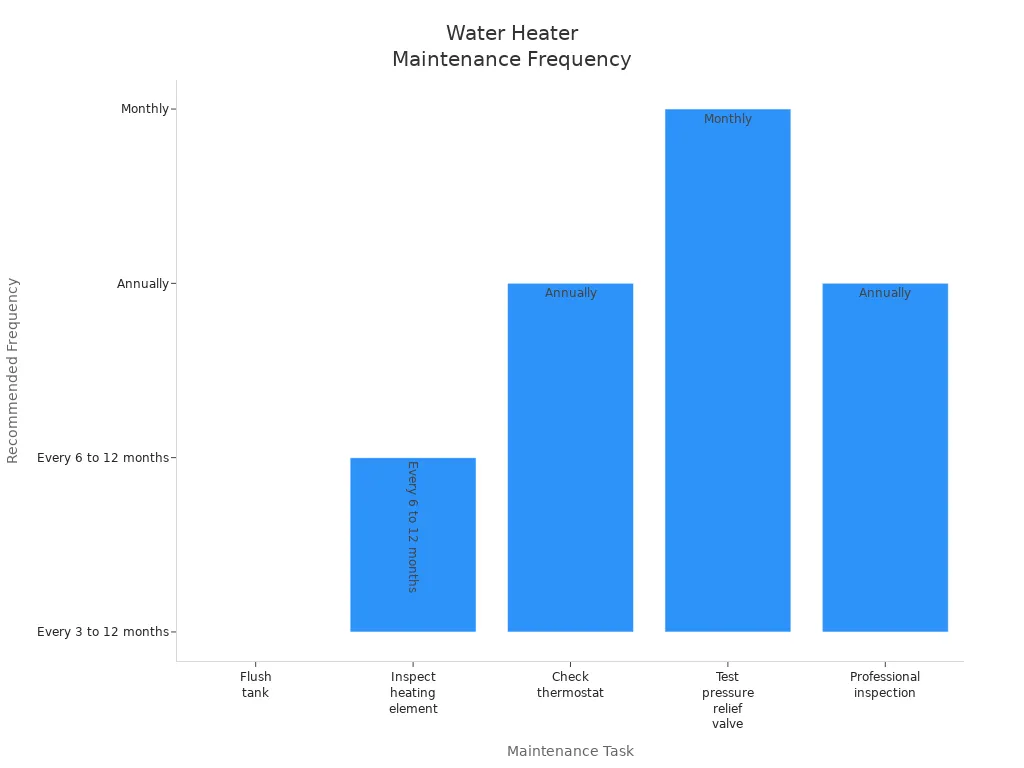
La siguiente tabla resume las tareas de mantenimiento esenciales y su frecuencia recomendada:
| Tarea de mantenimiento | Frecuencia Recomendada | Beneficio |
|---|---|---|
| Tanque de descarga | Cada 3 a 12 meses | Elimina la acumulación de sedimentos que causa el sobrecalentamiento y el desgaste del elemento. |
| Inspeccionar el elemento calefactor | Cada 6 a 12 meses | Detecta signos tempranos de daño para prevenir fallos en el elemento. |
| Compruebe el termostato | Anualmente | Asegura que la temperatura esté configurada a 120°F para reducir la tensión y el sobrecalentamiento. |
| Válvula de alivio de presión de prueba | Mensualmente | Previene la acumulación peligrosa de presión que puede dañar el elemento. |
| Inspección profesional | Anualmente | Revisión integral para mantener la seguridad y el funcionamiento eficiente. |
Purgar regularmente su tanque elimina los depósitos minerales que aíslan el elemento y causan sobrecalentamiento. En áreas con agua dura, aumente la frecuencia de esta tarea. Siempre llene el tanque antes de restaurar la energía para evitar el calentamiento en seco. Configure su termostato a 120°F para reducir el estrés en el elemento y prevenir el sobrecalentamiento. Las revisiones mensuales de fugas, corrosión y ruidos inusuales le ayudan a detectar problemas a tiempo.
Señales de que necesita reemplazar un elemento de 4500w.
Debe estar atento a varias señales de advertencia que indican que su elemento necesita reemplazo:
- El agua no se calienta o tarda mucho más de lo habitual.
- Escucha ruidos de chasquidos o retumbos provenientes del tanque, que indican acumulación de sedimentos.
- Observa corrosión visible, óxido o depósitos minerales en el elemento durante la inspección.
- El disyuntor se dispara con frecuencia cuando el calentador está en funcionamiento.
- Usted nota fugas o decoloración del agua.
Si observa alguno de estos problemas, programe una inspección profesional. Reemplazar un elemento defectuoso de inmediato previene daños mayores en su calentador y mantiene una operación segura.
Usted obtiene velocidad y eficiencia impresionantes con un elemento de calentador de agua de 4500W. Antes de actualizar, revise la compatibilidad y seguridad de su sistema. Las pautas de la industria recomiendan las siguientes verificaciones:
| Aspecto de Evaluación | Recomendación | Razón / Importancia |
|---|---|---|
| Voltaje | Coincidir el voltaje de suministro | Previene peligros |
| Potencia | No exceder el original | Evita daños |
| Densidad de vatios | Seguir los límites del fabricante | Garantiza una operación segura |
| Ajuste Físico | Confirmar tamaño y montaje | Previene fugas |
Consulte a un profesional si se siente inseguro. Una evaluación cuidadosa protege su inversión y garantiza agua caliente confiable.
PREGUNTAS FRECUENTES
¿Qué tamaño de interruptor necesita para un elemento de calentador de agua de 4500W?
Necesita un interruptor de 30 amperios para un elemento de calentador de agua de 4500W. Esta configuración garantiza una operación segura y cumple con los requisitos del Código Eléctrico Nacional. Utilice siempre cable calibre 10 con un interruptor de 30 amperios para prevenir sobrecalentamiento.
¿Puede reemplazar un elemento de menor vatiaje con uno de 4500W?
Puede actualizar si su tanque y sistema eléctrico soportan 4500 vatios. Verifique su interruptor, cableado y las recomendaciones del fabricante. Si no está seguro, consulte a un electricista autorizado antes de realizar cambios.
¿Con qué frecuencia debe purgar el tanque de su calentador de agua?
Debe purgar su tanque cada 3 a 12 meses. La purga regular elimina sedimentos, lo que ayuda a prevenir sobrecalentamiento y extiende la vida útil de su elemento calefactor.
¿Cuáles son las señales de que su elemento de 4500W necesita reemplazo?
Busca estas señales:
- El agua se calienta lentamente o no se calienta en absoluto.
- Ruidos de chasquido o retumbo
- Corrosión visible o acumulación de minerales
- Disparos frecuentes del interruptor
Programe una inspección profesional si nota alguno de estos problemas.
¿Es seguro un elemento de calentador de agua de 4500W para casas antiguas?
Las casas antiguas pueden tener cableado obsoleto o interruptores de capacidad insuficiente. Debe hacer que un electricista inspeccione su sistema antes de instalar un elemento de 4500W para garantizar seguridad y cumplimiento del código.
¿Un elemento de 4500W aumenta su factura de energía?
Un elemento de 4500W calienta el agua más rápido, por lo que puede no usar más energía en general. Su factura depende del uso de agua caliente, el aislamiento del tanque y la configuración del termostato. El uso eficiente puede ayudar a controlar los costos.
¿Qué materiales duran más en elementos de calentador de agua de 4500W?
Los elementos fabricados con Incoloy o aleaciones de níquel-cromo resisten la corrosión y la acumulación de sarro. Estos materiales ofrecen una mayor vida útil, especialmente en áreas con agua dura.