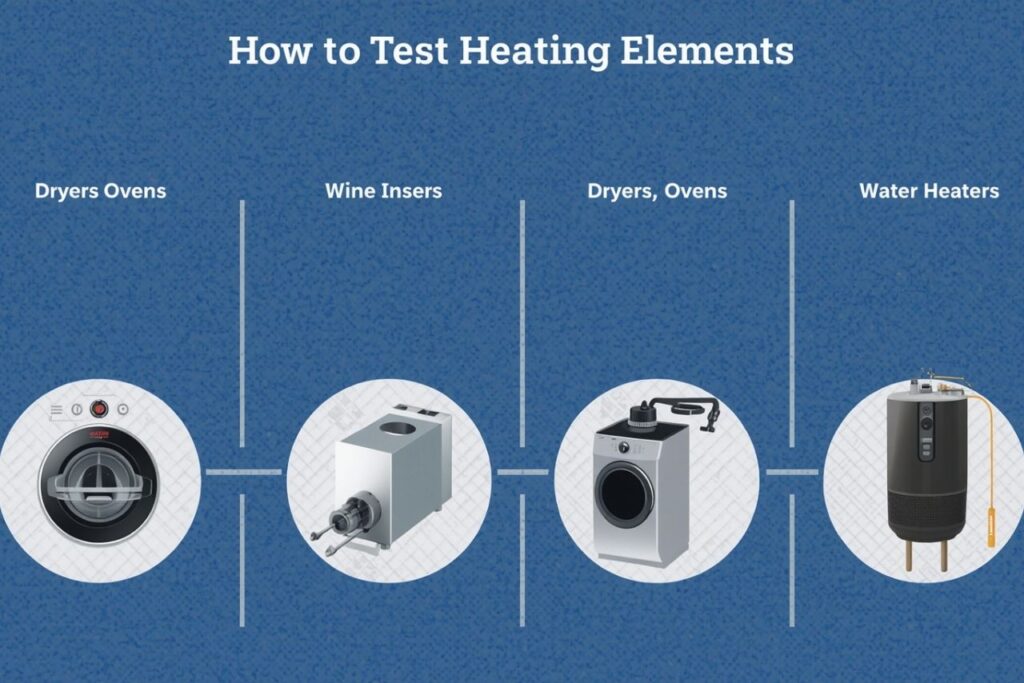
Testen von Heizelementen ist eine praktische Methode, um einen einfachen, kostengünstigen Fehler von einem tiefergehenden Steuerungs-, Verkabelungs- oder mechanischen Problem zu unterscheiden. In Trocknern, Backöfen und elektrischen Warmwasserbereitern ist ein Heizelement das resistive Bauteil, das elektrische Energie in Wärme umwandelt; wenn es unterbrochen wird (interner Bruch), einen Erdschluss verursacht oder außerhalb seines spezifizierten elektrischen Bereichs arbeitet, kann das Gerät schwach heizen, einen Schutzschalter auslösen oder die Heizfunktion vollständig einstellen. Diese Anleitung erklärt, wie Fachleute Fehler sicher überprüfen, welche Messwerte zu erwarten sind und wie die Ergebnisse für Garantie- oder Lieferantenunterstützung dokumentiert werden.
- Heating elements: what they are, what fails, and what “test” really means
- Tools, meter settings, and a fast decision tree
- How to test a dryer heating element (electric)
- How to test an oven bake/broil element
- How to test an electric water heater element
- How to interpret readings: resistance, wattage, and ground faults
- Element design choices that change failure patterns
- When testing points to a supply/spec issue (and what to tell a factory)
- FAQ
- Sources & further reading
Heating elements: what they are, what fails, and what “test” really means
A Heizelement ist eine Baugruppe, die eine resistive Legierung (das Bauteil, das die elektrische Last trägt) sowie Isolier- und Trägermaterialien umfasst, die den Strom dort halten, wo er hingehört, während Wärme in Luft, Wasser oder eine Metallplatte übertragen wird. Branchenreferenzen beschreiben das Kernprinzip oft als resistive (Joule’sche) Erwärmung und weisen darauf hin, dass das Heizelement mehr als nur ein Draht ist – Isolatoren, Anschlüsse und die mechanische Integration sind ebenso wichtig wie die Legierungsauswahl. Dies erklärt, warum zwei Elemente mit derselben Nennleistung in realen Geräten unterschiedlich reagieren können, insbesondere unter zyklischem Betrieb, Feuchtigkeit, Kalkablagerungen oder eingeschränktem Luftstrom.
Common failure modes (field reality)
- Unterbrechung Internal conductor breaks → no heat, infinite/OL resistance.
- Kurzschluss gegen Masse Insulation breakdown → breaker trips, GFCI trips, shock risk.
- Out of range Resistance changes (material, damage, overheating) → heats poorly or control faults.
- Wärmeübertragungsfehler Das Element ist elektrisch in Ordnung, aber Luftstrom/Wasserkontakt/Kalkablagerungen verursachen Überhitzung und vorzeitigen Ausfall.
What a “good test” should prove
A meaningful test verifies (1) continuity, (2) expected resistance range for the rated wattage/voltage, and (3) no leakage to the metal frame or water tank (ground). For water heaters, it also verifies the correct replacement part per the data plate and emphasizes filling/purging air before energizing to prevent dry-fire burnout.
Tools, meter settings, and a fast decision tree
For most appliances, the minimum toolkit is a digital multimeter with an ohms setting, insulated probes, a nut driver or socket set, and the discipline to confirm power is off. For water heaters, add a hose for draining, an element wrench or appropriately sized deep socket, and basic plumbing consumables (gasket).
Fast decision tree (practical workflow)
| Observed symptom | First test | Likely direction |
|---|---|---|
| Keine Wärmeentwicklung | Continuity + resistance check at element terminals | Open element, blown thermal fuse, failed relay, broken wiring |
| Breaker/GFCI trips | Resistance-to-ground test (element terminal to chassis) | Ground fault in element, wet terminal block, damaged wiring |
| Weak/slow heating | Compare measured Ω to expected Ω for rated V/W | Element out-of-spec, supply voltage low, scaling/airflow issues |
| Heats then fails repeatedly | Check airflow/water contact + scaling + mounting fit | Overheating, hot spots, poor heat sinking, incorrect watt density |
How to test a dryer heating element (electric)
Electric dryers commonly use a resistive heater assembly inside a metal housing, with airflow carrying heat through the drum. When airflow is restricted (lint, crushed venting), the element may overheat and fail early even if the electrical design is correct. That makes a “good” test both electrical and mechanical: confirm the element, then confirm the environment.
Step-by-step (continuity + resistance + ground)
- Stromversorgung trennen at the breaker. Confirm 0V at the dryer terminal block with a meter.
- Access the heater (varies by model). Photograph wiring before removal.
- Element isolieren: remove at least one lead to avoid reading through other circuits.
- Continuity test: a good element typically shows continuity; OL/infinite indicates an open element.
- Resistance test: record the ohms value and compare to the expected range (see calculator section below).
- Ground test: measure from each terminal to the metal heater frame. Any measurable continuity/low resistance suggests leakage to ground and is a red flag.
Was zu prüfen ist, wenn das Element “in Ordnung” scheint, aber dennoch keine Wärme erzeugt wird
Elektrische Prüfungen (allgemein)
- Korrekte Versorgungsspannung am Trockner (Fehlen einer Phase kann dazu führen, dass der Motor läuft, aber keine Wärme erzeugt wird).
- Status des Sicherheitsthermostats / der Temperatursicherung.
- Ausgang des Heizrelais / der Steuerplatine während eines Heizbefehls.
- Anschlussklemmenblock und Kabel auf Hitzeschäden oder lose Anschlüsse prüfen.
Luftstromprüfungen (Lebensdauerverlängerung)
- Flusensieb und Gehäuse gereinigt.
- Abluftkanal nicht gequetscht; Außenklappe öffnet vollständig.
- Übermäßig lange Abluftführung oder zu viele Bögen korrigiert.
How to test an oven bake/broil element
Ofenheizelemente sind typischerweise ummantelte Rohrheizkörper, die während des Betriebs rot glühen. Viele Fehler sind sichtbar (Blasenbildung, Risse, Durchbrennen), aber eine Sichtprüfung sollte die Messung nicht ersetzen. Ein Messgerät bestätigt, ob die innere Spule intakt ist und ob eine Leckage zum Ofengehäuse vorliegt.
Schritt-für-Schritt (sicherer Ansatz für die meisten Benutzer)
- Stromversorgung trennen am Sicherungsautomaten (die meisten Wandöfen und Elektroherde sind 240V).
- Zugang zu den Elementanschlüssen: Entfernen Sie die Rückwand (Herd) oder ziehen Sie das Element nach vorne (bei einigen Bauweisen), um die Flachsteckverbinder freizulegen.
- Element isolieren durch Abklemmen mindestens eines Kabels.
- Widerstand messen am Element. OL zeigt in der Regel ein defektes Element an.
- Prüfung gegen Erde: Elementanschluss zum Ofengehäuse sollte Unterbrechung (keine Durchgang) anzeigen.
Ofenspezifische Hinweise und häufige Fehldiagnosen
| Symptom | Ergebnis der Elementprüfung | Wahrscheinlicher nächster Schritt |
|---|---|---|
| Ungleichmäßiges Backen, lange Vorheizzeit | Widerstand höher als erwartet | Korrekte Ersatzleistung bestätigen; Verkabelung, Relais, Sensor-Kalibrierung prüfen |
| Grillen funktioniert, Backen nicht | Backelement OL | Backelement ersetzen; Anschlüsse auf Hitzeschäden prüfen |
| Sicherungsautomat löst beim Start des Backvorgangs aus | Ableitung zum Gehäuse | Element ersetzen; Kabelisolierung und Zugentlastung überprüfen |
How to test an electric water heater element
Elektro-Speicherwassererwärmer verwenden ein oder zwei Tauchheizkörper. Ein korrektes Verfahren muss sowohl das Risiko eines Stromschlags als auch das Risiko von Verbrühungen berücksichtigen. Die Herstelleranleitung für den Austausch betont, heißes Wasser laufen zu lassen, bis es kühl ist, die Kaltwasserzufuhr abzustellen, abzulassen und die Spannung und Leistung des Ersatzelements anhand des Typenschilds des Wassererwärmers vor der Installation zu überprüfen. Sie hebt auch einen kritischen Fehler hervor: Das Wiedereinschalten der Stromversorgung, bevor der Tank vollständig gefüllt ist, kann zu Trockenbrand führen und das obere Element zerstören.
Elektrische Prüfung (ohne Ausbau) — Durchgang und Widerstand
- Schalten Sie den Sicherungsautomaten aus und bestätigen Sie 0V an den Elementanschlüssen.
- Entfernen Sie die Abdeckung, die Isolierung und ggf. die Kunststoffabschirmung.
- Beschriften und trennen Sie die Kabel von den Elementanschlüssen.
- Widerstand messen am Elementanschluss und notieren Sie den Wert.
- Prüfung gegen Erde: Messen Sie von jedem Anschluss zum Metalltank. Ein gutes Element sollte keinen Durchgang zum Tank zeigen.
Austauschablauf (übergeordnet, gemäß Herstelleranleitung)
Das Folgende fasst eine übliche sichere Reihenfolge zusammen: Wasser abkühlen, Kaltwasserzufuhr abstellen, ablassen, Element mit einem Element-Schlüssel / Tiefbett-Steckschlüssel entfernen, Gewinde reinigen, Dichtung einbauen, festziehen, Kabel wieder anschließen, befüllen, Luft an einem Wasserhahn ablassen bis gleichmäßiger Durchfluss, auf Lecks prüfen, Abdeckungen/Isolierung wieder anbringen, dann Stromversorgung wiederherstellen. Herstelleranweisungen empfehlen außerdem, das Wasser mehrere Minuten lang voll laufen zu lassen, um die Luft zu entlüften, bevor die Stromversorgung wieder eingeschaltet wird.
Kalkablagerungen und Szenarien “gutes Element, schlechte Leistung”
In vielen Regionen sind mineralische Ablagerungen (Kalk) ein Hauptgrund für verminderte Heizleistung und vorzeitigen Elementausfall. Kalkablagerungen erhöhen den thermischen Widerstand zwischen Element und Wasser, erhöhen die Oberflächentemperatur des Elements und beschleunigen Oxidation oder Schäden an der Ummantelung. Wenn ein Element korrekt misst, aber die Wiederaufheizzeit schlecht bleibt, prüfen Techniker üblicherweise auf Sedimente, Kalk, Thermostatprobleme, Kabelüberhitzung oder Versorgungsspannungsprobleme.
How to interpret readings: resistance, wattage, and ground faults
Widerstandswerte sind nicht willkürlich; sie folgen grundlegenden elektrischen Beziehungen. Für einen Widerstandsheizkörper beträgt der erwartete Widerstand ungefähr: Widerstand (R) ≈ (V² / P) wobei (V) die Spannung und (P) die Leistung ist. Ein gemessener Wert weit über dieser Erwartung zeigt eine reduzierte Leistungsabgabe an. Ein Wert weit darunter kann auf eine kurzgeschlossene Spule oder eine falsche Elementleistung hinweisen – beides kann in manchen Systemen zu Überhitzung oder Fehlauslösungen führen.
Kurzreferenztabelle: Erwarteter Widerstand nach üblichen Leistungsangaben
| Stromspannung | Wattzahl | Erwarteter Widerstand (Ω) ≈ V² / P | Typischer Anwendungsfall |
|---|---|---|---|
| 120V | 1500W | ~9,6 Ω | Kleine Heizgeräte, einige Kompaktgeräte |
| 120V | 1000 W | ~14,4 Ω | Steckbare Handtuchwärmer/Heizkörper-Elemente (Beispiel-Produktkategorie) |
| 240 V | 4500 W | ~12,8 Ω | Viele elektrische Haushalts-Wassererwärmer |
| 240 V | 5500 W | ~10,5 Ω | Elektrische Haushalts-Wassererwärmer mit höherer Wiederaufheizrate |
Fehlerstromprüfung (Bedeutung)
Ein Fehlerstrom tritt auf, wenn Strom vom leitenden Pfad des Heizelements zu einem Metallmantel oder Gehäuse abfließt. In Geräten mit Erdung und Schutzvorrichtungen kann dies einen Schutzschalter oder FI-Schutzschalter auslösen. Bei Warmwasserbereitern ist ein Fehlerstrom besonders gefährlich, da das Heizelement in einem leitfähigen Tank mit Wasser installiert ist. Eine Kompromisslos-Regel bei der Wartung lautet: Jedes Heizelement, das Durchgang zum Gehäuse/Tank aufweist, ist als unsicher zu behandeln.
Element design choices that change failure patterns
Nicht alle Heizelemente sind gleich aufgebaut. Die Art und Weise, wie das Widerstandsmaterial gestützt wird – aufgehängt, gestützt oder eingebettet – verändert die Wärmeübertragung und das mechanische Verhalten. Eingebettete Bauformen (z. B. Patronenheizungen oder viele mit MgO gefüllte Mantelrohrkonstruktionen) nutzen die Wärmeleitung durch Isolierpulver zum Mantel; Luftstromheizungen sind stark auf Konvektionsdesign und -steuerung angewiesen. Dickschicht- und Dünnschichtsysteme bieten schnelles thermisches Ansprechverhalten und Gleichmäßigkeit, legen jedoch mehr Wert auf Substratwahl, Isolationsintegrität und Steuerungsstrategie.
Häufige Produktfamilien in Geräten und Heizungen
| Familie | Typische Konstruktion | Verwendungsbereich | Prüfhinweis |
|---|---|---|---|
| Röhrenförmige Heizelemente | Widerstandsdraht + MgO + Metallmantel (Edelstahl/Kupfer/Legierung) | Backöfen, Warmwasserbereiter, industrielle Luft-/Flüssigkeitserwärmung | Ω und Fehlerstrom prüfen; auch Wärmeübertragungsumgebung prüfen (Kalk/Luftstrom) |
| Heizplatten | Metall-/Keramiksubstrat mit gebondetem Heizbauteil | Reiskocher, Bügeleisen, Kaffeemaschinen, Kochplatten | Ω prüfen; Verzug, Haftung, Hotspots, Sensor Kontakt prüfen |
| Heizfolien (Dünn-/Dickschicht) | Gedruckte/geätzte/gesputterte Widerstandsschichten auf PET/Keramik | Smart-Sitze, Enteisung, Isolierung, kompakte Geräte | Ω messen; Isolationsintegrität und Steuergrenzen prüfen |
| Druckguss-Heizmodule | Integrierte Heizung + Metalldruckguss für Wärmeleitung und Festigkeit | Kaffeemaschinen, Wasserkocher, Heißwassergeräte, Thermomodule | Element kann in Ordnung sein; Sensoren, thermische Schnittstelle und Steueralgorithmus diagnostizieren |
Bezug zur Produktstruktur von Jinzhong
Jinzhong Electric Heating präsentiert sein **Heating Element**-Portfolio in drei Kernkategorien – Rohre, Platten und Folien – sowie integrierte **Die Casting Heating Solutions** und Hochleistungs-**Electric Boiler Heater**-Teile für kontinuierliche, hochbelastbare Flüssigkeitserwärmung. Diese Taxonomie spiegelt wider, wie Ingenieure typischerweise Lösungen auswählen: Medium (Luft/Wasser/feste Oberfläche), Platzbeschränkungen, erforderliche thermische Gleichmäßigkeit, Korrosionsbeständigkeit und Sicherheitsanforderungen wie Trockengehschutz.
Interne Anchor-Referenzen (Lieferantenseiten)
- Heizelement Übersicht und Kategorien
- Heizungsrohre für Wasserkocher, Backöfen, Warmwasserbereiter
- Heizplatte Serie für gleichmäßige Oberflächenerwärmung
- Heizfolie Kategorie für dünne/flexible Heizungen
- Druckguss-Heizlösungen Integrierte Thermomodule
- Elektrokessel-Heizung für Hochleistungs-Flüssigkeitserwärmungsszenarien
Unternehmenskontext (Leistungsfähigkeitssignale)
Wie auf der Unternehmenswebsite beschrieben, positioniert sich Jinzhong als in China ansässiger Hersteller von Heizelementen mit vollständiger Fertigungskette und einer monatlichen Kapazität von 3 Millionen Heizelementen, sowie ISO-bezogenen Managementsystemen und internationalen Zertifizierungen, die auf den Seiten genannt werden. Für Beschaffungsteams sind dies grundlegende Indikatoren, die bei der Lieferantenqualifizierung zu überprüfen sind (Auditberichte, Zertifikatsgültigkeit, Inspektionspläne, Rückverfolgbarkeit).
Bereitgestellte Anker: Hersteller von Heizelementen und Heizelement-Fabrik.
When testing points to a supply/spec issue (and what to tell a factory)
Wenn nach korrekter Installation wiederholt Feldausfälle auftreten, liegt die Ursache oft nicht allein an einer “schlechten Charge”. In Heizsystemen bilden das Element, die Steuerungsstrategie und die Umgebung eine einzige Zuverlässigkeitsschleife. Die Testdaten eines Technikers werden wertvoll, wenn sie Symptome mit einem messbaren Zustand verbinden: Widerstandsdrift, Ableitstrom zum Erdreich, Hotspot-Nachweise oder Wärmeübertragungsfehlanpassung (Kalk, schlechte Klemmung, eingeschränkter Luftstrom).
Was für EEAT-gerechte Fehlersuche und Eskalation zum Lieferanten zu dokumentieren ist
| Zu erfassende Daten | Warum das wichtig ist | Beispiele |
|---|---|---|
| Nennspannung/-leistung + gemessener Widerstand | Bestätigt korrektes Teil und identifiziert außerhalb des Bereichs liegende Drift | 240 V/4500 W Etikett; gemessen 18 Ω (unterdimensioniert) |
| Ergebnis der Ableit-/Erdungsprüfung | Sicherheitssignal; erklärt Schutzschalterauslösungen | Durchgang zwischen Anschluss und Mantel vorhanden |
| Installationsumgebung | Wärmeübertragungsfehler zerstören Heizelemente | Lüftungseinschränkung, starker Kalk, teilweises Eintauchen, Lufteinschlüsse |
| Einschaltdauer und Steuerungsmethode | Schnelle Zyklen verursachen thermische Ermüdung und Oxidation | Relaissteuerung vs. Triac/SSR; PID-Regelung; Sensorplatzierung |
| Fotos von Schäden | Visuelle Muster korrelieren mit der Ursache | Blasenbildung, Lichtbogenspuren, gerissener Mantel, verzogene Platte |
Lieferantenauswahl-Perspektive: Anpassung des Elementtyps an die Anwendung
Die Anwendungspassung ist in der Regel der schnellste Weg zu besserer Zuverlässigkeit. Rohrelemente eignen sich hervorragend für Flüssigkeiten und Hochtemperatur-Öfen, wenn Mantel und Leistungsdichte angemessen sind. Platten bieten eine gleichmäßige Wärmeleitung in Kochgeschirr oder Gehäuse. Folien unterstützen kompakte, massearme Baugruppen mit schnellem Ansprechverhalten. Integrierte Druckgussmodule verstärken Wärmeleitpfade und Verpackung, erfordern jedoch eine sorgfältige Sensorintegration und Oberflächenschnittstellenkontrolle. Branchenbezogene technische Referenzen heben auch hervor, wie Materialzusammensetzung, Spurenelemente in Legierungen und die Methode zur Stützung/Einbettung des Widerstandsleiters die Langlebigkeit unter Temperaturzyklen und Verunreinigungen verändern können.
FAQ
Was ist die zuverlässigste Methode, um festzustellen, ob ein Heizelement defekt ist?
Der zuverlässigste Ansatz besteht darin, das Element zu isolieren, den Widerstand zwischen den Anschlüssen zu messen und dann von jedem Anschluss zum Gehäuse/Tank zu messen, um einen Erdschluss auszuschließen. Eine Sichtprüfung hilft, aber elektrische Messungen liefern entscheidende Beweise.
Welcher Multimeter-Messwert zeigt ein durchgebranntes (offenes) Heizelement an?
Ein offenes Element zeigt typischerweise OL/unendlichen Widerstand an und besteht einen Durchgangstest nicht. In der Praxis zeigt das Messgerät keinen stabilen Ohmwert zwischen den Elementanschlüssen.
Warum löst ein Schutzschalter aus, wenn die Heizung eingeschaltet wird?
Auslösungen von Schutzschaltern oder Fehlerstromschutzschaltern werden häufig durch Ableitung gegen Erde (Isolationsbruch), beschädigte Verkabelung, Feuchtigkeit an den Anschlüssen oder ein kurzgeschlossenes Element verursacht. Eine Widerstandsprüfung zwischen Anschluss und Gehäuse ist eine schnelle Methode, um einen unsicheren Zustand zu bestätigen.
Kann ein Heizelementtest “gut” sein und dennoch nicht richtig heizen?
Ja. Wenn der Luftstrom eingeschränkt ist (Trockner), Ablagerungen das Element vom Wasser isolieren (Warmwasserbereiter), die Versorgungsspannung niedrig ist oder Steuerungen/Relais ausfallen, kann ein Element normalen Widerstand zeigen, aber im System eine schlechte Heizleistung liefern.
Was ist der größte Fehler beim Austausch eines Heizelements in einem elektrischen Warmwasserbereiter?
Die Wiederherstellung der Stromversorgung, bevor der Tank vollständig gefüllt und die Luft entlüftet ist. Dies kann zu Trockenbrand führen und das Element schnell zerstören. Die Herstelleranweisungen betonen, die Luft an einem Warmwasserhahn zu entlüften und sicherzustellen, dass der Tank voll ist, bevor die Spannung angelegt wird.
Fazit: Das Testen ist einfach, aber die Diagnose ist eine Systementscheidung
Ein Fachmann Heizelementtest hört nicht bei “Durchgang gut/schlecht” auf. Er setzt den Widerstand mit der Typenschildangabe in Beziehung, prüft auf Leckage gegen Erde und validiert anschließend die Umgebung, in der das Element arbeitet – Luftstrom bei Trocknern, Gehäusekontakt und Sensorsteuerung bei Backöfen sowie Füll- und Kalkbedingungen bei Warmwasserbereitern. Wenn Testergebnisse klar dokumentiert werden, wird die Fehlersuche reproduzierbar, und Gespräche mit Lieferanten entwickeln sich von Spekulationen zu technischen Fakten.
Für Teams, die Komponenten in großem Maßstab beschaffen, ist die Dokumentation von Fehlermodus und Betriebskontext auch der schnellste Weg zu besseren kundenspezifischen Designs – unabhängig davon, ob die Lösung ein **Rohrheizkörper**, eine **Heizplatte**, ein Dünn-/Dickschichtheizer oder ein integriertes Druckgussmodul ist.
<Teilen :