
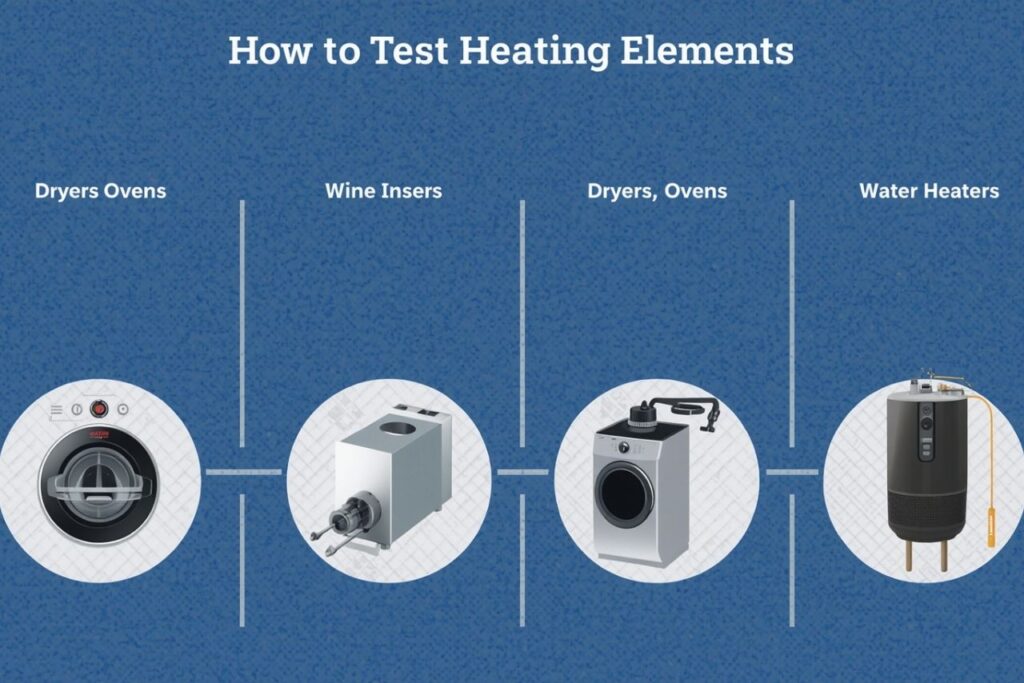
Testing heating elements is a practical way to separate a simple, low-cost fault from a deeper control, wiring, or mechanical problem. In dryers, ovens, and electric water heaters, a heating element is the resistive component that converts electrical energy into heat; when it opens (breaks internally), shorts to ground, or operates outside its specified electrical range, the appliance may heat weakly, trip a breaker, or stop heating altogether. This guide explains how professionals verify failure safely, what readings to expect, and how to document findings for warranty or supplier support.
- Heating elements: what they are, what fails, and what “test” really means
- Tools, meter settings, and a fast decision tree
- How to test a dryer heating element (electric)
- How to test an oven bake/broil element
- How to test an electric water heater element
- How to interpret readings: resistance, wattage, and ground faults
- Element design choices that change failure patterns
- When testing points to a supply/spec issue (and what to tell a factory)
- FAQ
- Sources & further reading
Heating elements: what they are, what fails, and what “test” really means
A heating element is an assembly that includes a resistive alloy (the part that carries the electrical load) and insulating/support materials that keep the current where it belongs while moving heat into air, water, or a metal plate. Industry references often describe the core principle as resistive (Joule) heating and note that the element is more than wire alone—insulators, terminals, and mechanical integration matter as much as alloy selection. This is why two elements with the same watt rating can behave differently in real equipment, especially under cycling, humidity, scaling, or restricted airflow.
Common failure modes (field reality)
- Open circuit Internal conductor breaks → no heat, infinite/OL resistance.
- Short to ground Insulation breakdown → breaker trips, GFCI trips, shock risk.
- Out of range Resistance changes (material, damage, overheating) → heats poorly or control faults.
- Heat transfer failure Element is electrically fine, but airflow/water contact/scale causes overheating and early failure.
What a “good test” should prove
A meaningful test verifies (1) continuity, (2) expected resistance range for the rated wattage/voltage, and (3) no leakage to the metal frame or water tank (ground). For water heaters, it also verifies the correct replacement part per the data plate and emphasizes filling/purging air before energizing to prevent dry-fire burnout.
Tools, meter settings, and a fast decision tree
For most appliances, the minimum toolkit is a digital multimeter with an ohms setting, insulated probes, a nut driver or socket set, and the discipline to confirm power is off. For water heaters, add a hose for draining, an element wrench or appropriately sized deep socket, and basic plumbing consumables (gasket).
Fast decision tree (practical workflow)
| Observed symptom | First test | Likely direction |
|---|---|---|
| No heat at all | Continuity + resistance check at element terminals | Open element, blown thermal fuse, failed relay, broken wiring |
| Breaker/GFCI trips | Resistance-to-ground test (element terminal to chassis) | Ground fault in element, wet terminal block, damaged wiring |
| Weak/slow heating | Compare measured Ω to expected Ω for rated V/W | Element out-of-spec, supply voltage low, scaling/airflow issues |
| Heats then fails repeatedly | Check airflow/water contact + scaling + mounting fit | Overheating, hot spots, poor heat sinking, incorrect watt density |
How to test a dryer heating element (electric)
Electric dryers commonly use a resistive heater assembly inside a metal housing, with airflow carrying heat through the drum. When airflow is restricted (lint, crushed venting), the element may overheat and fail early even if the electrical design is correct. That makes a “good” test both electrical and mechanical: confirm the element, then confirm the environment.
Step-by-step (continuity + resistance + ground)
- Disconnect power at the breaker. Confirm 0V at the dryer terminal block with a meter.
- Access the heater (varies by model). Photograph wiring before removal.
- Isolate the element: remove at least one lead to avoid reading through other circuits.
- Continuity test: a good element typically shows continuity; OL/infinite indicates an open element.
- Resistance test: record the ohms value and compare to the expected range (see calculator section below).
- Ground test: measure from each terminal to the metal heater frame. Any measurable continuity/low resistance suggests leakage to ground and is a red flag.
What to check if the element “tests good” but there is still no heat
Electrical checks (common)
- Correct supply voltage at the dryer (one leg missing can cause motor run/no heat).
- High-limit thermostat / thermal fuse status.
- Heater relay/control board output during a heat call.
- Terminal block and cord for heat damage or loose lugs.
Airflow checks (life-extension)
- Lint filter and housing cleaned.
- Vent duct not crushed; exterior flap opens fully.
- Excessively long ducting or too many elbows corrected.
How to test an oven bake/broil element
Oven elements are typically sheathed tubular heaters that glow red during operation. Many failures are visible (blistering, cracks, burn-through), but visual inspection should not replace measurement. A meter confirms whether the internal coil is intact and whether there is leakage to the oven chassis.
Step-by-step (safer approach for most users)
- Disconnect power at the breaker (most wall ovens and electric ranges are 240V).
- Access element terminals: remove the rear panel (range) or pull the element forward (some designs) to expose spade connectors.
- Isolate the element by removing at least one wire.
- Measure resistance across the element. OL typically indicates a failed element.
- Test to ground: element terminal to oven chassis should read open (no conduction).
Oven-specific clues and common misdiagnoses
| Symptom | Element test result | Likely next step |
|---|---|---|
| Uneven baking, long preheat | Resistance higher than expected | Confirm correct replacement rating; inspect wiring, relay, sensor calibration |
| Broil works, bake doesn’t | Bake element OL | Replace bake element; inspect terminals for heat damage |
| Breaker trips when bake starts | Leakage to chassis | Replace element; verify harness insulation and strain relief |
How to test an electric water heater element
Electric storage water heaters use one or two immersion elements. A correct procedure must address both electrical shock risk and scalding risk. Manufacturer guidance for replacement emphasizes running hot water until it is cool, turning off the cold supply, draining, and verifying the replacement element’s voltage and wattage using the water heater data plate before installation. It also highlights a critical mistake: restoring power before the tank is completely full can dry-fire and destroy the upper element.
Electrical test (without removal) — continuity and resistance
- Turn off the breaker and confirm 0V at the element terminals.
- Remove the access cover, insulation, and plastic shield if present.
- Label and disconnect wires from the element terminals.
- Measure resistance across the element terminals and record the value.
- Test to ground: measure from each terminal to the metal tank. A good element should show no continuity to the tank.
Replacement workflow (high-level, aligned with manufacturer guidance)
The following summarizes a common safe sequence: cool the water, shut off cold supply, drain, remove element using an element wrench/deep socket, clean threads, install gasket, tighten, reconnect wires, refill, purge air at a faucet until steady flow, check leaks, reinstall covers/insulation, then restore power. Manufacturer instructions also advise letting water run full stream for several minutes to purge air before turning power back on.
Scaling and “good element, bad performance” scenarios
In many regions, mineral scaling is a primary driver of reduced heating performance and early element failure. Scaling increases thermal resistance between the element and water, raising element surface temperature and accelerating oxidation or sheath damage. When an element measures correctly but recovery time remains poor, technicians commonly check for sediment, scale, thermostat issues, wiring overheating, or supply voltage problems.
How to interpret readings: resistance, wattage, and ground faults
Resistance values are not arbitrary; they follow basic electrical relationships. For a resistive heater, the expected resistance is approximately: Resistance (R) ≈ (V^2 / P) where (V) is voltage and (P) is wattage. A measured value far above that expectation indicates reduced power output. A value far below can indicate a shorted coil or incorrect element rating—either can create overheating or nuisance trips in some systems.
Quick reference table: expected resistance by common ratings
| Voltage | Wattage | Expected Resistance (Ω) ≈ V² / P | Typical Use Case |
|---|---|---|---|
| 120V | 1500W | ~9.6 Ω | Small heaters, some compact appliances |
| 120V | 1000W | ~14.4 Ω | Plug-in towel warmer/radiator elements (example product category) |
| 240V | 4500W | ~12.8 Ω | Many residential electric water heaters |
| 240V | 5500W | ~10.5 Ω | Higher-recovery residential electric water heaters |
Ground fault testing (why it matters)
A ground fault occurs when current leaks from the element’s conductive path to a metal sheath or chassis. In appliances with grounding and protection devices, this may trip a breaker or GFCI. In water heaters, ground leakage can be especially dangerous because the element is installed in a conductive tank with water present. A no-compromise rule in service work is that any element showing continuity to the chassis/tank should be treated as unsafe.
Element design choices that change failure patterns
Not all heating elements are built the same. How the resistive material is supported—suspended, supported, or embedded—changes heat transfer and mechanical behavior. Embedded styles (such as cartridge or many sheathed tubular designs filled with MgO) rely on conduction through insulating powder to the sheath; airflow heaters rely heavily on convective design and control. Thick-film and thin-film systems offer fast thermal response and uniformity but place more emphasis on substrate choice, insulation integrity, and control strategy.
Common product families seen in appliances and heaters
| Family | Typical construction | Where used | Testing note |
|---|---|---|---|
| Tubular heating elements | Resistance wire + MgO + metal sheath (stainless/copper/alloy) | Ovens, water heaters, industrial air/liquid heating | Check Ω and ground leakage; also check heat transfer environment (scale/airflow) |
| Heating plates | Metal/ceramic substrate with bonded heating component | Rice cookers, irons, coffee makers, hot plates | Check Ω; inspect warping, adhesion, hot spots, sensor contact |
| Heating films (thin/thick film) | Printed/etched/sputtered resistive layers on PET/ceramic | Smart seats, defrosting, insulation, compact appliances | Measure Ω; verify insulation integrity and controller limits |
| Die-cast heating modules | Integrated heater + metal die-casting for conduction and strength | Coffee machines, kettles, hot pots, thermal modules | Element may test good; diagnose sensors, thermal interface, and control algorithm |
Where this aligns with Jinzhong’s product structure
Jinzhong Electric Heating presents its **Heating Element** portfolio across three core categories—tubes, plates, and films—plus integrated **Die Casting Heating Solutions** and high-power **Electric Boiler Heater** parts for continuous, high-load liquid heating. This taxonomy mirrors how engineers typically choose solutions: medium (air/water/solid surface), space constraints, required thermal uniformity, corrosion resistance, and safety constraints such as dry-boil protection.
Internal anchor references (supplier pages)
- Heating Element overview and categories
- Heating Tubes for kettles, ovens, water heaters
- Heating Plate series for uniform surface heating
- Heating Film thin/flexible heating category
- Die Casting Heating Solutions integrated thermal modules
- Electric Boiler Heater for high-power liquid heating scenarios
Company context (capability signals)
As described on the company site, Jinzhong positions itself as a China-based heating element manufacturer with full-chain manufacturing and a monthly capacity stated at 3 million heating elements, alongside ISO-related management systems and international certifications referenced on its pages. For procurement teams, these are baseline indicators to verify during supplier qualification (audit reports, certificate validity, inspection plans, traceability).
Provided anchors: Heating Element manufacturer and Heating Element Factory.
When testing points to a supply/spec issue (and what to tell a factory)
If repeated field failures occur after correct installation, the root cause is often not “a bad batch” alone. In heating systems, the element, control strategy, and environment form a single reliability loop. A technician’s test data becomes valuable when it connects symptoms to a measurable condition: resistance drift, leakage to ground, hot-spot evidence, or heat transfer mismatch (scale, poor clamping, restricted airflow).
What to document for EEAT-grade troubleshooting and supplier escalation
| Data to capture | Why it matters | Examples |
|---|---|---|
| Rated voltage/wattage + measured resistance | Confirms correct part and identifies out-of-range drift | 240V/4500W label; measured 18Ω (underpowered) |
| Leakage/ground test result | Safety signal; explains breaker trips | Terminal-to-sheath continuity present |
| Installation environment | Heat transfer failures kill elements | Vent restriction, heavy scale, partial immersion, air pockets |
| Duty cycle and control method | Rapid cycling drives thermal fatigue and oxidation | Relay control vs triac/SSR; PID tuning; sensor placement |
| Photos of damage | Visual patterns correlate to root cause | Blistering, arc tracking, cracked sheath, warped plate |
Supplier selection lens: matching element type to application
Application-fit is usually the fastest route to better reliability. Tubular elements excel in liquids and high-temperature ovens when sheath and watt density are appropriate. Plates provide uniform conduction into cookware or housings. Films support compact, low-mass assemblies requiring fast response. Integrated die-cast modules strengthen conduction paths and packaging but require careful sensor integration and surface interface control. Industry engineering references also highlight how material composition, trace elements in alloys, and the method of supporting/embedding the resistive conductor can change longevity under temperature cycling and contaminants.
FAQ
What is the most reliable way to confirm a heating element is bad?
The most reliable approach is to isolate the element, measure resistance across terminals, and then measure from each terminal to chassis/tank to rule out a ground fault. Visual inspection helps, but electrical measurements provide decisive evidence.
What multimeter reading indicates a blown (open) heating element?
An open element typically reads OL/infinite resistance and fails a continuity test. In practical terms, the meter will not show a stable ohms value across the element terminals.
Why does a breaker trip when the heater turns on?
Breaker or GFCI trips are commonly caused by leakage to ground (insulation breakdown), damaged wiring, moisture at terminals, or a shorted element. A terminal-to-chassis resistance check is a fast way to confirm an unsafe condition.
Can a heating element test “good” and still not heat properly?
Yes. If airflow is restricted (dryers), scale insulates the element from water (water heaters), the supply voltage is low, or controls/relays are failing, an element may show normal resistance yet deliver poor heating performance in the system.
What is the biggest mistake during electric water heater element replacement?
Restoring power before the tank is completely full and air is purged. This can dry-fire and destroy the element quickly. Manufacturer instructions emphasize purging air at a hot water faucet and ensuring the tank is full before energizing.
Conclusion: testing is simple, but the diagnosis is a system decision
A professional heating element test does not stop at “continuity good/bad.” It ties resistance to the nameplate rating, checks for leakage to ground, and then validates the environment that the element operates in—airflow for dryers, chassis contact and sensor control for ovens, and fill/scale conditions for water heaters. When test results are documented clearly, troubleshooting becomes repeatable, and supplier conversations move from guesswork to engineering facts.
For teams sourcing components at scale, documenting failure mode and operating context is also the fastest path to better custom designs—whether the solution is a **tubular heating element**, a **heating plate**, a thin/thick-film heater, or an integrated die-cast module.
<Share :

