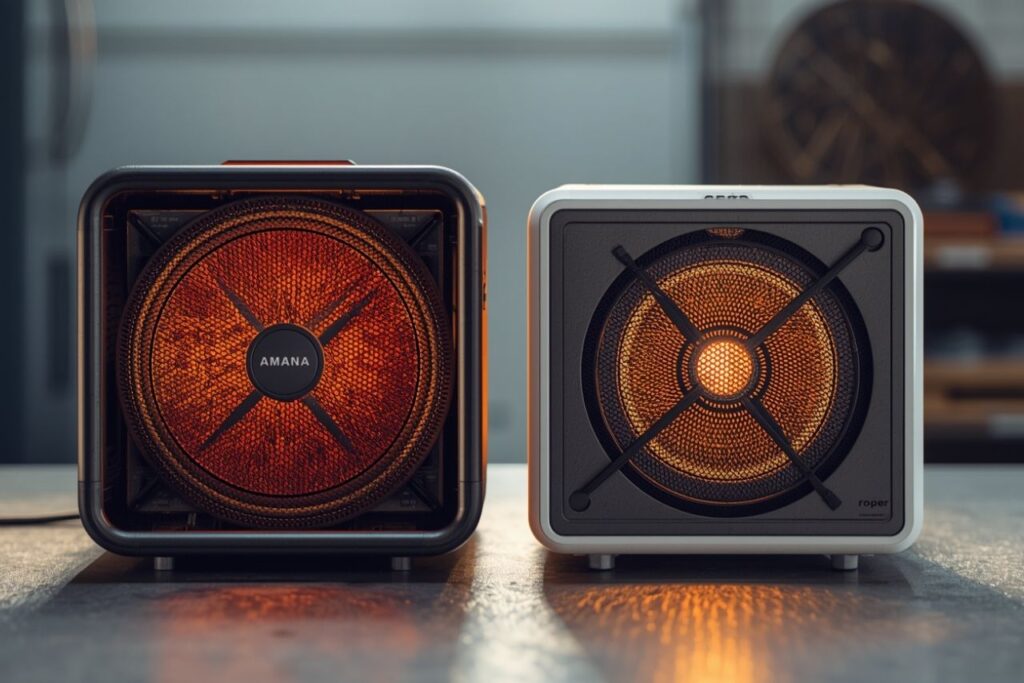
Heating elements for Roper and Amana dryers are sometimes interchangeable, but they are not “universally” interchangeable across all models. Interchangeability depends on the exact dryer model platform and the heating element being the correct **assembly**: matching electrical rating (voltage/wattage), physical form factor, mounting points, terminal layout, and how the coil is supported inside the heater housing. The safest selection method is to confirm the exact dryer model number and cross-reference the correct part number (or verified substitute) rather than relying on brand name alone.
Internal references: Heating Element, Heating Element manufacturer, Heating Element Factory, Die Casting Heating Solutions.
- What “interchangeable” actually means for dryer heating elements
- Roper vs Amana: brand label vs platform reality
- Compatibility checklist (what must match)
- Risks of “close enough” substitutions
- How to verify the correct element (practical workflow)
- Tables & charts: decision matrix, mismatch symptoms, spec fields
- FAQ (6 questions)
- Conclusion
- References and outbound links
What “interchangeable” actually means for dryer heating elements
In appliance repair, “interchangeable” should mean that the replacement part is functionally and safely equivalent in the target product—not simply that it “fits” or has similar terminals. Engineering guidance describes a heating element as a component made of both electrically conductive and insulating/support materials, including terminals and framework. In other words, a dryer heating element is not only a coil; it is an **electrical heating element assembly** whose geometry and supports help control heat transfer, clearances, and failure modes.
Same electrical rating and safe thermal behavior, same mounting and clearances, correct connector style, compatible with existing thermostats/ducting/airflow.
Bolts in place but runs hotter/colder, cycles abnormally, stresses connectors, or changes safety-device response. This is not a safe substitution standard.
Section summary
A dryer heating element is an **assembly**, so interchangeability must be evaluated as electrical + mechanical + thermal compatibility, not brand similarity.
Roper vs Amana: brand label vs platform reality
Roper and Amana are brand names. The dryer’s underlying design “platform” (heater duct size, element support method, airflow path, and control/safety device layout) determines what element assembly is required. Two dryers with different brand badges may share the same platform and accept the same element; two dryers with the same badge may use different platforms and require different elements.
Why platform matters (thermal behavior)
Heating element design interacts with airflow and the surrounding framework. Engineering references categorize wire elements by how they sit within insulation/support structures (for example, “supported” vs “suspended” concepts), which affects heat transfer and sag/clearance concerns. A heater duct designed for one element support style may not safely accept another, even if the terminals appear similar.
Section summary
Brand names alone do not define parts compatibility; the dryer model platform does.
Compatibility checklist (what must match)
A reliable compatibility review checks the specifications and interfaces that determine safe performance. The following checklist is intentionally conservative.
| Compatibility factor | What to match | Why it matters |
|---|---|---|
| Electrical rating | Voltage and wattage as specified for the dryer | Wrong wattage changes heat output and coil temperature; wrong rating can stress circuits and safety devices |
| Physical form factor | Overall dimensions, frame shape, element path, and clearances | Prevents coil contact with metal housing (shorting/hot spots) |
| Mounting points | Screw positions, tabs, bracket orientation | Ensures the assembly cannot shift or vibrate into failure |
| Terminal layout | Terminal type, spacing, and insulation condition | Loose or mismatched terminals create high-resistance heating and arcing risk |
| Support/insulation framework | Insulators and coil supports compatible with the heater box | Engineering guidance stresses that supports and insulators are part of the element “component” |
| Airflow compatibility | Element designed for the duct’s airflow and pressure drop | Airflow is the “cooling” mechanism; restrictions raise coil temperature and shorten life |
Section summary
True interchangeability requires matching rating, geometry, terminals, supports, and airflow interaction—not just bolt pattern.
Risks of “close enough” substitutions
Substituting an element that is “similar” but not verified can create a range of problems: nuisance high-limit cycling, scorched connectors, repeated element burnouts, and in worst cases, overheating events. Engineering discussions also highlight that heater life depends on oxidation behavior and operating temperature; higher coil temperature generally accelerates degradation. In dryers, restricted airflow and poor connections are common contributors to excessive local temperatures.
Practical red flags
- Element terminals do not match existing connectors (forcing fit, loose spades, or adapter hacks).
- Element frame does not fully seat into the heater duct (gaps, bending required).
- Burn marks on wiring or thermostat terminals near the heater.
- Repeated element failures with no vent/airflow corrective work performed.
Section summary
“Close enough” substitutions can alter coil temperature and connection quality—two major drivers of premature failure and unsafe operation.
How to verify the correct element (practical workflow)
The recommended workflow is model-first and specification-driven. Manufacturer service guidance in other heater contexts explicitly instructs verifying the replacement by checking the unit’s data plate for voltage and wattage before installation. The same discipline applies here: verify the dryer model, then verify the correct part number and electrical/physical attributes.
Step-by-step verification workflow
- Identify the exact model number from the dryer’s data plate.
- Find the OEM part number for the heating element assembly for that model.
- Check approved substitutes (if any) from reputable catalogs that explicitly list compatibility by model.
- Confirm key specs: voltage/wattage, frame geometry, terminals, mounting points.
- Inspect installation environment: vent restriction and lint accumulation must be corrected to prevent repeat failures.
Why spec literacy matters (contextual example)
Retail listings for heating elements in other applications commonly present essential spec fields such as power (e.g., 1000W), materials (e.g., ABS + stainless steel), approvals (e.g., UL), and protection ratings (e.g., IP67). Even though a plug-in radiator element is not a dryer element, the lesson is that disciplined reading of spec fields is a core competency when selecting heater components.
Section summary
Verification should be model-driven and spec-driven: confirm model → confirm part number/substitute → confirm voltage/wattage and interfaces → correct airflow issues.
Tables & charts: decision matrix, mismatch symptoms, spec fields
Table 1: Interchangeability decision matrix
| Check result | Meaning | Recommendation |
|---|---|---|
| Exact part number match | Same intended element assembly for the model | Proceed (after correcting airflow/lint issues) |
| Catalog lists substitute for the same model | Verified interchangeability by model cross-reference | Proceed, but compare terminals/mounting before installing |
| Brand-only match (Roper ↔ Amana) without model cross-ref | Unverified assumption | Do not treat as interchangeable; verify by model/platform |
| Similar shape but different terminals/mounts | Likely different platform | Do not install; source correct assembly |
Table 2: Common mismatch symptoms (after a “wrong but fits” install)
| Observed behavior | Potential mismatch driver | What to check first |
|---|---|---|
| High-limit thermostat cycles frequently | Wattage/geometry/airflow incompatibility → higher coil temperature | Vent restriction, lint, heater duct seating, element rating |
| Scorched connectors or melting insulation | Terminal fitment mismatch or loose spade connection | Connector tightness, correct terminal type, replace damaged terminals |
| Breaker trips | Short to chassis, incorrect assembly clearance, damaged insulation | Stop use; inspect for contact/short; professional evaluation |
| Weak heat output | Lower wattage element, control mismatch, or electrical supply issue | Verify rating and supply; confirm element is correct for model |
Table 3: Dryer element selection “spec fields” checklist
| Spec field | What to record | Why it is important |
|---|---|---|
| Dryer model number | Full model ID from data plate | Primary key for correct part selection |
| Element rating | Voltage and wattage | Ensures correct heat output and safe electrical load |
| Assembly geometry | Frame shape, coil path, mounting points | Controls clearances and vibration stability |
| Terminal style | Spade size/type, spacing, insulation | Prevents loose connections and local overheating |
Section summary
A decision matrix and symptom map help distinguish “verified substitute” from “brand-based guess,” and they highlight typical mismatch failure signatures.
FAQ
1) If a Roper element physically bolts into an Amana heater box, is it interchangeable?
Not automatically. Bolt-in fit does not confirm correct rating, terminal compatibility, or safe thermal behavior. Interchangeability should be confirmed by model cross-reference and specification match.
2) What is the single most important compatibility check?
The dryer model number and the correct element part number/substitute list. If the part is verified for that model, the remaining checks (terminals, mounts, clearances) should still be confirmed before installation.
3) Why do terminals matter so much?
Loose or mismatched terminals increase electrical resistance at the connection point, which creates localized heating. This can damage wiring, cause intermittent heat, and shorten component life.
4) Can airflow issues mimic a “wrong element” problem?
Yes. Vent restriction and lint buildup raise internal temperatures and can cause high-limit cycling and repeated element burnouts even when the correct element is installed.
5) Are heating elements “just coils of wire”?
No. Engineering definitions describe a heating element as an assembly including conductive alloy plus insulating framework and terminals. Those non-coil components strongly influence safety and durability.
6) Is it acceptable to use a “universal” element kit to cover both brands?
Universal kits can work only when they are explicitly listed as compatible with the exact dryer model and platform and do not require unsafe modifications. If the kit requires bending frames, adapting terminals, or bypassing safety devices, it should be rejected.
Conclusion
Roper and Amana dryer heating elements can be interchangeable in certain cases, but interchangeability is determined by the dryer’s model platform—not the badge. A correct substitution must match voltage/wattage, physical and mounting geometry, terminal interfaces, and coil support/clearance behavior. Following a model-driven verification workflow and correcting airflow restrictions is the most reliable way to avoid repeat failures and ensure safe operation.
References and outbound links
Heating element engineering concepts (assembly definition, alloys, supported/suspended/embedded frameworks, environment effects, watt density and life considerations):
https://tutco.com/conductive/heating-elements
Verification discipline (check data plate for voltage and wattage; safe sequencing mindset):
https://www.whirlpoolwaterheaters.com/support/help/element-was-out-of-range/24
Manufacturer product-family context (heating tubes/plates/films and customization framing):
https://jinzho.com/product-category/heating-element/
https://jinzho.com/product-category/heating-element/heating-tubes/
https://jinzho.com/product-category/heating-element/heating-plate/
https://jinzho.com/product-category/heating-element/heating-film/
https://jinzho.com/product-category/die-casting-heating-solutions/
https://jinzho.com/
Spec-format literacy example (wattage/materials/approval fields on a heating element listing):
https://usa.hudsonreed.com/1000-plug-in-watt-electric-heating-element-76309
Disclosure: This article provides general compatibility guidance. Exact Roper and Amana dryer designs vary by model and production series; verified model-based part cross-references should be used for final selection.