When a ceramic space heater stops heating, cycles on and off too quickly, or trips a safety cutoff, the root cause is usually not the ceramic itself. The failure point is typically in airflow restriction, temperature sensing, power delivery, or a protective device that is doing its job. This guide provides a structured, low-risk troubleshooting flow for ceramic-element heaters, with emphasis on electrical safety, airflow diagnostics, and evidence-based checks that match how heating elements are built and controlled.
Required internal resources: Heating Element, Heating Element manufacturer, Heating Element Factory, Die Casting Heating Solutions.
- Safety boundaries and “stop-now” symptoms
- How ceramic element heaters are constructed (why failures cluster)
- Fast triage checklist (5 minutes)
- Symptom-to-cause decision table
- Step-by-step troubleshooting flow
- Maintenance actions that prevent repeat failures
- FAQ (6 questions)
- Sources used and outbound links
Safety boundaries and “stop-now” symptoms
A portable space heater is a high-power appliance. Troubleshooting must start with risk control. The heater should be unplugged before any inspection, cleaning, or disassembly.
Stop immediately and do not power back on if any of the following is present
- Burning plastic smell, visible melting, smoke from internal wiring
- Sparking/arcing, buzzing near the plug or switch
- Power cord damage, loose plug blades, or hot-to-the-touch cord/plug
- Repeated breaker trips on multiple outlets
These symptoms point to faults that should be handled by a qualified technician or addressed via replacement.
How ceramic element heaters are constructed (why failures cluster)
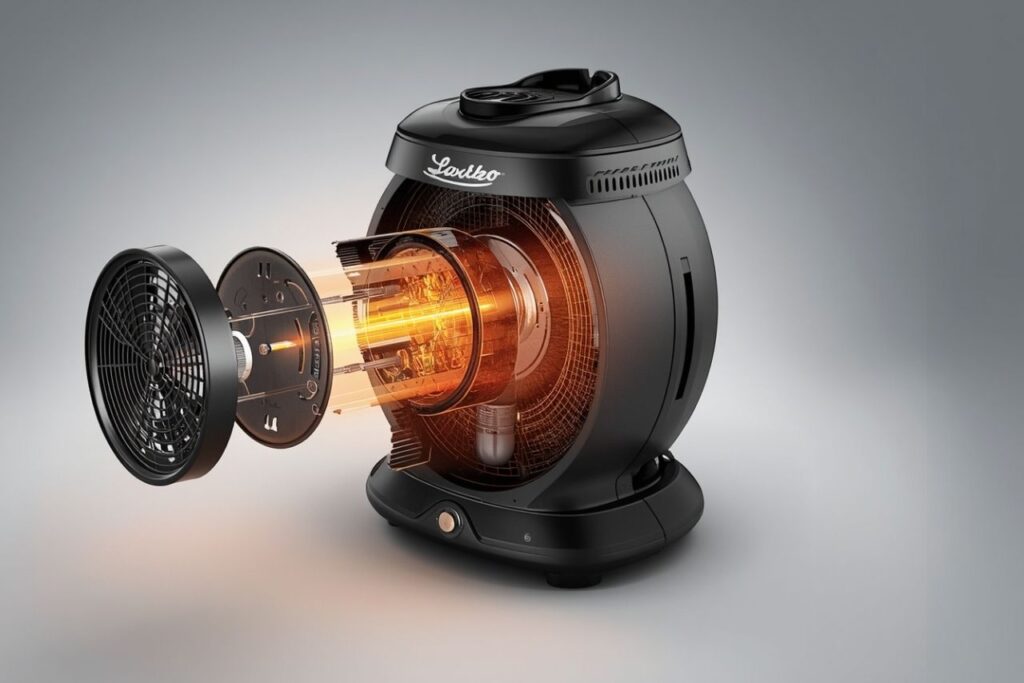
“Ceramic heater” is often a label for the insulating/support material or the heating module style—not a complete technical description. In heater engineering terms, a heating element is a component composed of electrically conductive material plus insulating material, assembled with terminals and supports to serve a heating purpose. In open or airflow-heated designs, wire elements may be suspended or supported by ceramic or mica, transferring heat largely by convection and radiation.
That construction explains why the most common field problems look like “heater stopped working,” when the real trigger is airflow or overtemperature protection. Restricted airflow drives internal temperatures up; protective controls react by cycling power, reducing output, or shutting down.
Fast triage checklist (5 minutes)
External checks (no tools)
- Outlet test: confirm the outlet works using another device.
- Heater mode: confirm it is set to heat (not fan-only) and temperature is set above room temperature.
- Placement: ensure clear intake and exhaust (no curtains, bedding, or wall clearance violations).
- Power path: avoid extension cords; plug directly into a wall outlet.
Visual intake/exhaust inspection
If intake grills show lint, pet hair, or dust mats, airflow is already compromised. Many ceramic heater “no heat” complaints resolve after cleaning the intake and internal dust accumulation (performed safely and without disassembly where possible).
Why airflow matters so much
In convective heater designs, the element is intended to transfer heat to moving air. If airflow falls, the element and nearby structures run hotter, raising the likelihood of protective shutdown or accelerated wear. Heater engineers explicitly design around airflow, pressure drop, and element temperature uniformity.
Symptom-to-cause decision table
| Symptom | Most likely cause | Low-risk check | Best next action |
|---|---|---|---|
| Fan runs, no heat | Thermostat set too low; safety cutoff engaged; heating circuit fault | Raise setpoint; move to warmer outlet circuit; inspect intake dust | Clean airflow path; if persists, service/replace |
| Heats briefly then shuts off | Overheat protection triggered (often airflow) | Check intake/exhaust clearance and dust load | Clean, cool-down reset; reassess placement |
| Trips breaker | Overcurrent; shared circuit load; internal fault | Try different dedicated outlet; remove other loads | If still trips, stop use and service/replace |
| Burning smell (dusty) first use | Dust burn-off on hot surfaces | Inspect for lint; check whether smell fades quickly | Clean intake; ventilate; discontinue if persistent acrid odor |
| Controls seem unresponsive | Thermostat sensor placement or control fault | Move heater away from drafts; confirm setpoint behavior | Service/replace if behavior is unstable |
Step-by-step troubleshooting flow
Step 1: Confirm a stable power source
The heater should be tested on a known-good wall outlet. If possible, use a different circuit. A heater sharing a circuit with other high-load appliances may appear “faulty” due to voltage drop or breaker trips.
Step 2: Reset conditions safely
Many portable heaters require a cool-down period after an overheat event. Unplugging and waiting allows protective devices to reset. The heater should never be covered or operated with restricted airflow.
Step 3: Inspect and clean airflow paths
Airflow restriction is the most common fixable cause of cycling and shutdown. Cleaning should be dry and gentle: use a soft brush and vacuum on exterior grills. If the manufacturer permits, compressed air can remove internal dust—performed carefully to avoid damaging delicate components.
In heater design discussions, the environment is treated as a core input. Contaminants and humidity can shorten heater life, and dust changes heat transfer. Consistent airflow keeps element temperature more uniform and reduces thermal stress.
Step 4: Evaluate thermostat behavior (controlled test)
A simple functional check is to set the heater to maximum heat and maximum setpoint for a short interval in a ventilated area, then reduce setpoint gradually. If output never changes, the issue may be control-related. If it cycles rapidly, the issue is often sensor placement, airflow, or heat trapping.
Step 5: Decide between repair and replacement
Portable heaters are typically not economical to repair at the component level unless a qualified service path exists. If a heater trips breakers, shows electrical odor, or repeatedly overheats after cleaning and proper placement, replacement is often the safer decision.
Why “element replacement” is rarely a consumer step for space heaters
Some heating products (for example, water heaters) provide structured procedures for replacing elements and emphasize critical safety rules, such as not energizing an element until the system is properly filled to avoid dry-fire damage. Portable space heaters are usually built as integrated assemblies; their safe servicing depends on design-specific guidance and parts availability.
Maintenance actions that prevent repeat failures
Routine cleaning schedule
| Interval | Action | Purpose |
|---|---|---|
| Weekly (heavy use) | Vacuum exterior intake/exhaust grills | Maintain airflow and reduce overheat trips |
| Monthly | Inspect cord/plug for heat discoloration or looseness | Reduce electrical hazard risk |
| Seasonal | Deep dust removal per manufacturer guidance | Improve stability of operation and longevity |
Material and module context (why this site discusses elements broadly)
Space heaters are only one endpoint for electric heating technologies. Manufacturers typically supply multiple element families—such as heating tubes (with sheaths, insulation powder, resistance wire), heating plates for uniform surface heating, and heating films for compact, conformal designs. Integrated die-cast thermal modules are also used in many appliances to improve heat transfer and mechanical robustness.
FAQ
Why does a ceramic space heater turn on and off so often?
Rapid cycling usually indicates the control system is reaching a temperature limit quickly—commonly due to restricted airflow, heat trapping, or sensor placement. Cleaning the intake and ensuring proper clearance typically reduces cycling frequency.
What does it mean if the fan runs but there is no heat?
Fan-only operation can occur when the thermostat setpoint is too low, a safety cutoff is engaged, or the heating circuit is not energizing. A controlled test with a higher setpoint and a clean airflow path is the first step.
Is a “burning smell” always dangerous?
A brief dusty odor can occur when dust burns off hot surfaces, especially at seasonal startup. A persistent acrid smell, visible smoke, or any sign of melting indicates the heater should be unplugged and not used.
Why does the heater trip a breaker on one outlet but not another?
The first outlet may share a circuit with other loads or have wiring that is not suitable for sustained high current draw. Testing on a dedicated circuit helps isolate whether the issue is the heater or the circuit.
Can the ceramic element itself be cleaned?
Cleaning should focus on airflow paths and dust removal. Direct scrubbing of internal heater components is not recommended unless the manufacturer explicitly provides instructions. The “element” is an assembly that includes conductive parts and insulating supports; damage can reduce safety margins.
When should a heater be replaced instead of troubleshot?
Replacement is the safer path when there are electrical fault signs (sparks/arcing, melting odor, hot plug/cord), repeated breaker trips across outlets, or persistent overheating after cleaning and correct placement.
Closing summary
Most ceramic heater failures that users can safely influence are airflow-related. A structured approach—power verification, cool-down reset, airflow cleaning, and controlled thermostat tests—solves a large share of “no heat” and cycling complaints while keeping risk low.
Sources used and outbound links
Engineering definitions and element construction concepts (heating element as conductive + insulating framework; suspended/supported/embedded classifications;
materials and environmental contaminants; watt density considerations) were based on:
https://tutco.com/conductive/heating-elements
Manufacturer product-family context (tubes/plates/films; die-cast integration; high-level capabilities and positioning) was based on:
https://jinzho.com/
https://jinzho.com/product-category/heating-element/
https://jinzho.com/product-category/die-casting-heating-solutions/
Safety-process framing example (element replacement steps emphasizing sequence and dry-fire avoidance in a different appliance category) was based on:
https://www.whirlpoolwaterheaters.com/support/help/element-was-out-of-range/24
Note: This guide is supplemental and should not override the heater’s printed manual or local electrical safety requirements.