
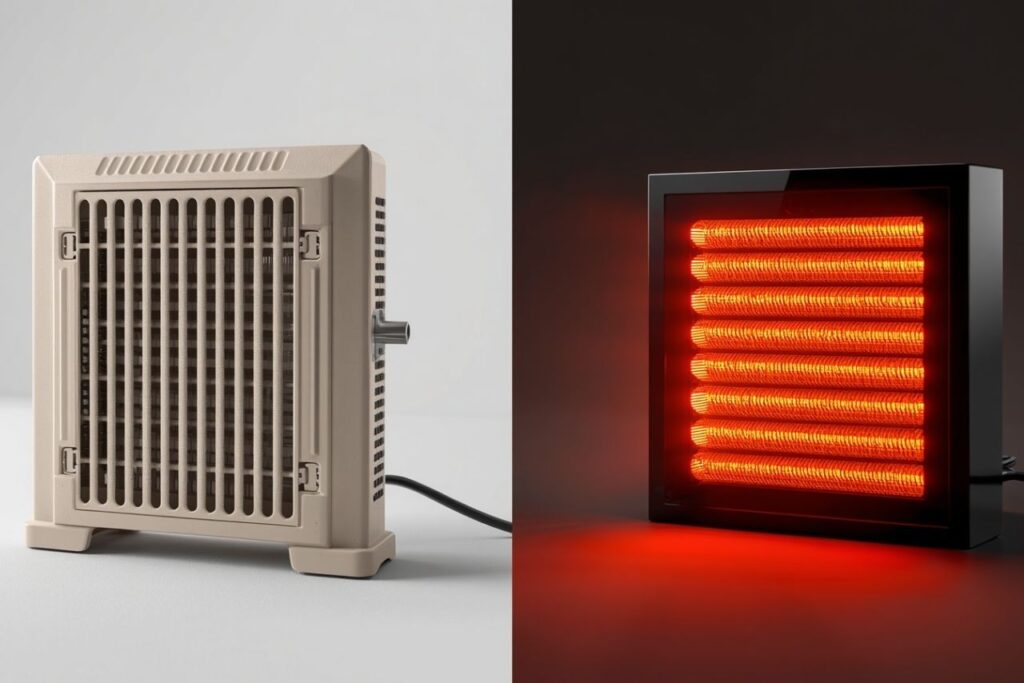
Choosing between a ceramic-based electric heater and an infrared heater is less about labels and more about heat transfer, control strategy, and the environment the heater will operate in. Ceramic systems often prioritize stable airflow heating and insulation frameworks, while infrared systems prioritize direct radiant comfort. The “better” option depends on the room layout, occupancy pattern, safety constraints, and how quickly comfort is needed.
For readers comparing heater technologies across appliances and industrial components, these category references are useful: Heating Element, Heating Element manufacturer, Heating Element Factory, Die Casting Heating Solutions.
- Clear definitions (ceramic vs infrared in plain engineering terms)
- How heat actually reaches people: convection vs radiation
- Side-by-side comparison table
- Which one is better for common use cases
- Engineering factors that matter more than marketing
- How element families map to real products (tubes, plates, films, die-cast modules)
- Safety and reliability considerations
- FAQ
- Referenced sources and outbound links
Clear definitions (ceramic vs infrared in plain engineering terms)
In heater design language, an electric heating element is a component composed of both electrically conductive material and an electrically insulating framework, assembled with leads/connectors so it can deliver heat safely. “Ceramic” commonly refers to the insulating/supporting portion (ceramic or mica), or to a ceramic substrate used for printed resistive patterns.
“Infrared heater” describes the dominant heat delivery method: the device emits radiant energy that warms people and surfaces directly. Many infrared heaters still use resistance heating internally—the difference is how the system is designed to emit and direct radiation.
How heat actually reaches people: convection vs radiation
Convection-focused heating (common in ceramic fan heaters)
Many ceramic space heaters are designed as compact forced-convection systems: a heating assembly warms air that is pushed into the room. In engineering classifications, wire elements supported or suspended by ceramic/mica are often optimized to expose surface area to airflow, delivering heat to air efficiently.
Radiation-focused heating (infrared heaters)
Infrared heating emphasizes radiation. When occupants sit in the heater’s “view,” comfort can feel immediate, even if the overall room air temperature changes more slowly.
Practical interpretation
In a drafty room or a space with frequent door openings, convection systems can “chase” the air temperature. Infrared can deliver perceived warmth to occupants faster—provided placement is correct.
Side-by-side comparison table
| Decision factor | Ceramic-based heater (typical behavior) | Infrared heater (typical behavior) |
|---|---|---|
| Primary heat transfer to user | Mostly convection (warm air), plus some radiation from surfaces. | Mostly radiation (direct warmth to people/surfaces). |
| Best for | General room warming, mixing air, short-to-moderate distances. | Spot comfort, desks/sofas, line-of-sight warming, large open areas with occupants in fixed zones. |
| Layout dependence | Lower; airflow mixes heat. | Higher; obstructions reduce radiant benefit. |
| Dust/contamination sensitivity | Airflow can pull dust through the heater; maintenance matters. | Still sensitive, but failure modes depend on design (reflector, emitter surface, enclosure). |
| Controls & ramp rate importance | High—especially if high watt density elements rely on airflow. | High—radiant surfaces can become very hot; stable regulation matters. |
| Comfort perception | “Warm room air” sensation once mixed. | “Warmth on skin” sensation quickly when in beam. |
Which one is better for common use cases
Bedroom at night (quiet + stable comfort)
In many bedrooms, stable temperature control and predictable cycling are more important than fast “burst heat.” A ceramic convection heater can suit this use when it provides consistent airflow heating and reliable protections. Infrared can work well when the goal is comfort directed at an occupied zone, but placement must be deliberate.
Home office desk (direct comfort during long sessions)
Infrared frequently performs well for desk comfort because it can warm the occupant directly without overheating the entire room. This is particularly attractive where the room is large but only one seat is used for hours.
Drafty living room or frequent door opening
Convection-based heating may lose effectiveness as warmed air is replaced; infrared can keep occupants comfortable if they remain within the radiant field. However, if occupants move around frequently, convection may offer more uniform comfort.
Bathrooms and wet-adjacent areas
Safety and ingress protection are non-negotiable. The heater’s design and approvals matter more than the heating label. For perspective, a plug-in heating element designed for radiator/towel-warmer applications may list an IP67 ingress rating and UL approval along with its wattage and materials—an example of how protection requirements are specified when moisture exposure is expected.
Selection discipline
Any heater used near water should be chosen and installed according to local electrical safety requirements and the product’s documented ratings. If the manufacturer’s guidance is unclear, professional advice is appropriate.
Engineering factors that matter more than marketing
1) Element construction: conductive alloy + insulating framework
A reliable heater is engineered as an assembly: conductive material does the electrical work, while insulating/support materials manage safety and geometry. For open-coil or airflow-exposed designs, ceramic or mica supports can suspend or support the wire. For embedded designs, the resistive coil can be locked inside insulating material.
2) Material properties and temperature-dependent behavior
Resistance alloys exhibit temperature-dependent resistance and thermal expansion behavior. Those properties—and even differences between alloy compositions—change performance and longevity. This is one reason experienced heater engineers match alloy, geometry, and operating environment rather than treating elements as commodity parts.
3) Watt density and airflow dependency
Watt density (watts per unit surface area) is a practical indicator for element temperature stress. High watt density designs can be compact and responsive, but they typically demand well-managed airflow and control logic to prevent overheating. In demanding process-air contexts, fast closed-loop control is highlighted as critical to avoid overshoot.
4) Environmental contaminants (often ignored in consumer comparisons)
Heater environments matter. Technical heater guidance notes that certain contaminants can shorten life depending on alloy choice. In homes, the “contaminants” are more often dust, aerosols, and lint. For convection heaters, filters/air paths and maintenance become meaningful reliability factors.
How element families map to real products (tubes, plates, films, die-cast modules)
Modern manufacturers typically organize heater components into families because the best element format depends on what must be heated (air, liquid, surface) and how. One catalog approach groups solutions into three core categories: heating tubes, heating plates, and heating films, with additional integrated modules using die-casting for thermal and mechanical benefits.
| Element family | Core idea | Typical strengths | Common applications (examples) |
|---|---|---|---|
| Heating tubes | Sheathed construction with insulation and resistance wire. | Electrical insulation, durability, adaptable shapes/wattages. | Kettles, ovens, water heaters; liquid heating equipment. |
| Heating plates | Stable surface heating; can use ceramic substrates and packaging processes. | Uniform heat distribution, mechanical strength, reduced heat loss by good adhesion. | Rice cookers, electric irons, coffee makers, thermostatic equipment. |
| Heating films | Thin, flexible heating technology on PET/ceramic substrates. | Rapid heating, uniform distribution, fits curved/tight spaces; often positioned for low-voltage use. | Smart toilet seats, medical devices, mirror defrosting, instrument insulation. |
| Die-cast thermal modules | Heating element integrated with metal die-casting (e.g., aluminum/copper alloys). | Improved heat transfer, mechanical strength, durability; supports customized structures. | Extruders, injection molding, commercial equipment; appliance thermal modules. |
Why this matters for the ceramic vs infrared decision
“Ceramic” may refer to the insulator framework (supporting wire elements), a ceramic substrate carrying a film/printed resistor, or a ceramic-based self-regulating element. Infrared is a delivery mode. A well-designed heater can combine ceramic insulation with an infrared-emitting surface, or use ceramic supports in a convection heater. The decision should focus on heat transfer goals and safety integration, not the single keyword.
Safety and reliability considerations
Do not treat heating elements as generic parts
Even within the same “type,” small differences in alloy composition or trace elements can alter oxidation behavior and life. Engineering sources emphasize that contaminants and enhancements in materials can affect performance significantly.
Follow the “no energizing in unsafe conditions” principle
Consumer service guidance for electric heating equipment repeatedly stresses not applying power until the system is in a safe operating state. For example, water-heater element replacement instructions emphasize verifying correct voltage/wattage, securing wiring, ensuring the tank is full, removing air, and checking for leaks before restoring power—highlighting a general safety discipline: never energize a heater when conditions can cause damage (such as dry operation or improper assembly).
Professional caution
If a heater shows abnormal odor, arcing, repeated shutdowns, or physical damage, it should be removed from service and inspected. Repairs should follow the manufacturer’s instructions and applicable electrical codes.
FAQ
1) Which heater type is “more efficient” on the electric bill?
For resistance heating, electrical input is converted to heat; the practical difference is how effectively the heat is delivered to the person and the intended zone. Infrared can reduce wasted heating of unused air in some scenarios, while convection can provide more uniform whole-room comfort.
2) Which feels warmer faster?
Infrared often provides faster perceived warmth for seated occupants because it heats surfaces and skin directly. Convection heaters may take longer to change the room air temperature but can feel more even over time.
3) Which is better for large rooms?
Large rooms with moving occupants often benefit from convection’s mixing effect. Large rooms with fixed seating zones can benefit from infrared if the heater can be positioned for direct line-of-sight comfort.
4) Is ceramic safer than infrared?
Ceramic materials can improve insulation and structural stability, but safety depends on the entire design: controls, overheat protection, wiring integrity, enclosure, and appropriate use conditions.
5) Do ceramic heaters dry out the air less?
Perceived dryness is often a comfort effect from warmer air and lower relative humidity, not a direct “moisture removal” by the heater. Both heater types can change perceived comfort; ventilation and humidity control determine actual moisture levels.
6) What specifications should be checked before purchase?
Documented ratings and protections matter: wattage, safety approvals, and any stated ingress protection where relevant. A separate example of a plug-in heating element lists features like UL approval and an IP rating for its intended installation environment—illustrating how products communicate protection levels when exposure risks exist.
7) When is a custom heating element solution justified?
When constraints are tight—unusual geometry, demanding cycling, specific environmental contaminants, or strict control requirements—engineering sources note that custom solutions can improve reliability and total cost of ownership by avoiding premature failures and difficult installations.
Conclusion
The better choice is the heater that matches the intended comfort mechanism. Convection-oriented ceramic heaters are strong candidates for general room warming and more uniform air temperature. Infrared heaters are strong candidates for rapid, targeted comfort when occupants remain within a defined zone. In both cases, the decisive factors are element construction, watt density management, control stability, and environmental suitability. When those fundamentals are addressed, the label becomes less important than the engineering behind it.
Referenced sources and outbound links
Engineering definitions and design considerations for heating elements (conductive + insulating assembly, suspended/supported/embedded classifications,
material properties, watt density, environment/contaminants, and control considerations in airflow-dependent heating) were informed by:
https://tutco.com/conductive/heating-elements
Manufacturer product-family context for heating tubes/plates/films and integrated die-cast modules, including the positioning of these technologies across appliance and industrial use cases, was informed by:
https://jinzho.com/
https://jinzho.com/product-category/heating-element/
https://jinzho.com/product-category/heating-element/heating-tubes/
https://jinzho.com/product-category/heating-element/heating-plate/
https://jinzho.com/product-category/heating-element/heating-film/
https://jinzho.com/product-category/die-casting-heating-solutions/
https://jinzho.com/product-category/electric-heater-parts/electric-boiler-heater/
A documented example of a plug-in heating element specification set (1000W, IP67, UL, cable length, materials, warranty, shipping/returns statements) was referenced for how heating products present compliance and protection details:
https://usa.hudsonreed.com/1000-plug-in-watt-electric-heating-element-76309
A safety-oriented example of heater servicing discipline (verify correct replacement, secure wiring, and do not energize until safe operating conditions are met) was referenced from:
https://www.whirlpoolwaterheaters.com/support/help/element-was-out-of-range/24
Note: This article provides general technical guidance and does not replace a specific heater’s instruction manual, certification requirements, or local electrical code obligations.

