Cluster Page ? ~2002 words ? Global ? 7 FAQs ? How-to / Repair ? Dryer no heat focus
A Maytag Centennial dryer that tumbles but won t heat often points to a failed heating element, a blown thermal fuse, a faulty high-limit thermostat, or restricted airflow that keeps tripping safety devices. This guide walks through a practical, step-by-step repair workflow from confirming symptoms and testing components, to replacing the bộ phận làm nóng and validating the fix.
Engineering context: a bộ phận làm nóng is a designed component (conductive alloy plus insulating framework and terminals), not just wire. Its life is strongly affected by temperature, environment, and cycling conditions. Reference: TUTCO加热元件概述.
- Unplug the dryer (or switch off the breaker) before opening panels.
- If testing live voltage is required, use extreme caution and stop if unsure consider a qualified technician.
- Let the dryer cool fully before working near the heater housing.
Safety discipline parallels heater replacement guidance in other appliances: confirm correct replacement specs and keep connections tight. Whirlpool s element procedure highlights verifying voltage/wattage and ensuring tight wiring connections. 参考.
- Phillips/flat screwdriver, nut driver set (common sizes), and a small socket set
- Kìm mũi nhọn
- Vacuum + lint brush (for cabinet and duct cleanup)
- Multimeter (ohms/continuity; ideally with audible continuity)
- Phone camera (to document wiring before disconnecting)
| Triệu chứng | Likely cause(s) | 应首先检查的项目 |
|---|---|---|
| Dryer runs, no heat at all | Bộ phận gia nhiệt open; thermal fuse blown; no 240V supply | Vent airflow + supply voltage + fuse/element continuity |
| 可能原因:气流受限 -> 过热 -> 高温限制器跳闸 | Restricted airflow; high-limit cycling; weak connections | Vent run, lint buildup, terminal discoloration |
| Long dry times, clothes still damp | Partial restriction; low airflow; thermostat issues | Exterior vent flow and duct condition |
| Burning smell near heater area | Lint near heater; overheated terminal; coil touching housing | Unplug immediately; inspect heater box and wiring |
Table 1 Dryer no heat symptoms usually trace back to airflow, safety cutoffs, electrical supply, or the element itself.
- Clean the lint screen (every load) and wash it if fabric softener residue is present.
- Inspect the vent hose behind the dryer for kinks/crushing; replace if damaged.
- Check outdoor exhaust flap: it should open strongly during a cycle.
- Remove lint from the blower intake area (requires cabinet access on many models).
Heater life is driven by operating temperature and cycling. TUTCO notes all resistance elements eventually burn out due to oxidation, resistance changes, damage, and deformation and design choices often aim to reduce watt density (lower element temperature) to extend life. A clogged vent effectively forces hotter operation and more stress. 来源.
Many electric dryers require a 240V supply (two hot legs). A dryer can still run the motor on partial power yet fail to heat.
- Check the breaker: some dryers use a double breaker that can half-trip.
- If comfortable and qualified, verify correct voltage at the receptacle or terminal block.
Maytag Centennial layouts vary by model, but the heating element is typically inside a heater housing/box, with thermostats and a thermal fuse nearby. Take photos of wiring before disconnecting anything.
Tip: Label wires with tape if multiple identical spade connectors are present.
With the dryer unplugged, remove at least one wire from the element terminal(s) to avoid backfeeding through the circuit. Set the multimeter to resistance/continuity and test across the element terminals.
- Pass: finite resistance (varies by wattage/design) and continuity.
- 失败: open circuit (infinite resistance / no beep) element likely blown.
If the coil is broken or visibly burned, replacement is typically required.
A blown thermal fuse is a common no heat cause and is often triggered by poor airflow. Test each safety device for continuity.
- Thermal fuse: should typically show continuity (closed) at room temperature.
- High-limit thermostat: often closed at room temperature (model-dependent).
- Cycling thermostat: switches with temperature; at room temp many read closed.
If a fuse is open, replace it and fix the airflow restriction that caused it.
Look for browned spade connectors, melted insulation, or loose-fitting terminals. A high-resistance connection can overheat and contribute to failures.
- Replace heat-damaged terminals (don t reuse a loose connector).
- Ensure all connections are tight when reassembled.
This aligns with Whirlpool s guidance to ensure wire connections are tight during element replacement in other appliances. 来源.
Centennial models differ. Use this as a general workflow and match your exact model number to the correct heating element kit. If your dryer uses a heater assembly that includes housing, thermostats, or fuse, replace components as specified for your platform.
- Unplug dryer / turn off breaker.
- Remove necessary panels to access the heater housing.
- Photograph wiring and disconnect the element terminals.
- Remove screws securing the heater housing or element mount.
- Slide out the element or lift out the heater assembly (as designed).
Vacuum lint from the heater box area, blower duct, and cabinet floor. This reduces overheating and fire risk.
- Seat the element so the coil cannot contact the metal housing.
- Reinstall fasteners snugly (avoid warping thin housings).
- Reconnect wires firmly; replace weak spade connectors.
- Reinstall any thermostats/fuses exactly as removed (orientation and contact surface matter).
- Confirm vent is connected and not crushed.
- Run a timed dry cycle with heat and observe: warm air at the exhaust, stable operation, no burning smell.
- Check the exterior vent flap for strong airflow.
- After the test, power off and feel for abnormal heat at cord/terminal area (carefully).
Normal heater cycling is expected. What s not normal: rapid cycling, repeated thermal fuse failures, or scorching at terminals. If problems persist, treat airflow and electrical supply as primary suspects before replacing a second element.
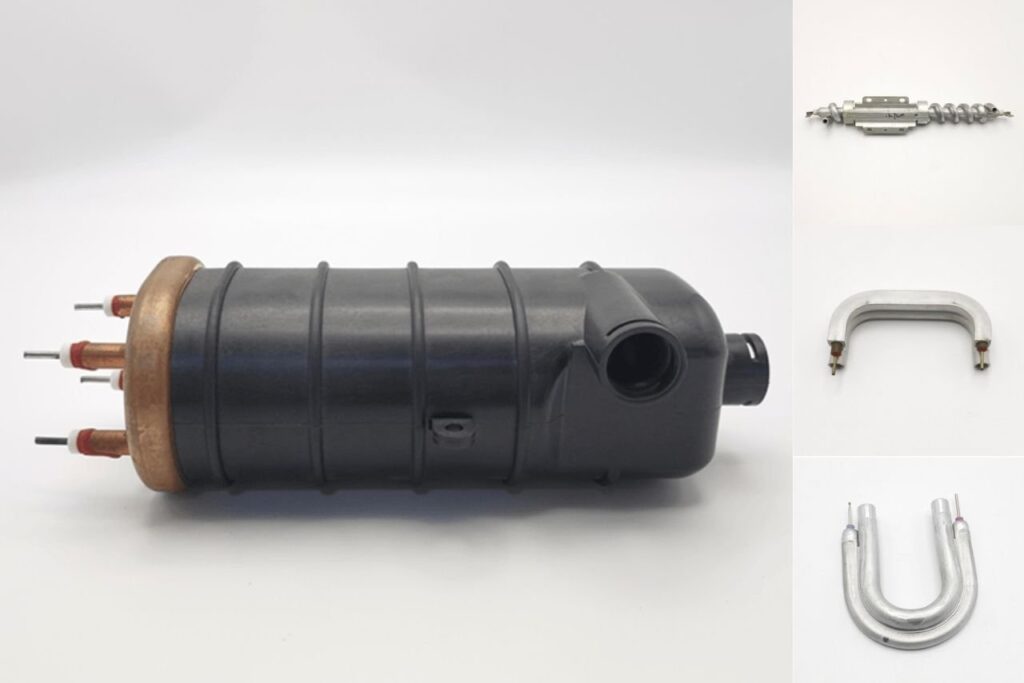
While a dryer typically uses an open-coil heater assembly, the broader heating element world includes many form factors. JINZHO organizes its product categories under Thanh gia nhiệt,下, Ống sưởi ấm, Tấm gia nhiệt,, Phim sưởi ấm. For integrated appliance heater modules, see Giải pháp gia nhiệt đúc khuôn 以及紧凑型锅炉组件,详见 Lò sưởi điện.
Company overview: Jinzhong presents itself as a 加热元件制造商 with 30+ years of experience and scaled output, with factory background on 加热元件工厂.
The most reliable check is a continuity/resistance test across the element terminals with the dryer unplugged and at least one wire disconnected. If it reads open (no continuity), the element is likely failed.
Yes. Electric dryers can sometimes tumble on partial power but fail to heat if one hot leg is missing. Check the breaker and (if qualified) verify supply voltage.
Not automatically. Replace the blown fuse and correct airflow problems first. If the element tests open or shows visible damage, then replace it.
Usually because the root cause wasn t fixed most commonly restricted venting, lint buildup near the heater, or loose/overheated terminals creating hot spots. Heater life is strongly affected by operating temperature and cycling stress. 参考.
It depends on the model design and parts availability. Some platforms allow element-only replacement; others are serviced as an assembly. Match by model number and compare the mounting and terminal layout before purchase.
Vacuum lint from the heater housing area, blower path, cabinet base, and vent connection. This improves airflow and reduces overheating risk.
Don t leave weak/loose terminals in place. Replace heat-damaged spade connectors and ensure all wire connections are tight poor connections can create localized overheating. (This mirrors Whirlpool s emphasis on tight connections during heating element replacement in other appliances.) 参考.
- TUTCO heater types, material considerations, and heater life concepts: https://tutco.com/conductive/heating-elements
- Whirlpool replacement procedure emphasizing correct element specs and tight wiring connections (used as general best-practice reference): https://www.whirlpoolwaterheaters.com/support/help/element-was-out-of-range/24
Note: A 如何影响更换选型? is different from a plug-in radiator element (example specs: 1000W, IP67, UL, 2-year warranty), but the listing demonstrates the importance of verifying wattage/materials/approvals when selecting heater components: Hudson Reed CHE1000W.
Disclaimer: This is general information. Always verify your Maytag Centennial model number and follow manufacturer service instructions. If you are not trained to work with high-voltage appliances, hire a qualified technician.