Cluster Page ? Global ? Professional/Formal ? Third-person ? ~2003 words ? 6 FAQs
Whirlpool Duet no heat complaints most often come from four categories: an open heater coil, an open thermal safety device, a power supply condition that prevents the heater from energizing, or restricted airflow that overheats the heater housing and triggers protection. The fastest reliable fix is not replace the element first, but a short decision path that confirms airflow and checks the heater circuit in a safe order.
- How the Whirlpool Duet heating system fails (in practice)
- Symptom-to-cause map (quick triage)
- Safety rules technicians do not skip
- The 7 most common no heat root causes in Duet-style electric dryers
- Heating element-specific issues (open, sag, hot spots, shorts)
- Airflow and venting: the hidden driver of repeat burnouts
- Selecting the correct replacement part (rating + fit + quality)
- Prevention checklist (what reduces repeat failures)
- ЧЗВ (6)
- References & outbound links
In an electric Whirlpool Duet dryer, the цепь нагревателя is intentionally protected by multiple safety devices. The heating element generates heat (resistive/Joule heating), while thermostats and fuses interrupt power if temperatures exceed safe limits. In real service work, this means a dryer can tumble normally yet never heat because the motor circuit can still run while the heater circuit is open.
From a heater engineering perspective, a heating element is more than a coil: it is a component assembly combining conductive alloy, insulating support, and lead connections designed to serve a specific thermal purpose. This assembly concept is emphasized in TUTCO s overview of heating elements, including how element integration (suspended/embedded/supported) influences heat transfer and reliability. TUTCO: Heating Elements.
This chart is a practical troubleshooting priority ranking used by service teams (not a warranty dataset). It reflects what is most often found first when technicians aim to avoid repeat failures.
| What the user notices | Most likely cause | Why it happens | Что проверить в первую очередь |
|---|---|---|---|
| Dryer runs, no heat at all | Thermal fuse open OR heater coil open OR missing supply leg | Heater circuit is interrupted even though motor circuit runs | Airflow + thermal fuse continuity + element continuity |
| Heats briefly, then stops | Airflow restriction triggering overheating protection | High temperature forces safety device to open / thermostat to cycle aggressively | Vent path, lint screen housing, exterior flap |
| Long dry times, clothes still damp | Restricted venting (most common) | Low airflow reduces heat transfer and moisture removal | Outdoor exhaust airflow strength |
| Burning smell near rear panel | Loose terminal / overheated connector | High resistance at the connection creates localized heating | Inspect spade terminals for discoloration/looseness |
| Overheats / shuts down / trips protection repeatedly | Severe vent restriction or element short to housing | Temperature rises beyond safe design window | Vent + element clearance/short test |
Table 1 Quick triage map. Whirlpool Duet no heat is often a system issue, not a single-part issue.
- Disconnect power at the breaker/outlet before opening panels.
- Allow components to cool before touching heater housings.
- If wiring insulation is brittle, melted, or charred, stop and use a qualified technician.
A useful cross-industry safety principle appears in Whirlpool s water heater element replacement guidance: verify the new element is correct for voltage/wattage, and do not re-energize the system until safe operating conditions exist. Their page warns that applying power before the tank is full can burn out the element ( dry fire ). While a dryer is not a water heater, the principle translates: do not energize a heater when the system cannot remove heat properly (for dryers, that means airflow). Whirlpool support: Replace the Heating Element.
Restricted exhaust venting is a leading cause of overheating, thermal fuse opening, and early element failure. A Duet dryer depends on forced convection to move heat across clothes and keep heater temperatures within a safe range.
- Check outdoor exhaust: strong flow should be felt at the termination.
- Inspect behind the dryer for crushed flex duct or long runs with many bends.
- Clean lint screen housing and internal lint accumulation (not just the screen).
The thermal fuse is designed to open when temperatures exceed safe limits. It is not a random failure component; most replacements should be paired with airflow correction, otherwise the replacement may open again.
A thermostat that cycles incorrectly can cause unstable temperatures, long dry times, or frequent safety trips. In troubleshooting, technicians separate thermostat failure from airflow restriction because airflow problems can mimic thermostat symptoms.
A coil break creates an open circuit: the dryer runs but produces no heat. Element life is influenced by temperature cycling, oxidation, deformation, and hot spots factors discussed in heater engineering literature. TUTCO notes that all resistance heating elements eventually burn out and highlights how design choices (including watt density) and environment affect longevity. Источник.
If the coil sags or contacts metal, it can short and cause abnormal heating behavior. This can lead to overheating, repeated fuse/thermostat failures, or electrical faults.
Many electric dryers can still run the motor with a partial supply condition, while the heater cannot energize properly. This is why it turns on, so power must be fine is a common diagnostic mistake.
Loose spade terminals can create localized heating due to increased resistance at the connection. Discolored connectors, brittle insulation, or melted terminal blocks indicate the need for wiring repair not only part replacement.
Most common direct element failure. Replacement is required, but technicians still verify airflow to prevent overheating of the new part.
heater continuity test, разомкнутая цепь, no-heat diagnosis
Sagging increases the chance of coil-to-housing contact. Overheating from blocked vents is a frequent upstream cause.
Restore airflow, ensure correct mounting, avoid bending heater housings during install.
Matching the correct replacement is not only about physical fit. Whirlpool s water heater guidance explicitly says to verify voltage and wattage on the data plate before installing a new element. That same discipline applies to appliance heaters: correct rating reduces overheating risk and improves reliability. Ссылка.
Airflow is the cooling system of a dryer heater. When airflow drops, element temperature rises, oxidation accelerates, and safety devices open more often. In heater engineering terms, this is a shift in operating conditions that pushes the element outside its intended thermal window.
A service reasoning chart: restricted venting explains both no heat and takes forever patterns, and it is the leading reason new elements fail again.
Heating elements are engineered assemblies. TUTCO emphasizes that alloys and insulators are manipulated to serve a purpose, and that material properties change with temperature and conditions. This is why correct selection matters not just physical similarity. Источник.
- Match the exact model compatibility and ratings where specified.
- Replace heat-damaged terminals instead of reusing them.
- If a thermal fuse opened, treat it as evidence of overheating and fix airflow.
Not every heating element is interchangeable across appliances. For example, Hudson Reed sells a 1000W plug-in heating element intended for radiators/towel warmers, listing features like IP67 ingress protection and UL approval, along with ABS & stainless materials and a 2-year warranty. This kind of specification is useful for understanding what application-specific design looks like, but it is not a dryer heater replacement. Hudson Reed: 1000W Plug-In Heating Element.
- Clean the vent path end-to-end (not only the lint screen).
- Confirm strong outdoor exhaust airflow after repair.
- Inspect and replace any heat-discolored spade terminals.
- Run a supervised test cycle and recheck for abnormal heat near connectors.
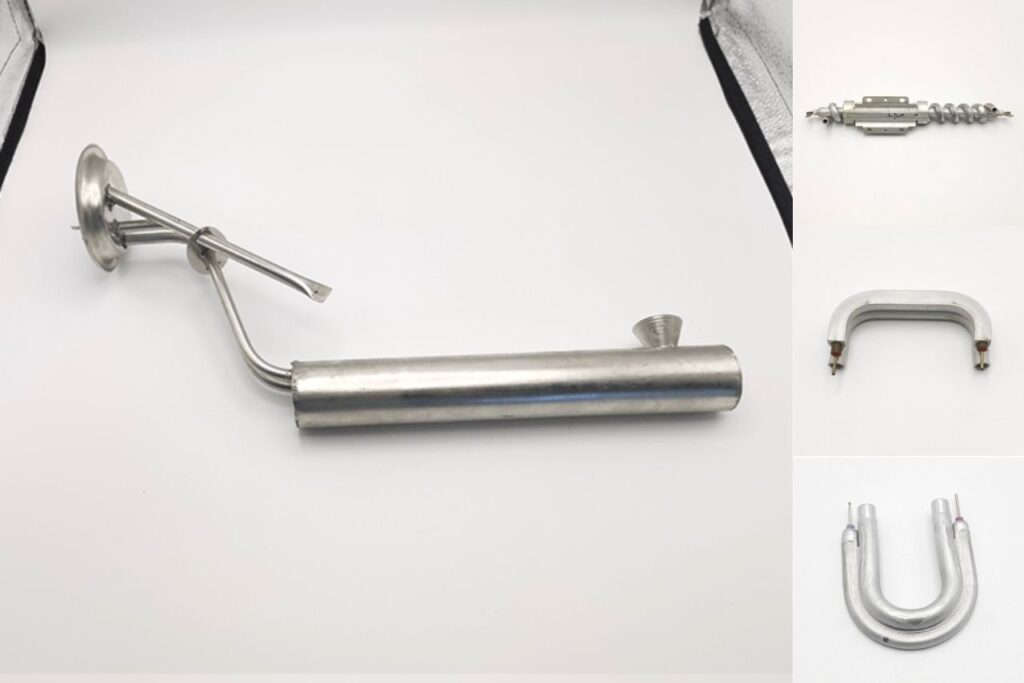
When designing heater systems across appliances, element construction varies tubes, plates, films, and integrated modules. Jinzhong s catalog categories provide a practical snapshot of common heater families, including Нагревательные трубки and product lines under Нагревательный элемент.
For integrated assemblies used in other appliances (e.g., coffee machine boilers), Jinzhong lists Решения по нагреву при литье под давлением featuring die-cast aluminum alloy substrates and thick film resistor technology in multiple products (e.g., boiler heat exchangers and coffee machine heater parts).
Yes. The motor can run while the heater circuit is open (blown thermal fuse, open thermostat, open element, or a supply issue preventing heater energizing).
Restricted airflow. Low airflow increases heater temperature and accelerates burnout and safety trips.
Only if testing confirms the fuse is open. If it is open, airflow issues should be corrected at the same time to prevent another failure.
Because mismatched ratings change current and heating behavior. Whirlpool s guidance for water heater elements specifically says to verify the new element by checking voltage and wattage on the data plate. That same verification mindset applies to appliance heaters. Ссылка.
It means electrical energy is converted into heat when current passes through a resistance alloy. TUTCO describes this as the fundamental core of how electric heaters produce heat. Ссылка.
Heater families include tubes, plates, films, and integrated die-cast modules. For an overview of product categories, see Jinzhong s Нагревательный элемент catalog and related categories.
- TUTCO-Farnam definitions, heater types, materials, and life factors: https://tutco.com/conductive/heating-elements
- Whirlpool Water Heaters support replacement workflow and rating verification principles (voltage/wattage; do not energize under unsafe conditions): https://www.whirlpoolwaterheaters.com/support/help/element-was-out-of-range/24
- Hudson Reed example of detailed heater product specification (application-specific; not a dryer part): https://usa.hudsonreed.com/1000-plug-in-watt-electric-heating-element-76309
Editorial note: This is original content written for practical troubleshooting and reliability. External sources are cited for definitions, safety principles, and specification examples.
Disclaimer: This guide is educational and does not replace model-specific service documentation or local electrical safety requirements.