
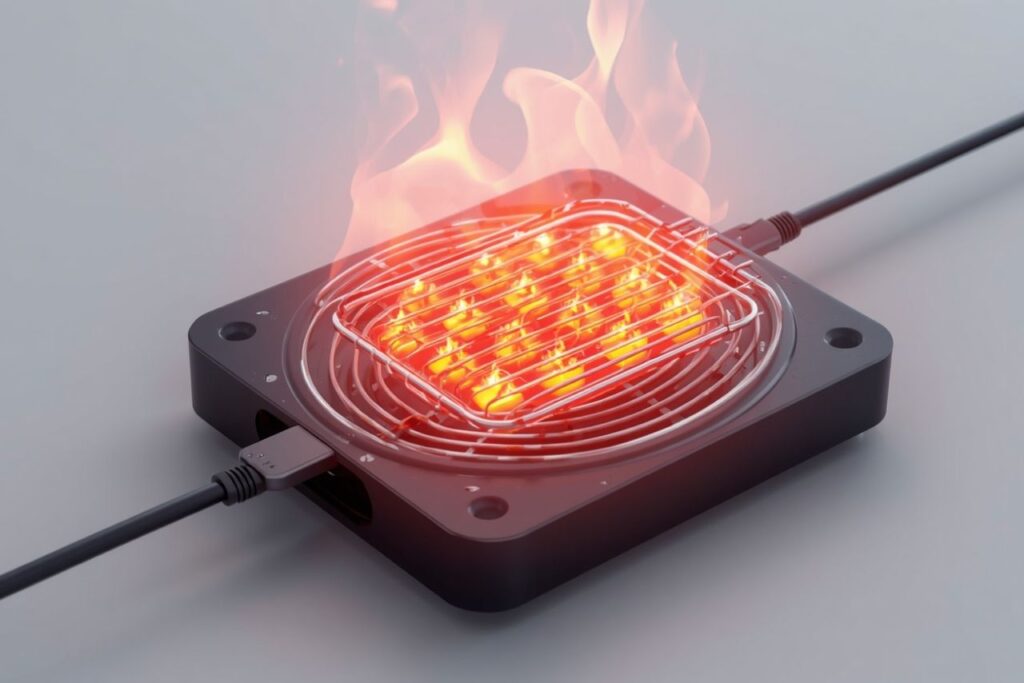
A ceramic heating element works by converting electrical energy into heat through resistive (Joule) heating, while ceramic materials primarily provide the electrical insulation, structural support, and controlled heat transfer path that make the element usable and safe. In practical products, “ceramic” can refer to several architectures—from ceramic-supported resistance wire to printed thick-film patterns on a ceramic substrate— so performance depends more on the complete element assembly, airflow or contact conditions, and the control system than on the word “ceramic” alone.
Key related pages: Heating Element, Heating Element manufacturer, Heating Element Factory, Die Casting Heating Solutions.
- What “heating element” means in engineering terms
- Why ceramic is used: insulation, stability, and temperature capability
- How heat is generated and delivered (conduction, convection, radiation)
- Common ceramic element architectures
- Quick comparison chart: ceramic-supported vs embedded vs film-on-ceramic
- Where ceramic elements show up in real products
- Design tradeoffs: watt density, airflow, and durability
- FAQ
- Sources used and outbound links
What “heating element” means in engineering terms
In heater design literature, a heating element is described as a component made of both electrically conductive material and electrically insulating material, designed to serve a specific heating purpose. This is an important distinction because the “element” is not only the alloy that gets hot; it also includes an insulating framework and lead connectors that safely connect the element to a circuit.
This framing matters for SEO and for purchasing decisions: when a product says ceramic heater, the ceramic portion is often the insulator/framework, not necessarily the conductive path that generates heat.
Why ceramic is used: insulation, stability, and temperature capability
Ceramic is widely used around heating elements because it is typically electrically insulating and can remain stable under elevated temperatures. In supported or suspended wire designs, ceramic (or mica) is used to hold the resistive wire in position while keeping it electrically isolated from metal housings. In film-based designs, ceramic can serve as a rigid substrate for printed resistive patterns.
How heat is generated and delivered (conduction, convection, radiation)
Step 1: electrical resistance creates heat
When current flows through a resistive conductor (wire, ribbon, or etched/printed trace), the conductor converts electrical power into heat. The material and geometry determine resistance, and resistance determines how much heat is generated for a given voltage/current.
Step 2: heat moves out of the element
After heat is created, it must be delivered to the target. The main pathways are:
- Conduction: heat moving through solids in contact (e.g., from coil → insulation → metal sheath; or trace → ceramic substrate).
- Convection: heat carried away by air movement (fan heaters, process air heaters, space heaters).
- Radiation: infrared heat emitted from hot surfaces (noticeable in radiant appliances).
Why airflow changes everything
In convective designs, insufficient airflow can increase element temperature rapidly. Engineering guidance emphasizes the relationship among power, airflow, and temperature rise. This is why many high-temperature air heaters depend on careful control loops and airflow management.
Common ceramic element architectures
Ceramic-supported resistance wire (supported or suspended)
In this architecture, a resistive wire alloy is held by ceramic (or mica) insulators. The wire may be arranged as a coil or corrugated shape. Heat transfer is commonly dominated by convection and radiation when the wire is exposed to air.
Engineering descriptions often classify wire elements by contact with their framework: suspended, supported, or embedded.
Embedded coil inside an insulating powder (ceramic/MgO) and metal sheath
An embedded design encases the resistive coil in an insulating material. The heater then transfers heat largely by conduction to an outer sheath. In broader heater families, this is a common pattern in cartridge and tubular heaters where the coil is locked inside insulating media.
Thick-film or thin-film resistive patterns on ceramic substrate
Ceramic substrates can carry printed or deposited resistive patterns. Jinzhong’s catalog explicitly references thick-film and thin-film heater products using ceramic substrates and printing/sputtering approaches, positioning them for compact designs and controlled heating.
This family often supports **precise temperature control**, and can be integrated with broader control systems depending on the product design.
Quick comparison chart: ceramic-supported vs embedded vs film-on-ceramic
| Architecture | Typical “ceramic role” | Primary heat transfer outward | Common use-case signals |
|---|---|---|---|
| Supported/suspended wire on ceramic | Insulating framework holding wire geometry | Convection + radiation | Airflow-facing heaters, compact fan heaters, designs needing direct air contact |
| Embedded coil in insulating media + sheath | Insulation surrounding coil; safe conductive path to sheath | Conduction to sheath, then convection/radiation from sheath | Robust assemblies, contact heating, tube/rod formats |
| Printed thick-film / thin-film on ceramic substrate | Substrate + insulation + thermal spreading platform | Conduction into substrate; then convection/radiation depending on mounting | Low-profile modules, uniform heating zones, compact appliance heating assemblies |
Where ceramic elements show up in real products
Appliance heating modules (plates, films, integrated assemblies)
Ceramic-related element strategies appear across appliance categories. For example, Jinzhong’s product positioning separates heater families into tubes, plates, and films—each aligned to how heat must be delivered (into liquids, through surfaces, or across tight geometries).
Related Jinzhong categories (context for readers)
Heating tubes are described with sheaths and magnesium oxide insulation; heating plates emphasize uniform surface heating and durable manufacturing; heating films are positioned as thin, flexible, and suited for curved surfaces and compact spaces.
Plug-in heating elements in hydronic accessories (context example)
Ceramic heating element discussions often overlap with other electric element products. A practical example is a 1000W plug-in heating element used for a radiator or towel warmer, which highlights how a heating element product is defined by application constraints (ingress protection, cable length, approvals) as much as by wattage. That product lists IP67, UL approval, ABS plastic & stainless steel materials, and a 35.4" cable with plug.
Design tradeoffs: watt density, airflow, and durability
Watt density as a risk and reliability driver
In heater engineering, watt density is used to compare designs by dividing total watts by heat-generating surface area. Higher watt density can push higher element temperatures, increasing oxidation stress and sensitivity to airflow shortfalls.
Material properties change with temperature
Resistance alloys exhibit temperature-dependent behavior (electrical resistance and thermal expansion), and the oxide layer behavior at high temperature influences longevity. Ceramic frameworks help maintain geometry and insulation as these properties shift during heating cycles.
Environment and contaminants
Heater environments matter. Engineering discussions highlight that certain contaminants can shorten life depending on alloy choices and exposure conditions. For ceramic-heater end products, practical correlates include dusty rooms, oily aerosols, and restricted intake filters—all of which can drive higher local temperatures.
Operational safety note
Ceramic materials can support safe insulation, but they do not remove the need for proper thermal cutoffs, stable controls, and correct airflow conditions. The safest consumer experience comes from a complete, well-integrated heater system rather than from a single material choice.
FAQ
Is a ceramic heating element the same as a PTC heater?
Not necessarily. “Ceramic” can describe the insulating framework or the substrate, while PTC refers to a behavior where resistance increases with temperature, helping limit overheating. Some products use ceramic-based PTC elements; others use ceramic only as insulation around a resistive conductor.
Why do some ceramic heaters feel hotter or heat faster?
Perceived heat is influenced by airflow design, surface temperature, and how much heat is delivered by convection versus radiation. Two heaters with similar wattage can feel different because their element architecture and airflow paths distribute heat differently.
Does “ceramic” automatically mean safer?
Ceramic can improve insulation and mechanical stability, but safety is determined by the complete heater assembly—controls, overheat protection, wiring integrity, and correct operation conditions.
What are “thick-film” and “thin-film” ceramic heaters used for?
Thick-film and thin-film approaches place a resistive pattern on a ceramic substrate to create compact, potentially uniform heating zones. Supplier catalogs describe these as suitable for applications needing low-profile heating and controlled heat distribution.
How should an engineer choose between wire-on-ceramic and ceramic-substrate film designs?
The decision typically starts with requirements: target medium (air vs. solid contact), allowable space, response speed, thermal control strategy, and expected environment. Wire-on-ceramic suits airflow-exposed designs, while ceramic-substrate films can suit compact modules and defined heating zones.
Conclusion
A ceramic heating element works because electricity heats a resistive conductor, and ceramic materials make that conductor usable by providing insulation, stable geometry, and a controlled heat path. In real products, ceramic may be a support for a wire, an insulating medium around an embedded coil, or a substrate for thick-film/thin-film traces. The most accurate way to evaluate a “ceramic heater” is to assess the full element assembly, heat-transfer mode, watt density constraints, airflow or contact conditions, and the protection/control system that prevents overheating in everyday operation.
Sources used and outbound links
Engineering definitions and classifications (heating element as conductive + insulating assembly; suspended/embedded/supported frameworks; alloy behavior and temperature notes;
watt density as a comparison concept; environment/contaminants) were derived from:
https://tutco.com/conductive/heating-elements
Product-family context for ceramic substrates, thick-film/thin-film heaters, and category structure (tubes/plates/films; manufacturing positioning; integration themes)
was drawn from Jinzhong Electric Heating pages:
https://jinzho.com/
https://jinzho.com/product-category/heating-element/
https://jinzho.com/product-category/heating-element/heating-film/
https://jinzho.com/product-category/die-casting-heating-solutions/
A consumer-facing example of a plug-in heating element specification list (wattage, IP rating, approval, cable length, materials, warranty, shipping/returns) was referenced for context:
https://usa.hudsonreed.com/1000-plug-in-watt-electric-heating-element-76309
Disclosure: the sources above were used to ground definitions, terminology, and product-category claims. Explanatory sections and comparisons were written uniquely to avoid duplication.

