
Usted depende de su calentador de agua a diario, pero quizás no se dé cuenta de que el elemento inferior del calentador de agua suele fallar primero. Sedimento y cal, especialmente del agua dura, se acumula en el fondo del tanque y recubre el elemento calefactor. Esta acumulación provoca sobrecalentamiento, ruidos extraños e incluso agua de color oxidado. Si ignora el mantenimiento regular, como purgar su calentador de agua, corre el riesgo de dañar el elemento y reducir la eficiencia. Los profesionales de fontanería a menudo ven estos problemas en hogares donde los problemas de calidad del agua no se abordan.
Resumen rápido de los elementos del calentador de agua
Los Los calentadores de agua utilizan dos elementos calefactores principales para mantener su agua caliente y lista. Cada uno elemento del calentador de agua tiene un trabajo y una ubicación específicos dentro del tanque. Comprender cómo funcionan estos elementos le ayuda a detectar problemas temprano y mantener su sistema de manera eficiente.
Elemento superior del calentador de agua
Función en el calentamiento
Encontrará que el elemento calefactor superior inicia el proceso de calentamiento. Cuando enciende su calentador de agua, este elemento calienta primero la parte superior del tanque. El elemento calefactor superior asegura que obtenga agua caliente rápidamente, especialmente después de que el tanque haya estado sin usar. Si usa mucha agua caliente, el elemento superior se activa primero para elevar la temperatura rápidamente. Una vez que la parte superior del tanque alcanza la temperatura establecida, el sistema cambia la potencia al elemento inferior.
Ubicación en el tanque
Los fabricantes colocan el elemento superior del calentador de agua cerca de la parte superior del tanque. Esta posición le permite calentar el agua que usa con más frecuencia. El elemento superior funciona con su propio termostato, que controla cuándo se enciende y apaga. Puede pensar en él como la primera línea de defensa para mantener su agua caliente.
Elemento inferior del calentador de agua
Función en el calentamiento
El elemento calefactor inferior toma el control después de que el elemento superior termina su trabajo. Cuando usa agua caliente, el agua fría entra en el fondo del tanque. El elemento calefactor inferior calienta esta agua fría entrante, asegurando que siempre tenga un suministro constante. Si usa mucha agua caliente, el elemento inferior trabaja duro para satisfacer la demanda. Este elemento a menudo funciona con más frecuencia, especialmente en hogares con alto consumo de agua.
Ubicación en el tanque
Encontrará el elemento inferior del calentador de agua en el fondo del tanque. Esta ubicación le permite calentar primero el agua más fría. El elemento inferior también tiene su propio termostato e interruptor de seguridad. Debido a que se encuentra en el fondo, enfrenta una mayor exposición al sedimento y la acumulación de minerales, lo que puede provocar una falla temprana.
Consejo: Purgar regularmente su calentador de agua ayuda a proteger el elemento calefactor inferior del daño por sedimento.
Aquí hay uno Comparación rápida de los dos elementos:
| Aspecto | Elemento Superior | Elemento Inferior |
|---|---|---|
| Función | Calienta primero la parte superior del tanque | Calienta la parte inferior del tanque después de que el elemento superior alcanza la temperatura establecida |
| Secuencia de operación | Se activa primero; una vez alcanzada la temperatura deseada, cambia la potencia al elemento inferior | Se activa en segundo lugar para calentar el agua restante en el tanque |
| Posición en el tanque | Ubicado en la parte superior del tanque | Ubicado en la parte inferior del tanque |
| Diseño | Aleación metálica en forma de varilla con funda protectora y cable de resistencia en el interior | Mismo diseño de varilla y materiales que el elemento superior |
| Control del termostato | Tiene un termostato que controla el calentamiento y cambia la potencia al elemento inferior | Tiene su propio termostato e interruptor de seguridad |
| Propósito | Asegura un calentamiento eficiente y un suministro constante de agua caliente | Calienta el agua fría entrante en el fondo para mantener una disponibilidad constante de agua caliente |
Ambos elementos calefactores trabajan juntos para proporcionar agua caliente constante para su hogar. Al comprender sus funciones y ubicaciones, puede mantener mejor su calentador de agua y evitar averías inesperadas.
¿Qué elemento del calentador de agua falla primero?
La falla más común
Vulnerabilidad del elemento inferior
Quizás se pregunte qué elemento del calentador de agua tiene más probabilidades de fallar primero. En la mayoría de los casos, el elemento calefactor inferior enfrenta el mayor riesgo. El elemento inferior se encuentra en el fondo del tanque de su calentador de agua, donde calienta constantemente el agua más fría. Esta posición lo expone a más estrés y ciclos que el elemento superior. Cuando usa agua caliente, el agua fría entra en el fondo del tanque, y el elemento calefactor inferior debe trabajar más para llevar esta nueva agua a la temperatura adecuada.
El sedimento y los depósitos minerales tienden a acumularse en el fondo del tanque. Con el tiempo, estos depósitos pueden cubrir el elemento calefactor inferior, causando que se sobrecaliente y eventualmente se queme. La acumulación actúa como aislante, haciendo que el elemento trabaje aún más para calentar el agua. Esta tensión adicional acorta su vida útil y aumenta la probabilidad de una falla temprana.
Nota: Si deja que su calentador de agua funcione vacío o lo drena sin apagar la alimentación, el elemento calefactor inferior puede quemarse casi instantáneamente. Siempre apague la alimentación de su calentador de agua antes de drenar el tanque.
Datos de la industria y experiencia
La experiencia de campo de fontaneros y técnicos respalda la idea de que el elemento calefactor inferior falla primero en la mayoría de los calentadores de agua. Aunque los fabricantes no publican estadísticas oficiales, los profesionales reportan consistentemente este patrón. Aquí hay algunas observaciones clave del uso en el mundo real:
- El elemento calefactor superior se activa primero para suministrar agua caliente rápidamente.
- El elemento inferior opera después de que el elemento superior alcanza su temperatura establecida y calienta el agua restante.
- El El elemento inferior es más propenso a fallar, especialmente si el tanque se vacía o se drena mientras está encendido.
- El elemento inferior enfrenta más estrés y ciclos porque siempre está sumergido en agua más fría.
- Aunque el elemento superior puede fallar primero en casos raros, la mayoría de los informes indican que el elemento inferior falla con más frecuencia.
Puede ver que el elemento inferior del calentador de agua soporta más desgaste. Esto lo convierte en el punto de falla más común en un calentador de agua típico.
Excepciones a la regla
Patrones de uso inusuales
No todos los calentadores de agua siguen el mismo patrón. En algunos hogares, el elemento calefactor superior puede fallar primero. Si usa agua caliente en ráfagas cortas o rara vez vacía el tanque, el elemento superior puede ciclar con más frecuencia. Esto puede provocar una falla temprana, especialmente si el termostato superior funciona mal y hace que el elemento permanezca encendido más tiempo del necesario.
Algunos hogares usan calentadores de agua de maneras que ponen una demanda adicional en el elemento superior. Por ejemplo, si tiene una bomba de recirculación o usa agua caliente para electrodomésticos que extraen de la parte superior del tanque, el elemento calefactor superior puede experimentar más estrés.
Problemas eléctricos y fallos del termostato
Los problemas eléctricos también pueden causar que el elemento calefactor superior falle antes que el inferior. Cableado defectuoso, conexiones sueltas o un termostato que funciona mal pueden impedir que el elemento superior se apague correctamente. Si el botón de reinicio se dispara con frecuencia o escucha ruidos extraños del tanque, puede tener un problema eléctrico que afecte al elemento superior.
En casos raros, una sobretensión o un cortocircuito pueden dañar directamente el elemento calefactor superior. Cuando esto sucede, puede perder toda el agua caliente, ya que el elemento superior controla el ciclo de calentamiento inicial.
Consejo: Si nota temperaturas de agua inconsistentes o un disparo frecuente del botón de reinicio, revise tanto el elemento calefactor superior como el inferior. Los problemas eléctricos pueden afectar a cualquiera de los elementos, independientemente de sus patrones de falla habituales.
Al comprender estas excepciones, puede diagnosticar mejor los problemas con su calentador de agua y evitar reparaciones innecesarias. Siempre considere sus hábitos de uso y esté atento a las señales de problemas eléctricos para mantener su calentador de agua funcionando de manera eficiente.
¿Por qué falla primero el elemento calefactor inferior?
Acumulación de sedimento en el calentador de agua
Cómo se forma el sedimento
El sedimento se forma en su calentador de agua cuando minerales como el calcio y el magnesio se separan del agua durante el calentamiento. A medida que el agua se calienta, estos minerales se depositan en el fondo del tanque. Con el tiempo, esta capa de sedimento se vuelve más gruesa, especialmente si vive en un área con agua dura. Puede que no note la acumulación al principio, pero puede convertirse rápidamente en un problema si no purga su tanque regularmente.
Los registros de mantenimiento y el asesoramiento de expertos destacan la acumulación de sedimento como una causa principal de falla del elemento calefactor. Los profesionales recomiendan purgar su calentador de agua al menos una vez al año. Si tiene agua dura, debe purgarlo cada seis meses. Este sencillo paso ayuda a prevenir la acumulación de sedimentos y prolonga la vida útil de su elemento calefactor.
Impacto en el Elemento Inferior
El elemento calefactor inferior se encuentra en el fondo del tanque, justo donde se acumulan los sedimentos. Cuando el sedimento cubre el elemento calefactor, actúa como aislante. El elemento calefactor debe trabajar más y durante más tiempo para calentar el agua. Este esfuerzo adicional provoca que el elemento calefactor se sobrecaliente y eventualmente se queme. Es posible que escuche chasquidos o ruidos retumbantes mientras el elemento calefactor lucha por calentar a través de la capa de sedimento. Si ignora este problema, corre el riesgo de una falla prematura del elemento calefactor inferior y una eficiencia reducida de todo su calentador de agua.
Consejo: Purgar su calentador de agua regularmente elimina los sedimentos y protege al elemento calefactor inferior de daños.
Ciclos de Calentamiento y Patrones de Uso
Frecuencia de uso
La demanda de agua caliente de su hogar afecta directamente la frecuencia con la que el elemento calefactor se enciende y apaga. Si tiene una familia numerosa o usa mucha agua caliente, el elemento calefactor inferior trabaja con más frecuencia. Cada vez que usa agua caliente, entra agua fría al fondo del tanque. El elemento calefactor inferior debe calentar esta agua nueva, lo que aumenta su carga de trabajo.
El mantenimiento regular, como purgar el tanque y revisar la varilla de ánodo, ayuda a reducir la tensión tanto en el elemento calefactor inferior como en el superior. Mantener su calentador de agua a una temperatura óptima, alrededor de 120°F, también evita el sobrecalentamiento y prolonga la vida útil de cada elemento calefactor.
Tensión en el Elemento Inferior
El elemento calefactor inferior enfrenta más tensión que el superior. Calienta el agua más fría y cicla con más frecuencia, especialmente durante períodos de alta demanda. Este uso constante provoca un desgaste más rápido. Si no mantiene su calentador de agua, la acumulación de sedimentos y los ciclos frecuentes se combinan para acortar la vida útil del elemento calefactor inferior.
| Aspecto | Elementos de Menor Potencia / Menor Densidad | Elementos Superiores / Elementos de Mayor Potencia |
|---|---|---|
| Velocidad de Calentamiento | Calientan el agua más lentamente, reduciendo el sobrecalentamiento | Calientan el agua más rápido, pero con más tensión |
| Longevidad | Potencialmente más duraderos con menos sobrecalentamiento | Pueden desgastarse más rápido debido a la mayor densidad de potencia |
| Tiempo de Recuperación | Más largo, puede no mantenerse al día durante el uso pico | Más rápido, mejor para alta demanda |
| Impacto de los Patrones de Uso | Los ciclos frecuentes causan tensión | Maneja cargas pico pero con mayor desgaste |
| Importancia del Mantenimiento | Es crítico purgar los sedimentos y revisar el ánodo | Se necesita el mismo mantenimiento para una larga vida útil |
| Efecto de la Densidad de Potencia | La baja densidad calienta de manera uniforme, menos fallas | La alta densidad calienta rápidamente, riesgo de incrustaciones |
Puede ver que ambos elementos necesitan cuidado regular, pero el elemento calefactor inferior enfrenta desafíos únicos debido a su posición y carga de trabajo.
Calidad del Agua y Depósitos Minerales
Efectos del agua dura
El agua dura contiene altos niveles de minerales como calcio y magnesio. Estos minerales se asientan dentro de su calentador de agua y forman una capa gruesa de sedimento. Esta acumulación reduce la eficiencia de calefacción y hace que los sensores de temperatura lean incorrectamente la temperatura del agua. Como resultado, el elemento calefactor se sobrecalienta y falla antes de lo esperado.
- Los minerales del agua dura se acumulan como sedimento dentro de los calentadores de agua.
- La acumulación de sedimento reduce la eficiencia de calefacción y causa sobrecalentamiento.
- Los depósitos minerales dañan físicamente el elemento calefactor, provocando fallas.
- El agua dura acelera la corrosión, lo que puede causar fugas y reparaciones costosas.
Incrustaciones y Acumulación de Minerales
Los depósitos minerales hacen más que solo cubrir el elemento calefactor. Crean sarro, que actúa como una barrera entre el elemento calefactor y el agua. Esta barrera obliga al elemento calefactor a trabajar más, aumentando el uso de energía y acortando su vida útil. También puede escuchar chasquidos o notar puntos débiles en su tanque. Tanto los calentadores de agua tradicionales con tanque como los sin tanque sufren de acumulación de minerales.
- La acumulación de sedimentos y sarro puede anular la garantía de su calentador de agua.
- La acumulación de minerales reduce la vida útil esperada de su calentador de agua en aproximadamente dos años.
- El mantenimiento preventivo, como la purga regular y la instalación de un ablandador de agua, ayuda a reducir los sedimentos y el sarro.
- El agua dura también puede obstruir las tuberías, afectando aún más el rendimiento de su calentador de agua.
Nota: La purga regular y la instalación de un ablandador de agua son las mejores maneras de proteger su elemento calefactor y prolongar la vida útil de su calentador de agua.
Señales de que el Elemento de su Calentador de Agua Está Fallando
Reconocer las señales de advertencia tempranas puede ayudarle a evitar una pérdida total de agua caliente y reparaciones costosas. Tanto el elemento inferior como el superior de su calentador de agua pueden fallar, pero cada uno muestra síntomas diferentes. Al comprender estas señales, puede tomar medidas antes de que el problema empeore.
Síntomas de Falla del Elemento Inferior
Falta de Agua Caliente
Cuando el elemento inferior falla, a menudo nota agua tibia en lugar del suministro de agua caliente habitual. Las duchas pueden comenzar calientes pero rápidamente se vuelven frías, especialmente durante un uso prolongado. Esto sucede porque el elemento inferior no puede calentar el agua fría entrante en el fondo del tanque. También podría escuchar silbidos o chasquidos, que indican acumulación de sedimento en el elemento.
El agua no está lo suficientemente caliente
Si su agua nunca alcanza la temperatura deseada, el elemento inferior podría ser el culpable. Puede ver agua turbia o descolorida, una señal de corrosión o sedimento. Algunos propietarios también reportan facturas de energía más altas, ya que el calentador de agua trabaja más para compensar el elemento defectuoso.
Los síntomas comunes de falla del elemento inferior incluyen:
- Agua tibia o agua que no se calienta adecuadamente
- Duchas calientes que se cortan antes de tiempo
- Silbidos o ruidos de estallido extraños
- Picos en las facturas de energía
- Agua turbia o descolorida
- Disparos frecuentes del interruptor
Nota: Estos síntomas a menudo apuntan a problemas con el elemento inferior, pero también pueden indicar otros problemas en su calentador de agua.
Síntomas de Falla del Elemento Superior
Sin agua caliente en absoluto
Un elemento superior defectuoso generalmente resulta en la ausencia total de agua caliente en su hogar. El elemento superior controla el ciclo de calentamiento inicial, por lo que cuando deja de funcionar, el tanque no puede suministrar agua caliente. Este problema a menudo aparece repentinamente y afecta a todos los grifos y electrodomésticos.
Botón de Reinicio Disparado y Ruidos Extraños
Puede notar que el botón de reinicio de su calentador de agua se dispara con frecuencia. Esta característica de seguridad se activa cuando el elemento superior se sobrecalienta o experimenta una falla eléctrica. Ruidos extraños, como zumbidos o clics, también pueden indicar un problema con el elemento superior o su termostato.
Prueba de un Elemento del Calentador de Agua
Verificaciones Sencillas de Bricolaje
Puede realizar pruebas básicas para determinar si un elemento del calentador de agua ha fallado. Siempre apague la alimentación del calentador de agua antes de comenzar. Retire la cubierta metálica para acceder al elemento. Use un multímetro configurado en la configuración de ohmios más baja. Coloque las puntas en los terminales del elemento. Una lectura cercana a la resistencia esperadaaproximadamente 13 ohmios para un elemento de 4500 vatios y 240 voltios) significa que el elemento probablemente funciona. Sin lectura o resistencia infinita sugiere un circuito abierto y un elemento defectuoso.
Para una verificación más exhaustiva, configure el multímetro en modo de voltaje de CA y mida entre los dos tornillos del elemento calefactor. Un elemento en funcionamiento debería leer aproximadamente 240 voltios. También puede usar una pinza amperimétrica para verificar el amperaje; un elemento típico de 4500 vatios debería consumir alrededor de 18,75 amperios. Si escucha un pitido durante una prueba de continuidad, el elemento está en buen estado. Sin pitido significa que necesita un reemplazo.
Cuándo llamar a un profesional
Si no está seguro de cómo probar un elemento de calentador de agua o no tiene las herramientas adecuadas, contacte a un fontanero o electricista con licencia. Los profesionales pueden diagnosticar fallas eléctricas, reemplazar elementos defectuosos y garantizar que su calentador de agua funcione de manera segura. También debe buscar ayuda si nota disparos frecuentes del disyuntor, ruidos persistentes o signos de corrosión.
⚡ Consejo: Probar regularmente un elemento de calentador de agua le ayuda a detectar problemas a tiempo y evitar duchas frías inesperadas.
Cómo prevenir fallas prematuras en el elemento del calentador de agua
Consejos de mantenimiento regular para su calentador de agua
Limpieza del tanque
Puede prolongar la vida útil de su calentador de agua purgando el tanque regularmente. La purga anual elimina los sedimentos que se acumulan en el fondo y causan puntos calientes. En áreas con agua dura, debe purgar cada tres a seis meses. El sedimento actúa como aislante, forzando al elemento calefactor a trabajar más y aumentando el riesgo de falla prematura. Los expertos coinciden en que la purga regular mejora la transferencia de calor, reduce los costos de energía y puede aumentar la vida útil de su calentador de agua hasta en un 50%. Muchas garantías de vivienda requieren este mantenimiento para mantener la cobertura vigente.
Consejo: Preste atención a ruidos retumbantes o note una caída en la temperatura del agua; estos signos a menudo indican acumulación de sedimentos.
Verificación de sedimentos
Debe verificar la acumulación de sedimentos durante las inspecciones de rutina. Busque agua turbia, ruidos extraños o presión reducida de agua caliente. Estos síntomas a menudo indican acumulación de sedimentos. Los fabricantes recomiendan drenar unos galones del tanque para inspeccionar residuos. Si encuentra sedimentos significativos, realice una purga completa. Ignorar este paso es uno de los errores más comunes que cometen los propietarios, lo que lleva a un desgaste prematuro del elemento.
- Purgue y drene el tanque regularmente.
- Inspeccione y limpie los elementos calefactores cada seis meses.
- Pruebe la válvula de alivio de temperatura y presión por seguridad.
Mejora de la calidad del agua para su calentador de agua
Instalación de un ablandador de agua
El agua dura causa acumulación de sarro en los elementos calefactores, lo que reduce la eficiencia y provoca reparaciones frecuentes. Instalar un ablandador de agua elimina minerales como calcio y magnesio antes de que lleguen a su calentador de agua. Este paso previene la formación de sarro, mejora la eficiencia energética y extiende la vida útil de sus elementos calefactores. Los ablandadores de agua utilizan intercambio iónico para proteger su sistema del daño mineral.
Uso de filtros de sedimentos
Los filtros de sedimentos atrapan partículas antes de que entren a su calentador de agua. Al instalar un filtro en la línea de suministro, reduce la acumulación de sedimentos y protege el elemento calefactor del aislamiento. Esta simple adición ayuda a mantener el rendimiento y previene uno de los errores más comunes: descuidar la calidad del agua. Combine filtros de sedimentos con purgas regulares para obtener resultados óptimos.
| Medida preventiva | Beneficio |
|---|---|
| Ablandador de agua | Previene el sarro, extiende la vida del elemento |
| Filtro de sedimentos | Reduce la acumulación, mejora la eficiencia |
Hábitos inteligentes de uso para elementos calefactores
Ajuste de la configuración del termostato
Configure ambos termostatos, superior e inferior, a 120°F. Esta temperatura equilibra seguridad, eficiencia energética y longevidad del elemento calefactor. Configuraciones más altas aumentan los costos de energía y causan desgaste prematuro. Configuraciones más bajas corren el riesgo de crecimiento bacteriano. Las configuraciones constantes del termostato garantizan un calentamiento uniforme y reducen el estrés en ambos elementos.
Evitar el uso excesivo
Puede reducir la tensión en su calentador de agua programar tareas de alta demanda juntas, como usar el lavavajillas y la lavadora de forma consecutiva. Instale accesorios de bajo flujo para disminuir la demanda de agua caliente. Evitar el uso excesivo y apagar la energía antes de drenar el tanque son pasos esenciales para prevenir ciclos innecesarios y daños. Inspeccione regularmente las fugas y reemplace la varilla de ánodo cada pocos años para mantener la salud del sistema.
⚡ Nota: Los hábitos inteligentes y el mantenimiento regular le ayudan a evitar reparaciones costosas y mantener su calentador de agua funcionando de manera eficiente.
Cuándo reemplazar el elemento de su calentador de agua
Decisión Entre Reparación y Reemplazo
Consideraciones de costos
Se enfrenta a una decisión importante cuando su calentador de agua deja de funcionar: reparar o reemplazar. El costo de la reparación del calentador de agua, especialmente por un elemento calefactor defectuoso, es mucho menor que reemplazar toda la unidad. Por ejemplo, reemplazar un elemento calefactor generalmente cuesta entre $15 y $60 por la pieza, mientras que un reemplazo completo del calentador de agua oscila entre $850 y $1,800. El promedio nacional de reparación de calentadores de agua ronda los $604, pero las reparaciones menores como reemplazar un elemento o una válvula cuestan mucho menos.
| Tipo de servicio | Rango de costos (incluyendo piezas y mano de obra) |
|---|---|
| Reparación del elemento calefactor | $15 a $60 (solo pieza), costo total de reparación generalmente menor que el reemplazo |
| Reparación promedio de calentador de agua | Alrededor de $604 a nivel nacional |
| Reemplazo de la unidad del calentador de agua | $850 a $1,800 |
Debe comparar el costo de la reparación con el precio de una unidad nueva. Si el costo de reparación supera la mitad del precio de un calentador de agua nuevo, a menudo es más conveniente optar por un reemplazo.. Las averías frecuentes o las fugas persistentes también indican que invertir en una unidad nueva puede ahorrarle dinero a largo plazo.
Edad del Calentador de Agua
La edad de su calentador de agua juega un papel importante en su decisión. La mayoría de los calentadores de agua tradicionales con tanque duran de 8 a 12 años.. A medida que la unidad envejece, la eficiencia disminuye y aumenta el riesgo de fallo del elemento calefactor. Las unidades más antiguas a menudo requieren reparaciones más frecuentes y pueden desarrollar fugas o corrosión.. Si su calentador de agua tiene más de 8 años, debería considerar su reemplazo, especialmente si observa óxido, fugas o fallos repetidos. Los modelos más nuevos ofrecen mejor eficiencia energética y fiabilidad,, lo que puede reducir sus facturas de servicios y disminuir las necesidades de mantenimiento.
Consejo: Consulte el número de serie de su calentador de agua para determinar su antigüedad. Planificar con anticipación le ayuda a evitar fallos inesperados.
Cómo Elegir el Reemplazo Correcto del Elemento Calefactor
Tipos de elementos calefactores
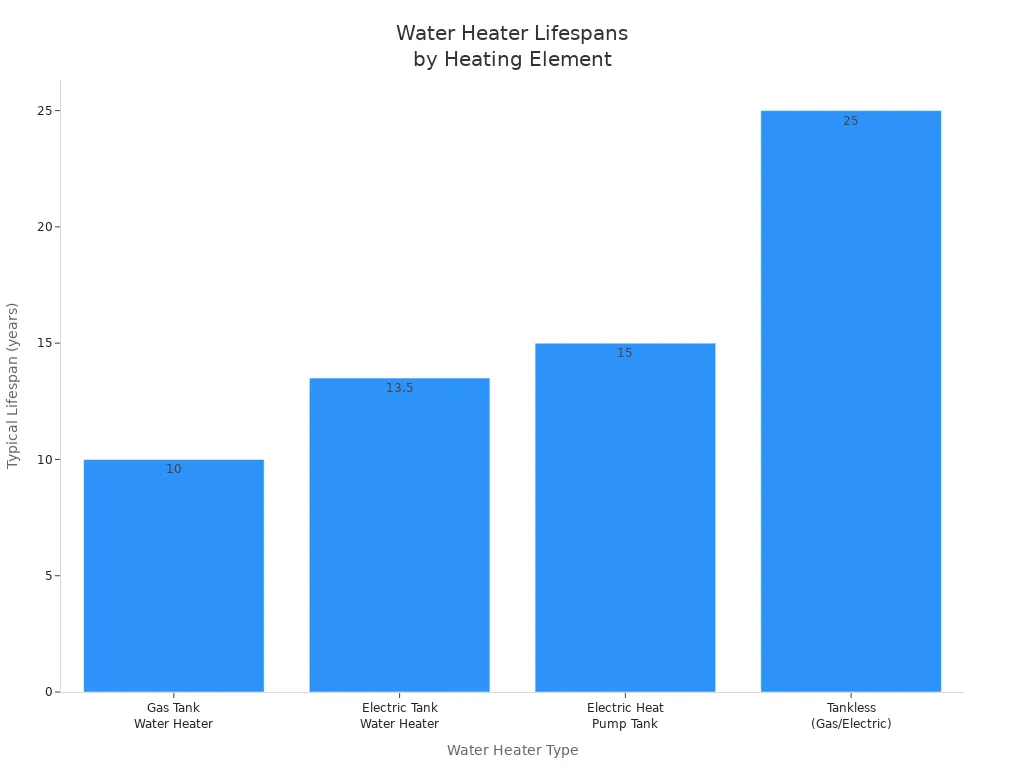
Encontrará varios tipos de elementos calefactores disponibles para calentadores de agua. Los calentadores de agua eléctricos con tanque utilizan elementos eléctricos, mientras que los modelos a gas dependen de quemadores. Los calentadores de agua sin tanque utilizan quemadores a demanda o elementos eléctricos, que duran más debido al menor desgaste. Los elementos eléctricos en unidades con tanque suelen durar de 12 a 15 años, mientras que los modelos sin tanque pueden funcionar de 20 a 30 años con el cuidado adecuado.
| Tipo de calentador de agua | Tipo de elemento calefactor | Vida Útil Típica | Impacto del Mantenimiento |
|---|---|---|---|
| Calentador de Agua a Gas con Tanque | Quemador de Gas | De 8 a 12 años | La acumulación de sedimentos causa puntos calientes; requiere limpieza anual; la corrosión del tanque es común sin mantenimiento del ánodo de sacrificio. |
| Calentador de Agua Eléctrico con Tanque | Elemento Eléctrico | 12 a 15 años | Requiere limpieza y reemplazo del ánodo de sacrificio cada 3-5 años para prevenir la corrosión. |
| Calentador de Tanque con Bomba de Calor Eléctrica | Elemento Eléctrico | Hasta 15 años | Igual que las unidades eléctricas con tanque; la vida útil está limitada por la corrosión del tanque de acero. |
| Sin Tanque a Gas/Eléctrico | Quemador/Elemento a Demanda | 20 a 30+ años | Sin acumulación de sedimentos; limpieza más fácil; no necesita ánodo de sacrificio; mayor vida útil compensa el costo inicial más alto. |
Consejos de Compatibilidad
Al seleccionar un elemento calefactor de reemplazo, debe asegurar la compatibilidad con su calentador de agua. Siga esta guía paso a paso para evitar errores comunes:
- Identifique el estilo de brida de su elemento actual (roscado, brida plana, brida universal o cabeza redonda).
- Ajuste el voltaje y la potencia a las especificaciones de su calentador de agua, generalmente encontradas en la placa de identificación.
- Elija la densidad de potencia correcta para evitar fallos prematuros.
- Confirme que la longitud y el material (cobre o acero inoxidable) coincidan con su elemento original.
- Utilice piezas recomendadas por el fabricante u OEM para mejores resultados y cumplimiento de la garantía.
- Siempre corte la energía y vacíe el tanque antes de retirar el elemento defectuoso e instalar el nuevo.
Recordatorio de Seguridad: Nunca intente reparar el calentador de agua sin cortar la energía y permitir que el tanque se enfríe.
Siguiendo estas pautas, asegura una reparación exitosa del calentador de agua y prolonga la vida útil de su sistema.
Puede prevenir la mayoría de los problemas del calentador de agua reconociendo signos de advertencia temprana y realizando mantenimiento regular. El elemento inferior suele fallar primero porque los sedimentos se asientan en el fondo y aumentan la demanda de calor. Para mantener su sistema funcionando eficientemente:
- Limpie el tanque cada seis meses para eliminar sedimentos.
- Inspeccione y limpie los elementos calefactores para evitar incrustaciones.
- Reemplace las piezas desgastadas y verifique la configuración del termostato.
El mantenimiento regular reduce los costos de energía,, previene fallos prematuros y asegura un suministro constante de agua caliente.
PREGUNTAS FRECUENTES
¿Qué causa con mayor frecuencia el fallo de un elemento de calentador de agua?
La acumulación de sedimentos y depósitos minerales suele causar el fallo del elemento de un calentador de agua. Estos materiales aíslan el elemento calefactor, forzándolo a sobrecalentarse. El mantenimiento y la limpieza regulares ayudan a prevenir este problema común.
¿Cómo saber si la resistencia está mal?
Puede notar agua tibia, duchas calientes cortas o ruidos extraños. Probar un elemento del calentador de agua con un multímetro le da una respuesta clara. Si no hay continuidad, necesita reemplazar el elemento.
¿Puede usted reemplazar un elemento del calentador de agua usted mismo?
Puede reemplazar un elemento del calentador de agua si sigue una guía paso a paso. Siempre comience cortando la energía y vaciando el tanque. Retire el elemento defectuoso, luego instale el nuevo. Si no está seguro, llame a un profesional para la reparación del calentador de agua.
¿Cuáles son los errores comunes al reemplazar un elemento calefactor?
Muchas personas olvidan cortar la energía antes de comenzar. Otras omiten vaciar el tanque o usan una pieza de reemplazo incorrecta. Siempre verifique la compatibilidad y siga los pasos de seguridad para evitar daños o lesiones.
¿Con qué frecuencia debe limpiar su calentador de agua?
Debe limpiar su calentador de agua cada seis meses. Esta rutina elimina sedimentos y extiende la vida del elemento calefactor. La limpieza también ayuda a mantener la eficiencia y previene fallos tempranos.
¿Es mejor reparar o reemplazar un calentador de agua viejo?
Si su unidad tiene más de ocho años o necesita reparaciones frecuentes, el reemplazo puede ahorrarle dinero. La reparación del calentador de agua funciona mejor para unidades más nuevas con problemas menores, como un solo elemento fallado.
¿Todos los calentadores de agua tienen dos elementos?
La mayoría de los calentadores de agua eléctricos con tanque tienen dos elementos. Algunos modelos más pequeños o antiguos pueden usar solo uno. Los calentadores de agua a gas utilizan un quemador en lugar de un elemento eléctrico.

