
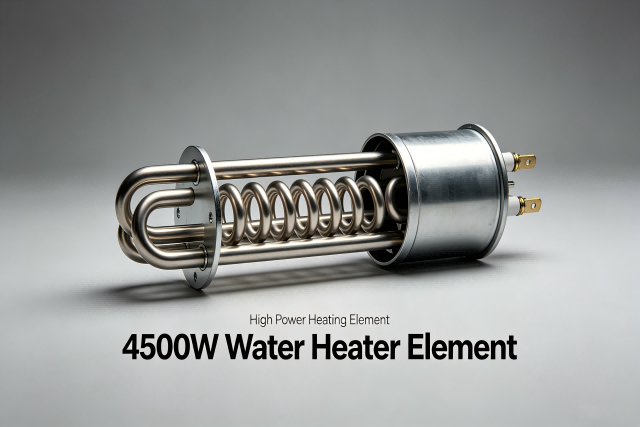
A 4500W electric water heater element is a common power class for residential tanks, and it can deliver fast recovery—when matched correctly to the heater’s voltage, wiring, thermostat controls, and tank condition. Performance “upgrades” usually do not come from simply choosing a higher wattage. They come from choosing the right element style for the water conditions, lowering unnecessary stress (scale, dry firing, poor connections), and installing with strict verification. Heater engineering guidance also reminds buyers that a heating element is an assembly (conductive alloy plus insulating/support materials and lead connectors), so the terminals, gaskets, and installation steps affect total performance and lifecycle cost.
For product family context and custom options: Heating Element, Heating Element manufacturer, Heating Element Factory, Die Casting Heating Solutions.
- What “performance” means for a 4500W element
- Heating element basics (why materials + framework matter)
- Smart upgrades that improve recovery and longevity
- Selection checklist (specs to match before buying)
- Installation essentials that prevent premature failure
- Common problems: slow recovery, tripping, scale, dry fire
- FAQ (3)
- References
What “performance” means for a 4500W element
For a tank-type water heater, element “performance” is typically judged by: recovery time (how quickly the tank reheats), temperature stability, and service life under real water conditions. A 4500W element can only deliver its rated heat when: the supply voltage matches the heater’s design, the thermostat and wiring allow full power, and the element can transfer heat efficiently into the water without being insulated by scale.
Metric
Recovery
Higher wattage improves recovery only if the heater is designed for that load and heat transfer remains efficient.
Metric
Efficiency in-tank
Scale layers reduce heat transfer; cleaning and material choices can matter more than wattage changes.
Metric
Longevity
Driven by element temperature, cycling, connection quality, and water chemistry/contaminants.
Section summary
A 4500W element’s “upgrade path” is mainly reducing heat-transfer losses and failure modes, not increasing wattage beyond the heater’s rating.
Heating element basics (why materials + framework matter)
Engineering guidance defines a heating element as a component made of both electrically conductive and insulating material, designed to serve a heating purpose. It is more than the heating alloy alone: it includes an insulating framework and lead connectors. Heat is produced through resistive (Joule) heating. Material selection (alloy composition, sheath materials, insulators) influences electrical resistance, thermal expansion, oxidation behavior, and therefore service life.
Why water heaters are hard on elements
- Scale and sediment can insulate the sheath and raise element surface temperature.
- Repeated cycling drives expansion/contraction and oxide-layer stress.
- Connection quality matters: loose terminals create local resistance heating and damage.
- Dry firing (energizing without water) can burn out an element rapidly.
Section summary
The best-performing 4500W elements are those whose materials, geometry, and connections keep element temperature under control in real-world conditions.
Smart upgrades that improve recovery and longevity
“Upgrade” can mean changing element style, improving maintenance, or improving installation discipline. The best upgrades are those that reduce the known failure drivers: scale, overheating, connector losses, and dry firing.
Upgrade options (what they change)
| Upgrade category | What it improves | What it does not fix |
|---|---|---|
| Element architecture choice | Heat transfer behavior and surface temperature characteristics | Wrong voltage/wattage mismatch; broken thermostats |
| Anti-scale strategy | Longer life and more consistent recovery by reducing insulation from mineral deposits | Will not correct undersized electrical supply |
| Connector/wiring refresh | Reduces resistance heating, arcing risk, and intermittent heating | Does not compensate for a burned-out element coil |
| Installation discipline | Prevents dry fire and leaks; avoids immediate failures | Cannot overcome an incorrect replacement selection |
What typically improves real-world performance most (relative impact)
Section summary
The most valuable “upgrades” reduce element temperature spikes: scale control, avoiding dry fire, and maintaining low-resistance terminals.
Selection checklist (specs to match before buying)
The most important selection rule is simple: match the water heater’s required voltage and wattage. Manufacturer service guidance for element replacement explicitly instructs verifying the new element by referring to the heater’s data plate for voltage and wattage.
| What to verify | Why it matters | Risk if ignored |
|---|---|---|
| Voltage and wattage (data plate) | Defines electrical load and heat output | Wrong element can underperform or cause overheating/tripping |
| Physical fit | Thread type, immersion length, clearance | Leaks, poor heating distribution, installation failure |
| Materials / sheath | Affects corrosion resistance and scaling tendencies | Shorter life in aggressive water conditions |
| Quality signals | Clear spec fields, approvals, warranty/returns | Higher wrong-part and early-failure cost |
Spec transparency example (general): a retail heating element listing provides wattage, materials, an ingress protection rating, UL approval, warranty length, and return policy. Regardless of brand or product type, those fields help buyers compare safety, suitability, and total cost.
Section summary
A “4500W upgrade” begins with data plate verification. Do not treat wattage as a “free performance knob.”
Installation essentials that prevent premature failure
The installation steps below reflect safety and reliability principles highlighted in manufacturer service guidance: verify the element is correct (voltage/wattage), keep wire connections tight, and do not energize before the tank is full of water and purged of air.
Key installation controls (high value)
- Verify replacement rating against the data plate (voltage and wattage).
- Install gasket correctly and tighten properly; check for leaks after refilling.
- Refill completely and purge air before restoring power (prevents dry fire burnout).
- Ensure tight wire connections to reduce resistance heating at terminals.
- Restore covers/insulation to maintain safety and proper operating conditions.
Dry fire warning (why it matters)
Service guidance explicitly warns not to apply electrical power unless the tank is completely full and all air is out—otherwise the upper element can burn out (dry fire). This is one of the fastest ways to destroy a new element and waste the “upgrade” cost immediately.
Section summary
The fastest way to “downgrade” a 4500W element is energizing before the tank is full or leaving loose wire connections.
Common problems: slow recovery, tripping, scale, dry fire
Most performance complaints fall into a few repeatable categories. Use these to decide whether the right “upgrade” is a new element type, a maintenance change, or a control/wiring fix.
| Problem | Likely cause | Best next step |
|---|---|---|
| Slow recovery | Scale insulation, wrong element rating, control issues | Verify rating; inspect for sediment/scale; confirm thermostats operate correctly |
| Element fails early | Dry fire, poor connections, severe scaling/corrosion environment | Audit installation steps; tighten connections; address scaling strategy |
| Breaker trips | Shorted element, wiring fault, incorrect rating | Stop and diagnose safely; confirm correct voltage/wattage element is installed |
| Leaking at element | Gasket damage or improper seating/tightening | Drain as needed; inspect gasket; reinstall correctly; re-check for leaks |
Section summary
Many “performance upgrades” are actually correcting failure modes: scale control, proper fill/purge, and tight terminals.
FAQ (3)
1) Can I replace a 4500W element with a higher wattage element for faster hot water?
Only if the water heater is designed and rated for it. Service guidance emphasizes verifying voltage and wattage against the heater data plate. Exceeding the rated load can create safety and reliability problems.
2) What’s the most important step to avoid burning out a new element?
Do not energize until the tank is completely full and all air is purged. Manufacturer guidance explicitly warns that applying power before the tank is full can burn out the upper element (dry fire).
3) Why do two “4500W” elements last different lengths of time?
Heater engineering guidance explains that element performance depends on materials, frameworks, trace elements in alloys, environment, and design tradeoffs. In water heaters, scaling and connector quality heavily influence element temperature and service life, even at the same wattage.
Conclusion
A 4500W water heater element can deliver excellent recovery, but long-term performance is driven by correct specification matching, controlled element temperature, and installation discipline. The most effective “upgrades” are usually (1) selecting an element style/material suited to local water conditions, (2) preventing scale from insulating the sheath, (3) ensuring tight electrical connections, and (4) preventing dry firing by fully filling and purging the tank before restoring power.
References
-
Heating element engineering overview: definition (assembly), resistive/Joule heating, materials, frameworks, environment effects, hidden lifecycle costs:
https://tutco.com/conductive/heating-elements -
Manufacturer-style replacement discipline (verify voltage/wattage on data plate; tighten wire connections; do not energize until tank is full and air is purged; check leaks; secure covers):
https://www.whirlpoolwaterheaters.com/support/help/element-was-out-of-range/24 -
Heating tube construction context (sheaths + MgO insulation + resistance wire) and product family structure (tubes/plates/films; custom solutions):
https://jinzho.com/product-category/heating-element/heating-tubes/
https://jinzho.com/product-category/heating-element/
https://jinzho.com/
https://jinzho.com/about/
https://jinzho.com/product-category/die-casting-heating-solutions/ -
Example of spec transparency in a heating element retail listing (wattage, materials, approvals, warranty/returns):
https://usa.hudsonreed.com/1000-plug-in-watt-electric-heating-element-76309
Disclaimer: This is general educational content. Always follow the water heater’s manual and local electrical/plumbing safety requirements.

