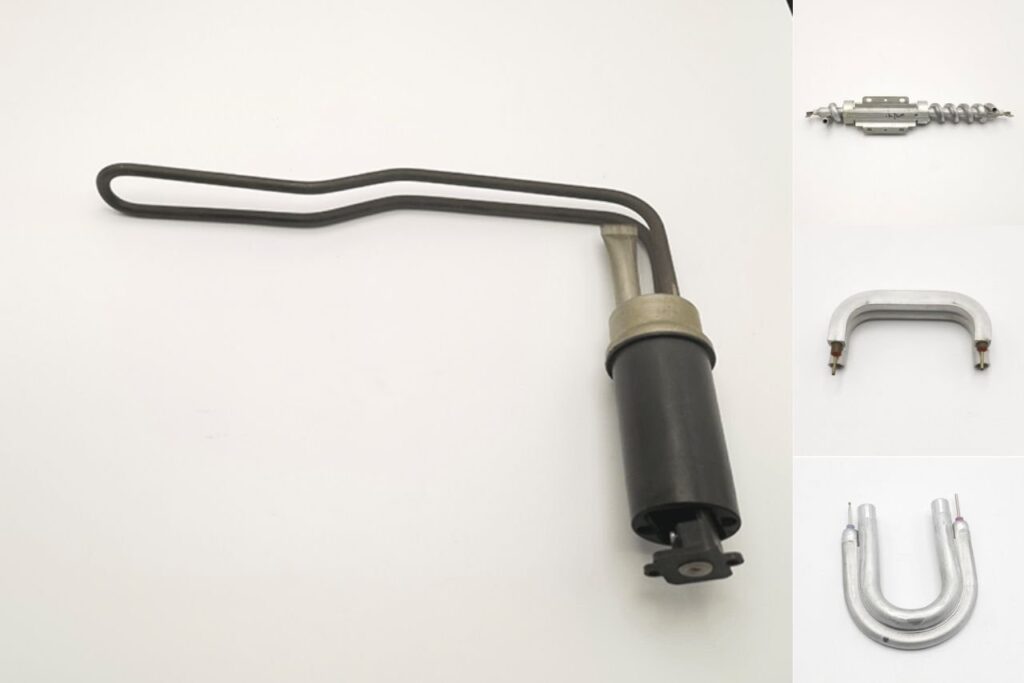
Cluster Page ? Troubleshooting ? Electric Water Heater Elements
A heating element is bad when symptoms and checks indicate it can no longer deliver stable resistive heating typically because it has failed open (no continuity), developed a short-to-ground, or is overheating under mineral scaling. In practice, a confident diagnosis comes from combining symptom patterns (especially in dual-element tanks) with careful inspection, safe electrical checks, and verification of the unit s rated voltage and wattage before any replacement is ordered.
Fast answer: the most reliable signs an element is failing
Most field diagnoses are correct when they rely on converging evidence instead of a single symptom. The list below prioritizes high-signal indicators that tend to hold up after the tank is opened.
High-confidence indicators
- No hot water in an electric tank that has power and intact controls (often an upper-element or control-chain issue).
- Only short bursts of hot water (often consistent with a lower element not heating in a dual-element tank).
- Breaker trips when heating starts (can indicate a short-to-ground).
- Element tests open circuit (no continuity) or shows abnormal resistance relative to its rating.
- Visible damage after removal: swelling, cracks, severe pitting, or heavy scale with signs of overheating.
Lower-confidence indicators (need confirmation)
- Water is not as hot as before (could be thermostat setting drift, mixing valve, or seasonal inlet changes).
- Unusual noises (often sediment, not necessarily a failed element).
- Rust-colored hot water (often tank/anode-related rather than the element alone).
Quick technical reference: what resistance should look like
A resistive heater s approximate resistance follows ( R approx V^2/P ). Example: an element rated 240V / 4500W is roughly 12.8 . Real readings depend on design and temperature. Electrical measurements should be performed using safe practices; local requirements and the heater s manual govern.
How a water-heater element fails (engineering context)
A water-heater element is a specific implementation of an electric heating element: a designed assembly of conductive and insulating materials that converts electrical energy into heat (resistive/Joule heating). TUTCO notes that a heating element is more than the alloy alone it includes a framework, insulators, and terminations and that material choice and integration style influence performance and failure behavior.
Failure mechanisms that explain real-world symptoms
- Open circuit: the conductive path breaks; the element stops heating.
- Ground fault: insulation/sheath failure allows current leakage; protection devices may trip.
- Thermal overload from scaling: deposits reduce heat transfer, increasing surface temperature and accelerating degradation.
- Connection heating: loose terminals create local resistance and heat, damaging wiring and causing intermittent operation.
Symptom patterns that point to upper vs lower element issues
Many electric storage heaters use two elements. The symptom pattern often provides the fastest clue: when only partial hot water is available, the lower element is frequently implicated; when there is no hot water at all, the issue may be upstream (upper element, thermostat chain, or supply/power).
Pattern guide (generalized)
| Observed symptom | Common interpretation | What to confirm next |
|---|---|---|
| Only brief hot water, then lukewarm | Lower heating path not contributing (often lower element) | Check controls and element condition; consider sediment and scale |
| No hot water at all | Upper heating path or power/control issue | Confirm supply power, thermostat chain, and wiring integrity |
| Breaker trips during heating | Possible short-to-ground or wiring fault | Inspect wiring and element insulation condition using safe practice |
This is a prioritization aid not a substitute for the unit s manual or local diagnostic protocol.
What to check before blaming the element
A bad element diagnosis is often correct, but the most costly mistakes come from skipping the obvious checks. The goal is to avoid replacing a good element while the real issue is a thermostat, wiring termination, or plumbing-side mixing.
Electrical and control-side checks
- Confirm the heater has the correct supply and protection is not tripping.
- Inspect visible wiring for discoloration, melted insulation, or loose terminals.
- Confirm thermostat settings and any high-limit safety condition (model dependent).
Plumbing-side checks that mimic element failure
- Mixing valve behavior (temperature blending can mask heating capacity).
- Seasonal inlet temperature changes (winter supply water reduces perceived output).
- Dip tube issues (can reduce effective hot-water draw).
A critical replacement-related warning that also affects diagnosis
If a newly installed element fails quickly, process error is a prime suspect. Whirlpool s replacement instructions state not to restore electrical power until the tank is completely full and all air is removed; otherwise the upper element will burn out from dry fire. This can be misread as defective new part if the refill-and-purge step was skipped.
A safe, structured diagnostic workflow (without risky shortcuts)
A reliable diagnostic workflow prioritizes safety, reduces rework, and protects the next step (replacement) from preventable failure. The outline below aligns with how manufacturer guidance structures replacement: control scalding risk, isolate power, drain when needed, verify specifications, and only energize after refill and air purge.
Workflow overview
Diagnostic detail varies by region, heater design, and qualification level. The principle is consistent: evidence first, then parts.
Replacement-readiness: what to confirm before ordering parts
Even when the element is confirmed faulty, ordering the wrong replacement creates a second failure mode: mismatch. Whirlpool s procedure explicitly requires verifying the new element against the data plate for voltage and wattage.
Minimum information to capture
- Data plate ratings: voltage, wattage, and model identifiers.
- Mounting standard and gasket type (thread/interface is not universal worldwide).
- Element geometry and space constraints (straight vs foldback, clearance from tank).
- Water conditions (hard water vs corrosive chemistry) that might justify a different sheath/material choice.
Specification transparency: why it matters
Retail product pages often reveal what verifiable specs look like when comparing components. For example, Hudson Reed s plug-in element listing specifies 1000W power, ABS plastic and stainless steel materials, IP67 ingress protection, and UL approval, plus a 2-year warranty and cable length. While this is designed for radiators or towel warmers rather than tank immersion, the structure of the spec disclosure is a useful benchmark.
When the question becomes part quality : sourcing and design considerations
If element failures are frequent across a product line (rather than isolated to a single tank), the root cause may shift from a bad element to design, environment, or supply-chain consistency. TUTCO s engineering discussion emphasizes that alloy composition and trace elements can change properties between suppliers, and that environment contaminants can shorten life. For OEMs and brand owners, this is why supplier capability and process control are part of reliability engineering.
Component families used across heating applications
- Heating Element (category hub)
- Heating Element manufacturer (company overview)
- Heating Element Factory (capabilities and background)
- Die Casting Heating Solutions (integrated heating bodies for compact boilers and appliance modules)
Why catalog breadth can matter
A supplier that supports multiple heater constructions (tubes, plates, films, and integrated die-cast modules) can be relevant for organizations standardizing thermal control strategies across products. Jinzhong s category structure distinguishes these families and highlights manufacturing claims such as multi-process integration and scaled capacity.
FAQ
What are the most common symptoms of a bad hot water heating element?
How can someone avoid replacing a good element?
Why does a brand-new element sometimes fail immediately after installation?
What should be verified before ordering a replacement heating element?
References and outbound links
Outbound sources used to support engineering definitions, safety-critical steps, and specification examples:
- Whirlpool Water Heaters element replacement steps and dry-fire warning: https://www.whirlpoolwaterheaters.com/support/help/element-was-out-of-range/24
- TUTCO heating element definition, materials, integration styles, and environment considerations: https://tutco.com/conductive/heating-elements
- Hudson Reed example of disclosed specs (1000W, ABS + stainless, IP67, UL approval, warranty/cable length): https://usa.hudsonreed.com/1000-plug-in-watt-electric-heating-element-76309
- Jinzhong Electric Heating internal references for supplier context and anchor placement: https://jinzho.com/product-category/heating-element/, https://jinzho.com/, https://jinzho.com/about/, https://jinzho.com/product-category/die-casting-heating-solutions/