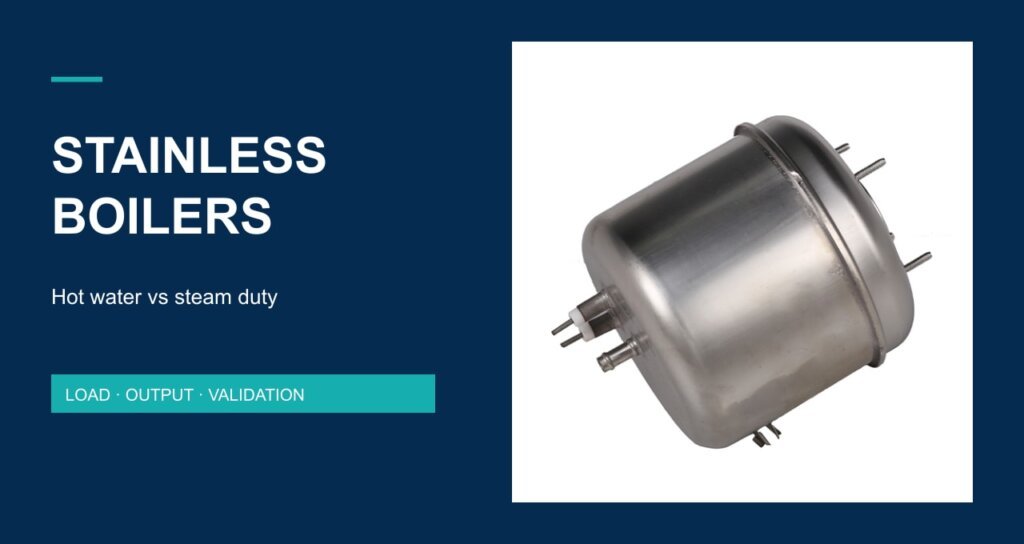
A stainless steel boiler should be sized against the heat delivered to its working fluid, rather than its nameplate wattage alone. Heating water and producing steam are different duties. The useful specification defines inlet conditions, output conditions, demand over time, and the complete assembly that must meet them.
For an OEM appliance, the key question is not simply “How many watts?” It is “What must leave the boiler, at what condition, and for how long?” This guide separates those questions using a transparent energy budget, then connects the calculation to vessel construction, interfaces and prototype acceptance. The numerical examples are hypothetical calculations, not Jinzhong product ratings or test results.
1. Define the delivery requirement before selecting a boiler
A boiler can be part of a coffee machine, a steam-cleaning appliance or a garment steamer, yet these applications do not impose the same demand. A short burst from stored energy is different from continuous delivery. A system may satisfy a brief demonstration and still fail a repeated operating cycle because it cannot recover between draws.
| Duty | Specify at the appliance boundary | What to verify |
|---|---|---|
| Batch hot water | Water mass; inlet and target temperatures; cold-start state | Time to the agreed water-temperature endpoint |
| Flowing hot water | Mass flow and inlet/outlet temperatures | Temperature stability throughout the draw |
| Steam delivery | Feedwater condition; outlet pressure; required mass flow and steam condition | Delivered mass and condition over a defined interval |
| Intermittent steam bursts | Burst duration; interval; number of bursts; initial fill state | Recovery, pressure behaviour and repeatability |
Separate stored energy from sustained output
State whether testing begins cold, at normal readiness, or immediately after a previous cycle. Record the initial fill quantity and the water-level control state. If a design uses stored hot water, its first burst can exceed the sustained rate supported by electrical input. Report both results with their operating conditions instead of combining them into a single output claim.
2. Why a hot-water calculation cannot establish steam capacity
Liquid-water heating uses a sensible-heat budget
For a planning calculation with liquid water and no phase change, Q = m c ΔT. Here Q is energy, m is water mass, c is specific heat and ΔT is temperature rise. The relationship is described in the OpenStax specific-heat reference. Use consistent units and state any constant-property approximation.
Worked example: one kilogram of water
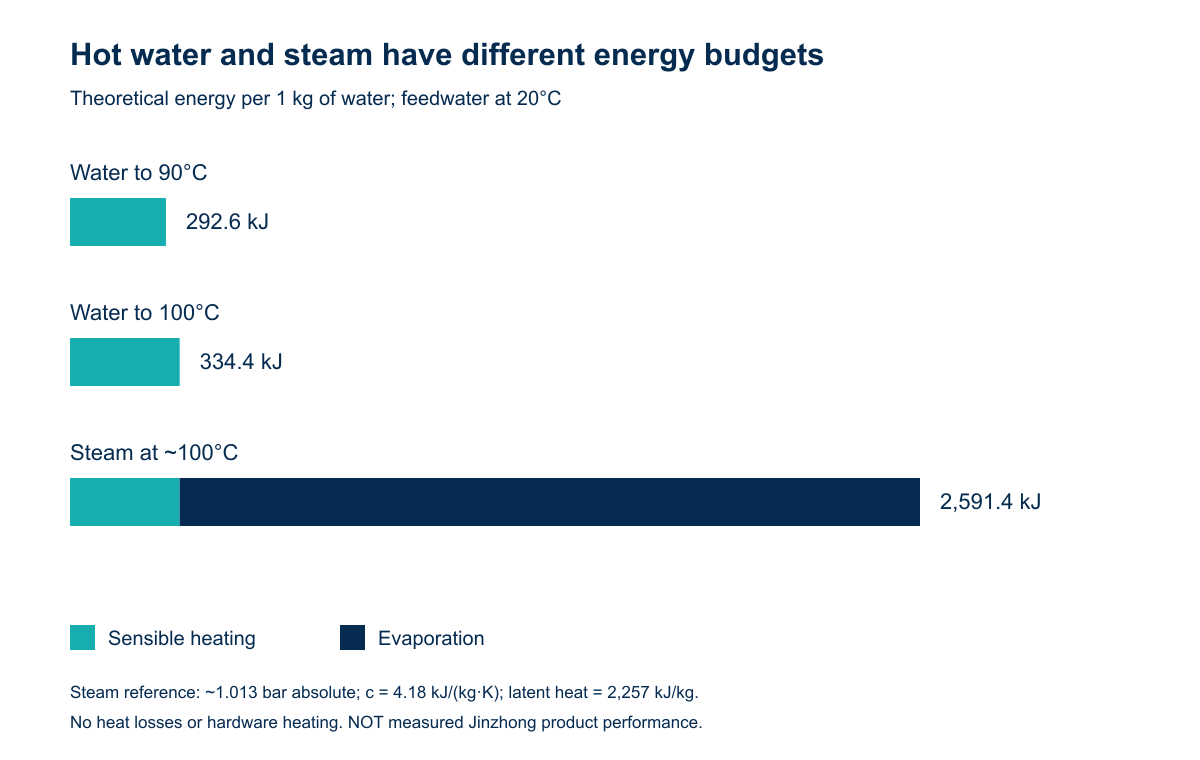
Assume water starts at 20°C. Using c = 4.18 kJ/(kg·K), heating 1 kg to 90°C requires 292.6 kJ. Heating it to 100°C requires 334.4 kJ under the same approximation. Neither figure includes evaporation, the vessel, fittings or heat lost to the surroundings.
Steam generation also needs latent heat
For an illustrative atmospheric case, take the saturation temperature as approximately 100°C at 1.013 bar absolute, and the latent heat of vaporisation as approximately 2,257 kJ/kg. These are rounded reference values, not an operating pressure or acceptance limit for a supplied boiler. The Spirax Sarco explanation of steam formation distinguishes sensible heating from the energy added during phase change.
Starting with 1 kg of liquid water at 20°C, an approximate energy budget to produce dry saturated steam at this atmospheric condition is 334.4 + 2,257 = 2,591.4 kJ/kg. This is about 8.9 times the 20-to-90°C hot-water energy in this example. It is not a universal ratio: feedwater temperature, pressure and outlet condition change the calculation.
| Illustrative task, per 1 kg | Sensible energy (kJ) | Evaporation energy (kJ) | Total (kJ) |
|---|---|---|---|
| Water: 20 → 90°C | 292.6 | 0 | 292.6 |
| Water: 20 → 100°C | 334.4 | 0 | 334.4 |
| Steam: 20°C feed → dry saturated steam at ~100°C | 334.4 | 2,257 | 2,591.4 |
Boundary of the example
This atmospheric example does not prescribe venting, a pressure setting or a test procedure for a real vessel. For a pressurised project, calculate the enthalpy rise from the actual feed condition to the specified outlet pressure and steam condition using suitable steam-property data. Distinguish absolute pressure from gauge pressure. The appliance and vessel design must be reviewed for the actual market and operating conditions.
3. Convert the energy budget into a power question
At steady state, the approximate ideal steam rate is ṁ = P / Δh, where P is heat transferred to the fluid in kJ/s and Δh is the required enthalpy rise in kJ/kg. Multiplying by 3,600 gives kg/h. Electrical input is not automatically identical to useful heat delivered to the fluid at the appliance outlet.
Using only the atmospheric example above, 1.5 kW corresponds to 1.5 × 3,600 / 2,591.4 = approximately 2.08 kg/h. This is an ideal, loss-free energy ceiling under the stated assumptions, not a proposed specification. Do not attach it to the pictured assembly or quote it as a production guarantee.
| Hypothetical continuous heat to fluid | Ideal steam rate, stated atmospheric case | What the number excludes |
|---|---|---|
| 1.5 kW | 2.08 kg/h | Startup, thermal losses, downstream losses and other loads |
| 2.0 kW | 2.78 kg/h | Same exclusions |
| 3.0 kW | 4.17 kg/h | Same exclusions |
Use prototype measurements to close the budget
Measure supply conditions, input power, initial water and metal temperatures, delivered output and the selected endpoint. Keep the test boundary consistent. A vessel sensor reaching its setpoint does not demonstrate that the outlet delivers the requested fluid condition. Condensate collection by itself also does not establish steam dryness when liquid carryover may contribute to the measured mass.
For intermittent service, define the whole duty cycle. Specify each burst, pause, refill event and recovery criterion. Compare results at the same initial state and repeat the sequence. A useful engineering report distinguishes cold-start readiness, first-burst behaviour and sustained repeat operation.
4. Review the stainless vessel and heater as one assembly
“Stainless steel” identifies a material family, not the complete wetted construction. Request the grade and finish of the actual water-contact parts, joining materials, seals and fittings. Evaluate them against water chemistry, cleaning agents, temperature cycling and the intended maintenance procedure. Do not infer the grade of a boiler from a grade listed for a different heating tube or tank product.
Welds, ports and mounting details affect the integration
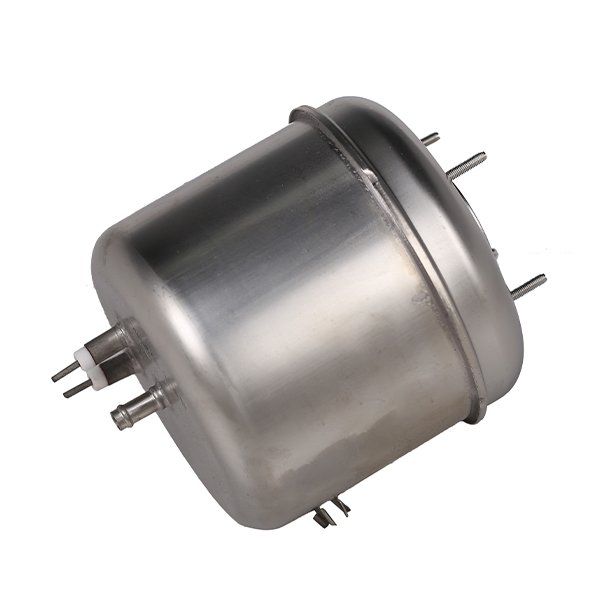
Jinzhong’s supplied company profile identifies stainless steel boilers and describes stamping/deep drawing and TIG welding for this product presentation. It also identifies coffee machines, steam mops and handheld garment steamers as application examples. Those statements support an engineering discussion; they do not establish that every catalogue model uses identical construction or carries the same operating limits.
The stainless steel boiler heater listing and coffee boiler listing are starting points for identifying the required assembly. Confirm the selected drawing revision and construction before transferring any catalogue statement to an appliance specification.
| Interface or condition | Information to agree | Evidence to request |
|---|---|---|
| Vessel and joints | Materials, geometry, joining process, wetted surfaces | Drawing, material documentation and agreed inspection records |
| Ports and mounting | Thread/seal details, orientation, loads and clearances | Interface drawing and assembly instructions |
| Heater and control | Electrical configuration, sensor location, operating endpoint | Wiring information and prototype records |
| Leak/pressure verification | Method, medium, conditions, acceptance limits and traceability | Model-specific agreed procedure and recorded results |
| Maintenance | Water quality, cleaning method, access and service interval basis | Validated instructions for the intended appliance |
Where a project needs a separate vessel-bottom heating arrangement, review the boiler bottom with heating tubes with its own interface requirements. A bottom assembly is not automatically interchangeable with a complete boiler. Confirm which party supplies the vessel, heater, seals, sensors and protective functions.
5. Agree the acceptance record before ordering prototypes
Define useful delivery in terms the development team can reproduce. Record the supply, fluid condition, initial state, control settings and measurement locations with each test. A temperature curve without those conditions is difficult to compare with a later sample. Include the drawing revision and any firmware or control configuration that changes the result.
Normal temperature regulation and independent protective functions serve different purposes. Review low-water operation, interrupted supply, sensor faults and abnormal operating cases at the complete-appliance level. Determine the required protective architecture and applicable assessment with the responsible engineering team. A catalogue photograph or a pressure-test statement cannot replace that work.
Jinzhong’s company profile mentions pressure testing for its stainless boiler presentation, but does not provide a model-specific pressure, hold time or acceptance record for the assembly pictured here. Ask for those details for the selected model instead of converting a general process statement into a pressure rating. Background company information is available in the Jinzhong company profile.
6. What to include in a stainless boiler enquiry
Send the intended appliance and output duty; feedwater conditions; required delivery temperature or steam condition; pressure basis; electrical supply; duty cycle; envelope and mounting; ports; sensing/control responsibilities; cleaning conditions; and documentation needed for the target market. Identify whether the request covers a complete boiler or only a vessel/heater subassembly.
For an engineering review, send Jinzhong the boiler duty cycle and interface drawing. The aim is a shared, testable requirement rather than a wattage-only enquiry. If the project is still choosing between a cast heating assembly and a separate boiler, the die-cast heating element design checklist covers the earlier assembly-definition stage.
Frequently asked engineering questions
Can a hot-water flow result be converted directly into a steam output?
No. Steam production includes phase-change energy and a defined pressure and outlet condition. Use an enthalpy budget for the actual feed and outlet conditions, then verify the complete system. A liquid-water result alone does not establish steam capacity.
Does a higher power rating guarantee better steam performance?
Higher input can increase the available energy, but delivered performance depends on the heat-transfer path, control behaviour, water supply and losses. First-burst output and continuous output are separate results. Match the power and assembly design to the stated duty cycle.
Does stainless steel construction establish a pressure rating?
No. Material, thickness, geometry, joints, ports and operating conditions all matter. Use the selected assembly’s agreed technical documents and applicable assessment. A generic material description is not a vessel rating or a certification.
What should the supplier report with a prototype result?
At minimum, identify the tested configuration, initial state, supply conditions, fluid conditions, measurement locations, duty cycle and acceptance endpoint. Record actual output and the limits of the test. Distinguish calculated planning values from measured results.
Sources and calculation basis
Company statements were checked against the supplied Jinzhong Company Profile.pdf, pages 15 and 18, and the product/application workbook records. The original photograph is supplied file 7001/1.jpg. General heat and phase-change relationships are referenced above. Tables 2 and 3 and Figure 1 use explicitly selected theoretical inputs; no model-specific output, efficiency, endurance or certification claim is made.