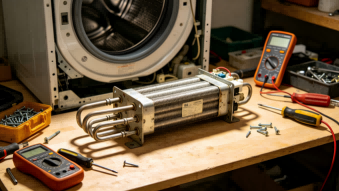
Extending the service life of a clothes-dryer heating element is primarily about controlling the element’s operating temperature and preventing avoidable stress. In most households, premature burnout is driven by restricted airflow, lint accumulation, poor heat transfer, repeated overheating cycles, or installation/repair mistakes that introduce electrical hot spots. Engineering guidance defines a heating element as a designed assembly—conductive alloy plus insulation and connectors—so longevity depends on the whole system, not only on the coil itself.
For sourcing and technology context beyond dryers, product families are commonly organized by heat-transfer needs. Jinzhong describes its portfolio under Thanh gia nhiệt and presents itself as a 加热元件制造商 with end-to-end capability described on its 加热元件工厂 page. Integrated modules are also covered under Giải pháp gia nhiệt đúc khuôn.
- 烘干机加热元件过早失效的原因
- Airflow management: the highest-ROI lifespan lever
- Electrical stress: connections, cycling, and hot spots
- Maintenance schedule (home + facilities)
- Replacement part selection and install practices that prevent repeat failures
- Data tables and charts (risk prioritization)
- 常见问题解答(4个)
- Phần kết luận
- Sources & outbound links
烘干机加热元件过早失效的原因
Dryer heating elements operate as resistive (Joule) heating devices: current passes through a resistance alloy and heat is produced at the electrical load point. Engineering references emphasize that the “element” is not only the alloy wire; it includes insulating framework and lead connections. In a clothes dryer, the element’s environment is defined by heated airflow and the appliance’s safety controls.
Four dominant failure pathways
| Failure pathway | 成因分析 | How it shortens life | What users typically notice |
|---|---|---|---|
| Overtemperature from restricted airflow | Lint buildup, crushed/long ducts, blocked vents, poor make-up air | Raises coil temperature; accelerates oxidation and deformation | Long dry times, very hot cabinet, recurring thermal cutouts |
| Electrical hot spots | Loose terminals, damaged connectors, poor contact pressure | Localized resistance heating at terminals increases temperature and failure risk | Intermittent heat, discoloration at connectors, burning smell |
| Thermal cycling fatigue | Frequent on/off cycling, high-heat habits, control overshoot | Repeated expansion/contraction contributes to cracking and breakage | Heat works sometimes, then fails more often over time |
| Contamination/corrosion environment | Chemical fumes, humidity, dust, residue on heater surfaces | Material mismatch can shorten life; oxide layer behavior matters | Unexpected early failure despite normal airflow |
LSI keywords that align with real repair outcomes
**airflow restriction**, **lint trap**, **vent duct**, **thermal cutoff**, **cycling frequency**, **resistance alloy**, **oxidation layer**, **terminal overheating**, **heat transfer**, and **watt density** (for design comparisons).
Airflow management: the highest-ROI lifespan lever
In a dryer, airflow is the element’s cooling mechanism. When air does not move correctly, the element’s operating temperature rises. Engineering heater guidance highlights that material properties shift with temperature and that many failures are rooted in operating conditions rather than the alloy itself. For dryers, restricted airflow is the most common condition that drives excessive temperature.
Airflow checklist (practical and measurable)
- Lint screen discipline: remove lint every load; a partially blocked screen changes airflow and increases heater temperature.
- Exhaust path inspection: confirm the exterior vent flap opens fully during operation and is not obstructed.
- Duct geometry control: minimize length and elbows where possible; avoid crushed flexible duct.
- Room ventilation: ensure adequate make-up air, especially in small laundry closets.
Relative impact on element lifespan (qualitative)
Why restricted airflow is expensive (hidden costs)
Heater engineering discussions emphasize that hidden costs often exceed part cost: repeat failures, labor, and downtime can dwarf the price of the element. In dryers, restricted airflow increases dry time, wastes energy, and shortens heater life—often triggering multiple service events until the airflow root cause is corrected.
Airflow restrictions lengthen runtime, increasing energy use and wear on components.
Replacing a heater without fixing airflow often repeats the failure pattern.
Electrical stress: connections, cycling, and hot spots
A heating element is the appliance’s electrical load point. Engineering references describe how alloy choice and design decisions influence efficiency and reliability. In field repairs, the most preventable electrical causes are loose connections and poor terminal contact—both of which increase local resistance and therefore local heating.
Connection quality and why it matters
Even a small increase in contact resistance can create a disproportionate temperature rise at terminals, especially over long cycles. A disciplined approach includes inspecting spade terminals, ensuring correct fit, replacing heat-damaged connectors, and avoiding reusing loose terminals.
Cycling and control behavior
Engineering heater guidance notes that rapid temperature cycling can shorten life when oxide layers and base alloys expand differently. In a dryer context, harsh cycling can be worsened by airflow restriction, overloading, or running high heat continuously in conditions that prevent proper heat removal.
Safety reminder for electrical work
Electrical servicing should follow local code and appliance instructions. When troubleshooting or replacing a heater, the safest practice is to de-energize the unit, confirm power is off, and restore all covers and insulation before operation to reduce shock and fire risk.
Maintenance schedule (home + facilities)
Lifespan extension is mostly routine. The schedule below focuses on actions that directly reduce heater temperature stress and prevent airflow-driven failures. It is intentionally model-agnostic, since procedures vary by installation and market.
| Tính thường xuyên | Hoạt động | Mục đích | What “done right” looks like |
|---|---|---|---|
| 每缸衣物 | 清洁棉绒过滤网 | Maintains airflow and reduces heater temperature | Screen is visibly clear; no waxy residue buildup |
| Hàng tháng | Inspect exterior vent outlet | Confirms exhaust is not obstructed | Vent flap opens freely during operation |
| 每季度一次 | Check duct for kinks/crush and excessive lint | Reduces restriction-driven overheating | Duct is intact, smooth path, minimal bends |
| Hàng năm | Deep clean exhaust path and internal lint areas (as permitted) | Restores airflow and reduces fire/overheat risk | Measured improvement in drying time; no hot-spot odors |
Replacement part selection and install practices that prevent repeat failures
If replacement is required, part selection should be specification-driven. Engineering guidance highlights that seemingly similar resistance alloys can differ by composition and trace elements, affecting properties and life. For purchasers, a credible supplier should provide clear ratings, materials, and quality signals.
What to demand from a credible listing
A well-specified product page generally lists power rating, materials, approvals (where applicable), warranty, and returns. For example, an electric heating element listing for radiators/towel warmers discloses wattage, materials (ABS and stainless steel), ingress protection rating, UL approval, warranty, and return terms. While not a dryer heater, it demonstrates the transparency pattern buyers should expect.
| Listing field | Why it matters for lifecycle cost | Common red flag |
|---|---|---|
| 电气额定值 | Avoids misapplication and overheating | Missing voltage/wattage details |
| Material disclosure | Predicts heat tolerance and corrosion sensitivity | Generic “high quality metal” wording only |
| Approvals / compliance | Signals testing expectations for the target market | Unverifiable claims without documentation |
| Warranty & returns | Reduces the cost of wrong-part purchases and quality escapes | No return policy clarity |
Installation discipline: preventing immediate repeat failure
Although the provided manufacturer support steps focus on water heater elements (not dryers), the underlying principles still apply: correct verification of the replacement, careful assembly, and ensuring the system is safe before energizing. The water-heater procedure explicitly emphasizes tight wire connections and safe commissioning steps to prevent immediate burnout (dry fire). In dryer work, similar discipline—tight connections, intact insulation barriers, and correct reassembly—reduces early failures and safety incidents.
Data tables and charts (risk prioritization)
The following tool-style view helps prioritize actions. The aim is to target the variables that most strongly affect heater temperature and stability.
Priority ranking for lifespan extension (qualitative)
Diagnostic mapping (symptom → likely driver)
| Triệu chứng | Most likely driver | First verification step |
|---|---|---|
| Dryer takes much longer than before | Airflow restriction / venting issues | Check lint screen + exterior vent flow |
| Heater fails repeatedly every few months | Restriction + overheating cycle; poor terminals | Inspect duct, blower path, and terminal discoloration |
| Intermittent heat | Loose connections or controls cycling abnormally | Check connectors and harness seating |
| Burning smell near rear/side panel | Lint accumulation or terminal overheating | Stop use and inspect exhaust path and terminals |
常见问题解答(4个)
1) What extends a dryer heating element’s life the most?
Improving and maintaining airflow. In a dryer, airflow removes heat from the element; restriction raises element temperature and accelerates failure mechanisms such as oxidation and deformation.
2) Why can a “new” heating element fail quickly?
The most common reasons are system issues rather than the part itself: restricted airflow, heavy lint accumulation, or electrical hot spots from loose connectors. Engineering guidance emphasizes that heater life is often dominated by operating conditions and integration quality.
3) Does alloy quality matter for appliance heating elements?
Yes. Engineering references note that resistance alloys can vary between manufacturers and may include trace elements that affect properties and lifespan. For procurement teams, this supports using spec sheets and quality signals rather than price alone.
4) What should be checked when replacing any heating element?
Verify correct ratings and fit, ensure tight electrical connections, and reassemble protective covers/insulation. Manufacturer service guidance for element replacement (in water heaters) explicitly stresses tight connections and safe commissioning; the same discipline reduces mistakes in other appliances.
Phần kết luận
The most reliable way to extend a dryer heating element’s lifespan is to keep the element cool enough to operate within its intended temperature range. That outcome is achieved less by “special parts” and more by controlling airflow, removing lint and restrictions, and ensuring electrical connections remain tight and undamaged. Engineering guidance supports this systems view: heating elements are designed assemblies whose longevity depends on material behavior, environment, and integration details. When replacements are necessary, specification-driven purchasing and disciplined installation reduce repeat failures and hidden lifecycle costs.
Sources & outbound links (transparency)
The article used the following references for factual grounding on heating element design concepts (conductive + insulating assemblies, resistive/Joule heating, material variability, environment effects, lifecycle costs), and on a manufacturer-style replacement procedure emphasizing rating verification and tight connections. A retail product page was used as an example of “good specification transparency” (materials, approvals, warranty/returns). Company/product family statements were referenced from Jinzhong’s published descriptions.
-
Heating element engineering overview (materials, integration types, environment effects, lifecycle considerations):
https://tutco.com/conductive/heating-elements -
Manufacturer-style element replacement steps (rating verification, tight connections, commissioning warnings):
https://www.whirlpoolwaterheaters.com/support/help/element-was-out-of-range/24 -
Example of specification transparency in a heater listing (materials, IP rating, UL approval, warranty/returns):
https://usa.hudsonreed.com/1000-plug-in-watt-electric-heating-element-76309 -
Manufacturer/product taxonomy and capabilities (heating tubes/plates/films; integrated die-cast modules):
https://jinzho.com/ | https://jinzho.com/product-category/heating-element/ | https://jinzho.com/product-category/die-casting-heating-solutions/
Disclaimer: This content is educational and does not replace the specific dryer service manual or local electrical safety requirements. For uncertain repairs, a qualified technician is recommended.