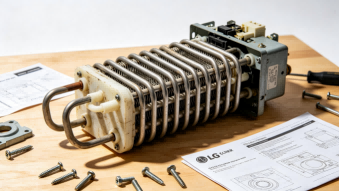
Most failed dryer-heater replacements are not caused by the new part itself; they are caused by preventable errors in diagnosis, installation, and safety checks. The highest-impact mistakes include installing the wrong-rated component, skipping electrical verification, leaving loose terminals, reassembling with crushed insulation or pinched wires, and ignoring the airflow system (lint blockage, duct restriction) that can overheat the heater housing. A professional approach treats the heating element as an engineered assembly—conductive material plus insulating framework and terminals—so the repair is completed only when electrical continuity, safe clearances, and airflow are all confirmed.
Heating components across appliances share common engineering principles. Product families such as Thanh gia nhiệt (tubes/plates/films), offered by a 加热元件制造商 and supported by the capabilities of a 加热元件工厂, help buyers and service teams specify materials, insulation methods, and integration styles. Integrated thermal modules described under Giải pháp gia nhiệt đúc khuôn illustrate how mechanical design and heat transfer are often addressed together in modern heater assemblies.
- Before starting: safety and confirmation steps
- The most common replacement mistakes (ranked)
- Diagnosis mistakes: replacing the heater when the fault is elsewhere
- Electrical mistakes: wiring, terminals, and verification
- Airflow and thermal mistakes: lint, ducting, and overheating
- Quality and procurement mistakes: how to choose credible parts
- Post-repair QA checklist (service-grade)
- 常见问题(8个)
- Phần kết luận
- Sources & outbound links
Before starting: safety and confirmation steps
A dryer heater circuit combines high current and high temperature. A safe workflow begins by removing electrical power at the appropriate disconnect, and it proceeds only after the technician confirms the repair target and replacement specification. Manufacturer-style service guidance for heater-element replacement in other appliances stresses similar fundamentals: verify voltage and wattage from the unit’s data plate, keep connections tight, and do not energize until the system is in a safe operating state. That logic is directly applicable to dryers even though the mechanical steps differ.
Safety note (EEAT)
Electrical servicing can cause shock, burns, or fire. If there is uncertainty about isolation, grounding, or wiring integrity, a qualified technician should perform the repair. After assembly, all covers should be secured to reduce risk—service guidance in related heater procedures explicitly emphasizes secured covers to reduce fire and shock risk.
Quick confirmation checklist
| 检查 | What “good” looks like | Why it prevents repeat failures |
|---|---|---|
| Correct part identification | Exact model/serial referenced; heater assembly matches | Avoids wrong geometry or connector mismatch |
| Element rating fit | Voltage/wattage align with appliance requirements | Prevents overload, overheating, and nuisance trips |
| Root cause validated | Evidence of open circuit, grounded coil, or damaged housing | Stops “parts cannon” repairs |
| Airflow baseline | Lint path and exhaust duct confirmed clear | Avoids immediate over-temperature cycling |
The most common replacement mistakes (ranked)
The mistakes below are ranked by how often they lead to a second failure or a safety incident. They are written for knowledgeable readers and service teams that want repeatable outcomes.
Typical impact on repeat failures (qualitative)
Mistake 1: Replacing the heater without proving it is defective
A dryer “no heat” complaint can be caused by multiple faults: a failed thermal cutoff, a cycling thermostat stuck open, a control board relay issue, a broken wire at the heater terminals, or inadequate voltage supply. Replacing the heater first may “fix” nothing, wasting time and money. A basic resistance/continuity test and a visual inspection of the coil path are typically the fastest proof steps.
Mistake 2: Installing a part that is not electrically equivalent
Heating elements are resistive loads. If wattage or voltage rating is mismatched, the circuit can run outside design conditions. Service guidance for heater-element replacement in other appliance contexts explicitly requires verifying replacement elements against the unit’s data plate for voltage and wattage. The same principle applies to dryers: the correct replacement is the one that matches the design load and connector system.
Mistake 3: Treating the element as “just wire” instead of an engineered assembly
Engineering references define a heating element as a component that combines electrically conductive material with insulating structures and lead connections. This is an important mindset shift: if the insulating supports are mispositioned, if the coil is allowed to sag and contact metal, or if terminals are not seated correctly, failure modes include shorting, arcing, and overheating.
Diagnosis mistakes: replacing the heater when the fault is elsewhere
A disciplined diagnosis reduces repeat repairs. The most common diagnosis mistakes are incomplete symptom classification and ignoring the conditions that killed the previous heater.
Symptom patterns that often point away from the element
| Observed behavior | Element-only failure likely? | High-probability alternatives |
|---|---|---|
| Heat appears briefly, then shuts off | Sometimes | Thermal cutoff, cycling thermostat, restricted vent causing overheat |
| Breaker trips during heat | 可能 | Grounded coil, pinched wire, damaged heater housing insulation |
| Runs but never dries | Often no | 气流受限, crushed duct, blocked lint filter path |
Mistake 4: Ignoring the “why it failed” question
Heater engineering guidance emphasizes “less obvious costs” and lifecycle thinking: a part that fails repeatedly creates labor cost, downtime, and customer dissatisfaction. In dryers, repeated heater failure often indicates an airflow and temperature-control problem rather than a parts quality problem. Without fixing the underlying restriction, the new heater runs hotter than intended.
Electrical mistakes: wiring, terminals, and verification
Electrical mistakes are both common and costly because they can trigger overheating at the contact point. Even a small increase in connection resistance at high current increases local heating. Service procedures for heater elements in other equipment explicitly call out tight connections for this reason.
Mistake 5: Leaving terminals loose or mis-seated
Loose terminals can discolor, oxidize, and lose spring tension. That can escalate into arcing and connector failure. A professional workflow includes cleaning contact surfaces when appropriate, ensuring the connector is fully seated, and verifying mechanical stability after reassembly.
Mistake 6: Damaging insulation or routing wires against hot surfaces
Heater housings often rely on insulating barriers and deliberate wire routing to keep conductors away from hot metal surfaces. Pinched wiring, missing grommets, or displaced insulation can cause shorts to chassis or progressive insulation breakdown.
Mistake 7: Skipping a post-install electrical check
A heater replacement should end with measurements, not hope. At minimum, the service team should confirm: continuity across the element (expected resistance range), no continuity from element terminals to chassis where it should be isolated, and stable voltage supply under operating conditions. This avoids reinstalling panels only to reopen the unit after a no-heat callback.
Confirm the heating path is intact and not grounded where it should be isolated.
Loose connections create local heating and can mimic heater failure symptoms.
Airflow and thermal mistakes: lint, ducting, and overheating
Dryer heaters depend on controlled airflow to carry heat into the drum and out the exhaust. If airflow drops, heater temperature rises. Overtemperature cycling increases thermal cycling stress and can trip safety devices or deform heater supports. This is why airflow is the most overlooked root cause in “new heater didn’t fix it” cases.
Mistake 8: Replacing the heater but leaving a restricted vent system
A blocked lint filter housing, crushed flexible duct, long vent runs, or external flap restrictions can all cause overheating. In many regions, lint accumulation and duct restrictions are among the highest-frequency contributors to poor drying performance and heater shutdowns. A repair is incomplete until airflow is validated.
Practical airflow checks (service-grade)
- Inspect lint filter, filter housing, and blower inlet for packed lint.
- Verify duct integrity end-to-end; remove kinks and crushed sections.
- Confirm exterior vent hood opens fully and is not blocked.
- Check that the dryer is not pushed tight against the wall, crushing the exhaust.
What restricted airflow typically increases (qualitative)
Quality and procurement mistakes: how to choose credible parts
Another repeat-failure driver is poor procurement: buying based on wattage keywords alone rather than specification completeness. A strong product listing typically includes materials, approvals, warranty terms, and return policy—signals that the seller expects scrutiny and can support issues. For example, a plug-in heating element product page (for radiators/towel warmers) specifies wattage, materials, ingress protection rating, UL approval, warranty, and returns, illustrating the transparency pattern buyers should seek even in dryer parts channels.
Mistake 9: Assuming “universal” equals correct
Universal fit claims can conceal differences in bracket geometry, connector style, insulation barriers, and sensor mounting points. Even if the coil heats, an incorrect housing interface can create contact points that encourage shorts or hot spots.
Mistake 10: Ignoring lifecycle cost
Engineering guidance on heater solutions highlights less-obvious costs: labor time, rework, field replacements, and reputation impact. For service organizations, this means a slightly higher-priced but well-documented part may reduce total cost by avoiding callbacks and repeat disassembly.
Post-repair QA checklist (service-grade)
A repair should be closed out with a structured quality check. The checklist below is designed to be recorded in a service ticket for repeatability.
| QA item | Pass criteria | If it fails |
|---|---|---|
| 元件导通性 | Resistance within expected range; no open circuit | Recheck connectors; replace element if defective |
| No unintended ground path | No short to chassis where isolation is expected | Inspect insulation barriers, wire routing, housing damage |
| Terminal seating | Fully seated, secure connectors; no wobble | Replace terminals, correct crimp, re-route wire |
| Airflow confirmation | Lint path/duct clear; vent hood opens | Clean/repair ductwork before declaring “fixed” |
| Reassembly integrity | All covers installed and secured; insulation replaced | Reinstall properly to reduce shock/fire risk |
常见问题(8个)
1) Why does a dryer still have no heat after the heater is replaced?
Common reasons include a failed thermal cutoff or thermostat, a wiring fault at the terminals, supply voltage issues, or airflow restriction causing immediate overtemperature shutdown.
2) What is the most frequent installation mistake?
Skipping airflow and vent inspection. Restricted airflow raises heater temperature and can trigger repeated shutdowns or component damage.
3) Can loose terminals really stop heating?
Yes. Loose terminals can overheat, oxidize, arc, and create intermittent power delivery—sometimes presenting as “bad heater” symptoms.
4) How should the correct replacement rating be confirmed?
The most defensible method is to reference the appliance’s rated requirements (model-based parts lookup and rating information). Manufacturer-style service guidance in other heater contexts explicitly requires verifying replacement elements against the data plate for voltage and wattage, illustrating the standard of care.
5) Why do heating elements fail over time even in normal use?
Heater engineering references note that all resistance heating elements eventually burn out due to oxidation, deformation, resistance changes, and damage. Environmental conditions and temperature cycling influence how quickly that happens.
6) Is it safe to run a dryer with panels off to test heat?
It is generally unsafe because exposed electrical parts and moving components increase shock and injury risk. Proper testing should be done with appropriate safety controls and covers secured where required.
7) What purchasing signals suggest a parts listing is credible?
Clear wattage and material disclosure, safety approvals where relevant, warranty terms, and return policy. Transparent product pages reduce wrong-part purchases and support claims.
8) How can service teams reduce repeat heater replacements?
Combine electrical verification with airflow validation, document terminal condition, replace compromised connectors, and ensure correct reassembly with insulation and covers restored.
Phần kết luận
Successful heater replacement is a process, not a single part swap. The most costly mistakes—wrong part selection, skipped verification, loose terminals, damaged insulation, and ignored airflow restrictions— can be prevented with a structured workflow and a documented QA checklist. Engineering guidance reinforces that a heating element is a designed assembly with conductive and insulating components, and that lifecycle costs often exceed the upfront part price when repeat failures occur. In dryer service practice, the best outcomes consistently come from confirming the root cause, restoring safe electrical connections, and ensuring the airflow system supports stable operating temperature.
Sources & outbound links (transparency)
The references below were used for factual grounding on heating element engineering principles (materials, integration, lifecycle costs) and on service-style replacement practices emphasizing rating verification and tight connections. The dryer-specific workflow and mistake ranking are original and written for practical service use.
-
Heating element engineering overview: definition as conductive + insulating component; material properties; supported/embedded/suspended classifications; lifecycle cost discussion:
https://tutco.com/conductive/heating-elements -
Manufacturer-style replacement steps emphasizing rating verification (data plate voltage/wattage) and tight wire connections, plus warnings about unsafe energizing and secured covers (water-heater context used for general service principles):
https://www.whirlpoolwaterheaters.com/support/help/element-was-out-of-range/24 -
Example of product-page specification transparency (wattage, materials, IP rating, UL approval, warranty and returns) used to illustrate procurement signals:
https://usa.hudsonreed.com/1000-plug-in-watt-electric-heating-element-76309 -
Heating component taxonomy and manufacturing context used for supplier-side discussion of heater assemblies and integration (tubes/plates/films, die-cast modules):
https://jinzho.com/ | https://jinzho.com/product-category/heating-element/ | https://jinzho.com/product-category/die-casting-heating-solutions/
Disclaimer: This content is informational and does not replace appliance manuals, local electrical codes, or professional training.