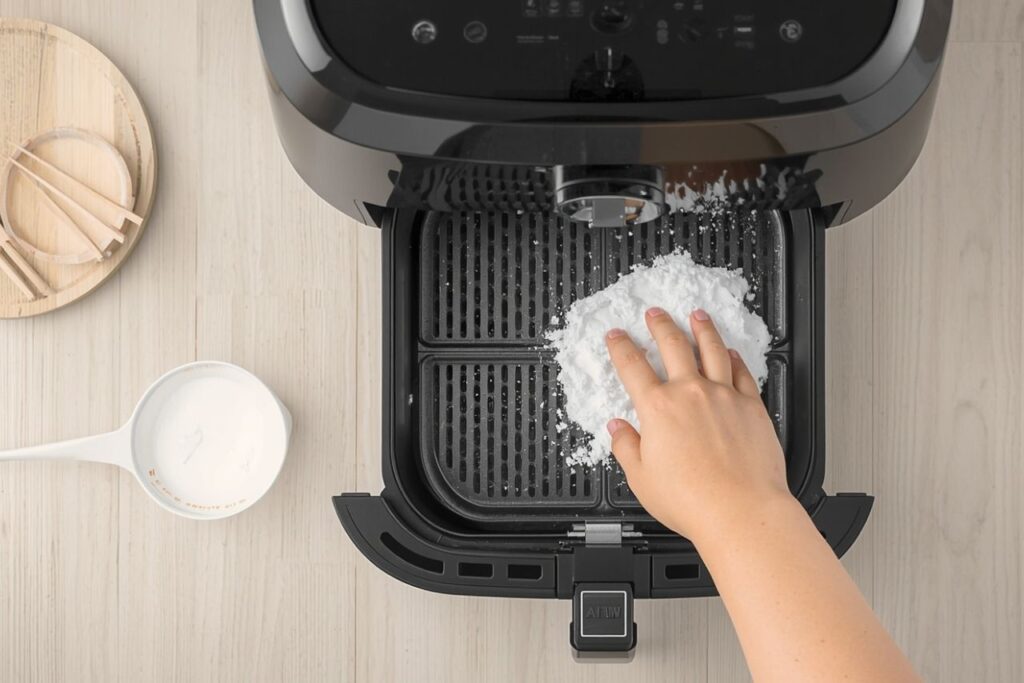
Baking soda is one of the simplest “natural” cleaners for an air fryer, but it works best when you treat the heating area like what it is: a precision heating element assembly, not a frying pan. The safest approach is gentle lifting (softening + wiping), not aggressive scrubbing.
Why baking soda helps (and when it doesn’t)
Baking soda works in two ways:
- Mild abrasion: it can help lift greasy film and light carbon from hard surfaces.
- Soil “release”: as a paste, it can soften and loosen baked-on residue so you can wipe instead of scrape.
小苏打仍具有研磨性。对于精密涂层、印刷表面、外露加热线圈或绝缘支架而言,研磨造成的损害可能大于益处。如果您的 空气炸锅的加热元件 是由绝缘体支撑的外露线圈,请将其视为易损电气组件——使用最少的水分,且几乎不进行擦洗。.
加热器设计基本原理解释了这一注意事项:一个 加热元件是由导电材料和绝缘材料共同组成的部件。某些元件是悬空安装的(通常位于云母/陶瓷支架上),某些是嵌入式的(例如内部带有绝缘层的护套式元件),每种结构都决定了“安全清洁”的具体方式有所不同。 conductive and insulating material. Some elements are suspended (often on mica/ceramic supports), some are embedded (for example, sheathed elements with insulation inside), and each construction changes what “safe cleaning” looks like.
Safety checklist before cleaning
- 拔下 the air fryer (don’t rely on the power button).
- 让其 完全冷却.
- Remove the basket/tray and wash those separately.
- Use a work light so you can see residue without scraping blindly.
3 natural baking-soda methods (gentle → stronger)
Method 1: Baking soda “dust + wipe” (lowest risk)
Best for: light grease haze and mild odor.
- Dry-wipe loose crumbs with a microfiber cloth.
- Lightly sprinkle baking soda onto a damp cloth (wring it out well).
- Wipe the greasy surfaces near the heater area gently (avoid pushing residue into vents/crevices).
- Wipe again with a clean damp cloth to remove powder.
- Dry thoroughly.
Method 2: Baking soda paste spot treatment (best balance)
Best for: sticky varnish-like grease spots on metal shields/reflectors.
- Make a paste:
2 parts baking soda : 1 part water(thick, not runny). - Apply paste to a cloth or soft sponge (not directly dripping onto the heater).
- Dab onto the spot and let sit 10–15 minutes.
- Wipe gently with a soft toothbrush or cloth. Reapply if needed—avoid heavy pressure.
- Rinse-wipe with clean water on a cloth until no powder remains.
- Dry completely before powering on.
Method 3: Baking soda + a drop of dishwashing liquid (for heavy grease)
Best for: heavier grease that keeps coming back (common in frequent air-frying).
- Make the paste above, then add one small drop 有助于紧固时避免垫片损伤(依据惠而浦建议)。.
- Use only on wipeable metal surfaces (avoid labels, wiring, insulation pads).
- Let it dwell, then wipe. Follow with a thorough rinse-wipe to remove soap film.
Grease behaves differently depending on heat and airflow. In air-heated appliances, residues can repeatedly re-bake and smoke.
Rinse + dry correctly (prevent smoke later)
Many “it still smokes after cleaning” complaints come from leftover cleaner residue, not leftover grease.
- Rinse-wipe: wipe with a cloth dampened with clean water until no chalky residue remains.
- Dry: wipe dry and air-dry with the drawer/basket open before plugging in.
What to avoid (most common damage mistakes)
| 应避免购买 | 可能出错的问题 |
|---|---|
| Scrubbing an exposed coil with baking soda | Abrasive wear, deformation, or damage to insulating supports/contacts. |
| Pouring water or paste into the top cavity | Liquid intrusion into electrical areas; residue wicking into seams. |
| Metal scrapers / steel wool | Scratches coatings and can create new “burn points” for grease to stick and smoke. |
| 在潮湿状态下通电 | Steam + residue = odor/smoke; moisture near electrical parts is unsafe. |
If you see sparks/arcing, melting plastic smell, damaged wiring, or repeated heavy smoke even after careful cleaning and drying,.
For readers who work with heater components beyond consumer cleaning: different product families (tubular heating tubes, plates, films,.