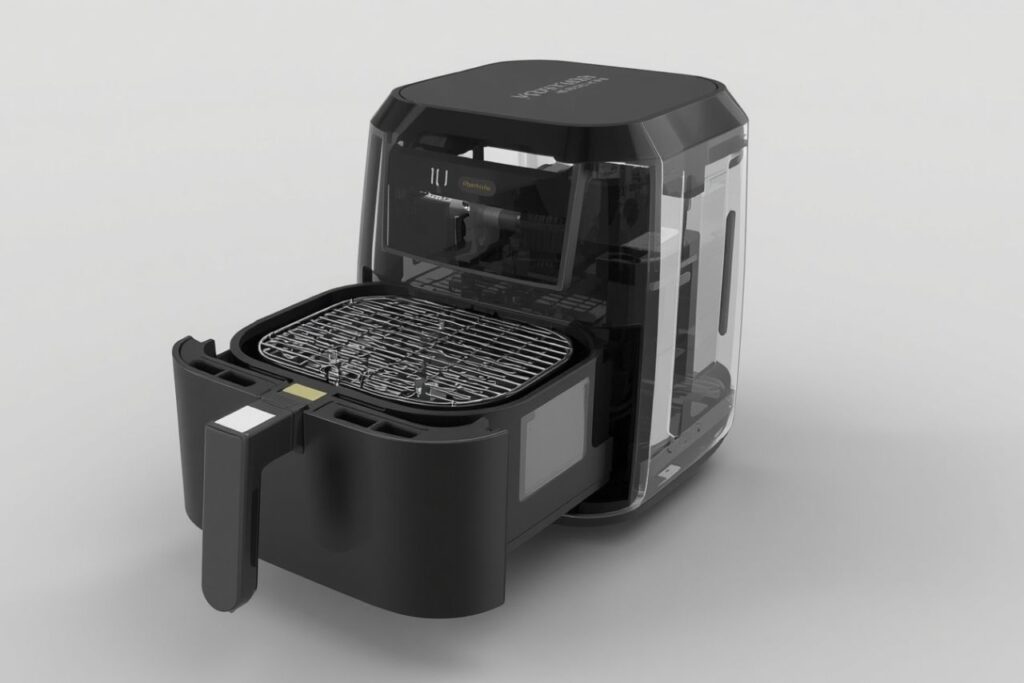
“热门空气炸锅品牌”并非都采用相同的内部布局,因此接触 空气炸锅加热元件的最安全方式 是遵循 construction patterns (drawer basket vs. oven-style vs. dual-basket), then confirm with your specific model’s manual before removing panels.
1) Before you open anything: safety + reality check
Air fryers are mains-powered appliances. Accessing the heating element often exposes wiring, terminals, and insulating parts. If your only goal is removing smoke/odor, cleaning the visible heater area is usually safer than a teardown.
Heating elements are engineered assemblies: conductive alloy produces heat (resistive/Joule heating), while insulating/support components (often ceramic/mica frameworks in open designs, or insulating powders like MgO in embedded/sheath designs) keep the heater safe and positioned. Damaging supports or insulation can create overheating, leakage, or unsafe operation.
2) Where the element usually is (what you can see without teardown)
In many countertop air fryers, the heater is located at the top of the cooking cavity, positioned to heat airflow. You can often see a coil/loop shape (open coil) or a covered/heater module behind a guard. If you can see it, you can usually clean it 无需 opening the base.
- Smoke from grease residue
- Odors from splatter on the ceiling/guard
- Crumbs and carbonized drips near the heater
3) Access patterns by air fryer style (brand-agnostic)
Instead of guessing a brand’s exact screw map, use the appliance style to predict the access route. Many “popular brands” reuse these chassis patterns across multiple models.
| Air fryer style | Where the heating element typically sits | Most common access route (if service access is required) |
|---|---|---|
| Drawer/basket air fryer (single basket) | Top of cavity, above food path | Top cover removal or rear cover removal to reach heater wiring/fasteners (varies by model) |
| Dual-basket air fryer | Top of each cavity | Separate top zones; service may require larger top housing removal |
| Oven-style air fryer (front door, racks) | Often top (and sometimes additional lower heaters) | Back panel access is common for internal wiring paths; heater may be retained from inside with guards |
| Air fryer + grill/plate hybrids | Top heater plus hot plate/grill surfaces | More internal heat shields; access can require multiple layered panels |
How to tell if the heater is “open” vs “embedded/covered”
- Open heater look: visible metal coil/loop suspended or supported by insulators/guard.
- Covered/embedded look: heater not directly visible; you see a plate, shield, or module. (In many heater technologies, the conductive part is embedded in insulating material; for example, embedded elements can use MgO insulation inside a sheath.)
Open elements are easier to inspect/clean but more sensitive to bending and contamination. Covered/embedded designs protect the conductive path, but you must avoid moisture intrusion and damage to shields/insulators.
4) Basic tools + “do not do this” list
Basic tools (typical)
- Phillips screwdriver set (and sometimes Torx/hex bits depending on model)
- Plastic spudger (to separate snap-fit covers without cracking)
- Needle-nose pliers (for connectors)
- Phone camera (before/after wire routing photos)
- Soft brush + damp cloth (for cleaning)
- Work while plugged in (even if “off”).
- Spray water or cleaner directly into the top housing.
- Scrape the element with metal tools (can deform coils or damage coatings/supports).
- Pull on wires—disconnect at the connector and document routing.
- Reassemble with missing heat shields/insulation pieces.
5) After access: inspection and safe reassembly
Once you can see the heater area clearly (either from inside the cavity or after removing a panel), focus on three checks:
- Contamination: grease/carbon on heater/guard/surrounding surfaces (common cause of smoke).
- Mechanical integrity: no sagging coil, cracked supports, loose fasteners.
- Wiring/insulation condition: 无烧焦的连接器、脆化绝缘层或热源附近出现熔化塑料。.
将每个屏蔽层、垫片和绝缘层完全按照原样复位。加热解决方案是作为系统设计的;缺少隔热层可能会改变气流/温度分布,并导致表面温度高于预期。.
FAQs (7)
1) 我能否在不打开空气炸锅的情况下接触 加热元件?
通常可以。如果您能从烹饪腔体看到加热器/防护罩,通常无需拆卸外部面板即可清理残留物并检查明显问题。对于接线故障、反复跳闸或明显损坏的部件,拆卸更为合适。.
2) 为什么有些空气炸锅将元件隐藏在盖子后面?
加热元件可以是开放式(支撑/悬挂式)或集成在框架内。盖子/防护罩可减少意外接触,并有助于管理气流和热传递。许多加热器设计结合了导电材料和绝缘/支撑材料,因此保护这些材料可提高安全性和使用寿命。.
3) 人们在接触过程中最常因什么原因损坏东西?
匆忙拆卸盖子并使用金属工具撬动。卡扣和薄塑料卡舌容易破裂,弯曲的加热器支架可能导致气流偏移或产生热点。请使用塑料撬棒,并在操作过程中拍照记录。.
4) 如果我的空气炸锅冒烟,是否意味着我必须接触加热元件?
不一定。烟雾通常是残留物在加热器附近的热表面上燃烧所致。首先对可见的加热器区域及周围顶部/防护罩进行安全清洁。如果在彻底清洁和干燥后烟雾仍然存在,再考虑进行维修接触或专业维修。.
5) 我可以自己更换加热元件吗?
这取决于型号和零件供应情况。由于加热元件是设计组件(导电元件加上绝缘/支撑件和连接器)的一部分,更换可能需要正确的布线、屏蔽和安全检查。如果您不确定,请使用合格的服务。.
6) 烤箱式 空气炸锅是否拥有多个加热元件?
一些加热设备使用多个加热器来管理温度和气流路径。在没有您特定型号文档的情况下,请假设可能存在多个加热区域,并在断定“缺少元件”之前仔细检查(先检查顶部,然后检查任何有防护的下部区域)。”
7) 不同设备(管式/板式/膜式/模块式)的加热技术有何不同?
加热解决方案因应用需求而异:管式加热器常见于需要铠装绝缘加热路径的场景;加热板侧重于均匀的表面加热;加热膜优先考虑超薄灵活性;集成热模块(包括压铸方式)可将金属结构与加热功能相结合。这些差异会影响接触、屏蔽和清洁的处理方式。.
提醒:本页面提供品牌无关的接触指导。对于“热门品牌”的具体信息,请始终将步骤与您的确切型号和服务手册相匹配。.