
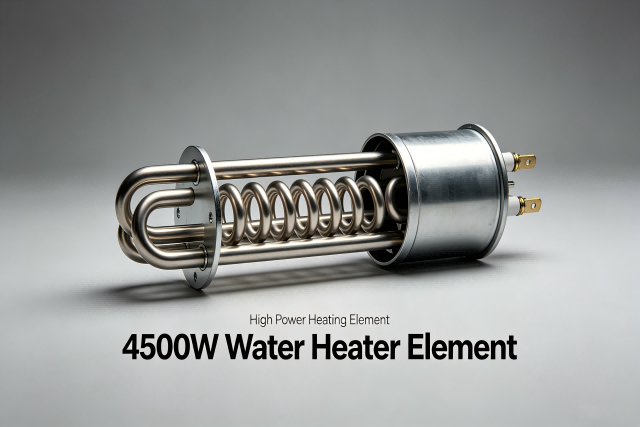
4500W电热水器加热元件是住宅储水式热水器常见的功率等级,当与热水器的设计参数正确匹配时,可实现快速恢复。 voltage, 包括接线、温控器控制及水箱状况。性能“升级”通常并非仅仅通过选择更高功率来实现,而是源于根据水质条件选择合适的元件类型,降低不必要的应力(水垢、干烧、连接不良),并通过严格验证进行安装。热水器工程指导也提醒买家,加热元件是一个 拆卸加热器外壳紧固件,小心取出加热器总成。 (导电合金加上绝缘/支撑材料及引线连接器),因此端子、垫圈及安装步骤会影响整体性能与生命周期成本。.
关于产品系列背景及定制选项: Thanh gia nhiệt, 加热元件制造商, 加热元件工厂, Giải pháp gia nhiệt đúc khuôn.
4500W元件的“性能”含义
对于储水式热水器,元件“性能”通常通过以下方面评判: recovery time (水箱重新加热的速度)、, ,口感尖锐、苦涩。沸腾的水(100°C / 212°F)会“烫伤”咖啡粉,产生明显的焦苦味。,, 使用寿命 在实际水质条件下。4500W元件仅在以下情况下能输出额定热量:供电电压与热水器设计匹配,温控器与接线允许满功率运行,且元件能有效将热量传递至水中而不被水垢隔热。.
Hệ mét
恢复速度
更高功率仅在热水器为该负载设计且热传递保持高效时才能提升恢复速度。.
Hệ mét
水箱内效率
水垢层会降低热传递;清洁与材料选择可能比改变功率更重要。.
Hệ mét
使用寿命
受元件温度、循环次数、连接质量及水质/污染物影响。.
章节总结
4500W元件的“升级路径”主要是减少热传递损失与故障模式,而非将功率提升至超出热水器额定值。.
加热元件基础(为何材料与结构至关重要)
工程指导将加热元件定义为由导电与绝缘材料共同构成的组件,旨在实现加热目的。它不仅仅是加热合金本身,还包括绝缘框架与引线连接器。热量通过 电阻(焦耳)加热方式运行.产生。材料选择(合金成分、护套材料、绝缘体)会影响电阻、热膨胀、氧化行为,进而影响使用寿命。.
热水器对元件要求苛刻的原因
- 水垢和沉积物 可能使护套绝缘并提高元件表面温度。.
- 反复循环 导致膨胀/收缩及氧化层应力。.
- 连接质量 连接质量至关重要:松动的端子会产生局部电阻加热并造成损坏。.
- 干烧 (无水通电)可迅速烧毁元件。.
章节总结
性能最佳的4500W元件是那些材料、几何结构及连接方式能在实际工况下有效控制元件温度的元件。.
提升恢复速度与使用寿命的智能升级
“升级”可指改变元件类型、改进维护或加强安装规范。最佳升级是减少已知故障诱因:水垢、过热、连接器损耗及干烧。.
升级选项(其改变内容)
| 升级类别 | 改进内容 | 未解决的问题 |
|---|---|---|
| 元件结构选择 | 热传递行为与表面温度特性 | 电压/功率不匹配;温控器损坏 |
| 防垢策略 | 通过减少矿物质沉积的隔热效应,延长寿命并实现更一致的恢复速度 | 无法纠正供电容量不足 |
| 连接器/接线更新 | 减少电阻加热、电弧风险及间歇性加热 | 无法补偿已烧毁的元件线圈 |
| 安装规范 | 防止干烧与泄漏;避免即时故障 | 无法克服错误的替换选择 |
通常最能提升实际性能的因素(相对影响)
章节总结
The most valuable “upgrades” reduce element temperature spikes: scale control, avoiding dry fire, and maintaining low-resistance terminals.
选购核对清单(购买前需匹配的规格)
The most important selection rule is simple: match the water heater’s required voltage và wattage. Manufacturer service guidance for element replacement explicitly instructs verifying the new element by referring to the heater’s data plate for voltage and wattage.
| 需验证事项 | 重要性 | 忽视的风险 |
|---|---|---|
| Voltage and wattage (data plate) | Defines electrical load and heat output | Wrong element can underperform or cause overheating/tripping |
| Physical fit | Thread type, immersion length, clearance | Leaks, poor heating distribution, installation failure |
| Materials / sheath | Affects corrosion resistance and scaling tendencies | Shorter life in aggressive water conditions |
| 质量信号 | Clear spec fields, approvals, warranty/returns | Higher wrong-part and early-failure cost |
Spec transparency example (general): a retail heating element listing provides wattage, materials, an ingress protection rating, UL approval, warranty length, and return policy. Regardless of brand or product type, those fields help buyers compare safety, suitability, and total cost.
章节总结
A “4500W upgrade” begins with data plate verification. Do not treat wattage as a “free performance knob.”
防止过早失效的安装要点
The installation steps below reflect safety and reliability principles highlighted in manufacturer service guidance: verify the element is correct (voltage/wattage), keep wire connections tight, and do not energize before the tank is full of water and purged of air.
Key installation controls (high value)
- Verify replacement rating against the data plate (voltage and wattage).
- Install gasket correctly and tighten properly; check for leaks after refilling.
- Refill completely and purge air before restoring power (prevents dry fire burnout).
- Ensure tight wire connections to reduce resistance heating at terminals.
- Restore covers/insulation to maintain safety and proper operating conditions.
Dry fire warning (why it matters)
Service guidance explicitly warns not to apply electrical power unless the tank is completely full and all air is out—otherwise the upper element can burn out (dry fire). This is one of the fastest ways to destroy a new element and waste the “upgrade” cost immediately.
章节总结
The fastest way to “downgrade” a 4500W element is energizing before the tank is full or leaving loose wire connections.
常见问题:恢复缓慢、跳闸、水垢、干烧
Most performance complaints fall into a few repeatable categories. Use these to decide whether the right “upgrade” is a new element type, a maintenance change, or a control/wiring fix.
| 问题 | 可能原因 | 最佳后续步骤 |
|---|---|---|
| Slow recovery | Scale insulation, wrong element rating, control issues | Verify rating; inspect for sediment/scale; confirm thermostats operate correctly |
| Element fails early | Dry fire, poor connections, severe scaling/corrosion environment | Audit installation steps; tighten connections; address scaling strategy |
| 断路器跳闸 | Shorted element, wiring fault, incorrect rating | Stop and diagnose safely; confirm correct voltage/wattage element is installed |
| Leaking at element | Gasket damage or improper seating/tightening | Drain as needed; inspect gasket; reinstall correctly; re-check for leaks |
章节总结
Many “performance upgrades” are actually correcting failure modes: scale control, proper fill/purge, and tight terminals.
常见问题解答(3个)
1) Can I replace a 4500W element with a higher wattage element for faster hot water?
Only if the water heater is designed and rated for it. Service guidance emphasizes verifying voltage and wattage against the heater data plate. Exceeding the rated load can create safety and reliability problems.
2) What’s the most important step to avoid burning out a new element?
Do not energize until the tank is completely full and all air is purged. Manufacturer guidance explicitly warns that applying power before the tank is full can burn out the upper element (dry fire).
3) Why do two “4500W” elements last different lengths of time?
Heater engineering guidance explains that element performance depends on materials, frameworks, trace elements in alloys, environment, and design tradeoffs. In water heaters, scaling and connector quality heavily influence element temperature and service life, even at the same wattage.
Phần kết luận
A 4500W water heater element can deliver excellent recovery, but long-term performance is driven by correct specification matching, controlled element temperature, and installation discipline. The most effective “upgrades” are usually (1) selecting an element style/material suited to local water conditions, (2) preventing scale from insulating the sheath, (3) ensuring tight electrical connections, and (4) preventing dry firing by fully filling and purging the tank before restoring power.
Tài liệu tham khảo
-
Heating element engineering overview: definition (assembly), resistive/Joule heating, materials, frameworks, environment effects, hidden lifecycle costs:
https://tutco.com/conductive/heating-elements -
Manufacturer-style replacement discipline (verify voltage/wattage on data plate; tighten wire connections; do not energize until tank is full and air is purged; check leaks; secure covers):
https://www.whirlpoolwaterheaters.com/support/help/element-was-out-of-range/24 -
Heating tube construction context (sheaths + MgO insulation + resistance wire) and product family structure (tubes/plates/films; custom solutions):
https://jinzho.com/product-category/heating-element/heating-tubes/
https://jinzho.com/product-category/heating-element/
https://jinzho.com/
https://jinzho.com/about/
https://jinzho.com/product-category/die-casting-heating-solutions/ -
Example of spec transparency in a heating element retail listing (wattage, materials, approvals, warranty/returns):
https://usa.hudsonreed.com/1000-plug-in-watt-electric-heating-element-76309
Disclaimer: This is general educational content. Always follow the water heater’s manual and local electrical/plumbing safety requirements.

