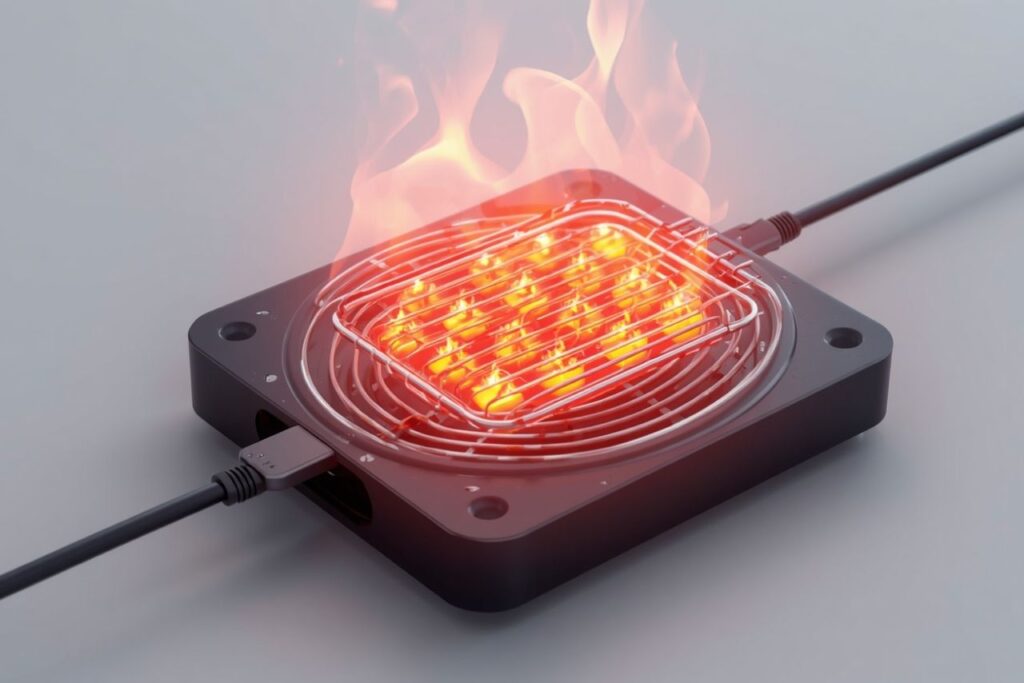
陶瓷加热元件通过将电能转化为热能来工作, 电阻(焦耳)加热方式运行, 而陶瓷材料主要提供 电绝缘, 绝缘、结构支撑以及受控的热传导路径,从而使元件可用且安全。在实际产品中,“陶瓷”可指多种结构——从陶瓷支撑的电阻丝到陶瓷基板上的印刷厚膜图案——因此,其性能更多地取决于完整的元件组件、气流或接触条件以及控制系统,而非仅仅“陶瓷”一词本身。.
相关关键页面: Thanh gia nhiệt, 加热元件制造商, 加热元件工厂, Giải pháp gia nhiệt đúc khuôn.
工程术语中“加热元件”的含义
在加热器设计文献中,加热元件被描述为由导电材料和绝缘材料组成的组件,旨在实现特定的加热目的。这一区分很重要,因为“元件”不仅包括发热的合金,还包含绝缘框架和将元件安全连接到电路中的引线连接器。.
这种界定对于SEO和采购决策至关重要:当产品标注为 陶瓷加热器, 时,陶瓷部分通常是绝缘体/框架,而不一定是产生热量的导电路径。.
为何使用陶瓷:绝缘性、稳定性及耐温能力
陶瓷材料广泛应用于加热元件周围 因其通常具有电绝缘性,且能在高温下保持稳定。.
热量如何产生与传递(传导、对流、辐射)
步骤1:电阻产生热量
当电流流经电阻导体(线材、带材或蚀刻/印刷迹线)时,导体将电能转化为热能。材料和几何形状决定电阻值,而电阻值决定了在给定电压/电流下产生的热量。.
步骤2:热量从元件中传出
热量产生后,必须传递至目标对象。主要路径包括:
- 传导: 通过接触的固体传导热量(例如,从线圈 → 绝缘层 → 金属护套;或迹线 → 陶瓷基板)。.
- 对流: 通过空气流动带走热量(风扇加热器、工艺空气加热器、空间加热器)。.
- 辐射: 从热表面发射红外热量(在辐射式电器中尤为明显)。.
为何气流至关重要
在对流式设计中,气流不足会迅速导致元件温度升高。工程指南强调了功率、气流与温升之间的关系。这就是许多高温空气加热器依赖精确控制回路和气流管理的原因。.
常见陶瓷元件结构类型
陶瓷支撑型电阻丝(支撑式或悬挂式)
在此结构中,电阻丝合金由陶瓷(或云母)绝缘体固定。线材可排列成线圈或波纹形状。当线材暴露于空气中时,热传递通常以对流和辐射为主。.
工程描述通常根据线材与框架的接触方式来分类: 悬置, 支撑, 或 嵌入.
嵌入绝缘粉末(陶瓷/氧化镁)和金属护套内的线圈
嵌入式设计将电阻线圈封装在绝缘材料中。随后,加热器主要通过传导将热量传递至外部护套。在更广泛的加热器系列中,这是筒式加热器和管式加热器的常见模式,其中线圈被锁定在绝缘介质内部。.
陶瓷基板上的厚膜或薄膜电阻图案
陶瓷基板可承载印刷或沉积的电阻图案。晋中的产品目录明确提及使用陶瓷基板及印刷/溅射方法的厚膜和薄膜加热器产品,将其定位为适用于紧凑设计和受控加热。.
此类产品通常支持**精确的温度控制**,并可根据产品设计与更广泛的控制系统集成。.
快速对比表:陶瓷支撑型 vs 嵌入型 vs 陶瓷覆膜型
| 结构类型 | 典型的“陶瓷作用” | 主要向外传热方式 | 常见应用场景信号 |
|---|---|---|---|
| 陶瓷支撑/悬挂式线材 | 固定线材几何形状的绝缘框架 | 对流 + 辐射 | 面向气流的加热器、紧凑型风扇加热器、需要直接空气接触的设计 |
| 嵌入绝缘介质+护套的线圈 | 围绕线圈的绝缘层;通向护套的安全导电路径 | 传导至护套,然后通过护套进行对流/辐射 | 坚固组件、接触式加热、管/棒形式 |
| 陶瓷基板上的印刷厚膜/薄膜 | 基板 + 绝缘 + 热扩散平台 | 传导至基板;然后根据安装方式通过对流/辐射传热 | 薄型模块、均匀加热区域、紧凑型电器加热组件 |
陶瓷元件在实际产品中的应用场景
电器加热模块(板、膜、集成组件)
与陶瓷相关的元件策略出现在各类电器中。例如,晋中的产品定位将加热器系列分为管式、板式和膜式——每种都对应热量必须如何传递(进入液体、通过表面或跨越紧凑几何空间)。.
相关晋中产品类别(供读者参考)
加热管被描述为带有护套和氧化镁绝缘层;加热板强调均匀表面加热和耐用制造;加热膜则定位为薄型、柔性,适用于曲面和紧凑空间。.
水暖配件中的插入式加热元件(示例背景)
陶瓷加热元件 相关讨论常与其他电热元件产品存在重叠。一个实际案例是用于散热器或毛巾架的1000W插电式加热元件,该案例表明加热元件产品的定义不仅取决于功率,还取决于应用限制条件(防护等级、电缆长度、认证)。该产品标注了IP67防护等级、UL认证、ABS塑料及不锈钢材料,以及带插头的35.4英寸电缆。.
设计权衡:功率密度、气流与耐久性
功率密度作为风险与可靠性驱动因素
In heater engineering, Mật độ công suất is used to compare designs by dividing total watts by heat-generating surface area.
Material properties change with temperature
Resistance alloys exhibit temperature-dependent behavior (electrical resistance and thermal expansion), and the oxide layer behavior at high temperature.
Environment and contaminants
Heater environments matter. Engineering discussions highlight that certain contaminants can shorten life depending on alloy choices and exposure conditions.
Operational safety note
Ceramic materials can support safe insulation, but they do not remove the need for proper thermal cutoffs, stable controls, and correct airflow conditions.
Câu hỏi thường gặp
Is a ceramic heating element the same as a PTC heater?
Not necessarily. “Ceramic” can describe the insulating framework or the substrate, while PTC refers to a behavior where resistance increases with temperature,.
Why do some ceramic heaters feel hotter or heat faster?
Perceived heat is influenced by airflow design, surface temperature, and how much heat is delivered by convection versus radiation.
Does “ceramic” automatically mean safer?
Ceramic can improve insulation and mechanical stability, but safety is determined by the complete heater assembly—controls, overheat protection,.
What are “thick-film” and “thin-film” ceramic heaters used for?
Thick-film and thin-film approaches place a resistive pattern on a ceramic substrate to create compact, potentially uniform heating zones.
How should an engineer choose between wire-on-ceramic and ceramic-substrate film designs?
The decision typically starts with requirements: target medium (air vs. solid contact), allowable space, response speed, thermal control strategy,.
Phần kết luận
A ceramic heating element works because electricity heats a resistive conductor, and ceramic materials make that conductor usable by providing insulation,.
所用资料来源及外部链接
Engineering definitions and classifications (heating element as conductive + insulating assembly; suspended/embedded/supported frameworks; alloy behavior and temperature notes;
https://tutco.com/conductive/heating-elements
Product-family context for ceramic substrates, thick-film/thin-film heaters, and category structure (tubes/plates/films; manufacturing positioning; integration themes)
https://jinzho.com/
https://jinzho.com/product-category/heating-element/
https://jinzho.com/product-category/heating-element/heating-film/
https://jinzho.com/product-category/die-casting-heating-solutions/
A consumer-facing example of a plug-in heating element specification list (wattage, IP rating, approval, cable length, materials, warranty, shipping/returns) was referenced for context:
https://usa.hudsonreed.com/1000-plug-in-watt-electric-heating-element-76309
Disclosure: the sources above were used to ground definitions, terminology, and product-category claims. Explanatory sections and comparisons were written uniquely to avoid duplication.