Vous pouvez rapidement rétablir les performances de votre four Kenmore en remplaçant l’élément défectueux. élément chauffant. La plupart des utilisateurs réalisent cette réparation DIY de niveau modéré avec seulement un tournevis et une pièce adaptée à leur modèle. Contrairement aux réparations plus complexes, ce processus nécessite rarement l’aide d’un professionnel ou des outils avancés. Chauffage électrique Jinzhong se distingue parmi fabricants d'éléments chauffants, fournissant des composants fiables éléments chauffants pour appareils ménagers qui s’adaptent précisément aux modèles Kenmore. Avec la bonne approche, vous minimisez les temps d’arrêt et reprenez la cuisson en toute confiance.
Comment identifier un élément chauffant défectueux

Signes courants d’un élément chauffant défaillant
Le four ne chauffe pas uniformément ou pas du tout
Vous remarquerez peut-être que votre four Kenmore a du mal à atteindre la température réglée ou ne chauffe pas du tout. Une cuisson inégale indique souvent un dysfonctionnement élément chauffant. Des aliments qui mettent plus de temps à cuire ou qui sortent insuffisamment cuits d’un côté signalent un problème. Lorsque le four ne peut pas maintenir une chaleur constante, vous perdez en efficacité et en qualité de cuisson.
Dommages visibles ou marques de brûlure sur l’élément
Inspectez attentivement l’élément chauffant. Recherchez des fissures, des cloques ou des marques de brûlure sur sa surface. Ces signes indiquent que l’élément a subi des dommages physiques ou une défaillance électrique. Un élément endommagé ne peut pas distribuer la chaleur correctement, ce qui entraîne de mauvaises performances du four.
L’élément chauffant ne devient pas rouge pendant l’utilisation
Un élément chauffant fonctionnel devient orange vif ou rouge lorsque le four est en marche. Si vous allumez le four et que l’élément reste sombre, il est probablement défaillant. Cette absence de lueur est l’un des symptômes les plus courants signalés par les utilisateurs.
Conseil : Un four anormalement sale peut également suggérer que l’élément ne fonctionne pas correctement, car les résidus alimentaires peuvent s’accumuler lorsque la répartition de la chaleur est mauvaise.
Symptômes les plus courants d’un élément chauffant défaillant :
- L’élément ne devient pas orange vif lorsqu’il est allumé.
- Des fissures ou des cloques visibles apparaissent sur l'élément.
- Les aliments cuisent de manière inégale ou prennent plus de temps que d’habitude.
- Des résidus alimentaires excessifs s’accumulent à l’intérieur du four.
- Les factures d’électricité augmentent de manière inattendue.
Test de l'élément chauffant
Étapes d'inspection visuelle
Commencez par débrancher l’alimentation de votre four. Retirez les grilles et localisez l’élément chauffant en bas ou en haut de la cavité du four. Examinez l’élément pour détecter tout dommage visible, comme des cassures, une décoloration ou une déformation. Utilisez une lampe de poche pour une inspection approfondie. Si vous constatez l’un de ces problèmes, vous avez probablement besoin d’un remplacement.
Comment utiliser un multimètre pour vérifier la continuité
Un multimètre vous aide à confirmer si l’élément chauffant est défaillant. Réglez votre multimètre sur le réglage de continuité ou de résistance. Touchez une sonde à chaque borne de l’élément. Si la lecture n’affiche aucune continuité ou une résistance infinie, l’élément est défectueux. Un élément fonctionnel affichera une faible valeur de résistance, indiquant un chemin électrique ininterrompu.
Remarque : Portez toujours des gants de travail et assurez-vous que le four est débranché avant de manipuler des composants électriques.
Choisir le bon élément chauffant de remplacement
Trouver le numéro de modèle de votre four Kenmore
Emplacements pour vérifier le numéro de modèle
Vous avez besoin du numéro de modèle correct pour garantir un ajustement parfait de votre pièce de remplacement. Suivez ces étapes pour le localiser:
- Ouvrez la porte du four et vérifiez le cadre de la porte pour l’étiquette du numéro de modèle.
- Le cas échéant, ouvrez le tiroir du gril ou de la cuisinière et cherchez l’étiquette sur le cadre de la porte.
- Retirez tout objet en vrac de la surface de cuisson et soulevez la table de cuisson pour vérifier en dessous des brûleurs.
- Inspectez l’extérieur de la cuisinière de chaque côté près du bas.
- Notez le numéro de modèle en le photographiant ou en l’écrivant.
Conseil : Vérifiez toujours l’exactitude du numéro avant d’acheter des pièces.
Pourquoi le numéro de modèle est essentiel
Le numéro de modèle agit comme un identifiant unique de votre four. Les fabricants conçoivent chaque four Kenmore avec des composants spécifiques. Utiliser le bon numéro de modèle garantit que vous sélectionnez une pièce élément chauffant qui correspond aux exigences électriques et aux dimensions physiques de votre four. Cette étape évite les problèmes d’installation et garantit des performances optimales.
Sélection de l'élément chauffant correct
Éléments chauffants de cuisson et de grill
Les fours Kenmore utilisent à la fois des éléments de cuisson et de grill, chacun ayant des rôles distincts. Le tableau ci-dessous met en évidence leurs différences :
| Élément chauffant | Ampérage | Fonctionnalité pendant les modes de cuisson |
|---|---|---|
| Cuisson | ~10 ampères | Cycle marche/arrêt pour maintenir une température stable après le préchauffage. |
| Gril | ~17 ampères | Cycle par courtes impulsions pour aider au préchauffage et au brunissage. |
Vous devez identifier quel élément nécessite un remplacement. L’élément de cuisson se trouve en bas et gère la plupart des cuissons. L’élément de grill, situé en haut, fournit une chaleur élevée pour le brunissage et le grill.
Adapter la pièce à votre modèle de four
Une fois que vous avez le numéro de modèle, recherchez une pièce de rechange qui lui correspond exactement. Les fabricants mettent souvent à jour les conceptions, donc même des éléments d’apparence similaire peuvent ne pas s’adapter ou fonctionner correctement. Comparez toujours les spécifications et les types de connecteurs avant de faire un achat.
Remarque : Les éléments chauffants de four durent généralement entre 5 à 10 ans. La fréquence d’utilisation, les habitudes de cuisson et la qualité de la pièce peuvent affecter cette durée de vie.
Où acheter un élément chauffant de remplacement
Détaillants en ligne pour pièces Kenmore
Vous pouvez trouver des pièces Kenmore authentiques auprès de plusieurs détaillants en ligne réputés. Considérez ces sources fiables :
- Reliable Parts est un détaillant en ligne réputé spécialisé dans les pièces d’appareils électroménagers, y compris les éléments chauffants de four Kenmore.
Acheter en ligne vous donne accès à une large sélection et à des options de livraison pratiques.
Magasins d’appareils électroménagers locaux et tarifs
Les magasins d’appareils électroménagers locaux stockent également des pièces Kenmore. Les prix peuvent varier en fonction de la puissance, de la tension et de la marque. Le tableau ci-dessous montre la fourchette de prix typique pour les éléments chauffants dans les magasins locaux :
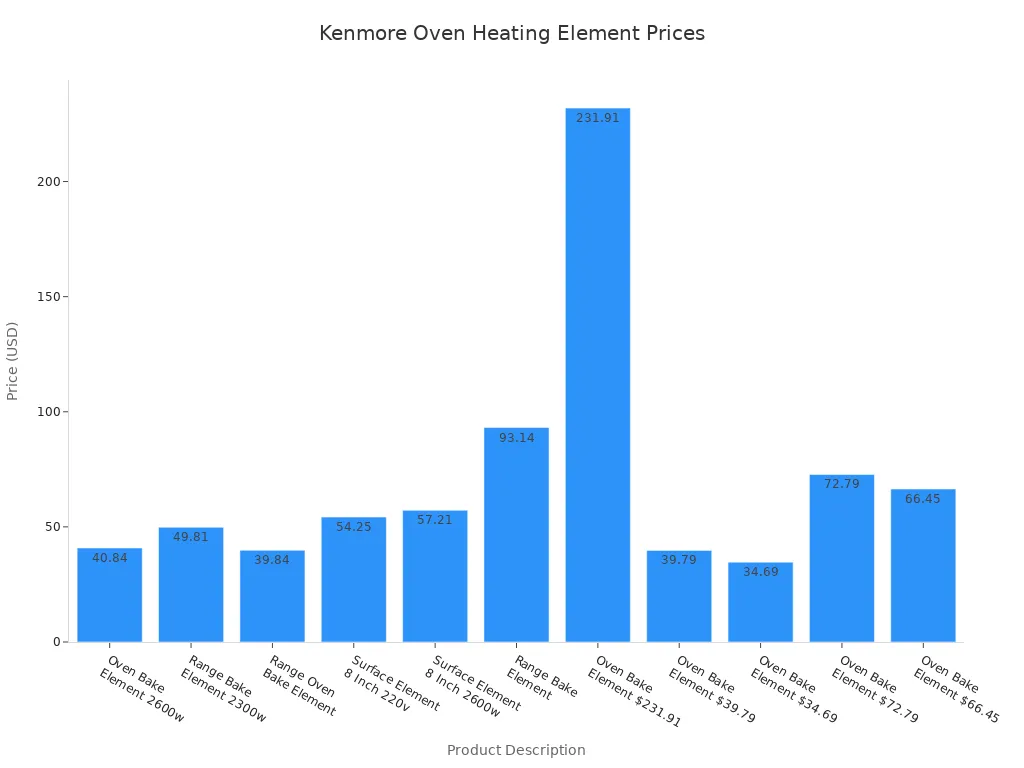
Vous pouvez vous attendre à payer entre $35 et plus de $200, selon la pièce spécifique et le magasin.
Outils et précautions de sécurité pour le remplacement de l’élément chauffant
Avant de commencer Pour remplacer l’élément chauffant de votre four Kenmore, vous devez rassembler les bons outils et suivre des mesures de sécurité strictes. Utiliser l’équipement correct et prendre les précautions appropriées garantit un processus de réparation fluide et sans blessure.
Outils nécessaires pour le travail
Tournevis (Phillips et plat)
Vous aurez besoin de tournevis cruciformes et plats. La plupart des fours Kenmore utilisent des vis cruciformes pour fixer l'élément, mais certains modèles peuvent nécessiter un tournevis plat. L'utilisation du tournevis approprié évite d'endommager les vis et l'intérieur du four.
Multimètre pour les tests
Un multimètre vous permet de tester la continuité de l'élément chauffant avant et après l'installation. Cet outil vous aide à confirmer que la nouvelle pièce fonctionne correctement et que vous avez résolu le problème de chauffe. Réglez le multimètre sur le mode continuité ou résistance pour des résultats précis.
Gants de protection pour le travail
Les gants de travail protègent vos mains des bords tranchants et des contacts électriques à l'intérieur du four. Ils aident également à éviter les brûlures si le four ou l'élément reste chaud. Choisissez des gants offrant une bonne adhérence et une isolation pour une sécurité maximale.
Étapes de sécurité essentielles
Déconnexion de l'alimentation du four
Vous devez toujours déconnecter l'alimentation avant de commencer toute réparation. Cette étape prévient les chocs électriques et assure votre sécurité. Suivez ces étapes pour garantir votre sécurité :
- Éteignez le four en le débranchant de la prise murale ou en désactivant le disjoncteur.
- Retirez toutes les grilles et plateaux du four.
- Enlevez le couvercle qui protège l'élément.
- Mettez des lunettes de sécurité et des gants.
- Attendez que l'élément chauffant refroidisse complètement avant de le toucher.
Conseil : Ne sautez jamais l'étape de déconnexion de l'alimentation. Même une petite quantité d'électricité résiduelle peut causer des blessures graves.
Prévention des chocs électriques et des blessures
Les fabricants recommandent plusieurs précautions de sécurité supplémentaires pour vous protéger pendant la réparation. Le tableau ci-dessous résume ces points clés :
| Précautions de sécurité | Détails |
|---|---|
| Déconnectez l'alimentation avant l'installation | Prévient les risques électriques et assure votre sécurité pendant les réparations. |
| Portez un équipement de protection individuelle | Utilisez des lunettes de sécurité, des gants isolants et des chaussures à semelles en caoutchouc pour vous protéger. |
| Laissez l’élément chauffant refroidir complètement | Prévient les brûlures lors de la manipulation de l'élément. |
| Maintenez l'espace de travail bien éclairé et organisé | Réduit les risques d'accidents pendant les réparations. |
| Utilisez les outils appropriés pour chaque tâche | Prévient les blessures et les dommages au four. |
| Reconnectez les fils de mise à la terre | Assure la sécurité contre les chocs électriques. |
| N'effectuez pas de réparations sauf si recommandé | Évite les risques inutiles. |
| Si vous sentez une odeur de gaz, quittez la zone | Appelez immédiatement votre fournisseur de gaz ou les pompiers pour prévenir les dangers. |
En suivant ces directives, vous réduisez le risque de choc électrique, de brûlures et d'autres blessures. Travaillez toujours dans un endroit bien éclairé et gardez votre espace de travail organisé. Si vous n'êtes jamais sûr d'une étape, consultez le manuel de votre four ou contactez un professionnel.
Guide étape par étape pour remplacer l'élément chauffant
Retrait de l'ancien élément chauffant
Accès à l'élément chauffant de votre four
Commencez par assurer votre sécurité. Débranchez votre four ou désactivez le disjoncteur. Attendez que le four refroidisse complètement. Retirez toutes les grilles de la cavité du four. Certains modèles permettent de retirer la porte du four pour un accès plus facile, mais cette étape est facultative. Localisez l'élément chauffant, qui se trouve généralement en bas pour la cuisson ou en haut pour le gril.
Conseil : Prenez une photo claire du câblage avant de déconnecter quoi que ce soit. Cette référence vous aidera à reconnecter correctement les fils lors de l'installation.
Dévissage et déconnexion sécurisée des fils
Utilisez le tournevis approprié pour retirer les vis fixant l'élément à la paroi du four. Tirez doucement l'élément vers vous jusqu'à voir les fils attachés à l'arrière. Avant de déconnecter, vérifiez à nouveau que le four n'est pas sous tension.
Lors de la déconnexion des fils, vous pouvez rencontrer plusieurs difficultés :
- Vous devez vous assurer que le four est débranché pour éviter les chocs électriques.
- La corrosion ou les dommages peuvent rendre les bornes difficiles à retirer.
- Des outils appropriés et une technique minutieuse sont nécessaires pour éviter d'endommager les connecteurs.
Saisissez fermement chaque connecteur de fil et tirez-le droit sur la borne. Si vous remarquez de la corrosion ou un ajustement serré, utilisez des pinces à bec fin pour un meilleur contrôle. Inspectez les bornes pour tout signe de brûlure ou d'usure. Si vous trouvez des connecteurs endommagés, remplacez-les avant de continuer.
Installation du nouvel élément chauffant
Connexion des fils au nouvel élément
Avant d'installer la nouvelle pièce, inspectez chaque fil et connecteur pour détecter tout dommage. Remplacez tout connecteur usé ou brûlé. Si vous trouvez un câblage endommagé, épissez une nouvelle section en utilisant un fil résistant aux hautes températures, comme du 12 AWG. Soudez de nouveaux connecteurs sur les fils de remplacement pour un ajustement sécurisé. Utilisez des connecteurs électriques à butée de qualité pour joindre les nouvelles longueurs de fil au câblage existant. Faites toujours correspondre les couleurs des fils correctement—neutre à neutre, phase à phase, et terre à terre. Fixez le fil de mise à la terre avec la vis de liaison à la terre.
Après avoir connecté les fils, tirez doucement sur chacun pour confirmer qu'il est bien fixé. Vérifiez votre travail par rapport à votre photo ou schéma précédent. Évitez d'utiliser des bornes endommagées ; remplacez la pièce entière si une borne à fourche est compromise.
Fixation de l'élément chauffant en place
Alignez les trous de montage du nouvel élément avec les trous de vis dans la paroi du four. Insérez les vis ou écrous à la main pour éviter un filetage croisé. Serrez chaque fixation jusqu'à ce qu'elle soit bien ajustée, mais ne serrez pas trop, car cela pourrait endommager les filetages. Assurez-vous que l'élément repose uniformément et ne touche pas les parois du four. Un ajustement sécurisé évite les arcs électriques et garantit un fonctionnement sûr.
Test du four après l'installation
Rétablir l'alimentation du four
Une fois que vous avez installé le nouvel élément et sécurisé toutes les connexions, réinstallez les grilles du four et la porte si vous l'avez retirée. Rétablissez l'alimentation en rebranchant le four ou en activant le disjoncteur.
Vérification du bon fonctionnement de la chauffe
Allumez le four et réglez-le à une température de cuisson standard. Observez le nouvel élément. Il devrait commencer à rougeoyer en quelques minutes. Écoutez tout bruit inhabituel et vérifiez une chauffe uniforme. Si le four chauffe correctement et que l'élément rougeoie comme prévu, vous avez terminé la réparation avec succès.
Remarque : Si le four ne chauffe pas ou si vous remarquez des problèmes, coupez immédiatement l'alimentation et revérifiez vos connexions.
Dépannage des problèmes de remplacement des éléments chauffants
Le four ne chauffe toujours pas après le remplacement
Même après avoir installé un nouvel élément chauffant, votre four Kenmore peut encore refuser de chauffer. Cette situation peut être frustrante, mais vous pouvez résoudre de nombreux problèmes en vérifiant quelques zones clés.
Vérification des connexions électriques
Commencez par inspecter chaque connexion électrique que vous avez touchée lors de l'installation. Des fils desserrés ou mal attachés causent souvent un dysfonctionnement du four. Utilisez une lampe de poche pour examiner chaque borne et connecteur. Assurez-vous d'avoir poussé fermement chaque fil sur sa borne. Si vous voyez de la corrosion ou une décoloration, nettoyez les contacts ou remplacez les connecteurs. Une connexion sécurisée garantit que l'élément reçoit de l'énergie et chauffe comme prévu.
Conseil : Référez-vous à la photo que vous avez prise avant de déconnecter les fils. Cette étape vous aide à confirmer que vous avez tout reconnecté correctement.
Inspection de la carte de commande du four
Si le câblage est correct, portez votre attention sur la carte de commande du four. Ce composant gère l'alimentation de l'élément chauffant. Une carte de commande défectueuse peut empêcher le four de chauffer, même avec un nouvel élément installé. Recherchez des signes de dommages, tels que des points brûlés ou une odeur de brûlé. Si vous soupçonnez la carte de commande, vous devrez peut-être la tester avec un multimètre ou consulter le manuel d'entretien de votre four pour des étapes de diagnostic. Le remplacement d'une carte de commande nécessite des compétences techniques, alors envisagez l'aide d'un professionnel si vous n'êtes pas sûr.
Quand faire appel à un professionnel
Certains problèmes de four vont au-delà d'un simple remplacement de l'élément chauffant. Reconnaître quand demander l'aide d'un expert vous protège, vous et votre appareil.
Signes de problèmes électriques plus graves
Vous devez contacter un professionnel si vous remarquez l’un des éléments suivants :
- Le four fait disjoncter le disjoncteur à plusieurs reprises.
- Vous voyez des étincelles ou sentez une odeur de plastique brûlé.
- L’écran du four fonctionne mal ou affiche des codes d’erreur.
- Le four ne répond pas aux réglages de température.
Ces symptômes indiquent souvent des problèmes électriques plus profonds nécessitant des outils spécialisés et des connaissances techniques.
Problèmes de sécurité nécessitant l’intervention d’un expert
Certains problèmes de sécurité exigent une intervention professionnelle immédiate. Donnez toujours la priorité à votre sécurité et à celle de votre foyer. Les risques courants incluent :
- L’utilisation d’outils inadaptés peut entraîner des dommages ou des blessures.
- Les bords tranchants à l’intérieur des fours plus anciens peuvent provoquer des coupures.
- Les réparations complexes, notamment celles impliquant des conduites de gaz ou des systèmes électriques avancés, doivent être confiées à des techniciens qualifiés.
Remarque : Si vous vous sentez incertain ou en danger lors d’une réparation, arrêtez-vous immédiatement et consultez un professionnel. Votre sécurité passe toujours en premier.
En suivant ces étapes de dépannage et en sachant quand demander de l’aide, vous garantissez un fonctionnement sûr et efficace de votre four Kenmore.
Entretien de l’élément chauffant de votre four Kenmore
Conseils de nettoyage réguliers
Prévention de l’accumulation sur l’élément chauffant
Tu peux Prolongez la durée de vie de l’élément chauffant de votre four Kenmore en le maintenant propre et exempt de résidus. Les déversements d’aliments et la graisse peuvent s’accumuler sur l’élément, entraînant un chauffage inégal et des dommages potentiels. Un nettoyage régulier améliore non seulement les performances, mais réduit également le risque de fumée ou d’odeurs désagréables lors de l’utilisation.
Pour entretenir votre élément chauffant, suivez ces méthodes de nettoyage efficaces :
- Essuyez les débris libres: Après chaque utilisation, laissez refroidir le four. Utilisez un chiffon humide pour retirer les particules alimentaires ou les miettes de l’élément et du fond du four.
- Lancez le cycle d’autonettoyage: Si votre four dispose d’une fonction d’autonettoyage, activez-la périodiquement. Ce cycle brûle les résidus incrustés à haute température, les transformant en cendres.
- Refroidissez et essuyez: Une fois le cycle d’autonettoyage terminé et le four refroidi, utilisez un chiffon doux pour essuyer les cendres restantes.
- Bicarbonate de soude et vinaigre: Pour les taches tenaces, préparez une pâte avec du bicarbonate de soude et de l’eau. Appliquez-la sur l’élément, laissez agir, puis vaporisez du vinaigre. Essuyez avec un chiffon humide.
- Jus de citron et bicarbonate de soude: Mélangez du jus de citron avec du bicarbonate de soude pour créer une pâte dégraissante. Appliquez-la sur les zones grasses, laissez agir, puis essuyez.
- Sel et bicarbonate de soude: Combinez du sel et du bicarbonate de soude pour les taches tenaces. Frottez doucement la zone affectée, puis essuyez.
Conseil : Débranchez toujours l’alimentation avant de nettoyer l’élément chauffant. N’utilisez jamais de tampons abrasifs ou de produits chimiques agressifs, car ils pourraient endommager la surface de l’élément.
En adoptant ces habitudes de nettoyage, vous contribuez à prévenir l’accumulation qui peut réduire la durée de vie de l’élément chauffant de votre four.
Inspection périodique de l’élément chauffant
Repérer les signes précoces d’usure ou de dommages
Une inspection de routine de votre élément chauffant garantit un fonctionnement sûr et efficace du four. Vous devez vérifier l’élément tous les quelques mois, surtout si vous utilisez votre four fréquemment. La détection précoce des problèmes vous permet de les résoudre avant qu’ils n’entraînent des réparations coûteuses.
Recherchez ces signes lors de votre inspection :
- Décoloration: Les zones qui semblent plus foncées ou plus claires que le reste de l’élément peuvent indiquer une surchauffe ou une usure.
- Fissures ou cloques: Les fissures en surface, les cloques ou les boursouflures suggèrent que l’élément se détériore et pourrait bientôt tomber en panne.
- Gauchissement: Un élément tordu ou déformé peut signaler un dommage interne.
- Connexions lâches: Vérifiez que tous les fils et bornes restent sécurisés et exempts de corrosion.
Si vous remarquez l’un de ces problèmes, remplacez l’élément chauffant rapidement. Une inspection régulière et un entretien en temps opportun permettent à votre four Kenmore de fonctionner en toute sécurité et efficacité.
Remarque : Des soins et une attention constants à l’élément chauffant de votre four vous aident à éviter les pannes imprévues et à maintenir des résultats de cuisson optimaux.
Erreurs courantes à éviter lors du remplacement d’un élément chauffant
Négliger les étapes de sécurité importantes
Oublier de débrancher l’alimentation
Vous devez toujours donner la priorité à la sécurité lorsque vous travaillez sur votre four Kenmore. L’une des erreurs les plus courantes consiste à oublier de débrancher l’alimentation avant de commencer le remplacement. Si vous laissez le four branché ou le disjoncteur allumé, vous vous exposez à un risque de choc électrique. Ce danger peut provoquer des blessures graves et endommager votre appareil.
Conseil : Débranchez toujours le four ou coupez le disjoncteur avant de manipuler tout composant interne. Cette simple étape vous protège et garantit un environnement de réparation sécurisé.
Porter des gants pendant le remplacement ajoute une protection supplémentaire. Les gants protègent vos mains des arêtes vives et des contacts électriques à l'intérieur du four. Vous devriez également utiliser un tournevis cruciforme pour la plupart des remplacements de résistance de chauffe. Cet outil s'adapte parfaitement aux vis et évite de les abîmer.
Liste de vérification de sécurité avant de commencer la réparation :
- Débranchez le four ou coupez le disjoncteur.
- Retirez toutes les grilles et plaques de la cavité du four.
- Enfilez des gants de travail pour protéger vos mains.
- Rassemblez le tournevis adapté à votre modèle de four.
Ignorer ces étapes peut entraîner des accidents et des erreurs coûteuses. Vous gardez le contrôle du processus de réparation en respectant chaque mesure de sécurité.
Utilisation d'une résistance de remplacement inadaptée
Importance de vérifier la correspondance du numéro de modèle
La sélection du élément chauffant pour votre sèche-linge Le four nécessite une attention particulière aux détails. De nombreux utilisateurs commettent l’erreur de choisir une pièce qui semble similaire mais qui ne correspond pas au numéro de modèle de leur four. Cette erreur peut entraîner de mauvaises performances, des problèmes d’installation, voire endommager votre appareil.
L’élément de cuisson se trouve au fond du four et joue un rôle crucial dans la cuisson au four. Si l’élément grille ou devient défectueux, vous devez le remplacer par une pièce conçue pour votre modèle spécifique. Les fabricants conçoivent chaque élément chauffant pour répondre à certaines exigences électriques et dimensions physiques. L’utilisation d’une pièce inadaptée peut empêcher votre four de chauffer correctement ou de s’ajuster de manière sécurisée.
Remarque : Localisez toujours le numéro de modèle de votre four avant d'acheter un élément de remplacement. Vous pouvez trouver ce numéro sur le cadre de la porte, sous la table de cuisson ou près de la partie inférieure extérieure de l'appareil.
Lorsque vous faites correspondre le numéro de modèle, vous vous assurez que le nouvel élément se connectera correctement et restaurera toutes les fonctionnalités. Le processus de remplacement consiste à dévisser l'ancien élément et à reconnecter le nouveau. Si vous utilisez la bonne pièce, vous évitez des complications inutiles et obtenez des résultats fiables.
Étapes pour s'assurer de sélectionner le bon élément chauffant :
- Identifiez les symptômes de défaillance, tels que peu ou pas de chaleur, ou les aliments mettant trop de temps à cuire..
- Localisez et notez le numéro de modèle de votre four.
- Comparez les spécifications et les types de connecteurs avant l'achat.
- Confirmez la position de l'élément de cuisson au fond du four.
- Remplacez les éléments grillés ou défectueux par des pièces compatibles.
En prêtant une attention particulière à ces détails, vous évitez les erreurs courantes et maintenez votre four Kenmore en fonctionnement sûr et efficace.
Remplacer l'élément chauffant de votre four Kenmore restaure des performances fiables et assure une distribution uniforme de la chaleur. Vous obtenez plusieurs avantages à long terme :
- Une meilleure performance de cuisson pour des résultats de cuisson constants
- Une efficacité énergétique améliorée, ce qui peut réduire les factures d'énergie jusqu'à 20 %
- Une durée de vie prolongée de l'appareil pour des années d'utilisation fiable
Vous pouvez effectuer cette réparation avec des outils de base et la bonne pièce. Agissez dès maintenant pour profiter d'une cuisson efficace et sans souci.
FAQ
À quelle fréquence devez-vous remplacer l'élément chauffant de votre four Kenmore ?
Vous devriez inspecter l'élément chauffant tous les 1 à 2 ans. Remplacez-le si vous constatez des dommages visibles, un chauffage inégal ou si le four n'atteint pas la bonne température.
Pouvez-vous utiliser votre four si l'élément chauffant fonctionne partiellement ?
Vous devriez éviter d'utiliser le four avec un élément défectueux. Un fonctionnement partiel peut entraîner une cuisson inégale et endommager d'autres composants. Remplacez l'élément pour un fonctionnement sûr et fiable.
De quels outils avez-vous besoin pour remplacer un élément chauffant de four Kenmore ?
Vous avez besoin d'un tournevis cruciforme, d'un tournevis à tête plate, d'un multimètre et de gants de travail. Ces outils vous aident à retirer et à installer l'élément chauffant en toute sécurité.
Où pouvez-vous trouver le numéro de modèle sur votre four Kenmore ?
Vérifiez ces emplacements :
- Cadre de porte (ouvrez la porte du four)
- Sous la table de cuisson
- À l'intérieur du tiroir du gril-pain
- Sur l'extérieur, près du bas
Combien de temps faut-il pour remplacer un élément chauffant ?
La plupart des remplacements prennent 30 à 60 minutes. Vous pouvez terminer le processus plus rapidement si vous avez les bons outils et suivez attentivement les instructions.
Que devez-vous faire si votre four ne chauffe toujours pas après avoir remplacé l'élément ?
Vérifiez à nouveau toutes les connexions électriques. Inspectez la carte de commande du four pour détecter tout dommage. Si le problème persiste, contactez un technicien professionnel pour un diagnostic plus approfondi.
Tous les éléments chauffants de four Kenmore sont-ils interchangeables ?
Non, les éléments chauffants ne sont pas universels. Faites toujours correspondre la pièce de rechange au numéro de modèle de votre four. Utiliser un mauvais élément peut causer des problèmes de performance ou des dommages.