
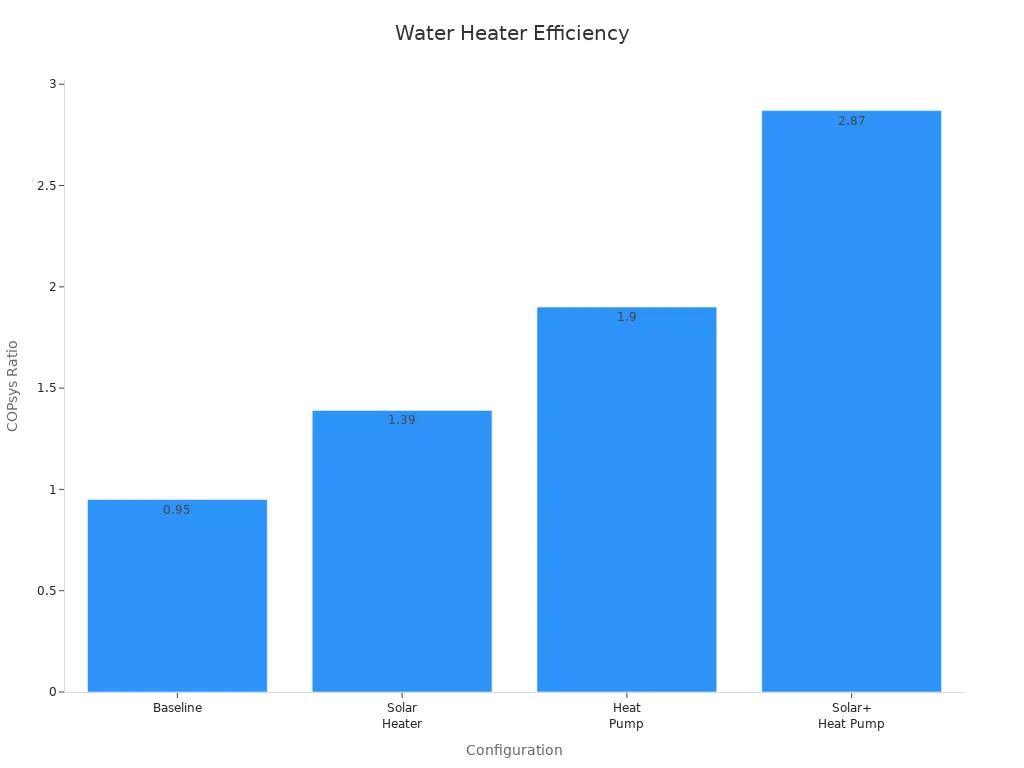
Vous comptez sur l' élément de chauffe-eau à l'intérieur de votre chauffe-eau pour fournir un approvisionnement constant en eau chaude pour les besoins quotidiens. Cette élément chauffant, souvent fabriquée en matériau robuste tubes chauffants, convertit directement l'énergie électrique en chaleur, maintenant votre alimentation en eau chaude à des températures comprises entre 55°C et 57°C. L'efficacité de chaque élément chauffant de l'eau a un impact sur la quantité d'énergie utilisée par votre système. Par exemple, la configuration de base du chauffe-eau électrique atteint un Coefficient de Performance (COPsys) de 0,95, comme illustré ci-dessous.
En moyenne, vous utilisez environ 246 litres d'eau chaude chaque jour, soulignant le rôle crucial de la résistance du chauffe-eau pour maintenir votre eau constamment chaude.
Notions de base sur la résistance du chauffe-eau
Qu'est-ce qu'un élément de chauffe-eau ?
Vous trouverez la élément de chauffe-eau au cœur de chaque chauffe-eau électrique. Ce composant ressemble à une tige métallique, souvent droite ou en forme de spirale, et se trouve à l'intérieur du réservoir. Les fabricants conçoivent ces éléments pour convertir l'énergie électrique en chaleur, augmentant ainsi la température de l'eau stockée dans votre réservoir. La plupart des résistances de chauffe-eau utilisent un fil résistif de l’élément, généralement en nichrome, enfermé dans une gaine métallique pour éviter la corrosion. La longueur de la résistance, généralement d'environ 12 pouces pour les modèles résidentiels, et sa puissance nominale déterminent la rapidité avec laquelle elle peut chauffer l'eau. Vous pouvez identifier le remplacement correct en vérifiant les tensions et puissances nominales indiquées sur la résistance elle-même. Ces spécifications garantissent la compatibilité et un fonctionnement sûr au sein de votre chauffe-eau.
Comment fonctionnent les résistances dans un chauffe-eau électrique
Lorsque vous allumez votre chauffe-eau électrique, le courant électrique traverse la résistance. Le fil résistif à l'intérieur de la résistance chauffe lorsque l'électricité le traverse. Ce processus convertit directement l'énergie électrique en énergie thermique, qui est ensuite transférée à l'eau environnante. Le thermostat surveille la température de l'eau et active la résistance lorsque la température descend en dessous de votre point de consigne. Une fois que l'eau atteint la température souhaitée, le thermostat coupe l'alimentation de la résistance, évitant ainsi la surchauffe. Des interrupteurs de sécurité ajoutent une couche de protection supplémentaire en désactivant la résistance si la température de l'eau dépasse les limites de sécurité.
Des données empiriques soutiennent ce processus. Par exemple, l'Engineering ToolBox démontre que l'énergie électrique fournie à une résistance de chauffe-eau se traduit directement par une augmentation mesurable de la température de l'eau. La relation suit l'équation : l'énergie électrique (U × I × t × μ) est égale à la variation d'énergie thermique (c × m × ΔT). En pratique, un chauffe-eau de 12 V, 10 A fonctionnant pendant cinq minutes peut augmenter la température de 0,4 kg d'eau d'environ 21,4°C, en supposant une efficacité parfaite. Cette conversion directe garantit que vous obtenez de l'eau chaude rapidement et de manière fiable.
Pourquoi les résistances de chauffe-eau sont essentielles
Vous dépendez de la résistance du chauffe-eau pour fournir de l'eau chaude pour les douches, le nettoyage et la cuisine. Sans une résistance fonctionnelle, votre chauffe-eau électrique ne peut pas chauffer l'eau, vous laissant uniquement avec de l'eau froide au robinet. L'efficacité et la durabilité de la résistance affectent directement vos factures d'énergie et la fiabilité de votre approvisionnement en eau chaude. La plupart des résistances de chauffe-eau résidentiels fonctionnent à 240 volts, avec des puissances nominales comprises entre 1000 et 6000 watts, adaptées à la taille et au taux de récupération de votre chauffe-eau. L'utilisation de la résistance correcte garantit un fonctionnement sûr et des performances optimales.
Les résistances de chauffe-eau existent également en différents modèles et matériaux, tels que les alliages métalliques ou la céramique. Les éléments en céramique offrent une meilleure efficacité et résistent à la corrosion, en particulier dans les zones avec une eau dure. La conception à double résistance, avec des éléments supérieur et inférieur, permet à votre chauffe-eau électrique de chauffer l'eau par étapes, améliorant ainsi l'efficacité et le temps de récupération. Vous pouvez voir l'impact des différents types de chauffe-eau dans le tableau ci-dessous :
| Type de chauffe-eau | Fourchette de coût moyenne | Durée de vie moyenne (années) | Niveau d'efficacité énergétique |
|---|---|---|---|
| Réservoir | $500 – $700 | 10 – 15 | Inférieur |
| Sans réservoir | $800 – $1 200 | 15 – 20 | Plus haut |
| Gaz | Moyen | Haut | Moyen |
| Électrique | Faible | Faible | Faible |
| Solaire | Haut | Haut | Haut |
| Pompe à chaleur | Modérée à élevée | Modérée à élevée | Haut |
Conseil : Faites toujours correspondre la puissance et la tension de votre résistance de chauffe-eau de remplacement aux spécifications de votre chauffe-eau. Cette étape garantit la sécurité et prolonge la durée de vie de votre système.
Vous comptez sur les résistances de chauffe-eau pour maintenir un approvisionnement constant en eau chaude. Leur conception, leur matériau et leur installation correcte jouent un rôle crucial dans le confort et l'efficacité de votre maison.
Types d'éléments chauffants pour chauffe-eau
Lorsque vous choisissez un chauffe-eau, vous devez comprendre les différents d'éléments chauffants disponibles. Chaque type affecte l'efficacité avec laquelle votre chauffe-eau fournit de l'eau chaude et la durée de vie du système. Explorons les principaux types de résistances que vous rencontrerez.
Élément chauffant à visser
Vous trouverez des résistances à visser dans la plupart des chauffe-eau électriques modernes. Les fabricants conçoivent ces éléments avec une base filetée, afin que vous puissiez facilement les visser sur le côté du réservoir. Cette conception permet un remplacement et un entretien rapides. Si vous avez besoin de remplacer un élément chauffant, vous pouvez utiliser une clé standard ou un outil à douille spécial. Les résistances à visser offrent une fixation sécurisée et réduisent le risque de fuites. Vous voyez souvent ces éléments dans les chauffe-eau résidentiels car ils offrent des performances fiables et une installation simple.
Conseil : Coupez toujours l'alimentation de votre chauffe-eau avant de remplacer une résistance à visser pour éviter les risques électriques.
Résistance à bride
Certains chauffe-eau plus anciens ou commerciaux utilisent des résistances à bride. Ces éléments se fixent au réservoir avec une bride plate, carrée ou ronde et plusieurs boulons. Vous devez retirer les boulons et la bride pour remplacer l'élément. Les résistances à bride offrent une étanchéité solide et fonctionnent bien dans les grands réservoirs. Cependant, vous pouvez les trouver moins courantes dans les nouveaux modèles résidentiels. Si votre chauffe-eau utilise une résistance à bride, vérifiez l'usure du joint et des boulons lors de l'entretien de routine.
| Taper | Méthode d'Installation | Cas d'utilisation courants |
|---|---|---|
| À visser | Fileté | Résidentiel, réparation facile |
| Bride | Bride boulonnée | Commercial, unités plus anciennes |
Éléments chauffants à faible densité de puissance vs à haute densité de puissance
Vous devez tenir compte de la densité de puissance lors de la sélection des résistances pour votre chauffe-eau. Les résistances à faible densité de puissance répartissent la chaleur sur une plus grande surface. Cette conception réduit le risque d'accumulation de minéraux et prolonge la durée de vie de l'élément, en particulier dans les zones avec une eau dure. Vous remarquerez que les éléments à faible densité de puissance fonctionnent à une température plus basse, ce qui aide à prévenir les brûlures et à garder votre eau chaude plus propre.
Les résistances à haute densité de puissance concentrent plus de chaleur dans une zone plus petite. Ces éléments chauffent l'eau rapidement et coûtent moins cher au départ. Cependant, ils peuvent s'user plus rapidement si votre eau contient beaucoup de minéraux. Si vous souhaitez que votre chauffe-eau dure plus longtemps et fournisse une eau chaude constante, vous devriez envisager des éléments à faible densité de puissance.
Remarque : Faites toujours correspondre la puissance et la tension de vos résistances aux spécifications de votre chauffe-eau pour un fonctionnement sûr et efficace.
En comprenant ces types de résistances, vous pouvez prendre des décisions éclairées concernant l'entretien, le remplacement et les améliorations de votre chauffe-eau. Le bon choix garantit que vous avez toujours accès à l'eau chaude lorsque vous en avez besoin.
Résistances supérieure et inférieure dans les chauffe-eau électriques
Lorsque vous regardez à l'intérieur d'un chauffe-eau électrique typique, vous trouverez deux résistances principales : une en haut (résistance supérieure) et une en bas (résistance inférieure). Chaque élément joue un rôle spécifique dans la manière dont votre chauffe-eau fournit de l'eau chaude de manière efficace et fiable.
La résistance supérieure se trouve près du haut du réservoir. Son rôle principal est de chauffer d'abord la partie supérieure de l'eau. Lorsque vous allumez votre chauffe-eau après une période d'inactivité, le thermostat supérieur détecte la température. Si l'eau est froide, la résistance supérieure s'active. Une fois que la partie supérieure du réservoir atteint la température de consigne, le thermostat désactive la résistance supérieure et envoie l'alimentation à la résistance inférieure.
La résistance inférieure prend le relais après que la section supérieure est chaude. Elle chauffe le reste de l'eau dans le réservoir, garantissant un approvisionnement complet en eau chaude. Ce processus, appelé fonctionnement non simultané, signifie qu'un seul élément fonctionne à la fois. La plupart des chauffe-eau résidentiels utilisent cette configuration car elle équilibre la consommation d'énergie et la sécurité.
Vous pouvez voir les avantages et les différences entre ces configurations dans la liste suivante :
- La plupart des chauffe-eau utilisent un fonctionnement non simultané, où la résistance supérieure chauffe d'abord, puis la résistance inférieure termine le travail.
- Un thermostat à double jet contrôle quel élément reçoit l'alimentation, empêchant les deux de fonctionner en même temps.
- Les temps de récupération pour les systèmes non simultanés varient d'environ 25 minutes à une heure, en fonction de la taille du réservoir et de la puissance.
- Certains chauffe-eau avancés utilisent un fonctionnement simultané, permettant aux deux résistances de fonctionner ensemble. Cette configuration réduit le temps de récupération de plus de moitié mais nécessite un câblage plus lourd et un disjoncteur plus grand.
- Dans les systèmes simultanés, la résistance inférieure effectue la majeure partie du travail, ce qui peut vous aider à profiter de tarifs d'électricité réduits si votre fournisseur propose des circuits séparés.
Remarque : Si vous remarquez que votre chauffe-eau manque rapidement d'eau chaude, l'une des résistances peut être défectueuse. Tester les deux éléments garantit que votre système fonctionne à son efficacité maximale.
La conception des résistances supérieure et inférieure aide votre chauffe-eau à fournir une eau chaude constante tout en gérant la consommation d'énergie. Vous bénéficiez de temps de récupération plus rapides et de performances fiables, en particulier pendant les périodes de forte demande. Lorsque vous comprenez comment ces éléments fonctionnent ensemble, vous pouvez prendre de meilleures décisions concernant l'entretien et les améliorations de votre chauffe-eau.
Structure et matériaux d'une résistance de chauffe-eau
Comprendre la structure et les matériaux des composants du chauffe-eau vous aide à prendre des décisions éclairées concernant l'entretien et le remplacement. Chaque partie de la résistance joue un rôle spécifique dans la fourniture d'eau chaude fiable et la garantie de la longévité de votre chauffe-eau.
Composants principaux d'une résistance
Un typique élément chauffant se compose de plusieurs composants clés du chauffe-eau. Ces pièces travaillent ensemble pour convertir l'énergie électrique en chaleur et la transférer efficacement à l'eau dans votre réservoir.
gaine métallique
Vous trouverez la gaine métallique comme couche la plus externe de l’élément chauffant. Les fabricants utilisent ce tube de protection pour isoler la bobine interne du contact direct avec l’eau. La gaine résiste à la corrosion et supporte des températures élevées, ce qui est essentiel pour des performances durables. Le choix du matériau de gaine approprié, tel que l’acier inoxydable ou l’Incoloy, permet de prévenir les attaques chimiques des minéraux présents dans votre alimentation en eau.
Serpentin de chauffage
À l’intérieur de la gaine, la bobine chauffante constitue le cœur de l’élément chauffant. Cette bobine, généralement fabriquée à partir d’un alliage nickel-chrome, génère de la chaleur lorsque l’électricité la traverse. La résistivité de la bobine détermine l’efficacité avec laquelle elle produit de la chaleur. Un coefficient de température de résistance stable garantit que la bobine maintient des performances constantes, même lorsque les températures fluctuent en cours de fonctionnement.
Isolation et joints d’étanchéité
L’isolation entoure la bobine chauffante, la maintenant électriquement isolée de la gaine métallique. Cette isolation, souvent constituée d’oxyde de magnésium, conduit la chaleur tout en évitant les courts-circuits électriques. Des joints d’étanchéité à chaque extrémité de l’élément empêchent l’eau de pénétrer et protègent les composants internes de l’humidité. L’étanchéité hermétique devient particulièrement importante dans les environnements exigeants, où l’exposition à l’eau ou aux produits chimiques pourrait endommager l’élément.
Conseil : Inspectez régulièrement les joints et l’isolation des composants de votre chauffe-eau pour éviter les fuites et les risques électriques.
Matériaux courants utilisés dans les éléments de chauffe-eau
Le choix des matériaux pour les composants de votre chauffe-eau affecte directement la durabilité, l’efficacité et la résistance à la corrosion. Voici les options les plus courantes :
Cuivre
Les éléments en cuivre offrent une excellente conductivité thermique et un bon rapport coût-efficacité. Vous voyez souvent du cuivre dans les modèles de chauffe-eau résidentiels standard. Cependant, le cuivre peut se corroder rapidement dans une eau dure ou agressive, ces éléments sont donc généralement dotés d’un revêtement protecteur.
Acier inoxydable
L’acier inoxydable offre une résistance supérieure à la corrosion et une résistance mécanique élevée. Si vous vivez dans une région avec une eau dure ou une teneur élevée en minéraux, les éléments en acier inoxydable contribuent à prolonger la durée de vie de votre chauffe-eau. Ces éléments résistent également à l’oxydation à haute température, maintenant leurs performances dans le temps.
Incoloy
L’Incoloy, un alliage nickel-fer-chrome, se distingue par sa résistance exceptionnelle à l’oxydation et aux attaques chimiques. Vous trouverez des éléments en Incoloy dans les chauffe-eau haut de gamme ou commerciaux, où des conditions exigeantes nécessitent une durabilité maximale. L’Incoloy conserve son intégrité à des températures plus élevées et offre une durée de vie plus longue que le cuivre ou l’acier inoxydable standard.
Vous pouvez comparer les propriétés qui influent sur la durabilité et les performances de ces matériaux dans le tableau ci-dessous :
| Propriété / Facteur | Description | Impact sur la durabilité et les performances |
|---|---|---|
| Résistivité | Résistance électrique du matériau, essentielle pour une production de chaleur efficace et une utilisation énergétique optimale. | Assure un chauffage constant et une efficacité énergétique. |
| Résistance à l'oxydation | Capacité à résister à l’oxydation à haute température, souvent via des couches d’oxyde protectrices dans les alliages ou les céramiques. | Empêche la dégradation et prolonge la durée de vie de l’élément. |
| Coefficient de température de résistance (TCR) | Variation de la résistivité avec la température ; un TCR faible est préféré pour une production de chaleur stable. | Maintient des performances de chauffage prévisibles sous les variations de température. |
| Propriétés mécaniques | Inclut la résistance au fluage, la résistance à la traction et la ductilité à des températures élevées. | Garantit l’intégrité structurelle et une fiabilité à long terme. |
| Point de fusion | Température de fonctionnement maximale limitée par le point de fusion et la résistance à l’oxydation. | Détermine la plage de température de fonctionnement sécurisée et évite les défaillances. |
| Densité de puissance | Puissance thermique par unité de surface ; doit être adaptée à l’application pour éviter une défaillance prématurée. | Optimise la distribution de la chaleur et prolonge la durée de vie de l’élément. |
| Compatibilité avec l’alimentation électrique | Les tensions et intensités nominales doivent correspondre à l’alimentation disponible pour éviter les problèmes électriques. | Empêche la surcharge électrique et les dommages à l’élément. |
| Débit de fluide | Le débit et le type de fluide affectent le transfert de chaleur et la température de l’élément. | Influence le contrôle de la température de l’élément et empêche la surchauffe. |
| Résistance à la corrosion | Matériaux de gaine (par exemple, acier inoxydable, Incoloy) protègent contre les attaques chimiques des fluides ou de l’environnement. | Maintient l’intégrité de la gaine et protège les composants internes. |
Pour maximiser la durée de vie de votre chauffe-eau, vous devez :
- Purger le réservoir régulièrement pour éliminer les sédiments et prévenir la corrosion.
- Choisir des matériaux de gaine qui résistent aux attaques chimiques.
- Adapter la densité de puissance à votre application pour éviter la surchauffe.
- Placer les capteurs de température avec précision pour surveiller la température de l’élément.
- Utiliser une étanchéité hermétique dans les environnements difficiles pour protéger les pièces internes.
Choisir la structure et les matériaux appropriés pour les composants de votre chauffe-eau garantit une eau chaude sûre, efficace et durable dans votre maison.
Comment un élément chauffant chauffe l’eau
Résistance électrique et production de chaleur
Vous vous appuyez sur le principe de la résistance électrique pour générer de la chaleur dans votre chauffe-eau. Lorsque vous allumez votre chauffe-eau électrique, le courant électrique circule à travers élément chauffant. le fil résistif. L’élément contient un fil de résistance, souvent fabriqué à partir d’un alliage nickel-chrome, qui résiste au passage du courant électrique. Cette résistance provoque l’échauffement du fil, et la chaleur se transfère directement à l’eau environnante.
Vous pouvez mesurer l’efficacité de votre élément chauffant en vérifiant sa résistance. Un élément fonctionnant correctement présente généralement une résistance comprise entre 5 et 25 ohms. 5 et 25 ohms. Pour un élément de 1400 W, vous obtenez généralement une lecture proche de 10 ohms. Si la résistance descend en dessous de 5 ohms, vous pourriez avoir un court-circuit. Si elle dépasse 25 ohms ou si vous n’obtenez aucune lecture, l’élément doit probablement être remplacé.
| Plage de résistance | Interprétation |
|---|---|
| 5 à 25 ohms | Élément chauffant probablement en bon état de fonctionnement |
| Proche de 10 ohms | Typique pour un élément chauffant de 1400 W |
| Inférieur à 5 ohms | Court-circuit possible |
| Supérieur à 25 ohms ou aucune lecture | L’élément est grillé et doit être remplacé |
Vous observez une relation directe entre l’électricité fournie et la chaleur produite. Les données expérimentales confirment ce lien. Le taux de chauffage, le taux d’électricité et l’énergie totale de chauffage du chauffe-eau montrent tous qu’en augmentant l’apport électrique, vous obtenez plus de chaleur produite. Ce processus garantit que votre chauffe-eau peut fournir de l’eau chaude de manière efficace et constante.
Immersion dans l’eau et transfert de chaleur
Une fois que l’élément chauffant devient chaud, il doit transférer cette chaleur à l’eau. Vous y parvenez en immergeant l’élément directement dans le réservoir. L’eau environnante absorbe la chaleur, augmentant ainsi sa température. L’efficacité de ce transfert de chaleur dépend de plusieurs facteurs, notamment la température de l’eau, le débit et la proximité du mouvement de l’eau autour de l’élément.
Des études en laboratoire montrent que le coefficient de transfert thermique de surface augmente avec la température de l'eau à l'entrée. Par exemple, à 18 °C, le coefficient est d'environ 845,4 W/(m²·K), mais il passe à 953,2 W/(m²·K) à 27 °C. Si vous utilisez un système à jet immergé, vous pouvez porter cette valeur à plus de 2300 W/(m²·K), rendant le processus beaucoup plus efficace. L'augmentation du débit d'eau améliore également le transfert thermique. À 8 litres par minute, le coefficient est d'environ 1495,7 W/(m²·K), mais à 18 litres par minute, il atteint 3136,2 W/(m²·K). Ces variations réduisent la température de surface de l'élément chauffant, ce qui aide à prévenir la surchauffe et prolonge sa durée de vie.
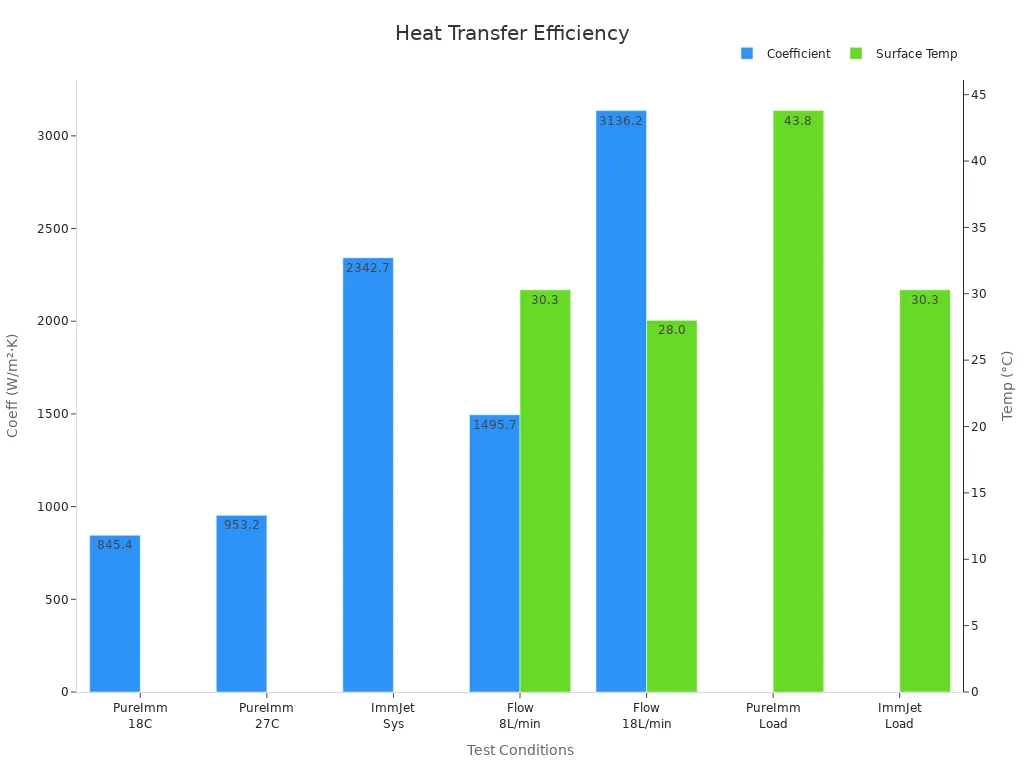
Vous pouvez constater que la manière dont l'eau circule autour de l'élément fait une grande différence. Des distances de jet plus rapprochées et des débits plus élevés perturbent la couche limite thermique, permettant un transfert de chaleur plus efficace. Cela signifie que votre chauffe-eau peut chauffer l'eau plus rapidement et maintenir un approvisionnement constant en eau chaude, même en période de forte demande.
Le rôle du thermostat dans un chauffe-eau
Le thermostat agit comme le centre de contrôle de votre chauffe-eau. Il surveille la température de l'eau et garantit que l'élément chauffant ne fonctionne qu'en cas de besoin. Lorsque la température de l'eau descend en dessous de votre point de consigne, le thermostat envoie de l'énergie à l'élément. Une fois que l'eau atteint la température souhaitée, le thermostat coupe l'alimentation, évitant ainsi la surchauffe et économisant de l'énergie.
Des méthodes d'essai normalisées provenant du monde entier vous aident à évaluer l'efficacité de ce processus. Ces tests mesurent la capacité de votre chauffe-eau à générer et transférer la chaleur dans des conditions contrôlées. Des références de performance, telles que le rendement de combustion et le rendement thermique, vous permettent de comparer différents modèles et technologies. Par exemple, des améliorations dans la conception des déflecteurs et la turbulence peuvent faire passer le rendement thermique de 35 % à plus de 67 %.. La dynamique des fluides numérique (CFD) et des nombres sans dimension comme le nombre de Nusselt aident les ingénieurs à optimiser le transfert thermique et à concevoir de meilleurs systèmes.
Conseil : Vérifiez régulièrement votre thermostat et votre élément chauffant pour garantir le fonctionnement optimal de votre chauffe-eau électrique. Cette simple étape peut vous aider à éviter des douches froides inattendues et à prolonger la durée de vie de votre chauffe-eau.
En comprenant comment la résistance électrique, l'immersion et le contrôle du thermostat fonctionnent ensemble, vous pouvez apprécier l'ingénierie derrière chaque douche chaude et chaque vaisselle propre. Votre chauffe-eau utilise ces principes pour fournir de l'eau chaude fiable chaque fois que vous en avez besoin.
Problèmes courants liés aux éléments de chauffe-eau
Symptômes d'une défaillance de l'élément de chauffe-eau
Pas d'eau chaude
Vous remarquerez peut-être que votre chauffe-eau cesse soudainement de fournir de l'eau chaude. C'est souvent le premier signe d'un défaillance de l'élément chauffant. Lorsque l'élément grille, il ne peut plus transférer la chaleur à l'eau. En conséquence, vous n'obtenez que de l'eau froide de vos robinets. Si vous rencontrez ce problème, vérifiez d'abord le disjoncteur et le thermostat. Si les deux fonctionnent correctement, l'élément chauffant doit probablement être remplacé. C'est une cause courante de remplacement d'élément dans de nombreux foyers.
Température de l'eau irrégulière
Parfois, vous constatez que la température de votre eau fluctue entre chaude et tiède. Ce symptôme indique un élément partiellement fonctionnel ou recouvert de dépôts minéraux. Lorsque des minéraux recouvrent l'élément, celui-ci ne peut pas chauffer l'eau efficacement. Vous pouvez remarquer une insuffisance d'eau chaude sous la douche ou lors de l'utilisation simultanée de plusieurs appareils. Des températures incohérentes indiquent souvent que l'élément a du mal à suivre la demande.
Bruits étranges provenant du chauffe-eau
Des bruits inhabituels, tels que des claquements ou des sifflements, peuvent signaler un problème à l'intérieur de votre chauffe-eau. Ces bruits proviennent généralement de l'accumulation de minéraux sur l'élément chauffant. Lorsque l'eau chauffe, des bulles d'air piégées s'échappent à travers les sédiments, créant ces sons. Si vous entendez des bruits persistants, inspectez le réservoir pour détecter les sédiments et le tartre. Traiter ces problèmes tôt permet d'éviter une défaillance complète de l'élément chauffant.
Causes des problèmes d'élément chauffant
Accumulation de minéraux
L'accumulation de minéraux est l'une des principales causes de défaillance de l'élément chauffant. L'eau dure introduit des minéraux qui se déposent au fond du réservoir et recouvrent l'élément. Cette couche isole l'élément, l'obligeant à travailler plus dur et finissant par le faire griller. Vous pouvez réduire ce risque en vidangeant le réservoir chaque année et en envisageant un adoucisseur d'eau pour votre maison.
Corrosion de l'élément
La corrosion affaiblit à la fois l'élément chauffant et le réservoir. Avec le temps, la tige anodique à l'intérieur de votre chauffe-eau se dégrade, permettant la formation de rouille. Une teneur élevée en minéraux accélère ce processus. Inspectez la tige anodique chaque année et remplacez-la si elle présente une corrosion importante ou si elle est réduite à moins de la moitié de sa taille d'origine. Cette simple étape prolonge la durée de vie de votre chauffe-eau et évite une défaillance prématurée.
Défauts électriques dans le chauffe-eau
Les défauts électriques peuvent également entraîner une défaillance de l'élément chauffant. Un câblage desserré, des thermostats défectueux ou des connexions endommagées perturbent le flux d'électricité. Lorsque cela se produit, l'élément ne peut pas chauffer l'eau correctement. Des inspections régulières vous aident à détecter ces problèmes avant qu'ils ne provoquent une insuffisance d'eau chaude ou une panne complète du système.
Conseil : Planifiez des inspections professionnelles tous les deux ans pour évaluer l'état de votre chauffe-eau et prévenir les pannes inattendues.
| Cause | Détails quantifiés | Effet sur la défaillance de l'élément chauffant | Mesures préventives |
|---|---|---|---|
| Accumulation de minéraux | L'eau dure entraîne une accumulation de sédiments | Isole et endommage les éléments chauffants, réduisant l'efficacité et provoquant une défaillance | Vidange régulière pour éliminer les sédiments ; adoucissement de l'eau |
| Corrosion | La tige anodique se dégrade généralement tous les 3 à 5 ans | La rouille et la corrosion affaiblissent les éléments chauffants et le réservoir, entraînant un dysfonctionnement | Inspecter et remplacer la tige anodique ; installer une tige anodique sacrificielle |
| Teneur élevée en minéraux | Accélère la dégradation de la tige anodique | Corrosion et accumulation de sédiments plus rapides | Adoucissement de l'eau ; inspection régulière |
Vous pouvez prévenir de nombreux problèmes courants en suivant quelques étapes simples :
- Vidangez et rincez le réservoir chaque année pour éliminer les sédiments et le tartre.
- Réglez la température du chauffe-eau à environ 120 °F pour éviter les dommages.
- Testez et remplacez la soupape de sécurité si nécessaire.
- Effectuez des inspections visuelles régulières pour détecter la rouille ou la corrosion.
En restant proactif, vous assurez que votre chauffe-eau fournit de l'eau chaude fiable et évite des pannes coûteuses.
Maintenance et Dépannage des Éléments de Chauffe-Eau
Maintenance Routinière pour Chauffe-Eau Électriques
Rinçage du réservoir du chauffe-eau
Vous pouvez prolonger la durée de vie de votre chauffe-eau en vidangeant régulièrement le réservoir. Les sédiments et les dépôts minéraux au fond du réservoir réduisent l'efficacité de chauffage et peuvent provoquer la surchauffe de l'élément. Pour maintenir un débit d'eau chaude efficace, drainez environ un quart du réservoir tous les quelques mois. Dans les régions à eau dure, vous devriez vider complètement le réservoir au moins une fois par an. Cette routine aide à empêcher la formation de tartre sur l'élément chauffant, ce qui peut entraîner des réparations coûteuses du chauffe-eau.
Astuce : Planifiez des inspections professionnelles annuelles pour détecter précocement les fuites, la corrosion ou les composants défectueux.
Inspection de la Corrosion et de l'Usure
Vous devriez inspecter votre chauffe-eau pour détecter des signes de corrosion et d'usure lors de la maintenance régulière. Vérifiez la tige d'anode annuellement. Si vous observez une corrosion importante ou que le fil central est exposé, remplacez la tige avant que la rouille ne se propage au réservoir. Examinez le réservoir et les raccords pour détecter les fuites. Testez la soupape de sécurité plusieurs fois par an pour vous assurer qu'elle s'ouvre et se ferme correctement. Ces étapes vous aident à éviter les pannes imprévues et à maintenir un approvisionnement en eau chaude fiable.
- Videz le réservoir environ une fois par an pour éliminer l'accumulation de sédiments.
- Vérifiez la tige d'anode annuellement et remplacez-la si nécessaire.
- Inspectez régulièrement les fuites pendant la maintenance.
- Testez la soupape de sécurité annuellement pour assurer son bon fonctionnement.
Dépannage d'un Élément Chauffant Défectueux
Tester l'Élément du Chauffe-Eau avec un Multimètre
Si vous constatez un manque d'eau chaude ou des températures inconstantes, vous pourriez avoir un élément chauffant défectueux. Vous pouvez tester l'élément à l'aide d'un multimètre. Tout d'abord, coupez l'alimentation du chauffe-eau au disjoncteur. Retirez les couvercles métalliques et l'isolation pour exposer les bornes de l'élément. Réglez votre multimètre sur le calibrage ohms le plus bas. Placez les sondes sur les deux vis de l'élément chauffant. Un élément fonctionnant correctement devrait afficher une lecture de résistance entre 10 et 30 ohms. Si vous obtenez une lecture de 0 ou 1 ohm, l'élément est probablement cassé ou grillé. Répétez ce processus pour chaque élément si votre chauffe-eau en a plusieurs.
Vérification du Thermostat du Chauffe-Eau
Parfois, c'est le thermostat qui cause des problèmes de chauffage plutôt que l'élément lui-même. Après avoir confirmé la résistance de l'élément, vérifiez le bon fonctionnement du thermostat. Retirez le couvercle et l'isolation, puis utilisez un détecteur de tension sans contact pour vous assurer que l'alimentation est coupée. Inspectez le thermostat pour détecter tout dommage visible ou connexion desserrée. Si le thermostat ne met pas en marche l'élément lorsque l'eau refroidit, vous devrez peut-être le remplacer. Des vérifications régulières du thermostat vous aident à maintenir une eau chaude constante et à éviter des réparations inutiles du chauffe-eau.
Note : Une maintenance régulière du chauffe-eau réduit le risque de pannes soudaines et prolonge la durée de vie de votre équipement.
Remplacer un Élément de Chauffe-Eau : DIY ou Aide Professionnelle
Quand Remplacer un Élément Chauffant
Dommage Irréparable de l'Élément
Vous devez prendre en compte remplacement de l'élément lorsque vous observez des signes visibles de dommage. Si l'élément chauffant de votre chauffe-eau présente des fissures, une corrosion importante ou des brûlures, il ne peut pas fonctionner en toute sécurité. Un test au multimètre peut révéler une absence de continuité, confirmant la nécessité de remplacer un élément de chauffe-eau. Continuer à utiliser un élément endommagé peut entraîner d'autres réparations du chauffe-eau et même des risques pour la sécurité.
Problèmes Persistants Après Dépannage
Si vous avez déjà vidangé le réservoir, vérifié le thermostat et testé l'élément, mais que votre chauffe-eau ne fournit toujours pas d'eau chaude constante, vous avez probablement besoin d'un élément de remplacement. Des problèmes persistants tels que des températures fluctuantes ou le déclenchement répété du disjoncteur indiquent souvent un composant défaillant. Dans ces cas, le remplacement de l'élément rétablit des performances fiables.
Guide de Remplacement d'Élément de Chauffe-Eau en DIY
Outils et Précautions de Sécurité pour le Remplacement
Avant de commencer, rassemblez les outils suivants :
- Tournevis
- Clé à douille ou à élément
- Multimètre
- Tuyau d'arrosage (pour la vidange du réservoir)
- Serviette ou seau
Coupez toujours l'alimentation au disjoncteur. Confirmez avec un détecteur de tension qu'aucun courant n'alimente le chauffe-eau. Laissez le réservoir refroidir avant de commencer. Portez des gants et des lunettes de sécurité pour vous protéger de l'eau chaude et des pièces électriques.
Astuce : N'essayez jamais de remplacer un élément si vous n'êtes pas sûr de vos compétences en électricité. La sécurité passe d'abord.
Processus de remplacement étape par étape
- Coupez l'alimentation électrique et la vanne d'entrée d'eau.
- Fixez un tuyau à la vanne de vidange et videz le réservoir sous le niveau de l'élément.
- Retirez le panneau d’accès et l’isolation pour exposer l’élément.
- Utilisez un multimètre pour confirmer que l'élément doit être remplacé.
- Desserrez et retirez l'ancien élément avec la clé.
- Nettoyez l'ouverture et insérez l'élément de remplacement, en le serrant fermement.
- Remplissez à nouveau le réservoir et vérifiez les fuites.
- Rétablissez l'alimentation et testez le chauffe-eau.
En suivant ces étapes, vous pouvez effectuer le remplacement de l'élément en toute sécurité et efficacité. Installer correctement le nouvel élément assure que votre chauffe-eau fonctionne à pleine performance.
| Aspect | Remplacement DIY | Remplacement professionnel |
|---|---|---|
| Coût initial | $10 à $60 (pièces uniquement) | $200 à $300 (service et pièces) |
| Risques | Installation incorrecte, dommages potentiels, garanties annulées, risques pour la sécurité | Précision, sécurité, tranquillité d'esprit, prévient des réparations futures coûteuses |
| Implications sur le Coût à Long Terme | Potentiellement plus élevé en raison d'erreurs ou de dommages | Généralement plus faible en raison de la qualité professionnelle et de la garantie |
| Compétence Requise | Compétence mécanique et connaissances électriques nécessaires | Expertise et expérience professionnelles |
| Résultat | Rentable à court terme mais risqué | Coût initial plus élevé mais plus sûr et plus fiable |
Quand appeler un professionnel pour la réparation d'un chauffe-eau
Problèmes Électriques Complexes dans le Chauffe-Eau
Si vous rencontrez des problèmes de câblage, des déclenchements répétés des disjoncteurs ou des signes de brûlure électrique, appelez un technicien agréé. Les professionnels ont l'expertise pour diagnostiquer et réparer des problèmes complexes qui vont au-delà d'un simple remplacement d'élément. Tenter ces réparations vous-même peut augmenter le risque de blessure ou d'autres dommages.
Considérations relatives à la garantie et à l'assurance
De nombreuses garanties de chauffe-eau exigent un service professionnel pour les réparations. Les travaux de bricolage peuvent annuler votre couverture. Les polices d'assurance peuvent également exclure les dommages causés par une installation incorrecte. Faire appel à un professionnel pour l'installation d'un élément de remplacement protège votre investissement et garantit la conformité aux conditions de garantie.
| Méthode de remplacement | Fourchette de coûts | Remarques et avertissements |
|---|---|---|
| BRICOLAGE | $10 à $60 (pièces uniquement) | Nécessite des compétences mécaniques et électriques ; risque de dangers électriques ; déconseillé aux personnes non familiarisées avec le câblage |
| Professionnel | $200 à $300 (service et pièces) | Garantit une installation sûre et correcte ; réduit les risques de dommages et de dangers pour la sécurité |
Remarque : Pesez les économies initiales du bricolage par rapport aux avantages à long terme des réparations professionnelles du chauffe-eau. Une eau chaude sûre et fiable dépend souvent d'une installation experte de votre élément de remplacement.
Maximiser la durée de vie de votre élément de chauffe-eau
Conseils d'entretien préventif pour les éléments de chauffe-eau
Réduire l'accumulation de minéraux dans le chauffe-eau
Vous pouvez prolonger la durée de vie de vos éléments chauffants en réduisant l'accumulation de minéraux à l'intérieur de votre chauffe-eau. L'eau dure introduit des minéraux qui se déposent sur la surface de l'élément, provoquant du tartre et réduisant l'efficacité. Pour y remédier, vidangez votre réservoir tous les trimestres pour éliminer les sédiments. Cette simple étape maintient l'élément propre et aide à assurer une production constante d'eau chaude. Inspectez la tige anodique tous les trois mois et remplacez-la chaque année ou lorsque vous constatez une corrosion importante. La tige anodique attire les minéraux, protégeant à la fois le réservoir et l'élément des dommages. Un nettoyage et une inspection réguliers des éléments chauffants, effectués mensuellement ou semestriellement, empêchent davantage l'accumulation de tartre.
Conseil : Utilisez des outils de maintenance prédictive, tels que des capteurs ou une surveillance des données en temps réel, pour détecter les inefficacités à un stade précoce. Ces outils vous aident à résoudre les problèmes avant qu'ils n'entraînent des réparations coûteuses.
Inspections régulières de l'élément chauffant
Les inspections de routine jouent un rôle crucial dans la maximisation de la durée de vie des éléments de chauffe-eau. Vérifiez la soupape de surpression chaque mois pour vous assurer qu'elle fonctionne correctement. Examinez l'élément chauffant pour détecter des signes de corrosion, de tartre ou de chauffage inégal. Si vous remarquez des problèmes, traitez-les rapidement pour éviter d'autres dommages. Assurez une ventilation adéquate autour de votre chauffe-eau pour prévenir l'accumulation de gaz et maintenir la sécurité. Pour les modèles à gaz, surveillez la couleur de la flamme lors des contrôles semestriels pour détecter les problèmes de brûleur. Ces actions préventives maintiennent votre chauffe-eau en fonctionnement efficace et réduisent le risque de pannes inattendues.
- Inspectez et nettoyez régulièrement les éléments chauffants.
- Testez la soupape de surpression chaque mois.
- Vidangez le réservoir tous les trois mois.
- Remplacez l'anode sacrificielle selon les besoins.
Choisir le bon élément de remplacement pour chauffe-eau
Correspondance entre la puissance et la tension pour votre chauffe-eau
La sélection de l'élément de remplacement approprié nécessite une attention particulière à la puissance et à la tension. Faites toujours correspondre la tension de l'élément à celle du système électrique de votre chauffe-eau, généralement 120 V ou 240 V. L'utilisation d'une tension incorrecte peut entraîner des risques de sécurité ou de mauvaises performances. La puissance détermine la vitesse à laquelle votre chauffe-eau chauffe l'eau et la quantité d'énergie qu'il consomme. Une puissance plus élevée chauffe l'eau plus rapidement mais augmente la consommation d'énergie. Tenez compte de la taille de votre réservoir et de la demande en eau chaude de votre foyer lors du choix de la puissance. La densité de puissance, ou puissance de sortie par unité de surface, affecte également la longévité de l'élément. Les éléments à faible densité de puissance chauffent plus uniformément et durent plus longtemps, ce qui les rend idéaux pour la plupart des applications résidentielles.
Remarque : Recherchez les indices d'efficacité énergétique tels que le Facteur d'Énergie Uniforme (UEF) et le label Energy Star. Ces indices vous aident à choisir des éléments de chauffe-eau qui minimisent les coûts d'exploitation et l'impact environnemental.
Sélection de matériaux durables pour la longévité
Le choix du matériau a un impact direct sur la durabilité des éléments chauffants. Choisissez des éléments fabriqués à partir de matériaux comme l'acier inoxydable ou l'Incoloy pour une résistance supérieure à la corrosion et aux températures élevées. Des études montrent que la composition du matériau, la température de fonctionnement et la densité de puissance influencent toutes la durée de vie de l'élément. Les températures élevées et les densités de puissance élevées accélèrent l'usure, tandis qu'un nettoyage et une inspection réguliers préviennent les points chauds et le chauffage inégal. Les facteurs environnementaux, tels que l'exposition à l'oxygène ou des conditions d'eau agressives, affectent également la durabilité. Les fabricants offrent généralement des garanties contre les défauts, mais vos pratiques d'entretien et vos habitudes d'utilisation jouent un rôle important dans la durée de vie de votre élément.
| Matériau | Durabilité | Résistance à la corrosion | Meilleur cas d'utilisation |
|---|---|---|---|
| Cuivre | Modéré | Faible | Zones d'eau douce |
| Acier inoxydable | Haut | Haut | Environnements d'eau dure |
| Incoloy | Très élevé | Très élevé | Systèmes à forte demande |
En suivant ces directives, vous vous assurez que votre chauffe-eau fournit de l'eau chaude fiable et que vos éléments chauffants atteignent une durée de vie maximale.
Vous comptez sur le élément de chauffe-eau pour fournir un approvisionnement constant en eau chaude pour vos besoins quotidiens. Un entretien régulier, tel que la vidange des sédiments et l'inspection de la corrosion, vous aide à éviter les pannes et maintient la fiabilité de votre approvisionnement en eau chaude. En suivant les directives du fabricant et en traitant les problèmes rapidement, vous réduisez les réparations coûteuses et prolongez la durée de vie de votre système. Un entretien proactif maintient non seulement l'efficacité, mais soutient également la durabilité en minimisant les déchets dus aux remplacements fréquents.
FAQ
À quelle fréquence faut-il remplacer un élément de chauffe-eau ?
Vous devez inspecter votre élément de chauffe-eau tous les 2 à 3 ans. Remplacez-le si vous remarquez de la corrosion, une efficacité de chauffage réduite ou des dommages visibles. Un entretien régulier vous aide à prolonger la durée de vie de votre chauffe-eau.
Peut-on remplacer soi-même un élément de chauffe-eau ?
Vous pouvez remplacer un élément de chauffe-eau si vous possédez des compétences électriques de base et les bons outils. Coupez toujours l'alimentation électrique et suivez les consignes de sécurité. En cas de doute, contactez un professionnel agréé.
Qu'est-ce qui cause la défaillance d'un élément de chauffe-eau ?
Les causes courantes incluent l'accumulation de minéraux, la corrosion et les défauts électriques. L'eau dure accélère la formation de tartre, qui isole l'élément et réduit l'efficacité. Une vidange et des inspections régulières vous aident à prévenir une défaillance prématurée.
Comment savoir si l'élément chauffant de votre chauffe-eau est défectueux ?
Vous pouvez remarquer une absence d'eau chaude, des températures incohérentes ou des bruits étranges. Utilisez un multimètre pour tester la résistance de l'élément. Une lecture en dehors de la plage normale indique un élément défectueux.
La qualité de l'eau affecte-t-elle la durée de vie de votre élément chauffant ?
Oui, l'eau dure avec une teneur élevée en minéraux raccourcit la durée de vie de votre élément chauffant. Les minéraux forment du tartre sur l'élément, provoquant une surchauffe et une défaillance précoce. Envisagez d'installer un adoucisseur d'eau pour de meilleures performances.
Quelle est la différence entre les éléments à faible densité de puissance et ceux à haute densité de puissance ?
Les éléments à faible densité de puissance répartissent la chaleur sur une plus grande surface, réduisant l'accumulation de tartre et durant plus longtemps dans l'eau dure. Les éléments à haute densité de puissance chauffent l'eau plus rapidement mais peuvent tomber en panne plus tôt dans des environnements riches en minéraux.
Conseil : Faites toujours correspondre la puissance et la tension de votre élément de remplacement aux spécifications de votre chauffe-eau pour un fonctionnement sûr.