
La longévité de votre appareil est directement proportionnelle à l'intégrité structurelle de son noyau chauffant.
En tant que composant thermique critique, un Élément chauffant fonctionne dans des conditions de fluctuations extrêmes de température qui provoquent la dilatation et la contraction des métaux. S'inspirant des connaissances en fabrication de Camewould (Jin Zhong) un acteur mondial Fabricant d'éléments chauffants avec plus de 40 ans d'expertise, ce guide fournit un protocole d'entretien de qualité professionnelle pour prévenir l'oxydation, les pertes d'énergie et la défaillance prématurée des composants.
Feuille de route d'entretien
Protocoles de nettoyage sécurisés pour les éléments tubulaires
La graisse accumulée et les particules alimentaires carbonisées ne se contentent pas de produire de la fumée ; elles créent des gradients thermiques localisés. Lorsqu'une partie de l'élément est isolée par des débris, les Usine d'éléments chauffants ingénieurs avertissent que le fil Nichrome interne peut surchauffer à cet endroit précis, entraînant un “ grillage ” catastrophique.”
La méthode de nettoyage en 3 étapes
- Mise hors tension et refroidissement : Assurez-vous que le four est débranché. Ne nettoyez jamais un élément même légèrement chaud, car un refroidissement rapide dû aux agents de nettoyage peut provoquer un choc thermique et des microfractures dans la gaine métallique.
- Élimination des débris secs : Utilisez une brosse à poils souples en nylon pour balayer doucement les cendres détachées. Pour les résidus carbonisés tenaces, un grattoir en plastique peut être utilisé. N'utilisez jamais de laine d'acier ni de grattoirs métalliques, car ceux-ci peuvent laisser des fragments conducteurs provoquant des arcs électriques.
- Nettoyage de surface : Utilisez une solution d'eau tiède et une goutte de liquide vaisselle. Essuyez le Élément chauffant avec un chiffon en microfibre humide. Rincez avec un second chiffon humidifié uniquement avec de l'eau pour garantir qu'aucun résidu savonneux ne subsiste, ce qui pourrait fumer lors de la prochaine utilisation.
Techniques d'inspection visuelle professionnelle
Un programme d'entretien proactif comprend une vérification visuelle mensuelle de la surface de l'élément. Les éléments de haute qualité provenant d'un Fabricant d'éléments chauffants certifié comme Camewould utilisent Incoloy 800 de l'acier inoxydable de haute qualité pour résister à l'oxydation, mais les facteurs environnementaux peuvent encore avoir un impact.
Ce qu'il faut rechercher :
- Piqûres : Petits “ cratères ” sombres sur la gaine. Cela indique que le métal s'amincit et qu'une brèche dans l' de haute pureté isolation est imminente.
- Cloques : Cloques sur la surface métallique. Cela suggère une défaillance de l'isolation interne, provoquant un chauffage direct de la gaine par le fil résistif.
- Décoloration des bornes : Noircissement aux points de connexion de l'élément avec les fils de la cuisinière. C'est un signe de connexion desserrée et de potentiel des arcs électriques.
Tableau de diagnostic de l'état de l'élément
| Observation | Signification technique | Action requise |
|---|---|---|
| Gris/Noir uniforme et terne | Couche d'oxydation saine | Aucune – Fonctionnement normal |
| Résidu blanc crayeux | Fuite d'isolation MgO | Remplacement immédiat |
| “ Points chauds ” rouge vif” | Déplacement de la bobine interne | Remplacement immédiat |
Entretien des solutions de moulage sous pression et spécialisées
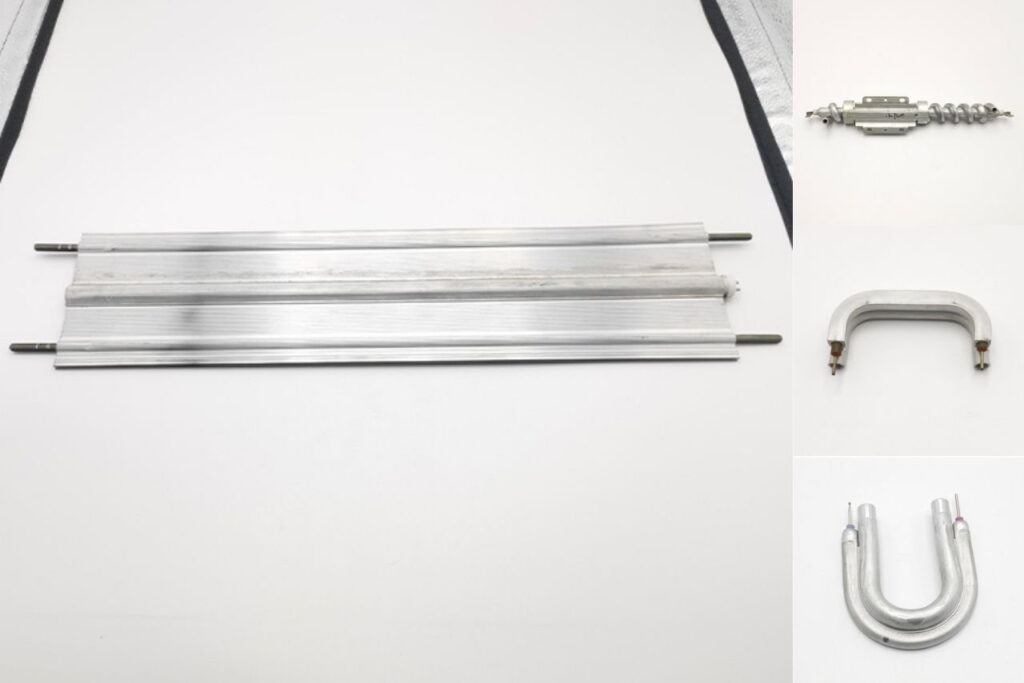
Les appareils haut de gamme modernes utilisent souvent Solutions de chauffage pour la coulée sous pression. Dans ces systèmes, l'élément chauffant est enfermé dans de l'aluminium ou un autre alliage. L'entretien diffère ici :
- Évitez les impacts : Le métal moulé peut se fissurer s'il est heurté par des ustensiles de cuisine lourds.
- Uniformité thermique : Comme le dissipateur thermique est en métal, évitez d'utiliser du papier aluminium sur le fond du four, car cela peut piéger la chaleur et déformer l'ensemble moulé sous pression.
- Contrôle de l'humidité : Assurez-vous que les joints autour de la plaque moulée sous pression sont intacts pour empêcher tout liquide d'atteindre les bornes électriques en dessous.
Mesures préventives pour la longévité industrielle
Chez Suli Technology (Camewould), notre Laboratoire accrédité CNAS Teste les éléments dans des conditions de vieillissement accéléré. Pour reproduire ces résultats dans votre cuisine :
- Minimisez les cycles d’autonettoyage : La chaleur extrême (jusqu’à 900 °F) des cycles d’autonettoyage est la principale cause de stress des éléments. Si possible, nettoyez manuellement.
- Assurez un stockage sec : Si la cuisinière se trouve dans un environnement très humide ou dans une maison de vacances, faites-la fonctionner une fois par mois pour “ éliminer par cuisson ” toute humidité que l’isolation en MgO aurait pu absorber.
- Stabilité de la tension : Les fluctuations de courant peuvent endommager le fil en NiCr. L’utilisation d’éléments conformes aux normes ISO9001 et VDE garantit que le composant présente la tolérance nécessaire aux variations standard du réseau.
FAQ sur l’entretien par des experts
Q1 : Puis-je utiliser un nettoyant pour four commercial sur mon élément chauffant ??
Non. La plupart des nettoyants commerciaux contiennent de l’hydroxyde de sodium (soude caustique), hautement corrosif pour l’acier inoxydable et les alliages Incoloy utilisés dans un Élément chauffant. Si vous devez utiliser un nettoyant sur les parois du four, couvrez l’élément avec du film plastique ou du papier aluminium (retiré avant utilisation) pour éviter tout contact.
Q2 : Pourquoi mon élément sent-il le brûlé après l’avoir nettoyé ?
Cela est généralement dû à des résidus microscopiques de savon ou à une humidité résiduelle. Assurez-vous que l’élément est complètement sec et essuyé avec un chiffon imbibé d’eau uniquement avant de rallumer le four. L’odeur devrait disparaître en moins de 10 minutes.
Q3 : Comment savoir si l’isolation interne (MgO) est défaillante ?
Un signe révélateur est le déclenchement du disjoncteur différentiel (GFCI) de votre cuisine lorsque le four est allumé. Cela indique que le courant “ fuit ” à travers l’isolation vers la gaine extérieure — un signe clair que l’entretien a échoué et qu’un remplacement est nécessaire.
Q4 : Les éléments “ de cuisson cachés ” sont-ils plus faciles à entretenir ?
Visuellement, oui, car ils sont protégés sous le plancher du four. Cependant, ils nécessitent toujours des périodes de “ brûlage ” pour éliminer l’humidité. Si vous remarquez des temps de préchauffage lents, l’élément caché peut avoir défailli sans signes visuels, nécessitant un test au multimètre.
Précision mondiale dans chaque composant
Fournissant 3 millions d’unités par mois aux plus grandes marques mondiales, Camewould est l’expert en technologie de chaleur propre. Faites confiance à nos 40 ans d’ingénierie pour rendre votre vie plus chaleureuse.
Références et sources de données techniques :
- [1] Camewould Electrical Technology – Normes d’entretien pour tubes et plaques chauffants (2025). jinzho.com
- [2] Wikipédia – Science des matériaux de l’isolation en MgO et des bobines en NiCr. en.wikipedia.org
- [3] IQS Directory – Bonnes pratiques pour la longévité des composants chauffants industriels. iqsdirectory.com
- [4] Sears Home Services – Guide complet d’entretien des composants de four. searshomeservices.com

