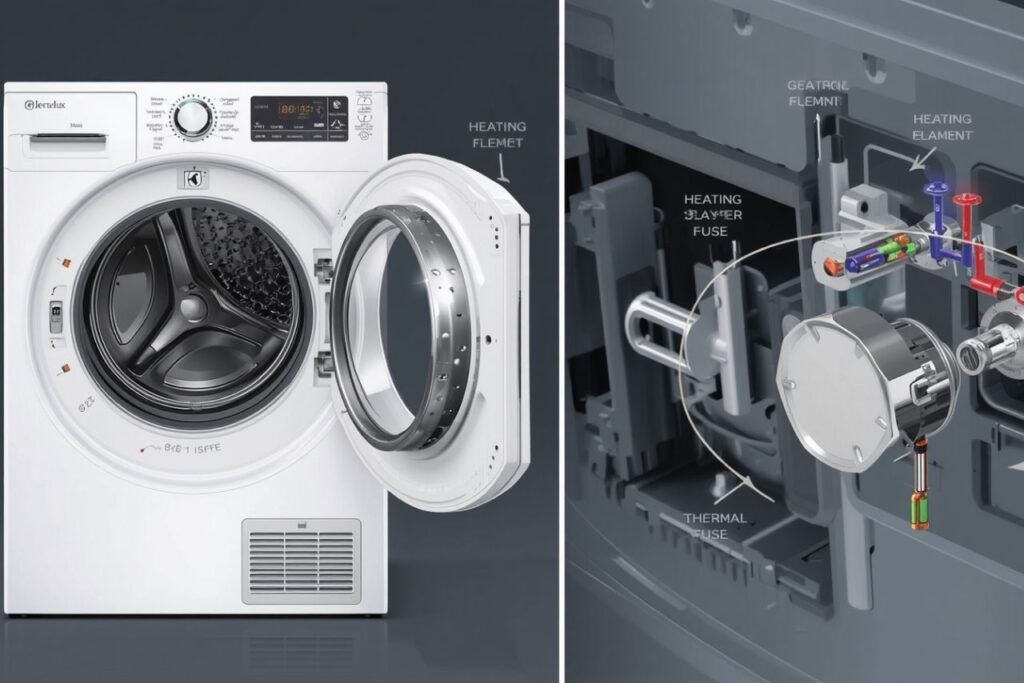
When an Electrolux dryer tumbles but produces no heat, the most reliable way to separate a failed heating element from a blown thermal fuse is to treat the problem as (1) an airflow/overheat protection event, or (2) an electrical continuity failure in the heating circuit. In practice, a thermal fuse opens to stop unsafe temperatures—often triggered by lint restriction—while a heating element fails from wear, oxidation, or physical breakage. A correct diagnosis usually requires safe access and a multimeter continuity check; however, many “no heat” complaints can be narrowed quickly by confirming airflow, exhaust restriction, and whether the dryer shuts down or simply runs cold.
Related product and manufacturing context: Heating Element, Heating Element manufacturer, Heating Element Factory, Die Casting Heating Solutions.
- Safety first: boundaries for DIY troubleshooting
- How a dryer makes heat (element as a designed component)
- Heating element vs thermal fuse: what fails, and why
- Symptom patterns that point to each part
- The airflow factor: why fuses blow and elements “seem” bad
- Practical test plan (tool-free checks + meter checks)
- Decision tables and charts
- FAQ (8 questions)
- References and outbound links
Safety first: boundaries for DIY troubleshooting
Electric dryers combine high current draw, exposed metal cabinets, and elevated temperatures. If troubleshooting goes beyond cleaning vents and verifying settings, the appliance should be disconnected from power. The guiding principle is to avoid energizing heating components under unsafe conditions.
Non-negotiable safety rules
- Disconnect power before removing panels or touching wiring.
- Do not bypass a thermal fuse, high-limit thermostat, or any safety switch “for testing.”
- If burning odor, arcing, or repeated breaker trips occur, stop and escalate to a qualified technician.
Procedural safety guidance for heater servicing in other appliances emphasizes correct sequencing and safe conditions before re-energizing. For example, published heating-element replacement procedures for water heaters include explicit warnings not to power the element until safe operating conditions are restored (e.g., tank full), reinforcing the broader principle of “no power until safe heat-transfer conditions exist.”
How a dryer makes heat (element as a designed component)
A dryer heating “element” is not only a resistive wire; it is an engineered assembly that combines an electrically conductive material with insulation, supports, and terminals. Engineering descriptions of heating elements emphasize that the component is an assemblage of parts and that alloy choice, insulation framework, and integration method influence performance and reliability.
LSI keywords: resistive heating, Joule heating, NiCr alloy, insulating framework, terminals, embedded element, supported element.
Heating element vs thermal fuse: what fails, and why
Heating element (what it is and how it fails)
The heating element is the resistive component that converts electrical energy into heat energy when current flows. Over time, resistance alloys can degrade due to oxidation, thermal cycling stress, and mechanical deformation. Engineering discussions note that alloy properties change with temperature, and that life depends on material selection, temperature cycling, and environmental conditions.
Practical implication: an element may fail “open” (broken conductive path), produce reduced heat (partial damage), or intermittently heat (connection issues).
Thermal fuse (what it is and how it fails)
A thermal fuse is a one-time safety device designed to open the circuit if temperatures exceed a safe threshold. It is not a “wear part” in normal conditions; it typically opens because the dryer overheated (most commonly due to poor airflow, blocked ducts, or lint accumulation).
Practical implication: replacing only the fuse without correcting airflow often leads to repeat failure.
Symptom patterns that point to each part
Patterns more consistent with a blown thermal fuse
- “No heat” begins suddenly after a long cycle, heavy load, or multiple back-to-back loads.
- Dryer seems to run longer and longer prior to failure (progressive airflow restriction).
- Exhaust airflow at the wall is weak, hot air recirculates, or the vent hood flap barely opens.
Patterns more consistent with a failed heating element
- Dryer tumbles normally but never produces meaningful heat across all heat cycles.
- Intermittent heat that correlates with vibration (possible element break/contact shift).
- Element shows visible damage when inspected (if accessible and safe to view).
Why “symptoms only” can mislead
Both an open thermal fuse and an open heating element produce the same electrical outcome: the heating circuit cannot carry load. Because a heating element is part of a broader assembly with terminals and insulation, a loose terminal or heat-damaged connector can mimic an element failure. A continuity test is the differentiator.
The airflow factor: why fuses blow and elements “seem” bad
Many no-heat calls start with an airflow problem. If exhaust flow is restricted, heater compartments run hotter, raising the likelihood that protection devices open. In other words, airflow is not a secondary detail; it is a core design constraint for heating systems.
| Restriction point | What it does | Typical consequence |
|---|---|---|
| Lint screen / filter housing | Reduces intake flow to blower | High heater temperature, longer dry times, nuisance safety trips |
| Flex duct behind dryer | Kinks/crush points add static pressure | Overheating at heater housing; potential thermal fuse opening |
| Long duct runs / clogged wall cap | Backpressure prevents heat removal | Increased risk of repeated overheating events |
Practical test plan (tool-free checks + meter checks)
Tool-free checks (5–10 minutes)
- Confirm cycle and temperature are not set to “Air Fluff / No Heat.”
- Verify strong airflow at the exterior vent hood while running.
- Inspect and clean lint screen; confirm housing is not packed.
- Check for crushed/kinked ducting behind the dryer.
- Run a short timed heat cycle and observe whether air warms at all.
Meter checks (the decisive step)
If airflow is acceptable and settings are correct, a multimeter continuity check is typically required to distinguish between an open heating element and an open thermal fuse. The unit should be unplugged before accessing internal components.
LSI keywords: multimeter continuity test, open circuit, resistance reading, terminal connections.
Do not re-energize until safe conditions are restored
Heating-element service procedures in other appliance contexts emphasize that power is restored only after the system is in a safe heat-transfer state. For example, published steps for replacing a water-heater element explicitly warn not to turn power on until the tank is completely full and air is purged. In a dryer, the analogous condition is restored airflow and properly reinstalled covers and insulation.
Decision tables and charts
Chart 1: Fast decision matrix (most common “no heat” scenarios)
| Observation | Most likely | Next best step |
|---|---|---|
| Weak airflow at outside vent | Vent restriction driving overheating | Correct venting first; then retest heat |
| Normal airflow, always cold on heat cycles | Open heating circuit (fuse/element/thermostat/wiring) | Continuity test the thermal fuse and element |
| Intermittent heat, vibration-related | Loose terminal, damaged connector, element break shifting | Inspect terminals/connectors; continuity and connection integrity |
| Breaker trips when heat should engage | Electrical fault / short / wiring issue | Stop use; professional diagnosis recommended |
Chart 2: Component comparison (element vs thermal fuse)
| Attribute | Heating element | Thermal fuse |
|---|---|---|
| Primary purpose | Generate heat via resistive (Joule) heating | Stop power if unsafe temperature occurs |
| Common failure driver | Oxidation, thermal cycling stress, deformation, connection fatigue | Overheating event, often from restricted airflow |
| Typical electrical state when failed | Open circuit (no continuity) | Open circuit (no continuity) |
| Best prevention | Maintain airflow; avoid chronic overheating; proper installation | Keep vent path clean and low restriction |
Chart 3: Why specifications matter (context example)
Appliance heating components are always bounded by power, materials, and safety standards. As an example of how heating elements are commonly specified and sold, a plug-in heating element product listing may highlight wattage (e.g., 1000W), material (ABS and stainless steel), ingress protection rating (e.g., IP67), and certification (e.g., UL). Dryers use different form factors, but the buying and matching logic—correct power and correct application—remains the same.
FAQ (8 questions)
1) If the dryer tumbles, does that rule out a thermal fuse?
No. Depending on design, some safety devices open only the heating circuit while the motor circuit still runs. The only reliable way to confirm is a continuity test.
2) Can a clogged vent cause “no heat” even if the heating element is good?
Yes. A clogged vent can drive overheating that opens a thermal fuse or high-limit device, removing power from the heating circuit. Clearing airflow is the first corrective step because it prevents repeat overheating.
3) Are heating elements just “a wire,” or more than that?
Engineering descriptions emphasize that a heating element is a designed component: conductive material plus insulating/support framework and terminals. That is why connection integrity and insulation condition matter during diagnosis.
4) What is the fastest way to tell element vs fuse?
A multimeter continuity check, performed with the dryer unplugged, is the fastest definitive method. Symptom patterns can suggest a direction, but both failures present as “open circuit.”
5) Should the thermal fuse be bypassed “just for a minute” to test heat?
No. Bypassing a thermal fuse defeats an overtemperature safety function and can create a fire hazard. The correct approach is to test continuity and correct the root cause of overheating.
6) If the thermal fuse is blown, is replacing it enough?
Usually not. A blown fuse indicates an overheating event. If airflow restriction is not corrected, the replacement fuse may open again.
7) Does coil material matter for heater performance and life?
Yes. Heating element materials have temperature-dependent electrical and mechanical properties. Alloy selection and thermal cycling behavior influence longevity, which is why heating systems are engineered as matched assemblies.
8) When should professional service be recommended?
Professional service is recommended when breakers trip, wiring shows heat damage, the unit exhibits arcing/odor, or repeated overheating occurs despite clean venting.
Closing summary
A no-heat Electrolux dryer is best evaluated by first ruling out airflow restriction and incorrect settings, then confirming electrical continuity of the heating circuit. A thermal fuse typically opens because the dryer overheated—often due to lint and vent restriction—while a heating element typically fails from material wear and thermal stress. Because both faults can present as the same symptom (tumbling with no heat), a continuity test is the dependable separator, and airflow correction is the essential prevention step.
References and outbound links
Engineering overview of heating elements as assemblies, material/alloy considerations, and classifications (suspended/embedded/supported):
https://tutco.com/conductive/heating-elements
Heating-element product families (tubes, plates, films) and manufacturing context:
https://jinzho.com/product-category/heating-element/
https://jinzho.com/product-category/heating-element/heating-tubes/
https://jinzho.com/product-category/heating-element/heating-plate/
https://jinzho.com/product-category/heating-element/heating-film/
https://jinzho.com/product-category/die-casting-heating-solutions/
https://jinzho.com/
Safety sequencing example for replacing a heating element (do not energize until safe operating condition is restored):
https://www.whirlpoolwaterheaters.com/support/help/element-was-out-of-range/24
Example of how heating elements are specified in retail listings (wattage, materials, IP rating, UL approval):
https://usa.hudsonreed.com/1000-plug-in-watt-electric-heating-element-76309
Disclosure: This page is a diagnostic guide and not a substitute for Electrolux model-specific service documentation. Component locations and test values can vary by model.